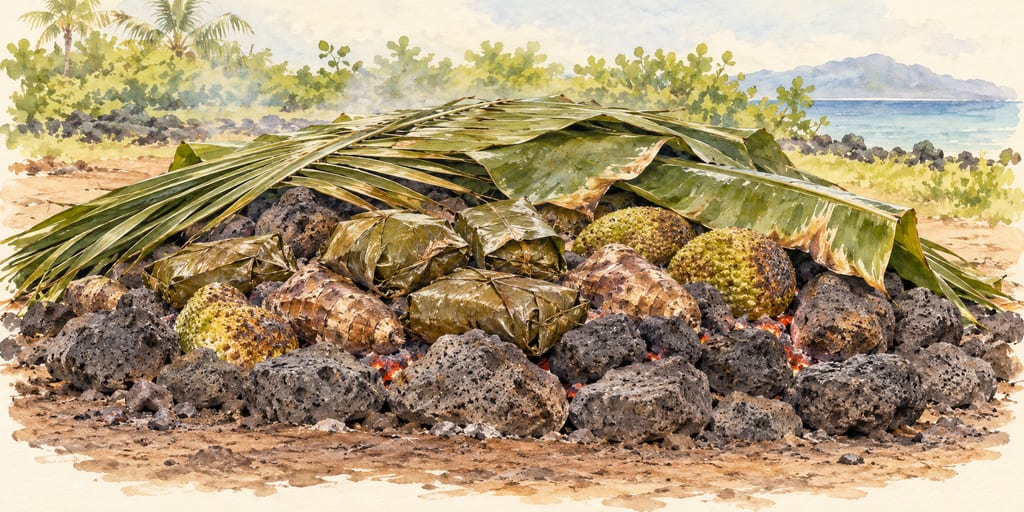
Samoan umu
The Samoan umu is an above-ground cooking build in which a fire heats volcanic stones, and foods cook on the surface beneath leaf coverings.
 FermenteaWhere food goes to change
Built structures · Pits and cavities
ahimā‘a
The Tahitian ahimā‘a is a ground oven built in a pit, where hot volcanic stones and layered leaves and earth cook food slowly.
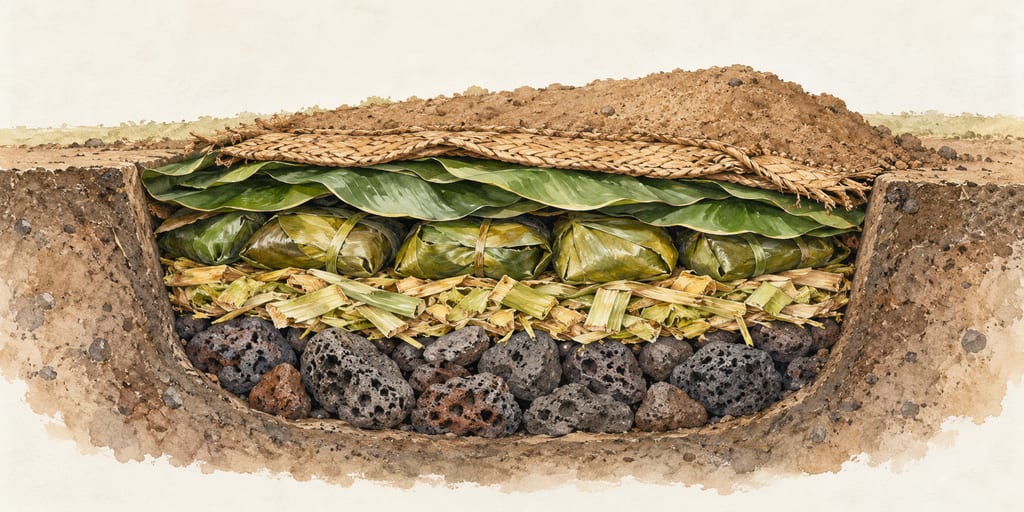
In the Reo Tahiti entry published by French Polynesia's Department of Culture, ahi means fire and mā‘a means food; ahimā‘a can name both the oven and the food cooked in it. The record here concerns the built pit. A related Rurutu form is called umu‘ai in Tahiti Tourisme's account, so that name is not treated as an alias for the Tahitian oven.
The ahimā‘a is a dug pit rather than a movable appliance. Its form depends on a cooking place in the ground, with heat-retaining layers assembled for a meal. The University of French Polynesia catalogues a postcard of a Tahitian open oven, probably issued between 1914 and 1920; this gives a dated depiction, not the beginning of the tradition.
Local descriptions place porous volcanic stones over a wood fire, with coconut husks also named as fuel by Tahiti Tourisme. Once the stones are hot, food is arranged above them. The Department of Culture describes crushed banana stalks as a layer that tempers the heat; foods may be wrapped in leaves or held in woven baskets.
Leaves, fibre mats and a covering of earth complete the layered arrangement. Tahiti Tourisme specifies jute mats and sand; the government description names woven fibres and earth. These covers retain heat and moisture while the meal cooks slowly. The government account gives four to five hours as an example, not a universal cooking interval. No source here supplies a standard pit size, soil specification or stone temperature.
Accounts mention pork, fish, taro, breadfruit, fē‘i bananas and sweet potatoes among foods cooked in an ahimā‘a. The selection and arrangement vary by meal; this page does not turn the list into a fixed menu. Tahiti Tourisme describes the oven as part of festive gatherings, while the Department of Culture notes the long preparation and involvement of much of a family. For Rurutu, the tourism source describes umu‘ai preparations for weddings involving the island community. Those present-day contexts are evidence of living social uses, not proof that every historical oven was prepared for the same occasion.
The University of French Polynesia's digital library catalogues a Tahitian ahimaa postcard as probably issued between 1914 and 1920. Its description depicts an open oven and breadfruit, but that record date is not an origin date. Current French Polynesian cultural and tourism sources describe the pit oven and its use. Present-day feasts should not be projected unchanged into a pre-Christian past.
A build is made where it stands: moving it means building it again.
The sources describe heating volcanic stones over a wood fire, sometimes with coconut husks.
Hazard sourceThe cooking arrangement uses heated stones under layered food and earth or sand.
Hazard sourceThese sources are cultural and descriptive accounts, not a construction or fire-safety specification. They provide no universal pit dimensions, soil conditions, fuel load, stone temperature or handling controls.
Tahiti is named by the local cultural and tourism sources. The Rurutu name umu‘ai is noted separately, not used as a synonym for this location.
The Samoan umu is an above-ground cooking build in which a fire heats volcanic stones, and foods cook on the surface beneath leaf coverings.

Soft, spreadable Calabrian pork sausage made with a great deal of red chilli and fatty pork, stuffed into natural casings, sometimes smoked and matured while staying soft.

A way to add independent temperature logging to an existing food dehydrator without changing its built-in controls or protections. It is a monitoring method, not a rewiring plan.

Pleurotus cystidiosus is the abalone mushroom, a cultivated oyster-type fungus with dark brown caps that grows more slowly and is more demanding than other Pleurotus species.

A dark, balanced vinegar from Emilia-Romagna made by combining cooked or concentrated grape must with wine vinegar, then acetifying and refining it in wood under a protected specification.

A living dairy inoculum that starts controlled cream fermentation, developing acidity and aroma before sour cream or cultured butter is finished.

A small electric incubator holds jars at a selected temperature for yogurt and other documented warm food preparations. Controls, capacity and vessel arrangement vary by model.

Adygean salt is a seasoned table salt associated with Adygea and the wider North Caucasian culinary tradition. Salt is blended with garlic and a variable selection of herbs and spices; the exact mix depends on the named style and maker.

The African Caesar-group mushroom, Amanita masasiensis, is a wild ectomycorrhizal species of central and southern African woodlands, eaten locally. The genus contains deadly poisonous species, so identification needs care.
No community contributions have been published for this entry yet.
Sign in to contribute. Published comments and photos are free to read.
Direction de la culture et du patrimoine, French PolynesiaName · Method · Materials · History
200 mots – Ahimā‘aThe Tahitian word ahi means fire and mā‘a means food; ahimā‘a names the oven and the food in it.
The description names a dug pit, porous volcanic stones heated with wood, crushed banana stalks, leaves, woven fibres and earth.
Food cooks slowly for four to five hours in the account; the source gives no universal dimensions or temperatures.
Preparation takes long hours and involves much of the family, as described in the local cultural resource.
Cited in: A Tahitian name for fire, food and the oven; A pit using stored heat; Food and community
Tahiti Tourisme – The Islands of TahitiMethod · Materials · Social context · Geography
Enjoy an ahimā‘aTahiti Tourisme describes a traditional Tahitian earth oven dug in the ground and heated with wood, coconut husks and volcanic stones.
It describes banana leaves, food parcels or pots, jute mats and sand as parts of the covered arrangement.
It names foods including pork, fish, breadfruit, taro, fē‘i bananas and sweet potatoes, and identifies umu‘ai as the Rurutu name.
The article describes present-day gatherings and weddings; it does not date the origin of the practice.
Cited in: A Tahitian name for fire, food and the oven; A pit using stored heat; Food and community
University of French Polynesia, Ana‘ite Polynesian digital libraryHistorical attestation
97. Tahiti. Le « Ahimaa », Four Tahitien / The Ahimaa, native ovenThe catalogue describes a postcard depicting an open Tahitian oven, breadfruit and leaves.
The catalogue estimates the postcard was probably issued between 1914 and 1920; this is not an origin date.
The archive item has a CC BY-NC-SA license; its image is not reproduced here.
Cited in: A Tahitian name for fire, food and the oven
Wikimedia CommonsVisual reference · Pit form
File:Four tahitien.jpgThe file page identifies the subject as a Tahitian earth oven (ahima‘a), photographed 12 May 2015.
The photograph is licensed CC BY-SA 4.0; it supports the visible open-pit form, not an exact standardized layout.