A chamber built into the cellar floor
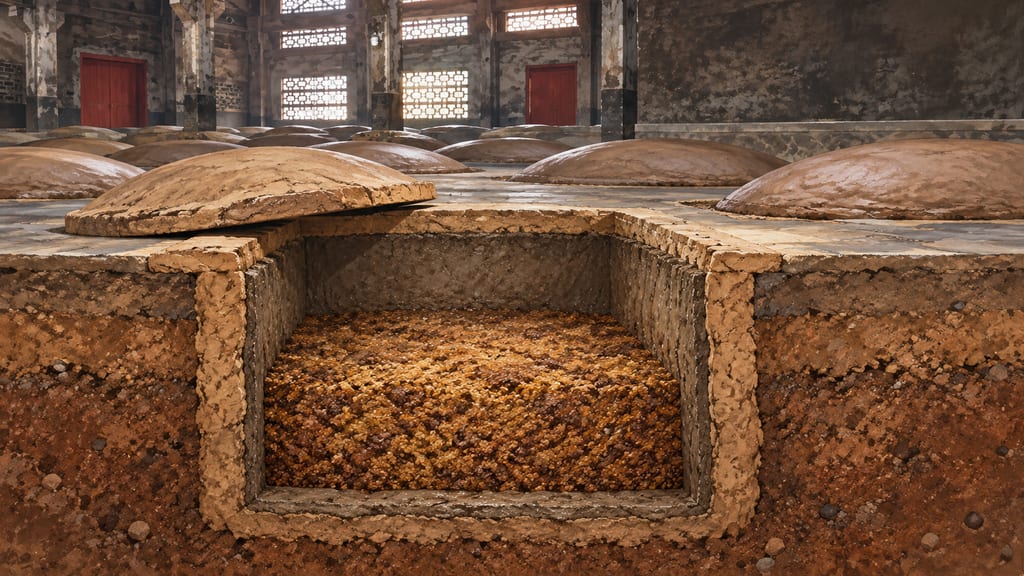
Strong-aroma baijiu uses a fermentation pit set below the distillery floor. A 2020 study describes the vessel as a cuboid pond-like chamber, surrounded by specialized fermentation pit mud. The chamber is part of the cellar architecture rather than a portable barrel or jar. Researchers have sampled distinct upper-wall, lower-wall and bottom mud zones, which shows why one tidy cross-section should not be mistaken for a universal construction plan.
Photographs of Luzhou Laojiao show repeated, low pit tops in a working distillery. The Wikimedia photograph linked here is primarily of a traditional distillation apparatus; its source identifies the fermentation pits in the background. It documents a real Luzhou setting, not the interior structure of every pit.
Sources for this section
Mud, grain and a living boundary
The vessel holds fermenting grain mash in contact with the mud lining. Studies of strong-flavor baijiu describe the pit mud as a microbial habitat, not a passive coating. Work on samples from different wall and bottom zones finds that the mud community and its chemistry vary across the chamber; those organisms and their metabolites are associated with the liquor’s aroma development.
Traditional strong-flavor pits are sealed with a mud cap, while modern studies also compare steel-sealed pits. The illustrated cutaway is an unscaled explanation of the traditional relationship: grain inside a below-ground chamber, with pit mud at the boundary and a mud cap at the opening. The sources do not establish one standard depth, capacity, wall thickness or seal shape.
Sources for this section
Examples in more than one production region
Luzhou in Sichuan is one documented production area; a 2023 biogeography study compared pit-mud samples from Luzhou with samples from Suqian in Jiangsu. That comparison is a reminder that strong-aroma baijiu pits are not confined to a single distillery, and that cellar age and local conditions matter. The linked photo shows the Luzhou Laojiao distillery, not a representative image of all Chinese fermentation pits.
This entry is specifically about mud-lined pits used for strong-aroma baijiu. Sauce-aroma baijiu stone-lined pits are a distinct build and should not be merged with this form.
Sources for this section
History
The cited studies document existing production pits and their use but do not establish when this vessel form originated.
Site
SettingBelow-floor fermentation cellars in Chinese strong-aroma baijiu production; the image reference is a Luzhou Laojiao distillery.
GroundThe fermentation vessel sits below the workshop floor and is lined with pit mud; exact chamber geometry differs by cellar.
ClimateThe cited sources do not establish a single temperature or climate design.
NotesThe article describes the documented form and function, not a construction plan. The cutaway is schematic and unscaled.
A build is made where it stands: moving it means building it again.
Places
Luzhou, Sichuan
Documented use · Region evidencePhotograph and a comparative pit-mud study document Luzhou; this row does not claim that the form is unique to Sichuan.
Suqian, Jiangsu
Documented use · Region evidenceA 2023 study sampled strong-flavor baijiu pit mud here; this does not identify one specific cellar design.