Later pits at Hemudu
Hemudu lies in Yuyao, Zhejiang, in the Lower Yangtze region. Fuller, Qin and Harvey distinguish the site's main village occupation, dated to about 5000–4600 BCE, from later nut-storage pits in layer 3B, dated to about 4400–4000 BCE. These dates describe site layers and groups of features; they do not give an individual date for every pit.
The site is known for preserved plant remains, which allow archaeobotanical study of stored foods. The evidence discussed here is archaeological storage evidence. It does not show that these pits were fermentation vessels.
Sources for this section
A range of surviving profiles
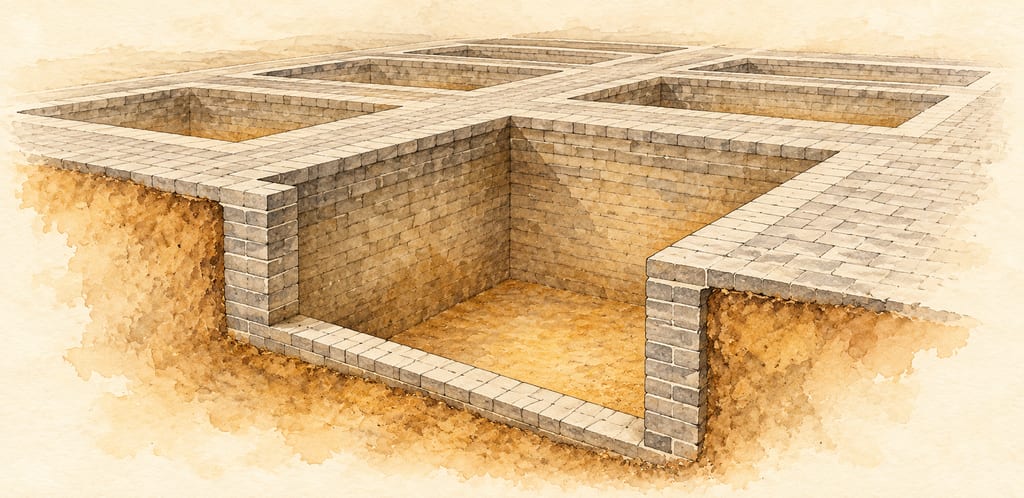
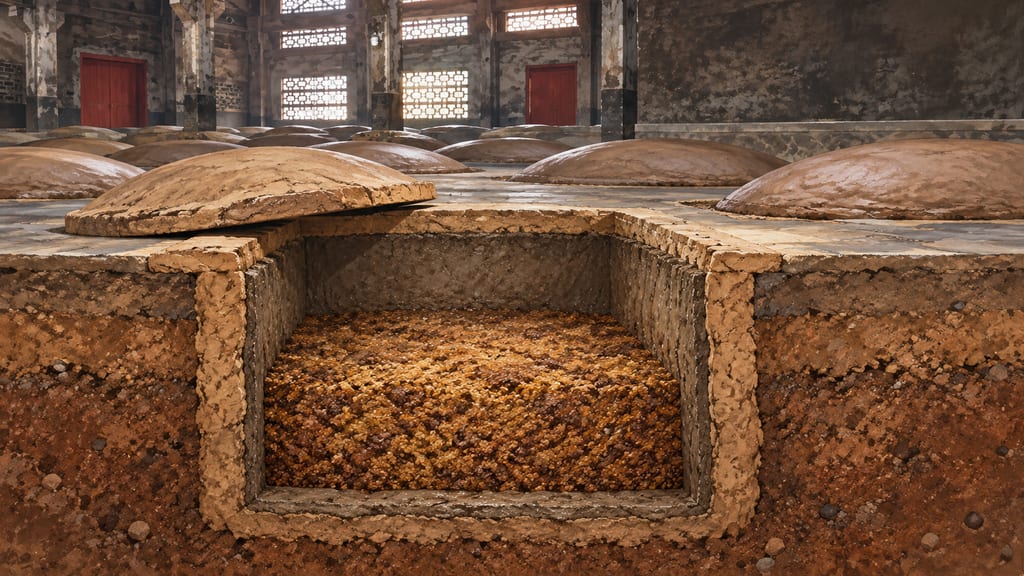
The published account describes a number of excavated pits as straight-sided to bell-shaped. It cautions that their profiles were probably truncated, so the surviving sections may not preserve their original upper edges or full depth. No standard measurements, soil lining, cover or closure system is established by the source.
A figure in the same study shows acorns concentrated at the base of pit H27. The image documents an excavated deposit, not a complete reconstruction of H27's original shape. Other pits contained different remains, so the figure should not be read as a universal plan.
Sources for this section
Contents and limits
Large stores of acorns were identified in several features. The authors report foxnuts and peach stones in one case. This variation is consistent with storage of gathered plant foods, but the available account does not specify a single filling sequence, container, lining material, or method of sealing.
The evidence supports describing these as nut-storage pits. It does not support fermentation, a moisture-control system, or a complete practical recipe for rebuilding them. Tools and construction steps are not recorded in the sources used here.
Sources for this section
History
Fuller, Qin and Harvey date the main Hemudu occupation to about 5000–4600 BCE and later layer 3B nut-storage pits to about 4400–4000 BCE. They describe excavated pits as straight-sided to bell-shaped and caution that the profiles may have been truncated. Several contained large stores of acorns; one case also had foxnuts and peach stones. A figure shows acorns concentrated at the base of pit H27, crediting Zhejiang Provincial Institute of Archaeology 2003. The evidence supports storage, not fermentation, standard dimensions, lining, closure or a uniform use for every pit.
Site
SettingArchaeological site at Hemudu, Yuyao, Zhejiang, in the Lower Yangtze region.
GroundDug pit profiles are described, but soil type and pit-wall treatment are not specified.
ClimateWaterlogged preservation contributed to the survival of plant remains; this describes archaeological preservation, not a documented storage condition.
FootprintSome excavated profiles were straight-sided to bell-shaped and may have been truncated. No reliable dimensions are reported in the cited discussion.
NotesThe dated layer 3B group is associated with nut storage. H27 is specifically shown with acorns at its base, but its complete original shape is not established.
A build is made where it stands: moving it means building it again.
Places
Hemudu Site, Yuyao City
Historical attestation · Locality evidenceYuyao is the locality named by the government source; the dated range refers to later pit use and not the full Hemudu culture.