The tinacal is the site, not the vessel
Pulque fermentation happens in containers placed at a fermentation site called a tinacal. The word names the room or dedicated place, not a particular barrel or tub. A research review describes closed rooms called tinacales, while a regional production account describes small tinacales that may be patios beneath a roof or spaces inside a producer's house. Larger operations may use dedicated rooms. These examples show why a tinacal cannot be illustrated or catalogued as one fixed vessel.
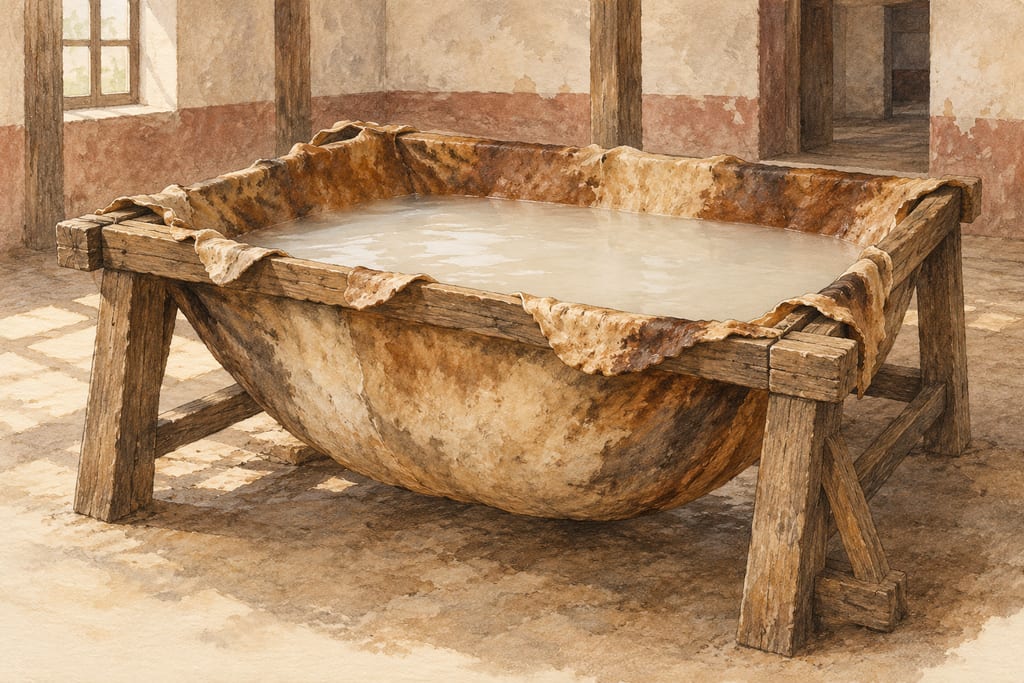
Inside that setting, the equipment is the container holding the liquid. Sources name wooden barrels, plastic containers and tubs, fibreglass vats and, in other documented traditions, leather vats. Each is a separate vessel type; the shared location does not make them interchangeable or turn the room into equipment.
Sources for this section
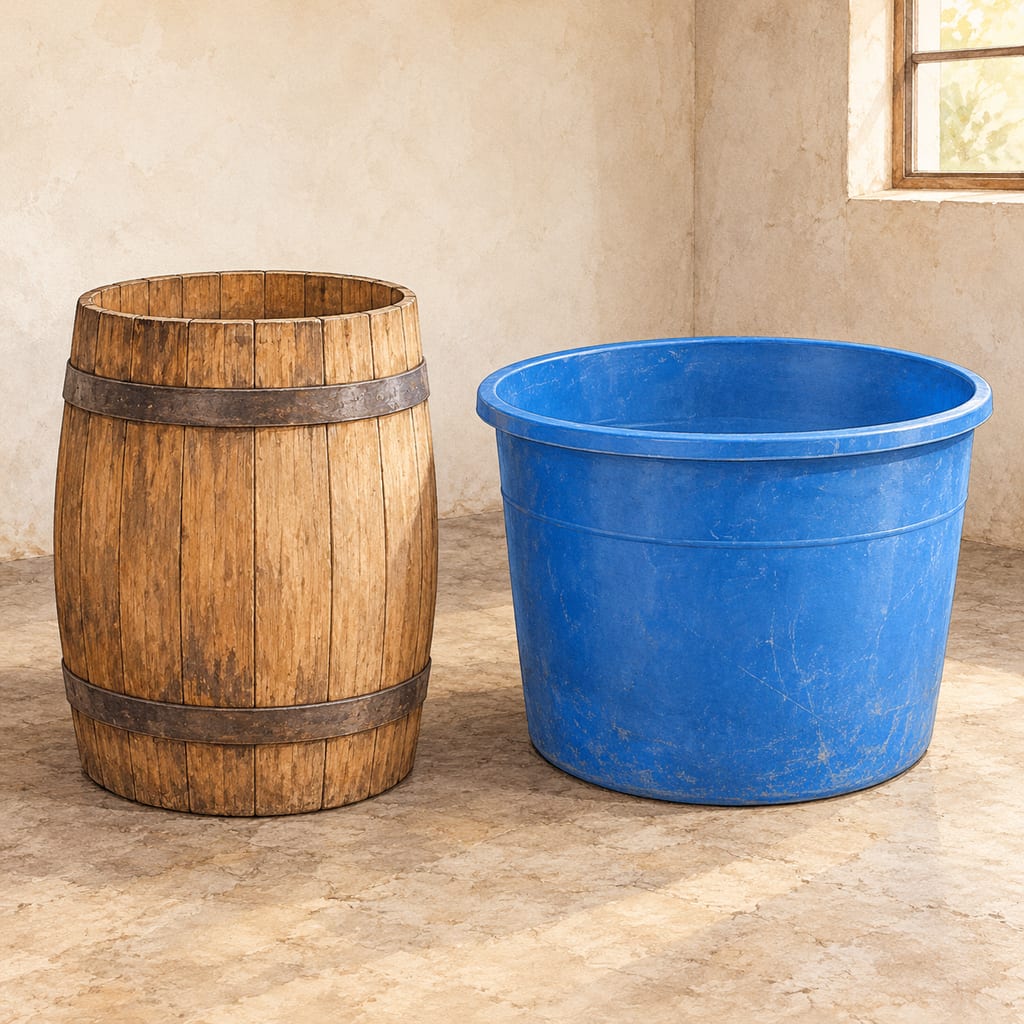
A wooden barrel alongside a modern tub
For small-scale pulque production, the Academia de Ciencias de Morelos account describes preparing the starter in either a wooden barrel or a plastic container, then adding fresh aguamiel. The wood barrel is one documented traditional vessel choice. The text does not name a wood species, give its dimensions or define a single construction shared by producers, so the illustration uses a restrained generic barrel form rather than claiming a unique local design.
Modern plastic tubs and fibreglass vessels are also part of the documented range. The 2016 review lists wood barrels and plastic or glass-fibre containers among the vessels used for pulque fermentation. The 2026 Pulque de Tlaxcala geographic-indication declaration describes barrels as increasingly scarce and lists plastic and fibreglass tubs among current options in that region. The sources record coexisting material choices; they do not establish a controlled ranking of how each vessel changes temperature, cleaning needs or microbial retention.
Sources for this section
Scale, geography and limits
The reported scale of a production system should not be read as a standard capacity for every vessel. The Academia de Ciencias de Morelos article discusses small-scale fermentation as well as larger systems using vats; it does not assign a universal litre capacity to a wooden barrel or plastic tub. Nor do the cited sources provide general dimensions, a manufacturing method or a common care routine for these two forms.
Pulque production is documented across central Mexico. The 2026 protected designation provides a more specific example for Tlaxcala and lists 25 municipalities within its geographic area. That source documents current regional practice; it does not say that barrels or tubs are made there. The linked research figure shows the broader production setting and different fermentation vessels, while the generated illustration is an editorial comparison of a generic wooden barrel and modern plastic tub—not a documentary photograph of one specific tinacal.
Sources for this section
History
Research describes wood barrels and plastic, glass-fibre and leather vessels in pulque fermentation. A 2026 Tlaxcala declaration says barrels are increasingly scarce and lists plastic or fibreglass tubs among current vessel options.
Equipment details
CapacitySources describe small and large production scales, but do not provide a standard capacity for an individual wooden barrel or plastic tub.
SizeThe sources identify barrel and tub forms but give no general dimensions for these vessels.
PowerNo power These are passive liquid-holding vessels; the production room and vessels are not described as powered equipment.
How you get oneNot established The sources document use, not where a reader can obtain a wooden barrel or modern tub.
CareThe sources do not provide a general cleaning, repair or reuse protocol for these equipment types. A tinacal description is not a care specification.
Made of
- Wood — Small-scale fermentation barrel
Pulque research and the Academia de Ciencias de Morelos account document wooden barrels for fermentation; they do not specify a universal species, stave plan or hoop design. - Plastic — Modern fermentation tub or container
The research reviews and current Pulque de Tlaxcala specification document plastic vessels; individual shape and construction vary. - Fibreglass — Fermentation vat
The 2016 review and 2026 Tlaxcala specification list glass-fibre or fibreglass vessels as another material. This is a separate vessel form, not a kind of wooden barrel.
Limits
A wooden barrel, a plastic tub and a fibreglass vat are distinct vessel forms/materials. The sources do not provide a controlled comparison of their heat transfer, cleaning or microbial retention.
Source →Reported batch or process sizes are not standard capacities for each barrel or tub; no universal vessel dimensions are given.
Source →The tinacal is the fermentation room or place; it is not the name of the barrel, tub or vat inside it.
Source →Places
Central Mexican Plateau
Documented use · Region evidenceThe research places pulque production and the described vessel range across the central Mexican plateau; this is not a claim that every vessel type occurs in every locality.
Tlaxcala
Documented use · Region evidenceThe 2026 geographic-indication declaration documents tinacal use and vessel choices in the protected Tlaxcala region; it does not establish a manufacture origin for barrels or tubs.