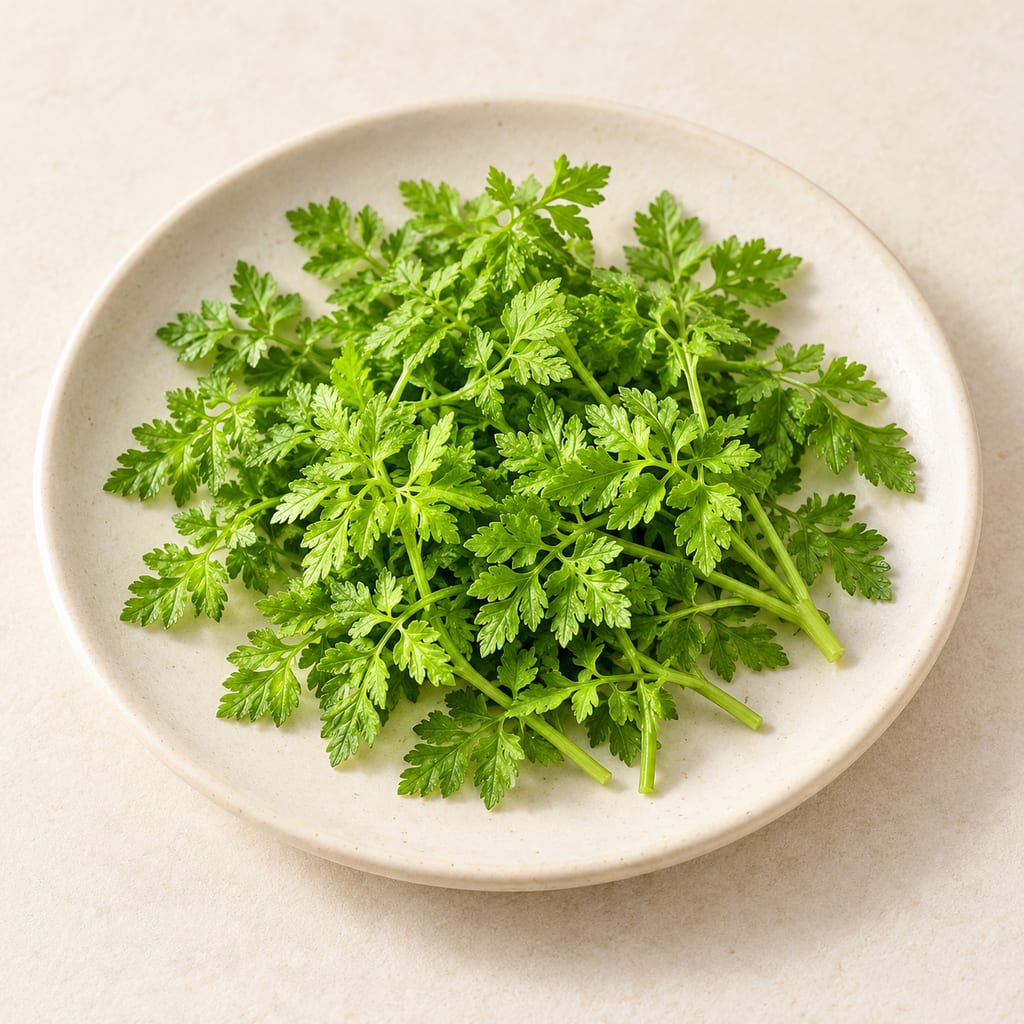
Wild chervil
Wild chervil is Anthriscus sylvestris, a mildly aromatic wild leafy herb distinct from garden chervil. It resembles poisonous Apiaceae; this account is not a foraging identification guide.
 FermenteaWhere food goes to change
Spices and aromatics
Few-flowered garlic (Allium paradoxum) is a bulbous perennial native from eastern Ukraine through the Caucasus to Iran. Its leaves and, in some documented traditions, stems, bulbs or bulbils are eaten fresh, cooked or preserved.
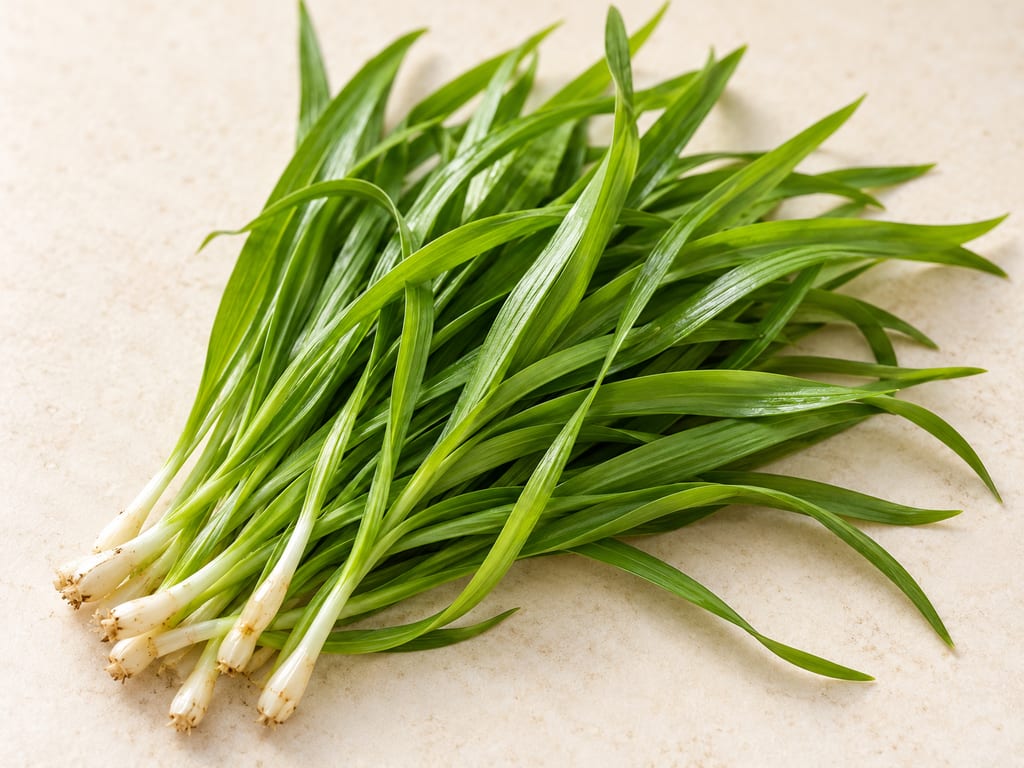
Few-flowered garlic is the accepted species Allium paradoxum (M.Bieb.) G.Don in the amaryllis family, Amaryllidaceae. Kew places its native range from eastern Ukraine across the Caucasus to Iran and describes it as a bulbous geophyte: it persists through the season in an underground bulb and sends up growth when conditions suit it. The common names few-flowered garlic and few-flowered leek refer to the same species. The name paradoxical onion is also used in English accounts; German names include Wunder-Lauch and Seltsamer Lauch, while Russian sources give Лук странный (luk strannyy). Common names vary and do not identify the plant by themselves.
The plant is modest in scale, generally around 15–30 centimetres tall. Its leaves are narrow, strap-like and keeled, arising from the base; a triangular or three-angled flowering stalk rises above them. The inflorescence can carry a white, nodding, bell-shaped flower marked with fine green lines, but the conspicuous form in many introduced populations is a cluster of small aerial bulbils, sometimes with one or a few flowers. Those bulbils are miniature vegetative propagules, not seeds or flower buds. The reproductive display varies: some plants bear bulbils with few flowers, while the less commonly reported var. normale bears several flowers without bulbils. A photograph or a written description helps with recognition but is not a complete identification key.
Leaves and bulbs give the familiar allium character that underlies culinary descriptions. Published accounts describe the taste as a mild, fresh garlic or chive note, with young foliage tending to be more delicate than mature growth; that taste description is qualitative, not a measurement or a guarantee that a specimen is correctly identified. The edible plant is the species, not a generic category called wild garlic. Three-cornered leek (Allium triquetrum) is another distinct species, with a different pattern of flowers and leaves; ramsons (A. ursinum) is distinct again. The careful use of a Latin name matters because vernacular names and the phrase wild garlic move between species and places.
The species is native across parts of eastern Europe and western Asia, including the Caucasus and northern Iran. Its natural setting is temperate, often in moist or shaded habitats. These facts about range and habitat describe the plant, not the origin of its use as food: the available sources do not establish a single first gathering, a domestication story or a dated beginning for culinary use. Kew's taxonomic account and the later ethnobotanical literature answer different questions and should not be collapsed into one chronology.
Outside that range the plant's European history is also tied to gardens. A 2023 review traces its introduction as an ornamental in Scotland in 1823, followed by records from the wild near Edinburgh in 1863. It appeared in Central European botanical gardens and parks in the nineteenth century, and later in naturalized sites. In some places it now forms dense spring stands. The same features that make it noticeable and easy to propagate for gardeners — early green leaves, bulbils and daughter bulbs — also make it capable of spreading beyond planted beds.
Food use and spread therefore sit beside one another in the species' modern history. In its native regions, people have long reported it among edible wild or garden plants; in parts of Europe, foragers have also adopted it as a spring green while botanists and conservation bodies describe ecological competition. Those are not interchangeable judgements. A plant can be food in a documented cuisine and an introduced invasive in a separate landscape. Neither fact alone establishes whether gathering is appropriate at a specific site.
The plant is conspicuous in early spring: the literature describes vivid green leaves appearing in April, when many other perennials are still dormant. That seasonal timing helps explain its place as a spring green in regional food accounts, but it does not set a universal harvest date. Latitude, elevation and local weather change when growth appears, and the sources do not give fixed kitchen-harvest dates. Seasonal descriptions provide context, not a schedule or a promise that a plant found at a given time is correctly identified.
In northern Iran, the review literature describes A. paradoxum as a familiar food plant and notes its cultivation in home gardens, particularly in Mazandaran. Young leaves and flowering or fruiting tops are reported raw as seasoning, boiled or fried, and pickled in vinegar. Other cited researchers report that leaves and bulbs have been collected and sold as fresh vegetables in local markets. The record links plant use to an ordinary seasonal food supply, not only to an ornamental garden or a novelty for modern foragers. It also contains an ecological caution: cited reports describe pressure from overharvesting in some native populations, so native status should not be treated as permission for unlimited collection.
In northeastern Iraqi Kurdistan, leaves are reported as sawza, eaten raw and used with bread or yoghurt, cooked with rice or bulgur, and preserved in brine. In the Hawraman area of southeastern Iraqi Kurdistan, cited accounts describe leaves boiled in soup or wrapped in dough and fried. These are region-specific accounts; they do not establish one universal Kurdish preparation. The shared ingredient is the identified species, while the surrounding meal and treatment vary.
In Armenia, young leaves, stems and bulbs are recorded fresh or pickled as seasonings; other sources cited in the review describe them as a snack, fried, put in soup, pickled or fermented in brine. In Azerbaijan, leaves and stems, sometimes with bulbs, are documented among the greens used in dovga, kutab and kuku. These dishes have their own broader compositions and traditions; the allium is one ingredient among several, not the defining recipe in every version.
A 2022–2023 survey of more than 300 people across Dagestan records A. paradoxum among wild food plants. A separate regional account in the Fermented and Preserved Foods of Russia research dossier groups preserved wild alliums, including this species, with other reported regional plant foods. Such records support a descriptive ingredient page and a sense of place. They do not tell us that every village follows the same method, nor do they provide a validated recipe for preserving this species.
Accounts most often foreground the young leaves, which can be used raw as a seasoning or cooked into a dish. Stems and bulbs appear in records from Armenia and Azerbaijan, and some northern Iranian sources describe bulbs as vegetables. In some forms the flowering head carries bulbils; accounts from Iran describe young aerial or inflorescence material used raw, cooked or pickled, while European foraging literature mentions drying bulbils as a condiment. These are documented options, not a direction to harvest every part or to dig up a wild plant.
The species' flavour is described in the ethnobotanical and food literature in familiar allium terms, but sources differ in how they compare it with chives, common garlic, leek or ramsons. Those comparisons communicate intensity and culinary role; they do not mean the species can be substituted measure for measure in every dish. Fresh leaves can contribute a mild aromatic edge, while bulbs and bulbils are denser plant parts and may behave differently when crushed, chopped, fried or dried. The evidence assembled here is descriptive rather than a standardized tasting study.
Quality is therefore easiest to read in the context of intended use and documented form. Tender spring leaves are the part repeatedly recorded for fresh seasoning and cooked dishes. When a source describes a bulb, stem or bulbil, keep that part explicit rather than silently replacing it with leaves. The sources do not set commercial grades, bunch sizes, a postharvest storage life or a sensory threshold for choosing market material.
The documented culinary range runs from eating leaves fresh with bread or using them as seasoning, through soups, rice and bulgur dishes, fried greens, herb mixtures and fillings, to vinegar pickling and brine fermentation. Each changes the role of the plant. Raw leaves keep their fresh allium character as a garnish or seasoning; heat softens and integrates the leaves into a meal; an acidic pickle and a brined ferment are separate preservation approaches. Naming those practices does not make them the same process.
The sources reviewed do not supply a complete, species-specific preservation protocol with weights, salt concentration, acidity target, temperature, time, container or validated storage life. The Dagestan survey documents the use of wild plants rather than a validated process, and the 2023 review summarizes reported uses from several earlier studies. This page consequently describes those methods as reported food practices and does not turn them into a step-by-step fermentation or canning formula. A preservation method must be evaluated on its own evidence and controls; the plant's aroma, taste, appearance or bubbling cannot establish safety.
Drying and grinding also appear in modern European accounts for aerial bulbils used as seasoning. That is a different product form from a wet brine or vinegar pickle and from fresh leaf seasoning. The evidence does not establish a single traditional drying schedule or a storage limit. Readers should not infer one from general knowledge about garlic or from an online substitution suggestion.
Allium paradoxum spreads both below ground through daughter bulbs and, in many introduced European populations, above ground through bulbils in the inflorescence. Seed production is described as rare in the common bulbil-bearing variety, while the flowering form differs. This reproductive flexibility helps explain why a patch can persist and expand. In parts of Britain, Germany and Czechia, the species is described as invasive or locally invasive because it competes with native plants. Its abundance in an introduced park is not a reason to carry bulbils, bulbs or soil to another location.
Rules depend on jurisdiction. The cited England and Wales order lists the species and says it competes directly with native species; it notes that few-flowered leek is on Schedule 9 in Scotland. The Wildlife and Countryside Act language is specific about causing listed plants to grow in the wild. This page records that context, not a legal determination for every country, garden, removal or collection scenario. Local guidance and access permissions matter.
Identification deserves the same care as legal status. Other Allium species can resemble one another, and the BSBI specialist note documents real difficulty distinguishing A. paradoxum from related non-native alliums. A three-angled stem alone is not a full identification; some congeners share that feature. The distinctive bulbil-bearing inflorescence is useful in the common variety, but flowering patterns vary. A common name, smell, patch abundance or an image viewed online is not an identification procedure. Do not eat a gathered plant unless its species has been confirmed by a qualified local botanist or other appropriate expert, and do not use this page as a foraging key.
Finally, regional reports of edible use are not toxicology findings and do not assess pesticide contamination, polluted sites, individual sensitivities or every plant part. The sources used here do not establish an allergen profile, safe portion, or medical benefit. The medicinal claims gathered in the review are deliberately outside this food description; a culinary record is not a therapeutic recommendation.
Literature reviewed for this page documents culinary use and garden cultivation here; the row does not claim the species' entire native range is limited to this region.
The review distinguishes reported uses in northeastern and southeastern Iraqi Kurdistan; this row records those source-specific reports without implying one uniform preparation.
The review reports fresh and pickled culinary uses for young leaves, stems and bulbs; this is not a claim that each use is national or universal.
The review records use among greens in named dishes and as a snack; the country-level row does not assign one recipe to every community.
A 2022–2023 survey records Allium paradoxum among wild food plants used in Dagestan; this supports reported use, not a specific preserved-food process.
Wild chervil is Anthriscus sylvestris, a mildly aromatic wild leafy herb distinct from garden chervil. It resembles poisonous Apiaceae; this account is not a foraging identification guide.
No community contributions have been published for this entry yet.
Sign in to contribute. Published comments and photos are free to read.
Royal Botanic Gardens, Kew, Plants of the World OnlineIdentity · Geography · Taxonomy
Allium paradoxum (M.Bieb.) G.DonKew accepts the name and authority; family Amaryllidaceae; native range eastern Ukraine, Caucasus to Iran; bulbous geophyte.
Cited in: Identity, names and visible form; A spring plant with more than one story
World Flora Online, description contributed by Flora HelveticaMorphology
Allium paradoxum (M.Bieb.) G.DonFlora description: 15–30 cm plant; basal keeled leaf; trigonal stem; inflorescence with bulbils and usually one bell-shaped white flower with fine green lines.
Cited in: Identity, names and visible form
Human Ecology, Springer NatureFood use · History · Ecology · Taxonomy · Regional use
Allium paradoxum from Asia to Europe: Ornamental, Invasive, Edible, and MedicinalLiterature review documents edible uses in northern Iran, Iraqi Kurdistan, Armenia and Azerbaijan; European introduction and spread; vegetative propagation; infraspecific variation and ecological impacts.
Cited in: Identity, names and visible form; A spring plant with more than one story; Regional food uses; Choosing the part and reading the flavour; Fresh cooking, pickling and brining are different records; Ecology, gathering and identification limits
Ethnobotany Research and ApplicationsTraditional use · Regional use
Ethnobotany of Dagestan2022–2023 questionnaire survey of more than 300 people across Dagestan records wild plants used for food, including Allium paradoxum. This is evidence of reported local practice, not validation of a preservation protocol or safety endpoint.
Cited in: A spring plant with more than one story; Regional food uses; Choosing the part and reading the flavour; Fresh cooking, pickling and brining are different records
Botanical Society of Britain and IrelandIdentification · Morphology
Problems with identification of Allium paradoxum – and some new diagnostic charactersSpecialist identification note discusses variation and diagnostic features of Allium paradoxum and confusion with other Allium species.
Cited in: Identity, names and visible form; Ecology, gathering and identification limits
legislation.gov.ukRegional legal status
The Wildlife and Countryside Act 1981 (Prohibition on Sale etc. of Invasive Non-native Plants) (England) Order 2014The order names Allium paradoxum as few-flowered leek and states the species competes with native species; it notes Schedule 9 status in Scotland. Claims are limited to the named jurisdictions and wording.
Cited in: Ecology, gathering and identification limits
Wikimedia CommonsImage reference
The Few-flowered Garlic, Allium paradoxum, Kilmaurs, East AyrshirePhotograph depicts a spring stand with foliage and flowers; file page identifies the subject and its CC BY-SA 4.0 license.