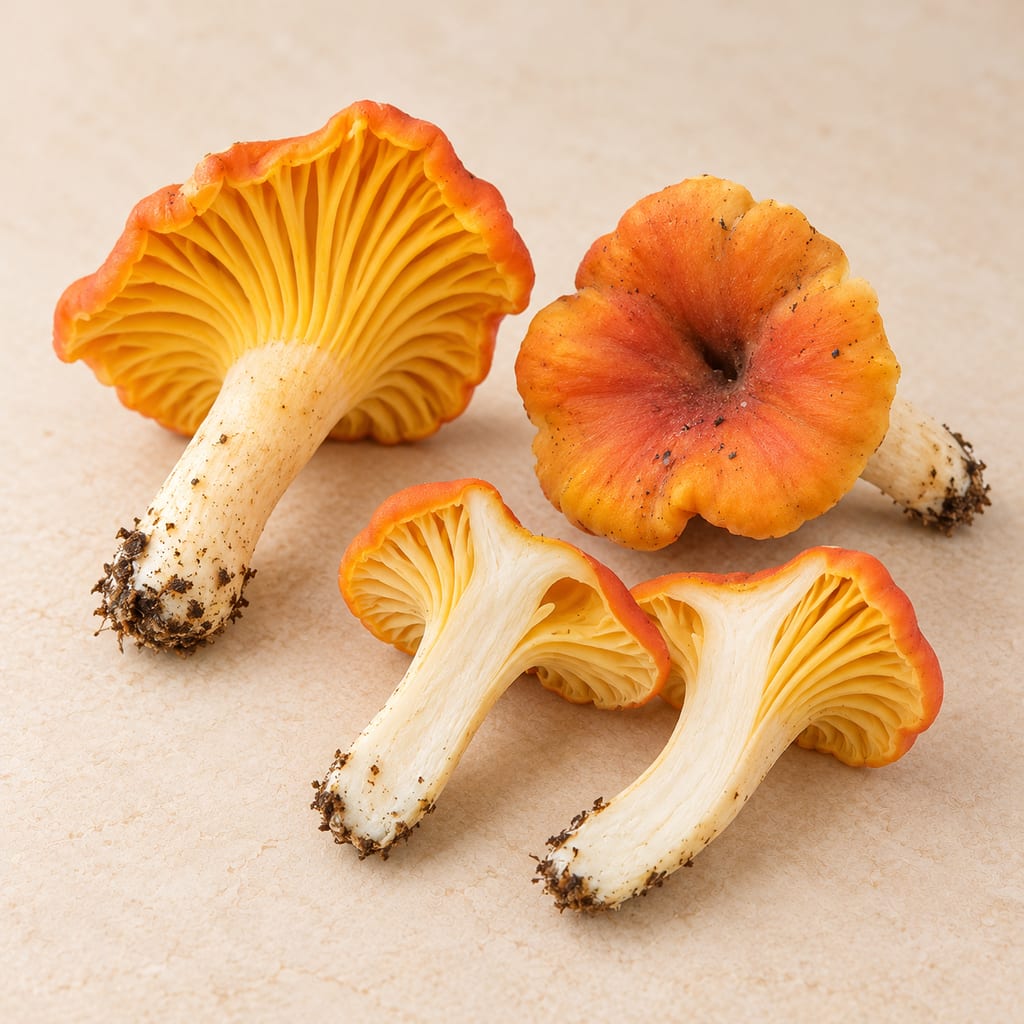
Cantharellus platyphyllus
Cantharellus platyphyllus is a red-to-orange chanterelle of tropical African woodland, gathered and sold locally in several countries. Its edibility rests on local use and literature, not a species-level safety study.
 FermenteaWhere food goes to change
Mushrooms
A historical name for a very large bolete reported from Madagascar and listed as edible by FAO. The taxon is unresolved, and no modern food tradition or safety evidence is documented.
Boletus bouriqueti is a name from the historical literature on Malagasy fungi. Heim described it in 1936 among three giant boletes from Africa and Madagascar. Bouriquet's 1970 guide to the mushrooms of Madagascar gave it a brown cap that may crack into angular plates and described it as exceptionally large.
The name has not been confirmed against modern taxonomy. The sources give no current preferred combination, no modern redescription and no DNA-linked voucher. Treat it as a historical label, not an established species.
The genus Boletus is placed in Boletaceae in the MNHN genus record. A 1996 national biodiversity table printed the name under Agaricaceae, which shows how uncertain the literature is. The FAO 2004 overview and the Madagascar literature warn that naming and source errors are common in older records.
Bouriquet's account is the only source describing the fungus. Its large size and cracked cap are historical observations and are not treated as a verified maximum. The name must not be assigned to Phlebopus colossus, Phlebopus sudanicus or any other bolete, even though some of their natural history is documented.
The only locality given is the Imerina area of the central highlands. The sources record no host trees, collection dates or fruiting season for this species. National rainy-season dates for Madagascar cannot be applied to it, because the locality is in the highlands rather than on the east coast.
The FAO 2004 global overview lists the species for Madagascar as edible, citing Bouriquet (1970). FAO uses edible for a reported property without confirmed consumption, and reserves food for confirmed use. A 1996 national monograph table gives it a culinary rating of good, with no collection, preparation or consumer detail.
No preparation method, market, cultivation or fermentation use was found in the sources.
No species-specific toxicology or validated preparation guidance was found. The historical edible listing does not establish that a wild bolete with similar features is safe to eat. Resemblance to other boletes, or to an old description, is not an identification. Do not eat a wild bolete on the strength of this entry.
No verified photograph of this species was found under this name in iNaturalist, GBIF or Wikimedia Commons. The 1936 plates and the 1970 guide's figures are historical illustrations whose rights and figure-to-species mapping are not confirmed. No image was generated for this page.
Missing: a modern taxonomic treatment, collection records, local names, any food preparation and any safety data.
Country-level record. The sources do not establish a current range or several independent localities.
The single historical locality description. It is an old account and not a verified collection record.
Cantharellus platyphyllus is a red-to-orange chanterelle of tropical African woodland, gathered and sold locally in several countries. Its edibility rests on local use and literature, not a species-level safety study.
The Malagasy brittlegill, catalogued as Russula edulis, is an ectomycorrhizal mushroom of Madagascar's central plateau that is locally eaten and sold; Russula is the genus most eaten in Madagascar.
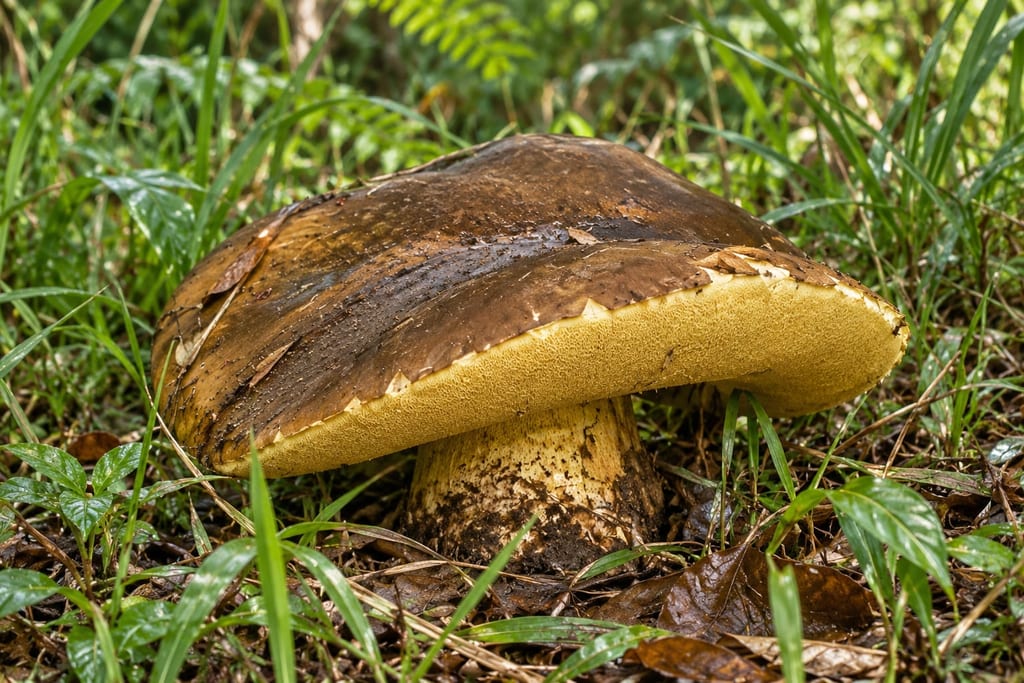
A very large tropical bolete with historical records in Madagascar and documented food-market use in Thailand. Earlier Madagascar food evidence is explicitly uncertain; Thai records provide stronger evidence of seasonal collection and sale.
No community contributions have been published for this entry yet.
Sign in to contribute. Published comments and photos are free to read.
Biodiversity Heritage Library (Revue de mycologie)History · Identity
Observations sur la flore mycologique malgache. III. Trois bolets gigantesques d'Afrique et de MadagascarHistorical treatment of Boletus bouriqueti among three giant boletes (1936).
Cited in: Overview; Images and gaps
Scribd (scan of Bouriquet 1970)History · Locality · Size
Principaux champignons de MadagascarHistorical description, cap appearance, size and the Imerina/Tananarive locality.
Cited in: Overview; Habitat and season
FAO Non-Wood Forest Products 17Food status · Safety
Wild Edible Fungi: A Global Overview of Their Use and Importance to PeopleMadagascar annex lists B. bouriqueti as edible, citing Bouriquet (1970); edible versus food definitions.
Cited in: Taxonomy and identity; Food status; Identification and safety
Economic BotanyContext · Season
The Edible Mushrooms of Madagascar: An Evolving EnigmaContext on Malagasy mushroom literature and naming errors; general rainy-season dates.
Cited in: Habitat and season; Food status; Identification and safety
Government of MadagascarFood status
Monographie nationale sur la diversité biologique de Madagascar, table 34Lists Boletus Bouriqueti with culinary value Bon, without collection or preparation detail.
Cited in: Food status
Muséum national d'Histoire naturelleTaxonomy
Boletus (genus record)Genus placed in Boletaceae.
Cited in: Taxonomy and identity