Boletus bouriqueti
A historical name for a very large bolete reported from Madagascar and listed as edible by FAO. The taxon is unresolved, and no modern food tradition or safety evidence is documented.
 FermenteaWhere food goes to change
Mushrooms
The Malagasy brittlegill, catalogued as Russula edulis, is an ectomycorrhizal mushroom of Madagascar's central plateau that is locally eaten and sold; Russula is the genus most eaten in Madagascar.
The Malagasy brittlegill is the common name in the catalogue for a mushroom catalogued under the scientific name Russula edulis. It is a brittlegill, a member of the genus Russula, which has brittle flesh and a cap that can be brightly coloured. The species grows on the ground in woodland of the central plateau of Madagascar and is ectomycorrhizal, living with tree roots.
It matters as a food because it is gathered and sold. The catalogue calls it an economically important mushroom locally eaten in Madagascar.
Russula is the most commonly eaten and economically important mushroom genus in Madagascar. Two species are singled out in the sources reviewed, R. prolifica and R. edulis. A 2008 paper, The Edible Mushrooms of Madagascar, describes R. edulis as a newly described species alongside R. prolifica.
The Heim studies of the Russulas and Lactarius of Madagascar, first published in 1938, are the older reference for the genus on the island. A later paper notes that an earlier general dislike of Russula among Malagasy people, which Heim recorded, is no longer the case.
The species is ectomycorrhizal and grows in the central plateau and in the woodland around it. Sources reviewed report that regularly cut Eucalyptus robusta plantations are a favoured habitat for two widely marketed edible Russula species in Madagascar.
The catalogue records the cultivation context as wild, so the mushroom is gathered rather than grown. The sources reviewed give no harvest quantity or season.
The mushroom is eaten locally and sold in markets. The sources reviewed do not give a preparation, a recipe or a traditional name in Malagasy, and the page does not supply one.
The common name Malagasy brittlegill is taken from the catalogue. The sources reviewed do not confirm it as a published common name, and the name should be checked against a Malagasy source before wider use.
The 2008 paper describes Russula edulis as a species from Madagascar, but a written species account is not a method for identifying a wild specimen. This page does not provide a field identification workflow or a species-level edibility verdict.
Poison Control advises never picking and eating wild mushrooms unless an expert has identified them. Local market use and a reported mild taste are not proof that a specimen is correctly identified or safe. The sources reviewed provide no preparation method for this species.
The catalogue's common name “Malagasy brittlegill” is not confirmed here by a Malagasy-language source. The sources reviewed provide no preparation method or species-specific public identification guide.
The catalogue places it on the central plateau; the sources reviewed describe local sale and eating in Madagascar.
A historical name for a very large bolete reported from Madagascar and listed as edible by FAO. The taxon is unresolved, and no modern food tradition or safety evidence is documented.
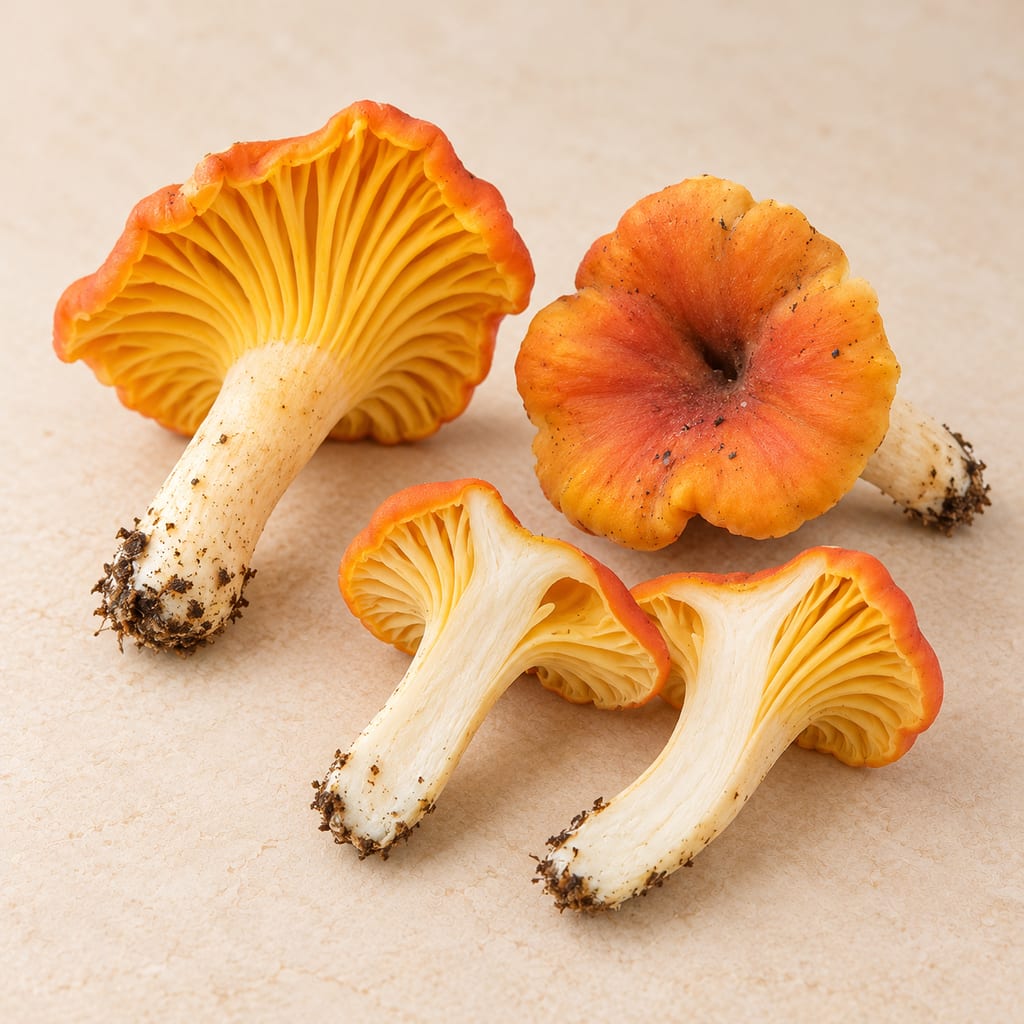
Cantharellus platyphyllus is a red-to-orange chanterelle of tropical African woodland, gathered and sold locally in several countries. Its edibility rests on local use and literature, not a species-level safety study.
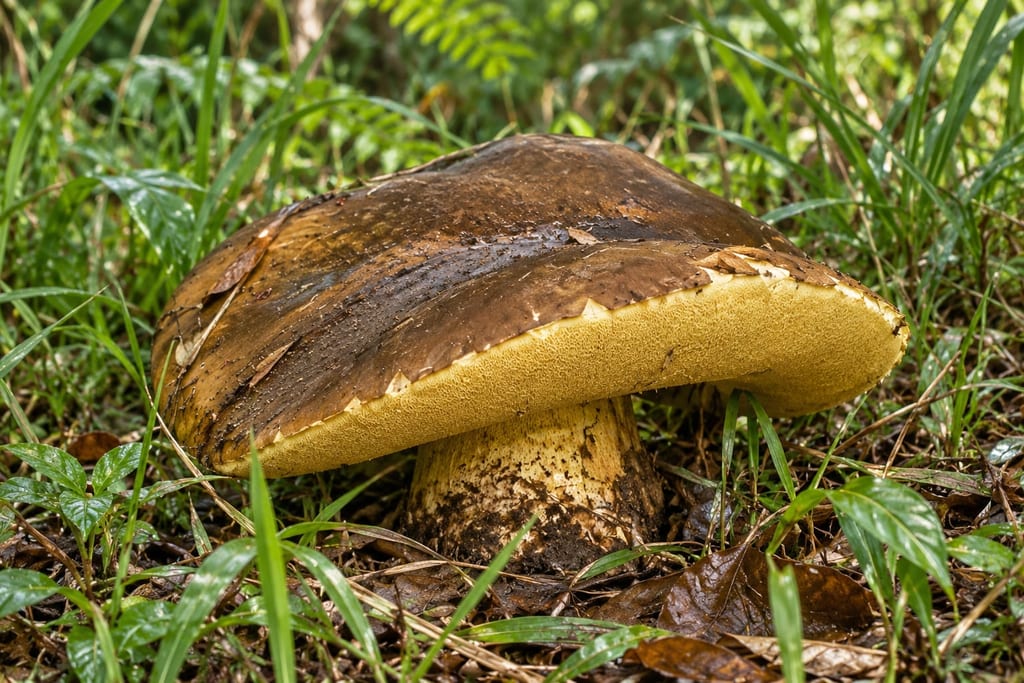
A very large tropical bolete with historical records in Madagascar and documented food-market use in Thailand. Earlier Madagascar food evidence is explicitly uncertain; Thai records provide stronger evidence of seasonal collection and sale.
No community contributions have been published for this entry yet.
Sign in to contribute. Published comments and photos are free to read.
Economic Botany / New York Botanical Garden PressIdentity · Food use · Habitat · Economy
The Edible Mushrooms of Madagascar: An Evolving EnigmaThe 2008 paper describes Russula edulis as a new species from Madagascar and provides its species description.
The paper records baskets of Russula edulis for sale and describes its cap as saturated brown and soon fissuring, with short, stout, whitish stem and whitish, often forked gills; its taste and odor are described as mild.
The paper reports the collection from an Eucalyptus robusta plantation on Madagascar's central plateau.
Cited in: Overview; Russula in Madagascar; Habitat and harvest; Eating and selling; Identification and safety; Open points
Australian Journal of TaxonomyHabitat · History
Australian Journal of Taxonomy, vol. 47 (Madagascar Russula paper, read from search summary)Reports that regularly cut Eucalyptus robusta plantations are the favoured habitat of two widely marketed edible Madagascan Russula species.
Notes that Heim (1938) described the Russulas of Madagascar and that a general dislike of Russula, which Heim recorded, is no longer the case.
Read from a search summary; the full PDF was not opened.
Cited in: Russula in Madagascar; Habitat and harvest
Poison ControlSafety
Mushroom poisoning: Don't invite “the death angel” to dinnerPoison Control advises never picking and eating wild mushrooms unless they have been identified by an expert, and warns that regional identification knowledge does not transfer between places.
Cited in: Identification and safety