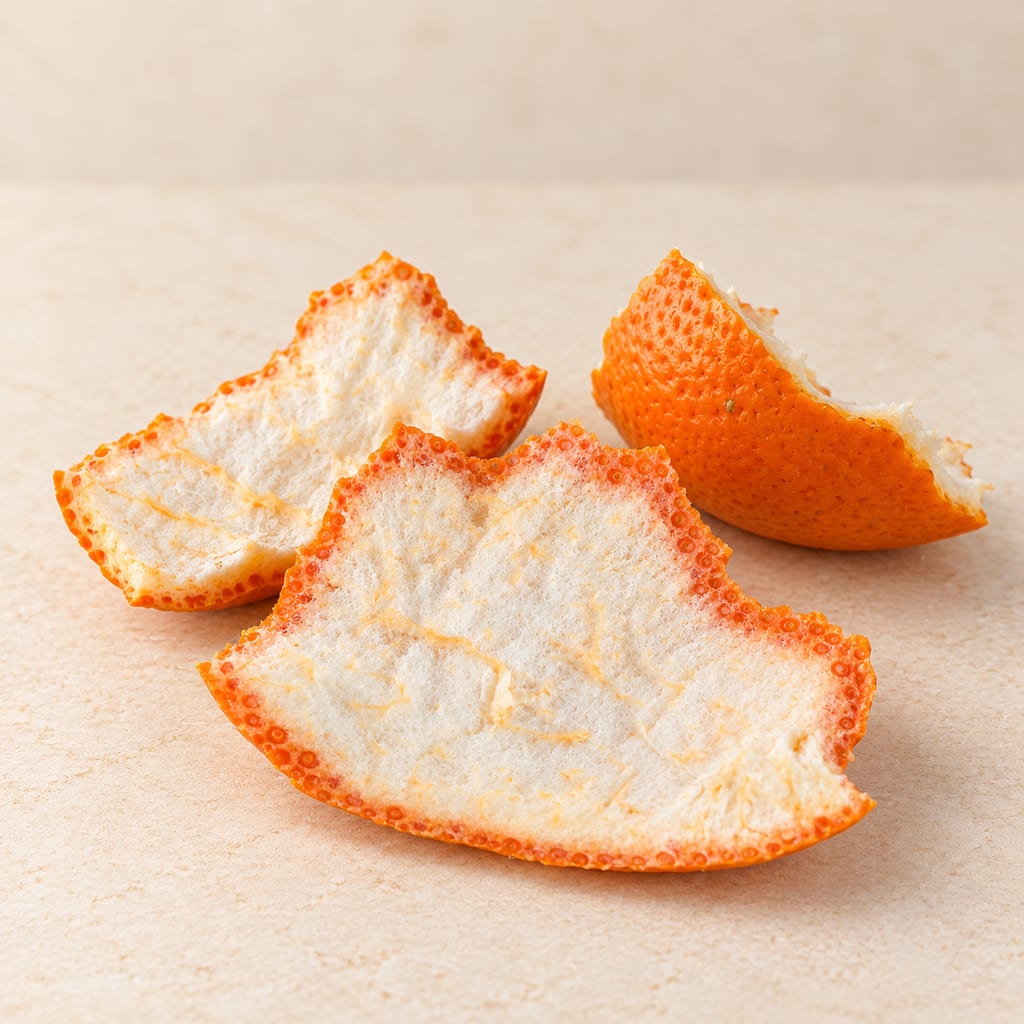
Orange peel with albedo
Orange rind retaining its white inner pith, combining aromatic outer peel with the body and pectin used in marmalade and other citrus preparations.
 FermenteaWhere food goes to change
Substrates
Dark-fruited muscadines have thick coloured skins, soft aromatic pulp and prominent seeds, used fresh or made into juice, preserves and red wine.
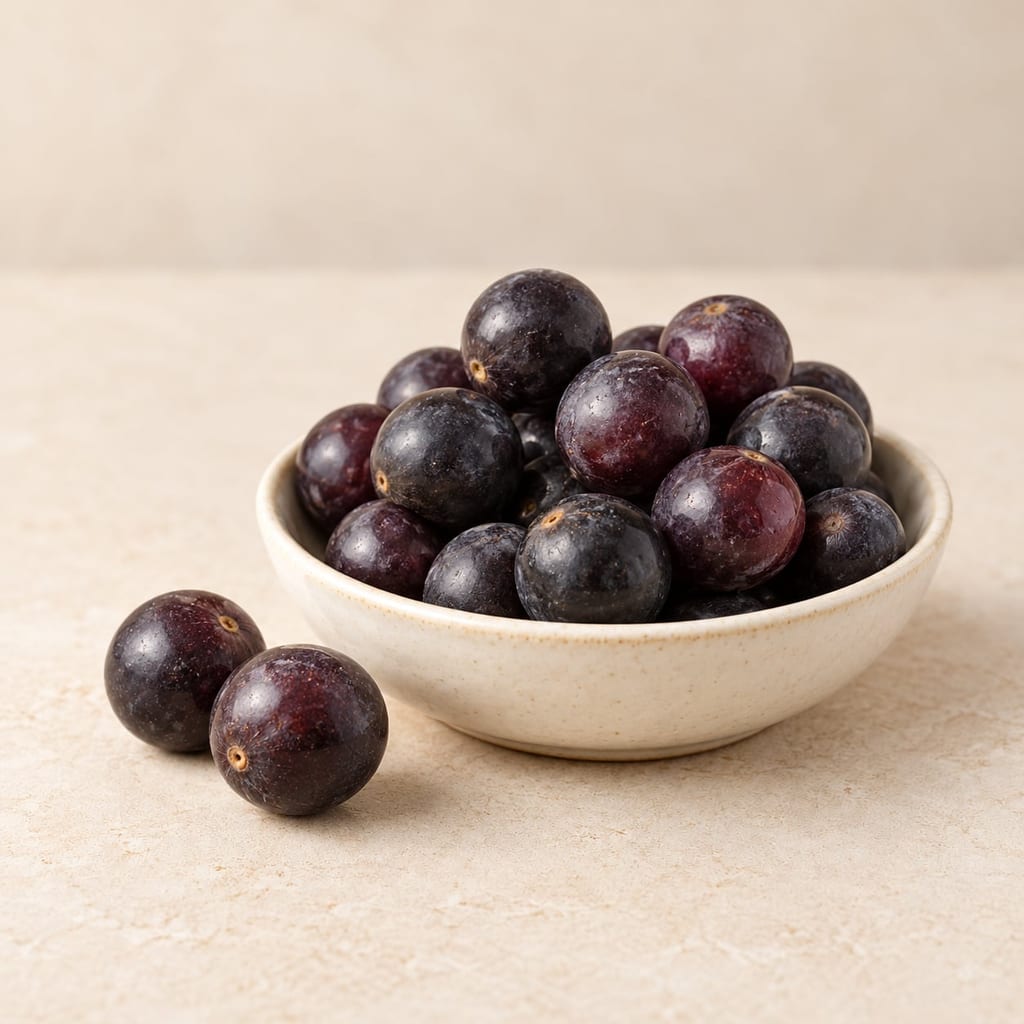
A dark muscadine is a substantial berry: a resilient skin surrounds soft, juicy pulp and conspicuous seeds. Its fruity, sometimes musky aroma is familiar in southern American gardens, farm stands and home kitchens. The skin gives fresh eating a different rhythm from eating a thin-skinned, seedless table grape. It also gives the cook several ingredients within one fruit: coloured skin, juice-bearing flesh and seeds that can be removed when a smoother texture is wanted.
The botanical name accepted by Kew is Vitis rotundifolia Michx., a member of the grape family, Vitaceae. Muscadinia rotundifolia (Michx.) Small is another name encountered in horticultural and scientific writing; Kew treats it as a synonym. Dark-skinned describes a fruit colour class within muscadines. It does not name a separate species or identify a particular cultivar. Bronze muscadines belong to the same crop, while ordinary European wine-grape cultivars belong to Vitis vinifera.
That distinction matters at the market. A basket labelled muscadines may contain fruit selected for fresh eating, juice or wine. Dark colour alone cannot tell the buyer how firm, sweet or acidic those berries will be. A cultivar name, when available, is more informative than treating every dark muscadine as an interchangeable black grape.
Kew places the species’ native range across the central and eastern United States into Mexico. The southeastern United States is especially important to its cultivation and food culture. North Carolina’s Coastal Plain is one setting where the crop is well adapted. Heat and humidity that complicate production of some other grapes are part of the muscadine’s familiar agricultural environment, although suitable drainage and local winter conditions still matter to the vine.
The fruit’s history reaches beyond vineyards. North Carolina State Extension recounts Indigenous preservation of muscadines as dried fruit before European settlement. This describes an established use of a native food, rather than an origin story beginning with a named commercial variety. In later southern households the fruit became associated with garden arbors, fresh eating, pies, jelly and wine. An arbor could provide both a shady place to sit and a crop to gather, linking the vine’s vigorous growth with everyday domestic life.
Names carry some of that regional history. Bullis, bullace, bull grape and bullet grape occur among older names for dark muscadines. Scuppernong has often been used much more broadly, but properly names a particular bronze cultivar. Its fame does not make it the correct name for the dark fruit described here. Keeping the distinction preserves a useful piece of regional vocabulary while making the ingredient clearer to someone buying it for the first time.
Wild vines and cultivated selections share an ancestry, but the fruit offered by a grower reflects deliberate choices. At the University of Georgia, organised muscadine breeding began at the Griffin Experiment Station in 1909. H. P. Stuckey and J. G. Woodroof worked toward sweeter flavour and berries that stayed attached more firmly. These practical goals connect the breeding plot directly with the kitchen: a berry must reach the eater in good condition as well as taste appealing on the vine.
Later selection developed larger fruit and cultivars suitable for commercial markets. B. O. Fry’s work contributed to this change. Cultivated muscadines now offer different combinations of berry size, skin toughness, flesh texture, fruit retention and flowering behaviour. A desirable trait for a household arbor is not necessarily the trait that makes fruit convenient to pack and transport.
Cowart illustrates these differences. It is a black cultivar with self-fertile flowers, historically used as a pollenizer alongside Fry. UGA describes its flavour as sweet, its skin as tough and its stem scars as prone to tearing. That combination can suit home use while making fresh-market handling more difficult. Scuppernong, by contrast, is a bronze wild selection with female flowers. The two names therefore communicate differences in both fruit and vine, rather than being alternative labels for a single generic grape.
Flower type affects the crop before any fruit reaches the kitchen. Some cultivated muscadines have female flowers and need a suitable pollen-producing cultivar nearby. Self-fertile cultivars have flowers that provide their own pollen. A garden planted without attending to that distinction may have healthy foliage yet disappoint at harvest. It is one reason the identity of the vine matters alongside the colour of its berries.
Ripening also shapes how growers bring muscadines to market. Fruit on a vine need not become ready all at once. Fresh-market and pick-your-own operations can return to the same planting to collect successive ripe berries. Processing vineyards may use mechanical harvesting, accepting a different balance between repeated selection and the efficiency of gathering a crop for juice or wine.
The point where a berry separates from its stem is important after harvest. A dry or rapidly drying scar leaves a more intact fruit; a torn, wet scar can leak juice and give decay an entry point. The commercial production guide consequently treats scar condition as a major quality trait. Firmness and an undamaged surface are useful buying observations, while the largest berry is not automatically the best fruit for every purpose. A small processing cultivar may be valuable for juice even when another cultivar is more convenient to eat fresh.
Anthocyanins give coloured muscadines much of their red, purple and black appearance. These water-soluble pigments accumulate mainly in the skin, and sometimes in the flesh. Their appearance also responds to chemical conditions, including acidity. The colour of an intact berry and the eventual colour of its juice or wine are therefore related, but they are not identical observations.
Coloured muscadines vary in their pigmentation as well as their soluble solids, acidity and pH. Genotype and growing year can change those traits, with considerable variation even within dark-fruited selections. The fruit entering a kitchen or winery can consequently differ before any extraction takes place. A deeply coloured skin supplies pigment-bearing tissue, but it does not give the cook a fixed pigment concentration or a complete description of the juice within.
Skin and seeds contain different mixtures of polyphenols, and their profiles vary with cultivar and growing place. These compounds belong to several chemical families rather than forming one uniform substance. Separating the seeds, retaining the skins or pressing only juice changes which parts of the berry enter a preparation. A strained liquid and a food containing finely processed skin therefore draw on different portions of the same fruit, even when they begin with the same cultivar.
Fresh muscadine flavour combines aroma, sweetness and acidity. Soluble-solids measurements are useful in evaluating ripeness, but the reading is not a complete sensory description. A fruit can carry appreciable soluble solids and still taste sharply acidic; another can seem milder because its acid balance differs. Texture and the fragrant skin contribute to the eating experience as well.
Acid content and pH describe different aspects of the juice and are measured separately. Their numbers are not interchangeable, just as a soluble-solids reading alone does not describe the whole flavour of a berry. Considering soluble solids alongside acid content gives a fuller account of the balance between sweetness and sourness. That balance is useful when choosing fruit for fresh eating or evaluating the juice that will enter a wine.
A grower’s cultivar, site and harvest decisions therefore matter to a winemaker or cook receiving the fruit. The home-winemaking method linked to this ingredient calls for measuring the strained juice with a hydrometer before calculating added sugar. That measurement makes the actual fruit lot part of the process. The instruction would lose its purpose if an assumed sweetness were attached permanently to the words dark-skinned muscadines.
In the linked dry red muscadine wine, the dark skins have a specific job. The Georgia method gives Hunt and Cowart as examples of dark varieties for red wine, alongside light varieties for white wine. These are examples for choosing fruit; the archived recipe does not identify its actual cultivar. For the red method, juice ferments in contact with the mashed fruit before the solids are strained away. For white wine, the pulp is separated promptly.
Crushing opens the fruit and brings juice into contact with the skin. Keeping those materials together gives skin colour time to enter the liquid. Straining earlier changes that opportunity, which is why simply choosing a dark grape does not fully describe a red-wine process. Skin contact is a physical extraction stage occurring alongside fermentation.
Fermentation itself is the work of yeast converting fruit sugars into ethanol and carbon dioxide, with other compounds contributing to aroma. Crushing and extracting colour do not perform that conversion. Added wine yeast, fruit sugar, skins and juice each have distinct roles, even though they meet in one vessel. The grape supplies fermentable material, acidity and flavour; its dark skin supplies the colour-bearing material used by the red method.
Muscadines also belong in foods that do not undergo alcoholic fermentation. Fresh berries offer their full contrast of skin, pulp and seeds. Juice removes much of that physical contrast, while pies and preserves can retain more fruit character. A cook’s choice between a clear jelly and a textured jam is partly a choice about which parts of the berry remain in the finished food.
A North Carolina State muscadine jam example handles the components separately: skins are removed and puréed, the interiors are softened, and the seeds are strained out before the fruit is recombined. The sequence makes practical use of the berry’s structure. Soft pulp and resilient skin need different treatment to become a spread with an even texture. Removing seeds does not require discarding all of the coloured skin.
Jelly takes a different route toward a smooth result by using extracted juice. Pie retains a place for recognisable fruit, while wine uses the juice as a fermentable liquid. These uses explain why fresh-eating quality and processing quality overlap without being identical. The desirable texture of a whole berry need not be the texture wanted in a preserve, and the colour that attracts a fresh-fruit buyer can become an ingredient in a cooked or fermented preparation.
Look for mature berries with the colour and character of their variety, clean surfaces and intact skins. USDA’s muscadine market standard distinguishes sound fruit from berries that are excessively soft, dried, crushed, split, leaking, mouldy or decayed. Check below the top layer of a container as well as the most visible berries. Juice accumulating in the pack can reveal damaged fruit that is otherwise easy to overlook.
Keep fresh fruit refrigerated and avoid crushing it during transport or storage. Commercial growers use ventilated packs and cold holding to preserve market quality. At home, inspect the fruit before preparation, remove spoiled berries and rinse the fruit under running water. Washing fruit with soap or household detergent is unnecessary; clean hands, utensils and preparation surfaces matter when handling the exposed pulp and juice.
Choose the preparation with the fruit’s condition and intended use in mind. A sound, firm berry can be enjoyed fresh, while ripe fruit can be prepared for juice, jam or a specified wine method. For a preserve intended for storage, follow the complete preservation method appropriate to that food. The ingredient remains the raw grape: a thick-skinned native fruit whose aroma, juice and coloured skin can take different roles in the kitchen.
Central and eastern U.S. within the species range, not a precise origin of the linked batch.
Kew native range includes Mexico; no exact growing location assigned.
UGA muscadine breeding began at Griffin Experiment Station in1909.
Linked dry-red-wine method gives cultivar examples but no actual lot cultivar, farm or harvest date.
Orange rind retaining its white inner pith, combining aromatic outer peel with the body and pectin used in marmalade and other citrus preparations.
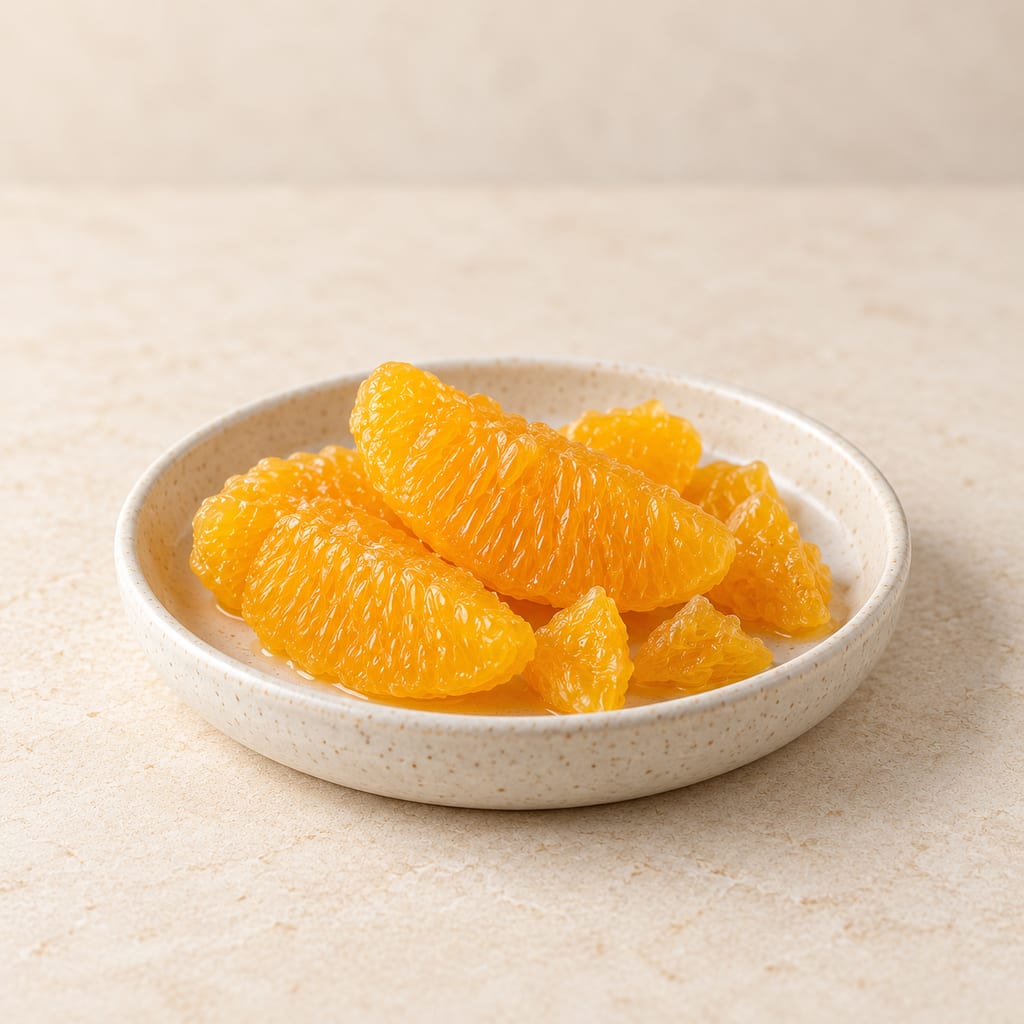
Fresh orange segment flesh, prepared separately from rind and membranes, bringing juicy tissue, sweetness, acidity and aroma to marmalade and other foods.
No community contributions have been published for this entry yet.
Sign in to contribute. Published comments and photos are free to read.
Royal Botanic Gardens, Kew, Plants of the World OnlineResearch
Vitis rotundifolia Michx.Kew accepts Vitis rotundifolia Michx. in Vitaceae and treats Muscadinia rotundifolia as a synonym. The species is native across the central and eastern United States into Mexico.
Cited in: A southern grape with its own character; Vines, gardens and a regional food
NC State ExtensionResearch
Muscadine Grapes in the Home GardenNorth Carolina muscadine cultivation includes Coastal Plain adaptation, female and self-fertile cultivars, distinctive aroma and fresh or processed uses. The institutional history recounts Indigenous drying of the fruit and regional common names.
Cited in: A southern grape with its own character; Vines, gardens and a regional food; From flower to ripe berry; Cooking the skin, pulp and juice
University of Georgia Institute of Plant Breeding, Genetics and GenomicsResearch
Muscadines: A Southern TraditionMuscadines have thick skins, large seeds and soft pulp. UGA records its Griffin breeding program from 1909, including H. P. Stuckey and J. G. Woodroof’s work on flavour and berry retention and later B. O. Fry selections.
Cited in: A southern grape with its own character; Vines, gardens and a regional food; Selecting a cultivated grape
NC Cooperative Extension AG-94 / University of Georgia(2020)Research
Muscadine Grape Production Guide for the SoutheastSoutheastern fresh-market and processing muscadines differ in cultivar and handling needs. Successive ripening affects harvest methods; stem-scar condition, ventilated packaging and cold holding affect fruit quality.
Cited in: From flower to ripe berry; Choosing and keeping the fruit
University of Georgia Muscadine Grape BreedingResearch
Cowart: Choosing a CultivarCowart is a black, self-fertile cultivar historically used as a pollenizer with Fry. Its sweet flavour, tough skin and tearing stem scar influence home and fresh-market uses.
Cited in: Selecting a cultivated grape
University of Georgia Muscadine Grape BreedingResearch
Scuppernong: Choosing a CultivarScuppernong is a bronze wild selection with female flowers. Its proper cultivar name is distinct from loose use of the name for other muscadines.
Cited in: Vines, gardens and a regional food; Selecting a cultivated grape
Foods10(5):1101(2021)Research
Evaluation of Biochemical Juice Attributes and Color-Related Traits in Muscadine Grape PopulationColoured muscadines contain water-soluble anthocyanins, mainly in skin and sometimes flesh. The Florida study found genotype and year differences in colour and juice traits, including soluble solids, acid content and pH.
Cited in: Skin colour and the flavour within; Sweetness, acidity and a changing harvest; What skin contact does in wine
International Journal of Molecular Sciences18(3):631(2017)Research
Profile of Polyphenol Compounds of Five Muscadine Grapes Cultivated in the United States and in Newly Adapted Locations in ChinaSkin and seed polyphenol profiles differed among five named cultivars grown in the United States and southern China, reflecting cultivar and site effects.
Cited in: Skin colour and the flavour within
University of Georgia Cooperative Extension, full review18January2013Research
Winemaking at Home, Circular717Yeast converts fermentable sugars into ethanol and carbon dioxide. The muscadine method measures juice before sugar adjustment and distinguishes prompt white-wine pulp separation from red-wine skin contact, with named cultivar examples.
Cited in: Sweetness, acidity and a changing harvest; What skin contact does in wine
NC State Department of Horticultural Science, Small Fruits(10June2020)Research
Recipe: Muscadine JamThis posted jam example treats skins and pulp separately, softens the interiors, strains seeds and recombines the fruit for texture. It is a culinary example rather than a tested canning standard.
Cited in: Cooking the skin, pulp and juice
USDA Agricultural Marketing ServiceResearch
Muscadine Grapes Grades and StandardsUSDA market standards describe mature, clean, well-coloured muscadines with sound texture, without leaking, crushing, mould or decay.
Cited in: Choosing and keeping the fruit
U.S. Food and Drug AdministrationResearch
Selecting and Serving Produce SafelyChoose sound produce, wash it under running water without soap or detergent, and use clean preparation surfaces and appropriate refrigeration for cut fruit.
Cited in: Choosing and keeping the fruit