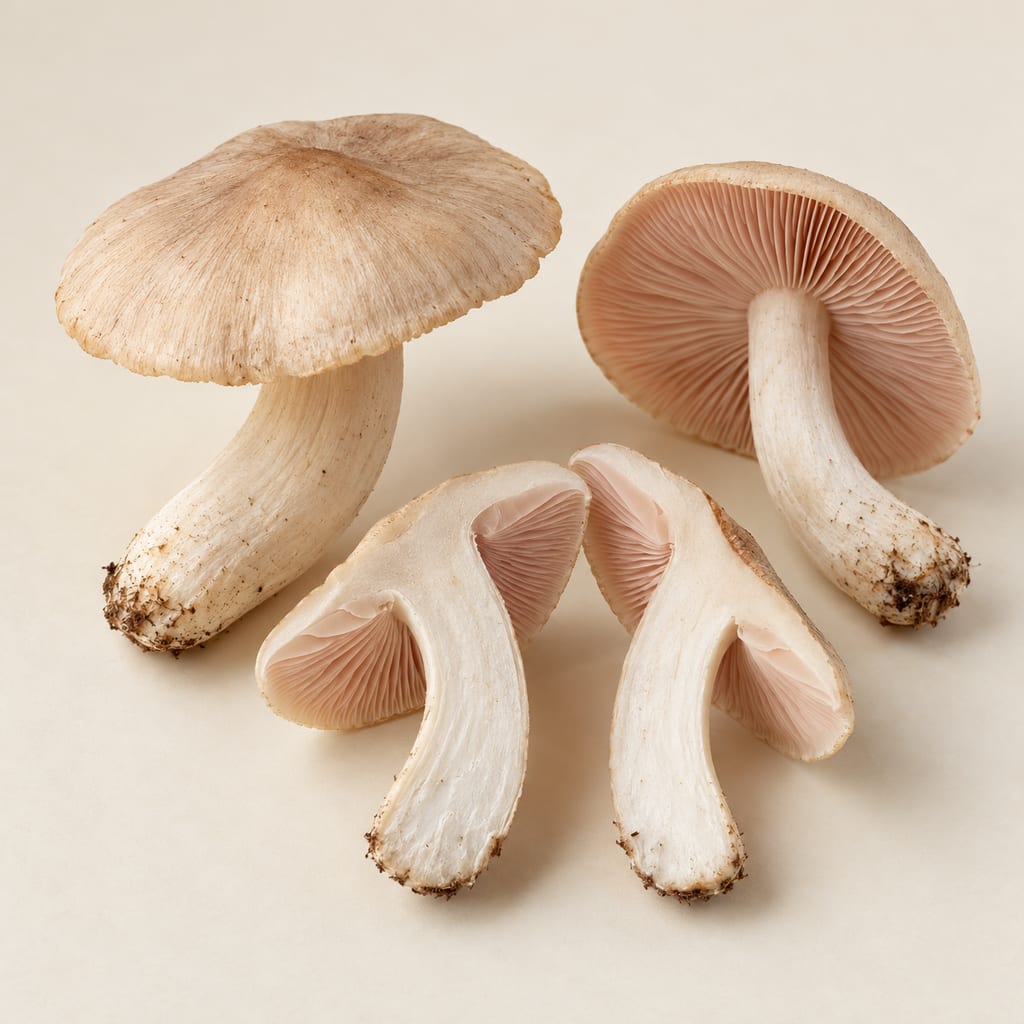
Entoloma sepium
Entoloma sepium is a spring pinkgill associated with Rosaceae. Chinese and European sources list it as edible or conditionally edible, while taxonomic uncertainty and a poisonous lookalike warrant caution.
 FermenteaWhere food goes to change
Mushrooms
Bloxam's entoloma is a rare pink-gilled mushroom of old grasslands. Historical sources call it edible, but food-use evidence and older identifications remain uncertain; this does not recommend gathering or eating it.
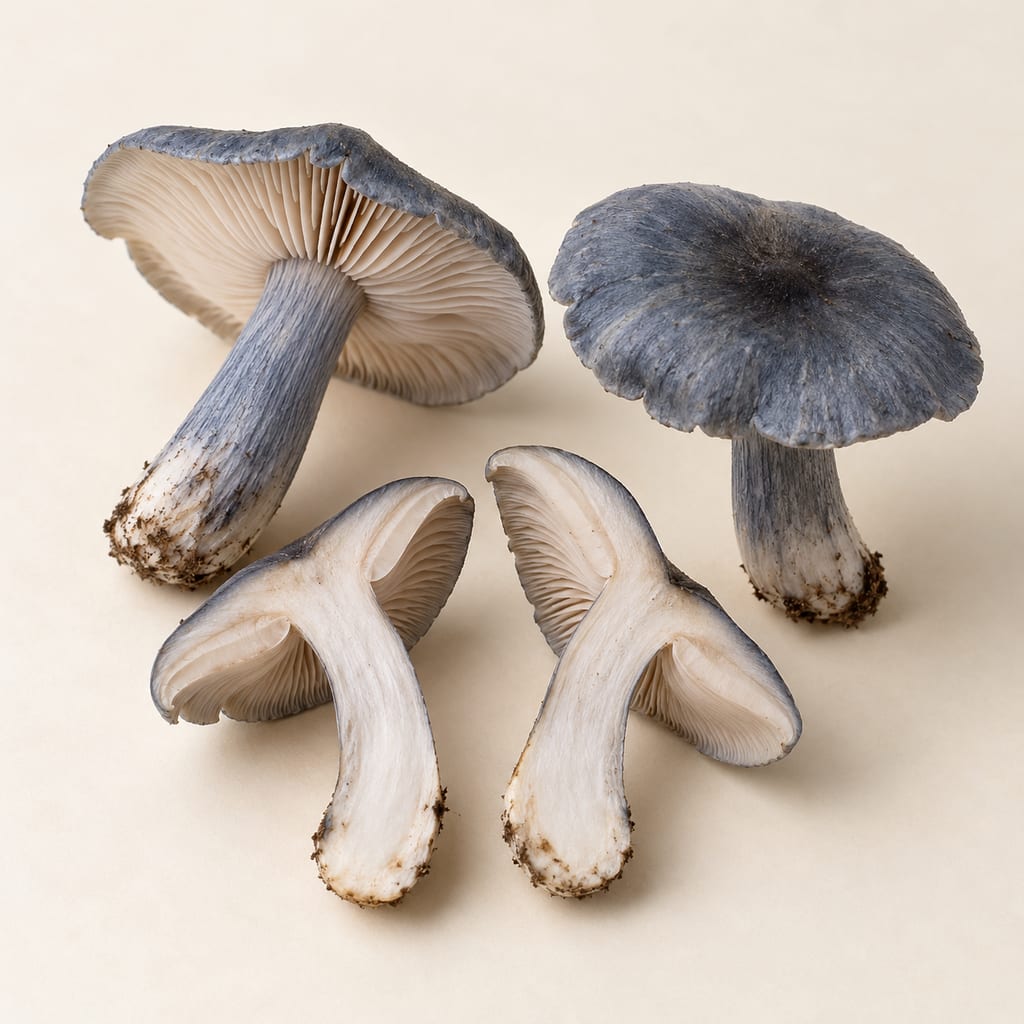
The current name is Entoloma bloxamii (Berk. & Broome) Sacc., published in 1887; Index Fungorum records Agaricus bloxamii as the 1854 basionym and notes the original spelling ‘bloxami’. The common name Big Blue Pinkgill describes its blue-grey cap and stem and pinking gills, but colour alone does not establish an identification.
For many years, records used E. bloxamii in a broad sense that gathered several blue-capped pinkgills together. DNA-informed work anchored the strict-sense name to an epitype and separated it from E. madidum and other similar taxa. Historical records under the broad name cannot automatically be treated as verified occurrences or food-use records of the modern strict-sense species.
The strict-sense assessment describes a saprotrophic mushroom of long-established, nutrient-poor semi-natural grassland, commonly on calcareous or base-rich soil. It may occur singly or in small groups, and its fruit bodies are short-lived. Fertiliser, ploughing, reseeding, cessation of grazing, scrub growth, and afforestation can change the turf and soil conditions associated with these fungi.
Plantlife's UK guidance lists August through November, with autumn as the principal season. This is a UK observation window, not a universal calendar; the sources reviewed do not give reliable fruiting months for every part of the scattered range.
The supplied index links this name to a historical edible listing in the FAO global overview, a historical US country entry, and the 2024 Brazilian audit, where edibility is marked uncertain and occurrence confidence varies. The FAO list supports the statement that an edible claim was published, not that the strict-sense species was repeatedly or safely eaten in those places.
A proposed 2026 assessment says the species is not known to be traded or used. It is not a final IUCN assessment, but it reinforces the lack of evidence for present-day culinary use. No species-specific recipe, preparation, market chain or cultivated supply is established. The old edible claim is recorded, while actual use, the identity of historical specimens and safety remain unresolved.
Do not treat the old edible label as a food recommendation. The Brazilian audit's uncertain classification and the history of taxonomic lumping leave both source identity and food-use evidence unresolved. Entoloma is a large genus with species reported to cause gastrointestinal poisoning; the sources reviewed do not establish a toxin profile or safe preparation for E. bloxamii itself. A lay observer cannot resolve these uncertainties by colour, taste, or photograph.
The mushroom is rare in its strict-sense range and associated with threatened old grassland. The proposed assessment describes scattered, infrequent records and habitat decline; Plantlife identifies it as vulnerable in the UK context. This draft is a taxonomic and food-history record only. It does not encourage gathering, sale, or eating, and no method or safety assurance should be inferred.
Modern sequence-confirmed records reported in the proposed assessment come from scattered parts of Europe, including the United Kingdom, France, Spain, Portugal, the Netherlands, Denmark, Germany, Italy, Austria, Sweden, Norway and the Ural region of Russia. It warns that many older records under the broad name belong to other species in the complex. These country-level occurrences do not demonstrate a food tradition.
Five linked photo leads are different photographs from one iNaturalist observation near Lennestadt, Germany, dated 4 November 2023. Commons identifies the photographer and CC BY-SA 4.0 terms. They form one visual lead and one precise observation point, not five independent locality records, DNA confirmation, or proof of edibility. The US and Brazil evidence is retained at country level and marked historical or uncertain.
Photographed iNaturalist occurrence identified as E. bloxamii; not sequence confirmation and not evidence of consumption.
FAO country record supports an old edible claim; older broad-name records may not match the strict-sense taxon.
Indexed Brazilian audit status is uncertain edibility and occurrence confidence varies; not confirmed consumption.
Entoloma sepium is a spring pinkgill associated with Rosaceae. Chinese and European sources list it as edible or conditionally edible, while taxonomic uncertainty and a poisonous lookalike warrant caution.
No community contributions have been published for this entry yet.
Sign in to contribute. Published comments and photos are free to read.
Royal Botanic Gardens, KewTaxonomy
Index Fungorum name record: Entoloma bloxamiiAccepted name, authority, original spelling bloxami, basionym Agaricus bloxamii (1854), Entolomataceae.
Cited in: A name with a changing boundary
Global Fungal Red List InitiativeTaxonomy · Habitat · Distribution · Conservation · Safety
Entoloma bloxamii s. str.Proposed assessment, not final; strict-sense concept is epitype-anchored and separate from E. madidum; sequence-confirmed records are scattered in Europe; nutrient-poor grassland; rare; no known trade or use.
Cited in: A name with a changing boundary; Grassland ecology and season; Food reports and their limits; Safety and conservation; Places and evidence
Food and Agriculture Organization of the United NationsFood history
Wild edible fungi: a global overview, Annex 3FAO global edible list includes E. bloxamii; a historical listing, not taxonomic or toxicological validation.
Cited in: Food reports and their limits
IMA Fungus / Springer NatureFood history · Safety · Geography
Over 400 food resources from Brazil: evidence-based records of wild edible mushroomsIndex assigns Brazil uncertain edibility; source distinguishes edibility, occurrence and consumption.
Cited in: Food reports and their limits; Safety and conservation
PlantlifeSeason · Habitat · Identification · Conservation
Big Blue PinkgillUK guidance lists August-November/autumn, long-established unfertilised grasslands on neutral or calcareous soils, vulnerable in UK context.
Cited in: Grassland ecology and season; Safety and conservation
iNaturalistGeography · Image provenance
Bloxam's Entoloma, observation 190210541Photographed observation identified as E. bloxamii near Lennestadt, Germany, 4 November 2023; not sequence confirmation.
Cited in: Places and evidence
Food and Agriculture Organization of the United NationsHistorical use · Geography
Wild edible fungi: a global overview, Annex 2 country recordsThe supplied index associates this historical country record with the United States; not current distribution, consumption verification, or strict-sense taxonomy.