
Spices and aromatics
Fenugreek
Fenugreek has separate leaf and seed food uses. This account distinguishes Tamil Nadu field guidance and a Gujarat protected-crop trial from two Egyptian station experiments, regional food reports and untested household container growing.
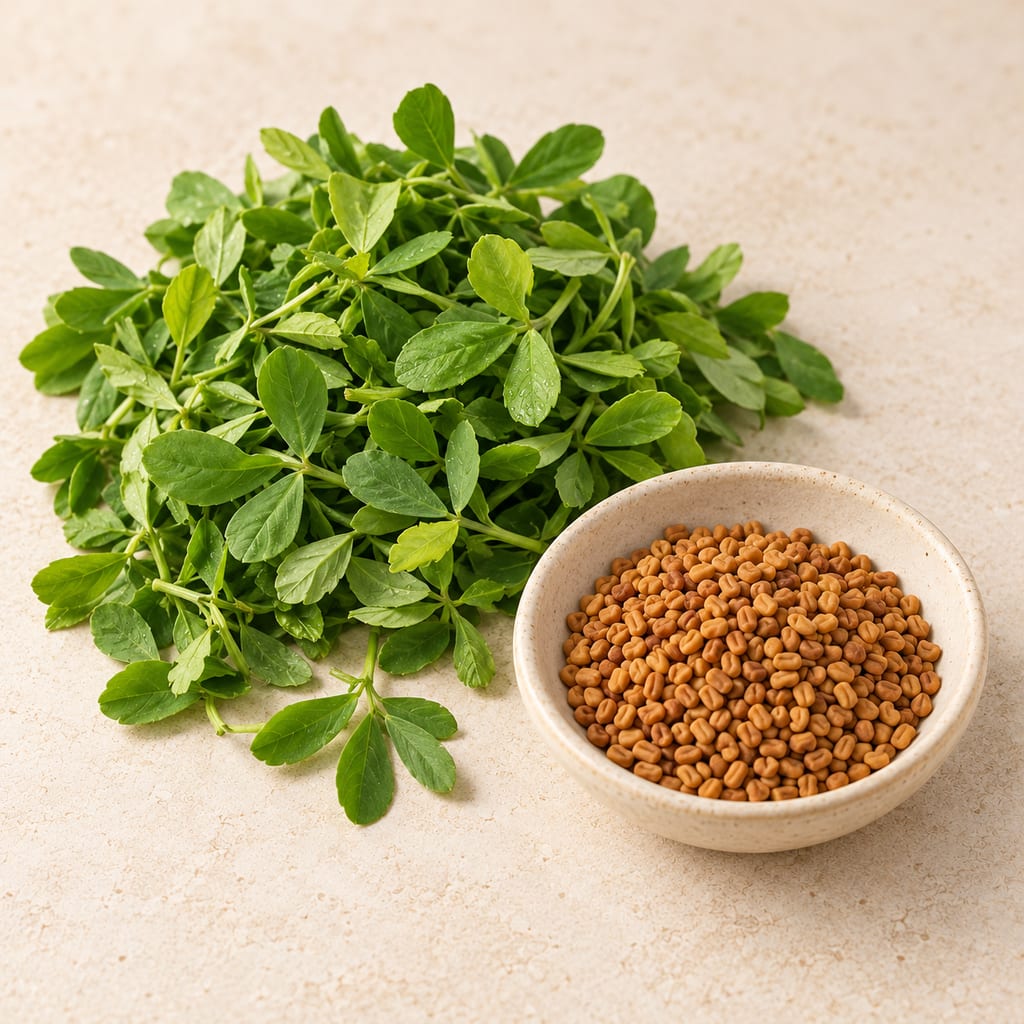
One plant, separate leaf and seed uses
Kew accepts Trigonella foenum-graecum L., an annual native from Iraq to northern Pakistan. Indian food sources use names including methi for the plant or leaves, methi dana for seed and kasuri methi for dried leaves. ICAR–Indian Institute of Spices Research describes seeds in spice blends, pickles and curry preparations, and leaves in Indian cooking, including paneer and curry dishes. These references do not make the two harvests interchangeable: seed and leaf are distinct food forms.
The Egyptian Drug Authority’s 2024 herbal monograph records the species name with the Arabic forms Hulbah and Helba (حلبة). It is a medicinal monograph; this name record does not support a medicinal recommendation. A 2004 food-habits table separately lists fenugreek sprouts in a raw sprouted-legume category and whole fenugreek as a hot infusion. These brief table entries do not supply a preparation method or current prevalence estimate.
Sources for this section
- Trigonella foenum-graecum L. →
- Fenugreek – Trigonella foenum-graecum L. →
- Introduction to Indian Cookery, BHM-401T →
- Egyptian Herbal Monograph: Trigonella foenum-graecum L. →
- Food habits of the Egyptians: newly emerging trends →
- Food habits of the Egyptians: newly emerging trends — author-uploaded full-text access copy →
Reported dishes and source-bounded preparation
The Uttarakhand Open University course lists methi thepla in a Gujarat sample menu and methi murg in a Hyderabad menu, but provides no recipe for those entries. Elsewhere it describes fenugreek seed in Madras-style curry powder and sambar masala, and dried fenugreek leaves in a gravy context. The course’s common names and menu listings do not establish the plant part in every dish or verify a particular cultivar. These are food-use records, not a complete executable recipe with yield and storage limits.
Ahram Online reports presenter Osama Ghazali’s account at a heritage event of Nubian porridge based on helba, contrasted with date porridge in Siwa and molasses porridge in Upper Egypt. This is a reported regional heritage account, not an independently audited field study or complete recipe. The 2004 food-habits table also records whole fenugreek as an infusion and sprouts as raw, without proportions, timing or a sprouting protocol.
Sources for this section
- Fenugreek – Trigonella foenum-graecum L. →
- Introduction to Indian Cookery, BHM-401T →
- Food habits of the Egyptians: newly emerging trends →
- 'Something's Cooking' on Heritage Food at the House of Egyptian Architecture →
- Food habits of the Egyptians: newly emerging trends — author-uploaded full-text access copy →
Field growing evidence in India
Tamil Nadu Agricultural University describes a cool, comparatively dry, frost-free climate, well-drained loamy soil and June–July or October–November sowing for its field context. Its guidance gives 20 × 15 cm field spacing and says seedlings thinned at 20–25 days can be used as greens. These are Tamil Nadu field recommendations, not a national calendar or a pot-growing plan. The page also gives different crop durations for greens, grain and cultivar RMt-143; the ICAR–Indian Institute of Spices Research profile gives a separate 90–120 day maturity summary, so the figures should not be averaged.
Sources for this section
Field trials in India and Egypt
A study at Jagudan, Gujarat, ran from September 2019 to January 2020 with Pusa Early Bunching. It compared open field, 50% green shade net, 50% white shade net and a naturally ventilated polyhouse, alongside sowing dates from the third week of September through the first week of November. The authors recommend white shade net and third-week October sowing, but Tables 1–3 present growing-condition and sowing-time results separately; they do not demonstrate a joint treatment optimum or a general greenhouse advantage. The study reports one cultivar at one site in one season, not a household container or protected-growing protocol.
Egyptian field evidence comes from two different research stations and seasons. A Minia University study on sandy soil compared three sowing dates (20 September, 5 October and 20 October) over 2021–22 and 2022–23; the paper reports site soil pH values 8.15 and 8.01. A South Sinai experiment at El-Tor compared 1 September, 1 October and 1 November planting in 2019–20 and 2020–21 under the study’s drip-irrigated design. These are local experimental treatments and site observations, not an Egypt-wide calendar, pH optimum, household watering plan or greenhouse prescription. The current pass could not reopen the Minia paper directly; its cited details are carried from the prior dossier’s full-text inspection.
Sources for this section
- Effect of growing conditions and sowing time on growth, yield and quality of fenugreek (Trigonella foenum-graecum) →
- Enhancing fenugreek productivity under water deficient Egyptian sandy soils: optimizing organic inputs and nutrients efficiencies →
- Response of the active ingredients of fenugreek plant to spraying with different forms of microelements and planting dates under El Tor conditions in South Sinai →
Research gaps
The cookery course’s regional dish listings do not include a full leaf recipe; no complete source-specific leaf method, yield or storage endpoint was established.
Tamil Nadu season and field-spacing advice is regional. No household container method, seed-starting depth, greenhouse operating specification or all-India calendar was found.
The Gujarat study’s marginal treatment and sowing-date results do not establish a combined optimum; its weather observations are not species-wide heat or humidity limits.
TNAU reports 90–100 days to grain generally and 140–150 days for RMt-143; ICAR–IISR gives 90–120 days to maturity. The contexts differ and remain unresolved.
Egyptian food-use entries are descriptive tables or reported heritage context, not complete recipes; no Egyptian household batch with quantities, steps, yield and storage endpoint was verified.
The Minia study is carried forward from the dossier's earlier full-text inspection; the article could not be reopened directly in this publication pass. Its site pH and sowing treatments are not species-wide optima.
The EDA source is a medicinal monograph and is used only for the Arabic name/taxon record; no medicinal claim or dose is included.
The WHO article was read via an author-uploaded full-text copy after the official PDF fetch failed. Regional food evidence is partial and does not establish current prevalence or an all-Egypt growing calendar.
Sources for this section
- Trigonella foenum-graecum L. →
- Fenugreek →
- Fenugreek – Trigonella foenum-graecum L. →
- Introduction to Indian Cookery, BHM-401T →
- Effect of growing conditions and sowing time on growth, yield and quality of fenugreek (Trigonella foenum-graecum) →
- Egyptian Herbal Monograph: Trigonella foenum-graecum L. →
- Food habits of the Egyptians: newly emerging trends →
- 'Something's Cooking' on Heritage Food at the House of Egyptian Architecture →
- Enhancing fenugreek productivity under water deficient Egyptian sandy soils: optimizing organic inputs and nutrients efficiencies →
- Response of the active ingredients of fenugreek plant to spraying with different forms of microelements and planting dates under El Tor conditions in South Sinai →
- Food habits of the Egyptians: newly emerging trends — author-uploaded full-text access copy →
Research status
The underlying plant account received a partial source review. Its review scope is described in the original plant article.
Sources for this section
Places
Unknown
Relationship not established · Place not establishedThe available research does not establish a single origin for this ingredient.
Community
No community contributions have been published for this entry yet.
Share what you made
Sign in to contribute. Published comments and photos are free to read.
Sources
Royal Botanic Gardens, Kew, Plants of the World OnlineIngredient research
Trigonella foenum-graecum L.Cited in: One plant, separate leaf and seed uses; Research gaps
Tamil Nadu Agricultural University, Agritech PortalIngredient research
FenugreekCited in: Field growing evidence in India; Research gaps
ICAR–Indian Institute of Spices ResearchIngredient research
Fenugreek – Trigonella foenum-graecum L.Cited in: One plant, separate leaf and seed uses; Reported dishes and source-bounded preparation; Field growing evidence in India; Research gaps
Uttarakhand Open UniversityIngredient research
Introduction to Indian Cookery, BHM-401TCited in: One plant, separate leaf and seed uses; Reported dishes and source-bounded preparation; Research gaps
D. L. Parmar, Piyush Verma, H. N. Leua and C. J. Thakar, Indian Journal of Agricultural Sciences 93(6): 673–675Ingredient research
Effect of growing conditions and sowing time on growth, yield and quality of fenugreek (Trigonella foenum-graecum)Cited in: Field trials in India and Egypt; Research gaps
Egyptian Drug Authority, Medicinal Plants Used in Egypt (2024), pp. 569–575Ingredient research
Egyptian Herbal Monograph: Trigonella foenum-graecum L.Cited in: One plant, separate leaf and seed uses; Research gaps
World Health Organization, Eastern Mediterranean Health Journal 10(6):898–915 (2004)Ingredient research
Food habits of the Egyptians: newly emerging trendsCited in: One plant, separate leaf and seed uses; Reported dishes and source-bounded preparation; Research gaps
Ahram OnlineIngredient research
'Something's Cooking' on Heritage Food at the House of Egyptian ArchitectureCited in: Reported dishes and source-bounded preparation; Research gaps
A. A. Hassan et al.; Scientific Reports 15, article 17992 (2025)Ingredient research
Enhancing fenugreek productivity under water deficient Egyptian sandy soils: optimizing organic inputs and nutrients efficienciesCited in: Field trials in India and Egypt; Research gaps
Rania M. R. Khater; Middle East Journal of Agriculture Research 11(2):351–359 (2022)Ingredient research
Response of the active ingredients of fenugreek plant to spraying with different forms of microelements and planting dates under El Tor conditions in South SinaiCited in: Field trials in India and Egypt; Research gaps
H. Hassan-Wassef; author-uploaded full-text copy of Eastern Mediterranean Health Journal 10(6):898–915 (2004)Ingredient research
Food habits of the Egyptians: newly emerging trends — author-uploaded full-text access copyCited in: One plant, separate leaf and seed uses; Reported dishes and source-bounded preparation; Research gaps
FermenteaResearch provenance
Fenugreek (Trigonella foenum-graecum): original plant researchCited in: Research status