
Spices and aromatics
Culantro leaves
A source-linked account of Eryngium foetidum as a culinary leaf in Trinidad and Pará, alongside distinct Peru and Brazil cultivation reports and unresolved home-use limits.
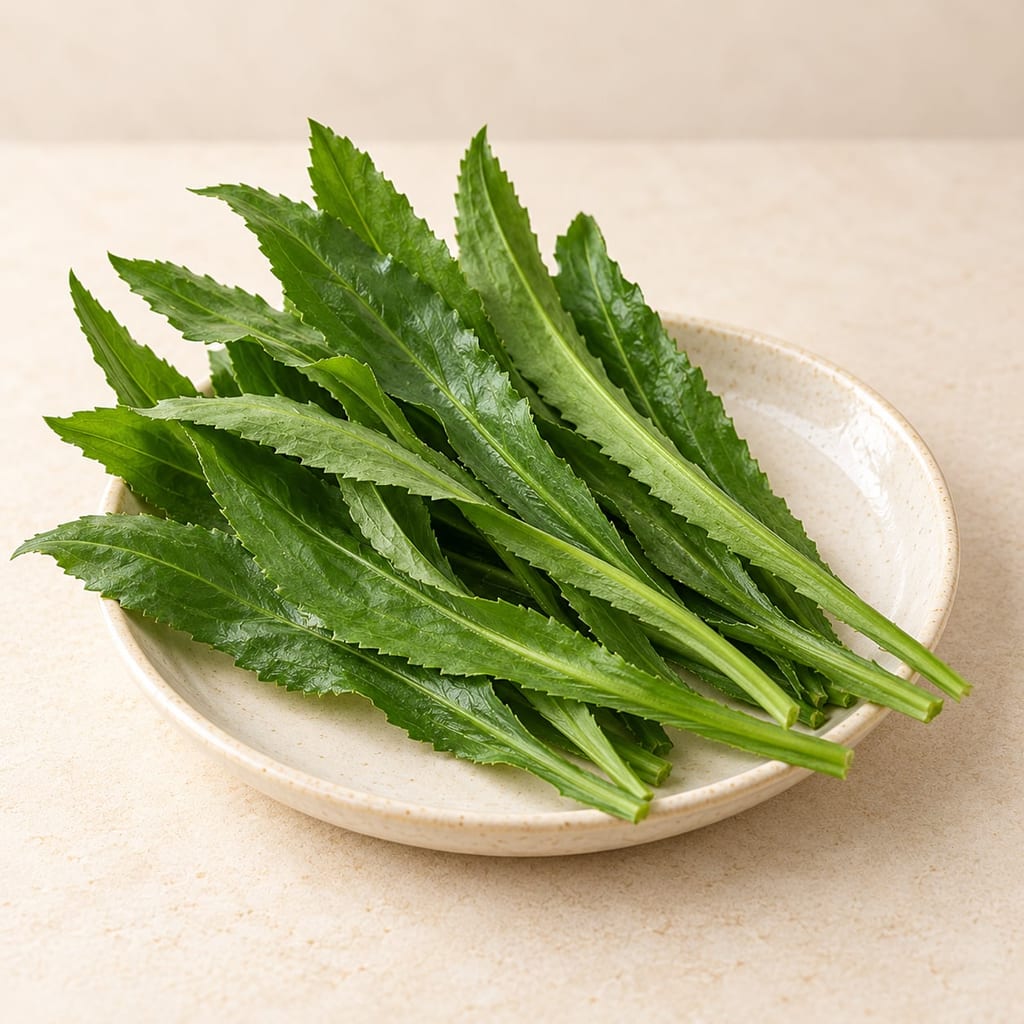
Species and common names
Kew accepts Eryngium foetidum L., an Apiaceae species native from Mexico through tropical America. Sources use names such as culantro, shado beni, bhandhanya, sacha culantro and chicória-do-Pará. Some accounts also use “cilantro” or “coriander,” but E. foetidum is not Coriandrum sativum. Common-name overlap cannot identify a market bundle or wild plant.
How it is used as food
The University of the West Indies identifies shado beni as a green seasoning herb in Trinidad and Tobago. Brazil’s MAPA manual describes chicória-do-Pará as a pungent condiment in cheiro-verde, especially with fish dishes, pato no tucupi and tacacá. The manual does not give a recipe or ingredient quantities, so these are food contexts rather than cooking instructions.
Peru and Brazil growing reports
Peru’s IIAP page describes warm, humid, high-rainfall conditions, cultivation throughout the year with preference for rainy periods, and soils ranging from clay to sandy clay with neutral to slightly acidic pH. Brazil’s 2010 MAPA manual describes Amazonian crop settings, sensitivity to acidic soils and better performance in light, fertile, moist, well-drained, organic-rich sandy soils. The descriptions are regional and differ in emphasis; neither sets a universal garden target.
Sources for this section
Propagation and harvest are source-specific
The Peru guide reports seed germination at about seven days or propagation from stem-base sections, and says harvest begins from older lower leaves about three months after sowing. Brazil’s manual describes transplanting from seedbeds and whole-plant harvest, including roots, around 60 days after transplant at tillering or the beginning of flowering. These refer to different regional systems and harvest units, and should not be collapsed into a single household schedule.
Sources for this section
Containers and drying
The Trinidad Ministry handbook recommends containers or troughs for culinary herbs generally and lists “Chadon Beni” with seed, young plants or plant base at 15 × 15 cm spacing. It does not identify the plant scientifically, so those dimensions cannot be assigned confidently to E. foetidum. The UWI abstract reports laboratory drying and quality changes but no household moisture endpoint, storage duration or safe drying procedure. Peru’s IIAP page mentions shade drying without specifying an endpoint or shelf life. Separately, NParks lists E. foetidum for herb gardens and container planting, with full sun or semi-shade, moderate water, and seed or division propagation. These are Singapore landscape-record fields; the page gives no container size or measured food-crop yield.
Limits of the available growing advice
The inspected sources do not specify frost tolerance, a hardiness rating, greenhouse conditions or a species-confirmed household container design. Peru describes wild plants in both open and shaded places and flood-prone settings, while Brazil advises moist but well-drained cultivated soil; natural flood tolerance is not a recommendation to keep pots waterlogged. The sources also do not provide a complete dish formula, validated storage limit or plant-identification method.
Research gaps
No full Trinidad or Pará source-batch recipe with quantities, ordered stages and yield was verified.
The Trinidad handbook and MAPA PDF could not be reopened for this source review; their specific claims are not newly verified here.
The Trinidad handbook’s chadon beni name is not botanically identified; its container and 15 × 15 cm spacing entry cannot be treated as species-specific evidence.
Peru and Brazil describe different soil, harvest and production contexts; household timing, regrowth and yields remain open.
No frost or hardiness rating, greenhouse protocol, mature container dimensions or local invasive/conservation assessment was established.
Research status
The underlying plant account received a partial source review. Its review scope is described in the original plant article.
Sources for this section
Places
Unknown
Relationship not established · Place not establishedThe available research does not establish a single origin for this ingredient.
Community
No community contributions have been published for this entry yet.
Share what you made
Sign in to contribute. Published comments and photos are free to read.
Sources
Royal Botanic Gardens, Kew, Plants of the World OnlineIngredient research
Eryngium foetidum L.Cited in: Species and common names; Limits of the available growing advice; Research gaps
National Parks Board, Singapore, Flora & Fauna WebIngredient research
Eryngium foetidum L.Cited in: Species and common names; Containers and drying; Limits of the available growing advice; Research gaps
West Indian Journal of Engineering, University of the West IndiesIngredient research
Quality Changes of the Green, Culinary Herb, Shado Beni (Eryngium foetidum L.) During DehydrationCited in: Species and common names; How it is used as food; Containers and drying; Research gaps
Extension, Training and Information Services Division, Ministry of Agriculture, Land and Marine Resources, Trinidad and TobagoIngredient research
How to Grow Seasoning HerbsCited in: Containers and drying; Research gaps
Instituto de Investigaciones de la Amazonía Peruana (IIAP)Ingredient research
Sacha culantroCited in: Species and common names; Peru and Brazil growing reports; Propagation and harvest are source-specific; Containers and drying; Limits of the available growing advice; Research gaps
Ministério da Agricultura, Pecuária e Abastecimento, BrasilIngredient research
Manual de Hortaliças Não-ConvencionaisCited in: Species and common names; How it is used as food; Peru and Brazil growing reports; Propagation and harvest are source-specific; Limits of the available growing advice; Research gaps
FermenteaResearch provenance
Culantro and shado beni (Eryngium foetidum): original plant researchCited in: Research status