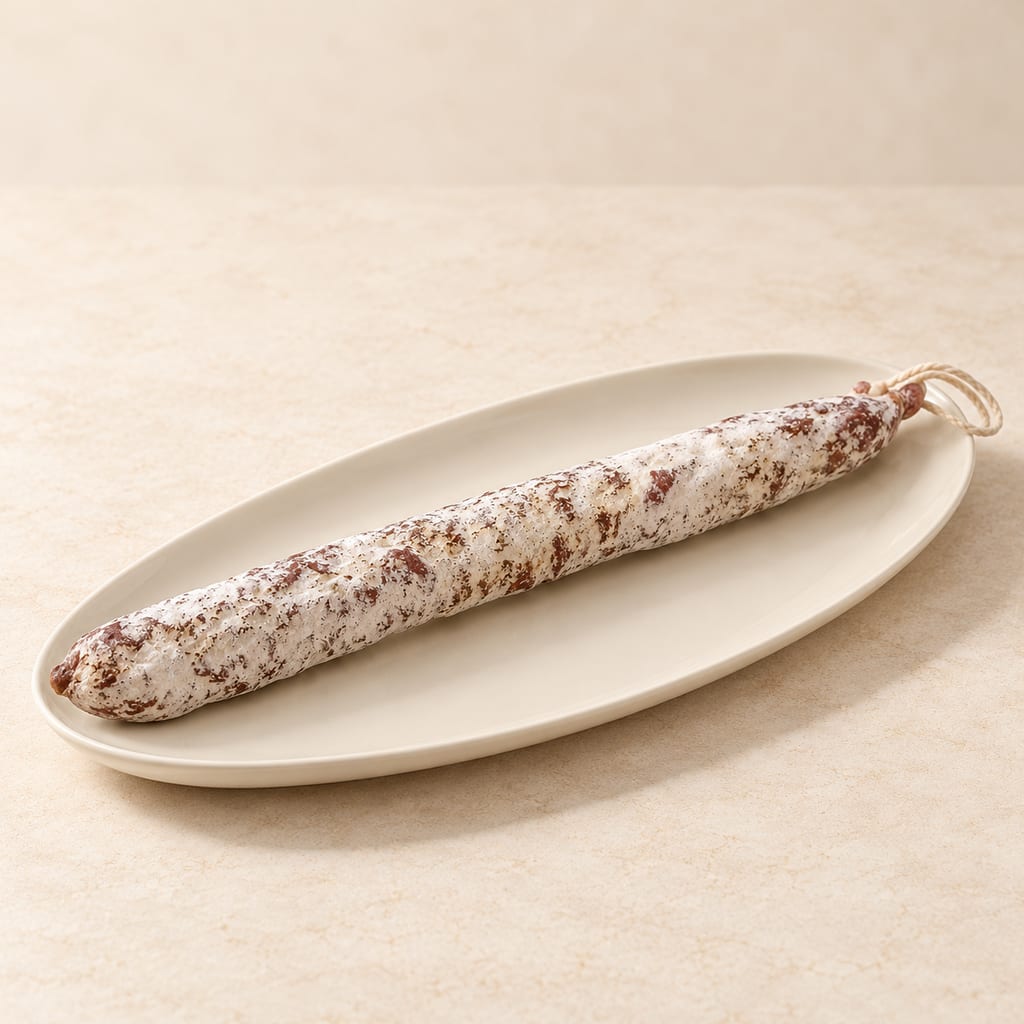
Fuet, starter-cultured
A documentary account of a modern starter-cultured Fuet formula and its place in Catalan sausage culture. The cited raw-pork process lacks matched safety validation, so this page does not present it as a household recipe.
 FermenteaWhere food goes to change
Salt
Insta Cure #1 is a measured salt and sodium nitrite blend used in specified meat-curing methods, including bacon and some sausages. It differs from nitrate-containing Cure #2 and must be matched to the recipe and product.
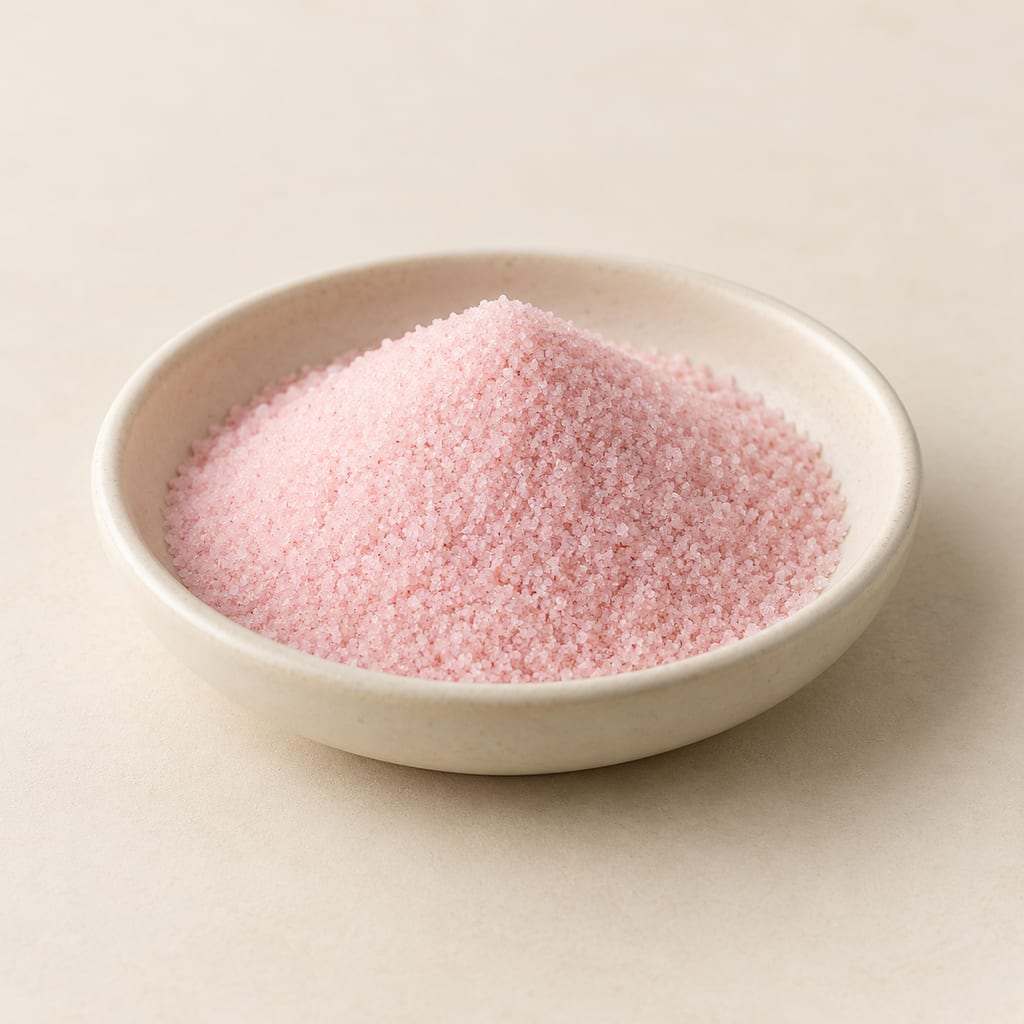
Insta Cure #1 is a curing-salt blend, not a salt to scatter over a finished meal. Its familiar form is a fine, lightly coloured dry mixture in which ordinary sodium chloride carries a much smaller proportion of sodium nitrite. The Sausage Maker's current product uses 6.25 per cent sodium nitrite and annatto colouring. The blend is made to be weighed into a meat formulation, where the nitrite can be distributed in a controlled amount. Its colour helps distinguish it from table salt, but colour alone cannot tell a cook which cure, concentration or manufacturer a packet contains.
The name travels through the curing trade under several labels: Insta Cure #1, Cure #1 and Prague Powder #1. Oregon State University Extension describes a common formulation of 6.25 per cent nitrite and 93.75 per cent sodium chloride, while warning that proprietary curing blends need their own instructions. A branded packet and a generic recipe term therefore have to be matched by their ingredient declaration and directions. The pinkness is not the active ingredient; some products use synthetic dye, while this maker's current listing uses annatto. Neither dye choice makes the blend a different fermentation starter.
It is easy to mistake this powder for Himalayan pink salt, which is coloured by mineral traces, or for plain sea, kosher or table salt. Those are not substitutes for a nitrite-bearing curing mix. Pure sodium nitrite is different again: this product is diluted in salt and is not measured as if it were pure nitrite. The difference matters in a bowl of ground pork because a very small change in the weighed blend changes the amount of active cure delivered. The exact package, not its shade or nickname, is the beginning of a defensible calculation.
One visible result of nitrite curing is the characteristic pink-red colour of many cured meats. The Sausage Maker explains the colour as a reaction involving meat myoglobin; nitrite-derived nitric oxide associates with that pigment. The product also contributes the familiar cured-meat flavour. These are chemical changes in the meat, distinct from the souring done by lactic acid bacteria in a fermented sausage. A cure packet contains no starter organisms and does not cause fermentation simply because it is stirred into mince.
Nitrite is also used because it can inhibit growth and toxin production of Clostridium botulinum in suitable curing conditions. Oregon State presents it as an important part of bacon curing, alongside salt and temperature control. FSIS's guidance for ready-to-eat fermented and dried meats treats nitrite or nitrate as one of several possible hurdles, with salt, acidification, drying and process controls doing different work. None of those statements means that a pink colour, a cured aroma or an added dose proves a raw sausage safe. A food can look conventionally cured without having met a validated process.
The salt carrier has its own contribution. Sodium chloride changes the water available to microorganisms and helps shape taste and texture, while nitrite is present at a much lower level for its curing functions. In a recipe that also lists kosher salt, the carrier in Cure #1 enters the mixture in addition to the separately measured culinary salt. Their roles overlap in the finished meat but their measurements should not be merged casually: changing the amount of one also changes the nitrite delivered. The product is therefore a formulated ingredient, not simply another seasoning.
The number is part of the product identity. The Sausage Maker's current Insta Cure #1 contains nitrite but no added nitrate. Its current #2 lists 6.25 per cent sodium nitrite and one per cent sodium nitrate, as well as salt and annatto. In a longer curing process, nitrate can serve as a reservoir that is converted to nitrite over time. FSIS discusses this use of nitrate in long-term processing, while Oregon State describes #2 as a product for meats cured without a later cooking step, such as salami or prosciutto. These are differences in formulation and intended time course, not a claim that #2 is merely a stronger version of #1.
The manufacturer describes #1 primarily for meat that will be cooked, smoked, brined or canned and eaten within weeks. Its same product page also supplies a direct-addition table for some smoked or dry-cured sausages described as two- to four-week recipes. That range of uses is narrower and more conditional than the slogan 'one cure for all sausage.' A recipe maker must fit a product to the actual process; switching to #2 simply because a casing is wider is not a general rule established by these product descriptions.
Other curing mixes add sugar, spices or different curing agents. Oregon State explicitly cautions that proprietary mixtures may not suit recipes written for Prague Powder #1. The same goes for substituting a packet called 'pink cure' without reading its declared strength. Even among #2 products, nitrate concentrations vary by manufacturer. Preserving the number and full product name in an ingredient line makes it possible to see what the original maker intended, but it does not verify that a purchased packet matches the formulation used to write the recipe.
Salting meat is much older than the small coloured curing sachet. Salt draws water from meat and lowers the water available to many microbes, a preservation approach that can be combined with drying, cooking or smoking. Modern curing salts add a separately controlled nitrite source to that older toolkit. Oregon State's account places plain salt and nitrite side by side because the ingredients have related but different functions; one cannot be treated as an all-purpose replacement for the other.
The standardized #1 blend belongs to an era of measured meat processing, where a known concentration of nitrite can be added to a known weight of meat and checked against process and regulatory requirements. The word 'Prague' in a product name is not evidence that the current branded mixture was invented in that city, and the linked Catalan fuet recipe does not date the brand's origin. We have a modern commercial product and a modern maker's formula. The long history of salting or the regional history of fuet cannot be transferred to the coloured packet itself.
Today the blend is defined by measured composition and a manufacturer’s use directions. Those details are more informative than a romantic origin story for the word 'Prague' or a claim that a modern packet is itself a traditional Catalan ingredient. A recipe can inherit an older cured-meat style while using a newly specified culture and cure. That is how the linked fuet should be understood: it is a contemporary formulation for a named sausage, not evidence that this exact commercial powder belongs to an ancient regional practice.
The linked Fuet Salami formula at 2 Guys & A Cooler uses 800 grams of lean pork and 200 grams of pork backfat. It adds 25 grams of kosher salt and 2.5 grams of Insta Cure #1, with dextrose, garlic, white pepper, white wine and a separate Flavor of Italy starter culture. The meat and fat are ground cold, the cure is mixed through the mince, and the mixture is stuffed into hog casings described as 32–34 millimetres wide. The page says to use Cure #2 instead when the casing diameter is greater than 34 millimetres. That is the recipe author's instruction, not a universal identity rule for these two cures.
The process then gives an 18–24-hour fermentation and drying toward 30–40 per cent weight loss, with an estimated drying period of 30 days. These numbers describe one published method, not proof of its lethality or shelf stability. The manufacturer distinguishes #1 and #2 partly by cure duration and whether the product is cooked. That makes the fuet's uncooked, dried use of #1 a question for process-specific validation, especially because the source's casing-diameter switch is not justified by a safety study in the inspected material. The ingredient page can retain exactly what the recipe says without turning that method into a general recommendation.
If the 2.5-gram addition were a 6.25-per-cent nitrite blend and the meat-and-fat block were exactly one kilogram, the arithmetic yields 156.25 milligrams nitrite per kilogram, or 156.25 parts per million ingoing. The maker's table states a 156 ppm maximum for direct addition to ground meat; FSIS's training table also lists 156 ppm for comminuted products in its regulatory context. The computed value is numerically above that figure, however slightly. The source does not specify the actual packet assay or demonstrate a matching validated process, so this comparison is a flagged formulation question, not a legal-compliance conclusion or a revised dose.
In meat preservation, the ingredients and stages work together. Salt changes water availability, bacterial cultures may make acid during fermentation, a controlled environment governs that fermentation, and drying reduces available moisture over time. Nitrite or nitrate can add a chemical hurdle and help develop cured colour and flavour. FSIS's ready-to-eat fermented-meat guidance examines these as a combined process because a single measured ingredient cannot stand in for every other condition. The physical work of grinding, mixing and stuffing determines how evenly ingredients are distributed; the biological work of a starter culture is a separate event.
That guidance addresses inspected processors and asks for scientific support whose critical parameters match the actual product and for evidence that the establishment runs the process as designed. Salt percentage, sugar type, nitrite level, fat, temperature, pH and drying conditions can each change the result. An attractive sliced link, a target weight loss or a sour smell is not itself such support. The fuet page gives several process targets, but the primary documents inspected here do not test its exact combination of meat, cure product, culture, casing, fermentation and drying against the relevant hazards.
A packet should be identifiable by its full name, manufacturer, ingredient statement and declared strength. The current Sausage Maker #1 listing says sodium nitrite at 6.25 per cent and annatto for colour; a differently named or older packet may use another colourant or a different formulation. Oregon State warns that several brands sell curing salts and that some proprietary blends are not suited to recipes written for Prague Powder #1. A pink colour does not replace that label check. Neither a teaspoon borrowed from another product nor a casual gram-for-gram swap is a reliable conversion across formulations.
Store the ingredient in its original, clearly marked container according to the maker's directions and keep it separate from ordinary finishing salts. The reason is straightforward: the same handful of pale or pink crystals can represent very different chemistry. Confusing a nitrite mix with table salt changes both the amount of active curing agent and the intended use. The food-book story ends at the packet label because this ingredient is meant to be measured as part of a formulated process, not tasted from the pot or sprinkled onto a plate.
In cooking, the finished foods associated with nitrite curing range from bacon and ham to various sausages and corned beef, but their methods differ: some are cooked before eating, while others rely on controlled fermentation and drying. The linked fuet is one modern application.
The linked Catalan-style recipe documents a modern use of a commercial cure; it does not establish a manufacturing origin or traditional local use for this packet.
A documentary account of a modern starter-cultured Fuet formula and its place in Catalan sausage culture. The cited raw-pork process lacks matched safety validation, so this page does not present it as a household recipe.
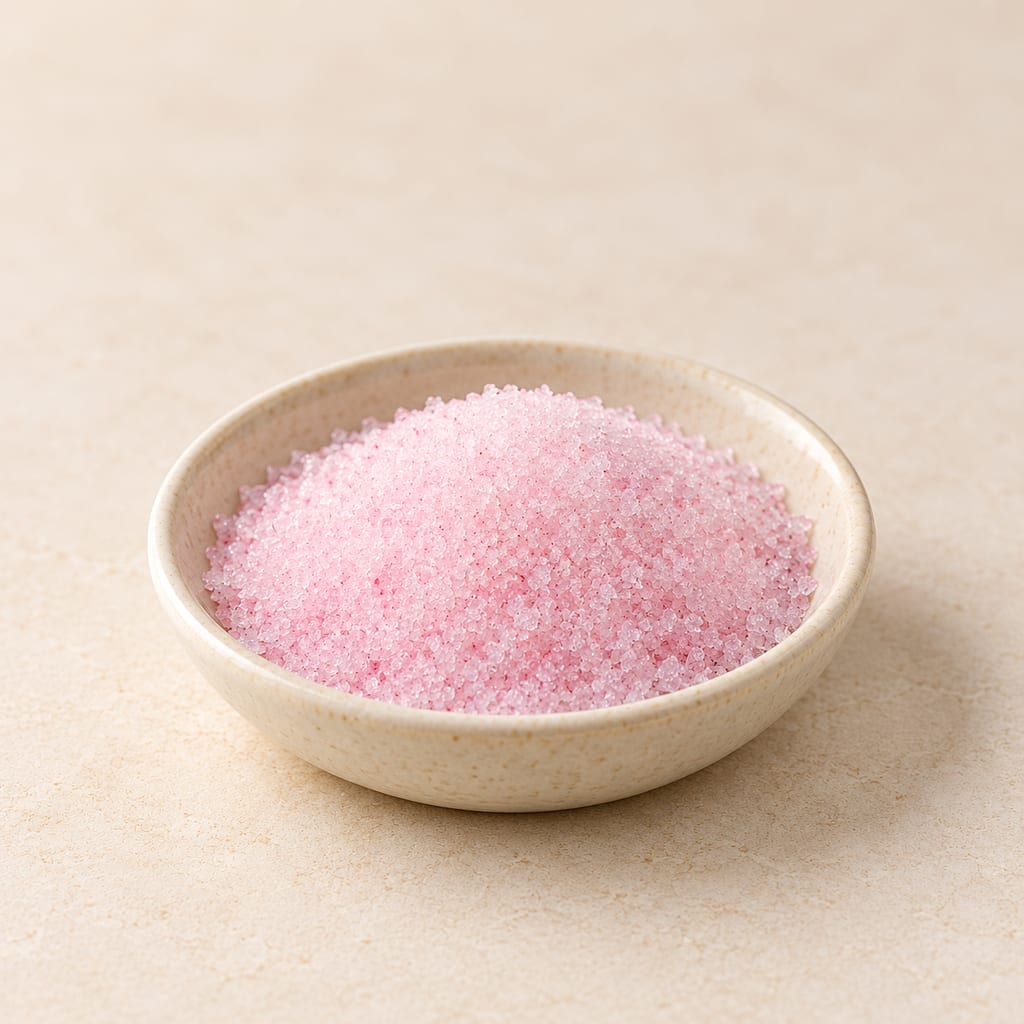
Curing salts are measured blends of sodium chloride with sodium nitrite, or nitrite and nitrate, used to cure meat. Cure #1, Cure #2 and proprietary mixes differ in composition and in the processes they suit.
No community contributions have been published for this entry yet.
Sign in to contribute. Published comments and photos are free to read.
The Sausage MakerIngredient
Insta Cure #1 Pink Curing Salt — Prague Powder #1, No Red DyeThe current product contains 6.25% sodium nitrite and annatto, explains cured colour/flavour, and distinguishes its use from Cure #2; its direct-addition table gives 156 ppm as a maximum.
Cited in: A small pink measure with a specific job; Why cured meat changes colour and flavour; The distinction between Cure #1 and Cure #2; An old preservation aim and a modern measured blend; The exact fuet formula, and the question it raises; A cure is one part of a meat process; Choosing and keeping a packet identifiable
The Sausage MakerIngredient
Insta Cure #2, Naturally Colored (No Red Dye)The current #2 product declares 6.25% sodium nitrite and 1% sodium nitrate with salt and annatto; the maker distinguishes longer uncooked dry cures.
Cited in: The distinction between Cure #1 and Cure #2
Oregon State University ExtensionIngredient
Making cured bacon at home (PNW 784)The August 2025 guide describes common Prague Powder #1 as 6.25% nitrite and 93.75% salt, distinguishes #2 and proprietary blends, and explains salt/nitrite roles in its bacon-specific context.
Cited in: A small pink measure with a specific job; Why cured meat changes colour and flavour; The distinction between Cure #1 and Cure #2; An old preservation aim and a modern measured blend; A cure is one part of a meat process; Choosing and keeping a packet identifiable
2 Guys & A CoolerRecipe
Fuet SalamiThe 17 October 2021 formula lists 800 g pork, 200 g backfat, 2.5 g Insta Cure #1, a 32–34 mm casing, a diameter-based #2 note, fermentation and drying; it does not supply safety validation.
Cited in: The exact fuet formula, and the question it raises; A cure is one part of a meat process; Choosing and keeping a packet identifiable
U.S. Food Safety and Inspection ServiceSafety
FSIS Ready-to-Eat Fermented, Salt-Cured, and Dried Products Guideline (FSIS-GD-2023-0002)The 5 May 2023 processor guideline treats cure, salt, fermentation and drying as combined hurdles and requires scientific support matched to the actual process.
Cited in: Why cured meat changes colour and flavour; The distinction between Cure #1 and Cure #2; An old preservation aim and a modern measured blend; The exact fuet formula, and the question it raises; A cure is one part of a meat process; Choosing and keeping a packet identifiable
U.S. Food Safety and Inspection ServiceSafety
Further Processing and Labeling Inspection Course, April 2023: curing-agent tableThe official training table lists 156 ppm maximum ingoing sodium nitrite for comminuted meat products in its regulatory context; not a validation of the linked fuet.
Cited in: The exact fuet formula, and the question it raises