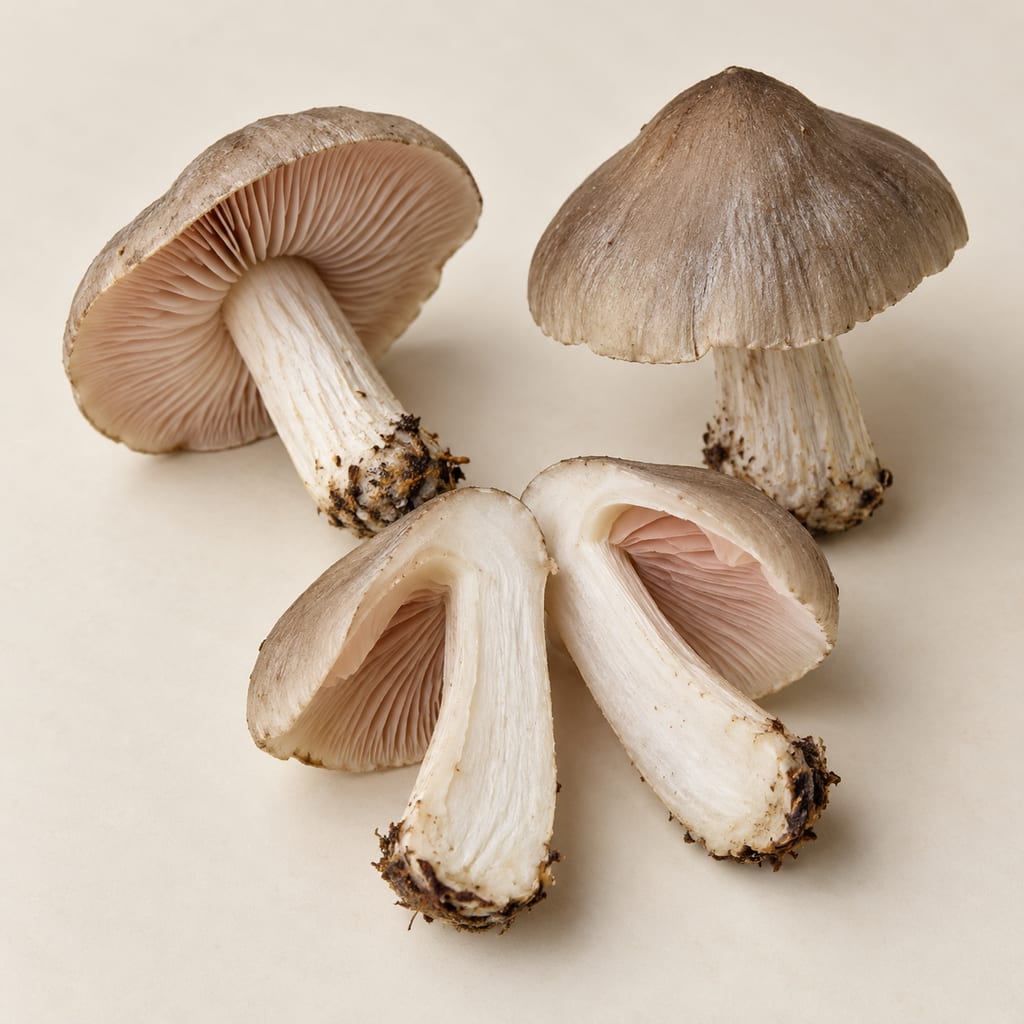
Entoloma lividoalbum
A woodland pinkgill reported as local food in Sikkim and parts of Italy, but difficult to identify and subject to strong regional warnings about confusion with toxic Entoloma species.
 FermenteaWhere food goes to change
Mushrooms
Tuber magnatum is a subterranean, tree-associated European truffle prized for its aroma. It is often shaved raw over warm, simply prepared foods during local autumn and winter seasons.
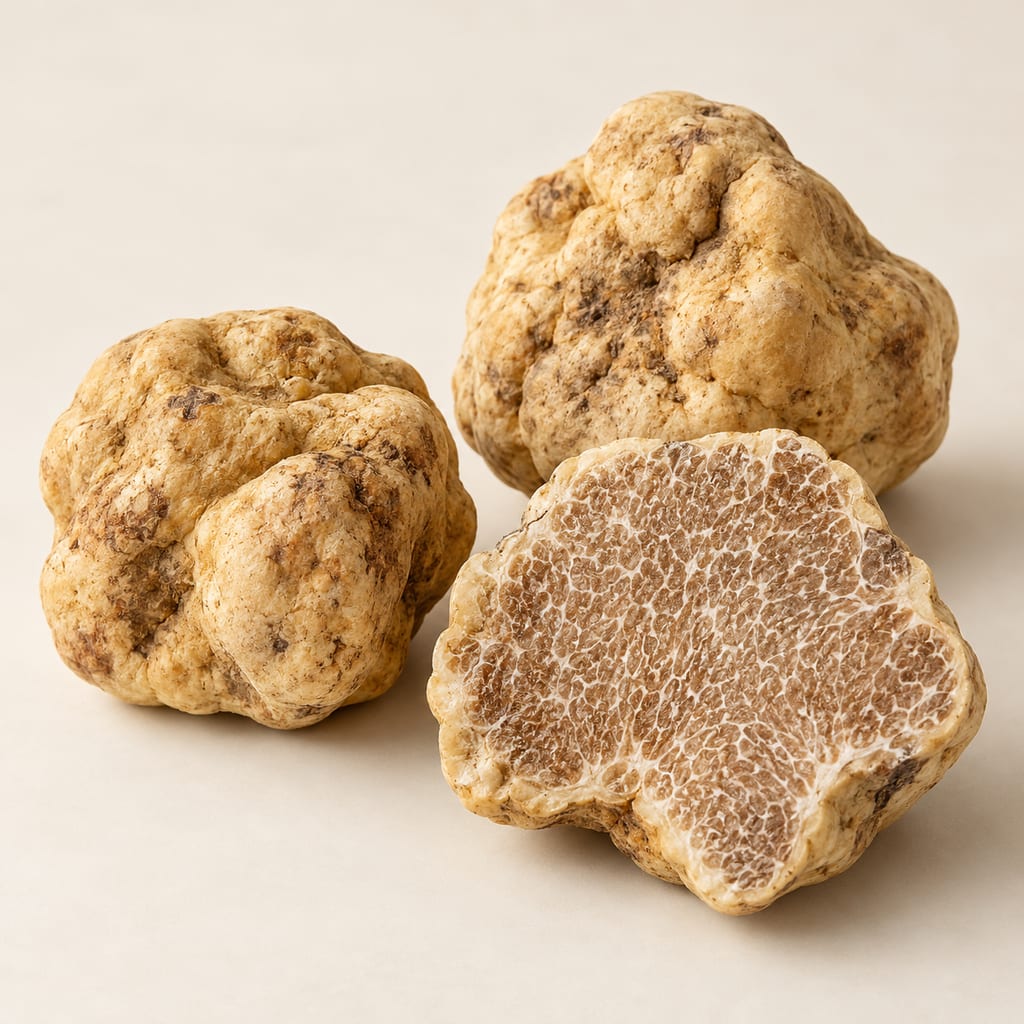
The white truffle sold as Tuber magnatum is the underground fruiting body of an ascomycete fungus. It is not a plant tuber. Its mycelium lives in soil and forms an ectomycorrhizal association with the fine roots of trees: the plant supplies carbon compounds, while the fungus helps the roots access water and mineral nutrients. The visible truffle develops below the surface, where soil, roots and seasonal conditions shape its irregular form.
A mature fruit body is commonly pale cream to ochre on the outside, sometimes with pinkish tones, and has a pale interior crossed by branching veins. Shape and colour vary. Neither is sufficient to identify the species. The aroma is intense and often described as sulfurous, garlic-like, earthy or musky. Chemical studies identify bis(methylthio)methane among its major odorants, but a mixture of volatile compounds and the specimen's maturity and handling influence the smell. Aroma is a culinary characteristic, not a safety test.
“White truffle” is a market name rather than a complete botanical identification. Other pale underground fungi, including Tuber borchii, are also called white truffles in some contexts. This page concerns T. magnatum only; it is not a field key. A photograph, colour, strong smell or informal market description cannot establish species identity.
The scientific name prevents a market adjective from doing the work of taxonomy. “White” describes a commercial and culinary category, while Tuber magnatum identifies a particular species. Regional names such as tartufo bianco d'Alba can communicate a place and tradition, but the place-name does not prove that a particular specimen was harvested in Alba. A seller's traceable origin statement is separate evidence from the species name.
The truffle's value is closely connected to this combination of hidden growth, a short seasonal supply and intense aroma. Its form is also variable: soil, stones and root structure can make fruit bodies rounded, lobed or irregular. Those differences influence appearance but do not provide a dependable species test. For this reason, a consumer description can explain its character and use while leaving identification to traceable trade and appropriate expertise.
Tuber magnatum depends on living host trees. Reported associations include oaks, poplars, willows, hornbeams and other broadleaf trees. A 2023 ecological review of reported sites found oaks frequently represented and poplars and willows prominent in some records outside Italy. The authors also identify gaps in published distribution and host observations. It would be misleading to name a single tree as the species' universal host.
The ecological partnership explains why truffle production differs from growing a free-living mushroom on prepared substrate. Orchards require compatible inoculated trees, appropriate soil and climate, and careful management. Establishing a host tree does not guarantee a fruiting body; successful inoculation and harvest remain difficult. Experimental orchard production should not be confused with a dependable commercial supply.
INRAE and its nursery partner reported a controlled orchard result in Nouvelle-Aquitaine: three truffles harvested in 2019 and four in 2020 from a four-year-old orchard, outside the species' recognized natural range. This shows that controlled production is possible under a specific research and cultivation program. It does not establish routine yields or a general production method.
A mycorrhizal relationship is a partnership rather than a simple host-and-parasite story. The fungal network extends through soil around the roots and participates in nutrient exchange with the tree. The truffle fruit body is only one visible outcome of a much larger underground organism. Finding a truffle at a tree does not by itself prove that the tree is its exclusive host, and a reported host in one region should not be turned into a universal orchard prescription.
Orchard management is a long-term proposition. A grower must establish suitable host trees and the intended fungal association, then wait for the underground system to develop under local conditions. The research result from France is notable precisely because dependable production has been difficult. It should be described as an experimental success with reported yields in a particular orchard, not as proof that any inoculated tree will bear truffles or that this fungus is now routinely farmed.
Italy is the best-known source, and the Alba name anchors the ingredient in Piedmont's Langhe, Roero and Monferrato hills. Other Italian truffle grounds contribute to the country's supply. Ecological reviews also report natural sites in parts of southeastern and southern Europe, including the Balkans, as well as Switzerland and southeastern France. The map is patchy: a documented occurrence does not mean every intervening area supports the fungus or shares Alba's harvest scale and food traditions.
Nouvelle-Aquitaine in France belongs in a different geographic category: the reported orchard harvest was experimental controlled production outside the recognized natural range. The distinction between a natural site and a planted orchard matters when describing origin. “French-grown” is not interchangeable with “wild from the natural range,” and orchard production should not be generalized from a small number of reported fruit bodies.
Alba's reputation reflects a particular regional relationship among truffle grounds, hunters, markets, cooking and the annual fair. A local historical account cites 1741 as an attestation of the truffle's economic importance and 1929 as the beginning of the fair. These are useful dates for regional history, not claims that the town invented truffle use.
Natural range records are patchy. A review that maps reported sites brings together observations made at different times and with different levels of detail; it is not a census of every suitable forest. Regional absence from a published map can reflect incomplete searching as well as true absence.
The biological fruiting period is described broadly from late summer into early winter, with many mature harvests in autumn and winter. Weather and locality alter what is available in a given year. Legal collection calendars are a separate matter: they determine when and how people may collect in a jurisdiction, not the exact biological moment at which every truffle matures.
For example, the Centro Nazionale Studi Tartufo calendar gives 1 October through 31 January for Tuber magnatum in its Italian calendar, while the Emilia-Romagna regional calendar for 2026–2030 gives 1 October through 20 January. These dates differ because rules are regional. They should not be presented as a single European season or as a current permission for a reader in another place. Anyone gathering must check the current rules and permits issued by the relevant local authority.
The distinction between harvest season and market season matters too. Collection dates may be established to protect local populations or coordinate regulated harvest, while mature truffles depend on weather and site conditions. A calendar can establish the dates when collection is legally permitted in a named jurisdiction, but it cannot guarantee fruiting on a particular day. Truffle availability in a restaurant or market may also reflect storage and trade, so serving date alone does not establish harvest date.
In Piedmont, a trifolau searches with a trained dog that locates the hidden truffle by scent. Local descriptions mention a small hoe used to lift a specimen carefully. The practice depends on knowledge of the ground, the season and local collection rights. Rules on permits, tools, protected sites and open dates vary. This account describes a regional food practice, not an instruction to forage or disturb a site.
Most supply is associated with natural truffle grounds, while orchard production remains experimental and limited in the evidence cited here. Fresh truffles pass through hunters and traders to markets, restaurants and seasonal fairs. Prices can be high and vary with weather, quantity, size and quality. Auction records and headline lots are exceptional events, not ordinary retail prices. A high price is no proof of species, freshness or origin.
Because the fruit body develops underground, skilled harvesters use trained dogs and local knowledge rather than searching for a visible crop. Any excavation affects soil and can disturb fine roots. The local account's description of careful lifting is a cultural and historical detail; it is not a substitute for permits, current rules or habitat protections. A reader interested in the tradition can learn about it without treating an editorial description as permission to collect.
In Piedmont, Tuber magnatum is often shaved raw in thin slices over warm, simply prepared food just before serving. Named local pairings include tajarin, egg-rich pasta often finished with butter, along with risotto, fonduta, eggs and raw beef preparations. The warm food releases the truffle's volatile aroma into the air while the truffle itself is not simmered for a long time.
A restrained base lets the truffle remain distinct. The regional examples use mild, rich foods rather than a strongly spiced sauce, a pattern that suits an ingredient valued for its aroma. This is a useful culinary observation, not a mandatory or uniquely authentic recipe. White-truffle shavings are commonly a finishing ingredient; prolonged high heat can alter delicate volatile aromas.
Keep a fresh truffle cool and follow the seller's handling advice. Brush or wipe it shortly before use rather than soaking it. Freshness, maturity, harvest condition and storage all affect keeping quality, so this page does not assign a universal shelf life. Discard food that shows clear spoilage; smell alone cannot verify safety or species.
The thin slice is also a way of portioning a scarce ingredient: it spreads a small amount over a dish while allowing the fragrance to reach the diner. Warmth helps volatile aroma compounds become noticeable, while the simple base avoids masking them. These culinary observations describe why regional cooks often finish a dish at the table. They do not establish a required serving quantity, a preservation method or a safe storage duration; those depend on the actual product and supplier guidance.
The aroma can be fleeting after a truffle is cut, which helps explain the practice of shaving it immediately before eating. A warm plate can carry the scent without requiring the truffle to be cooked into the dish. This service style also means that truffle is often purchased for a particular meal rather than stored as a pantry staple. Exact quantities and value depend on the specimen and the cook; the sources do not support a fixed serving measure.
Buy from a reputable supplier who can state the scientific name and origin, and retain the product label or invoice. The words “white truffle” can describe more than one species in commerce, while a truffle-flavored product may use added aroma rather than Tuber magnatum. Read the ingredient statement and do not infer species or provenance from a product's name, price or fragrance.
Established regional food use of Tuber magnatum does not make a wild fungus that has not been identified by a qualified source safe to eat. Do not identify a truffle from a single photograph or use smell, colour or cooking as a safety test. The harvest calendar and collection permissions change by jurisdiction; follow current local rules and avoid collecting in closed or protected areas.
Species and provenance are separate questions. A correct species name does not prove where a specimen was collected, and a celebrated origin name does not prove that the specimen is Tuber magnatum. For fresh whole truffles, a retailer should be able to explain both the identification and the supply chain. For prepared products, the ingredient list can show whether the fungus itself is present or whether the product instead uses a truffle aroma. Such distinctions help readers understand what they are buying without relying on price or sensory impressions as proof.
The supplier's information is especially useful for a product this seasonal. Ask whether the product is fresh or preserved, which species is present, and what origin is documented. If the truffle has been processed into oil, butter or another prepared food, the product name alone may not show how much actual fungus it contains. Ingredient declarations and seller traceability are more useful than a generic “white truffle” claim. This page does not substitute for food-label requirements or professional advice.
Alba-region source documents local culinary traditions and market history; this is not a claim that all Italian white truffles come from Alba.
The regional authority documents a legal collection season; dates do not establish a universal biological season.
Ecological review maps reported natural occurrence sites here; exact country and local culinary use are not assigned by this row.
INRAE reports controlled orchard production outside the recognized natural range; this is not evidence of routine commercial supply.
A woodland pinkgill reported as local food in Sikkim and parts of Italy, but difficult to identify and subject to strong regional warnings about confusion with toxic Entoloma species.
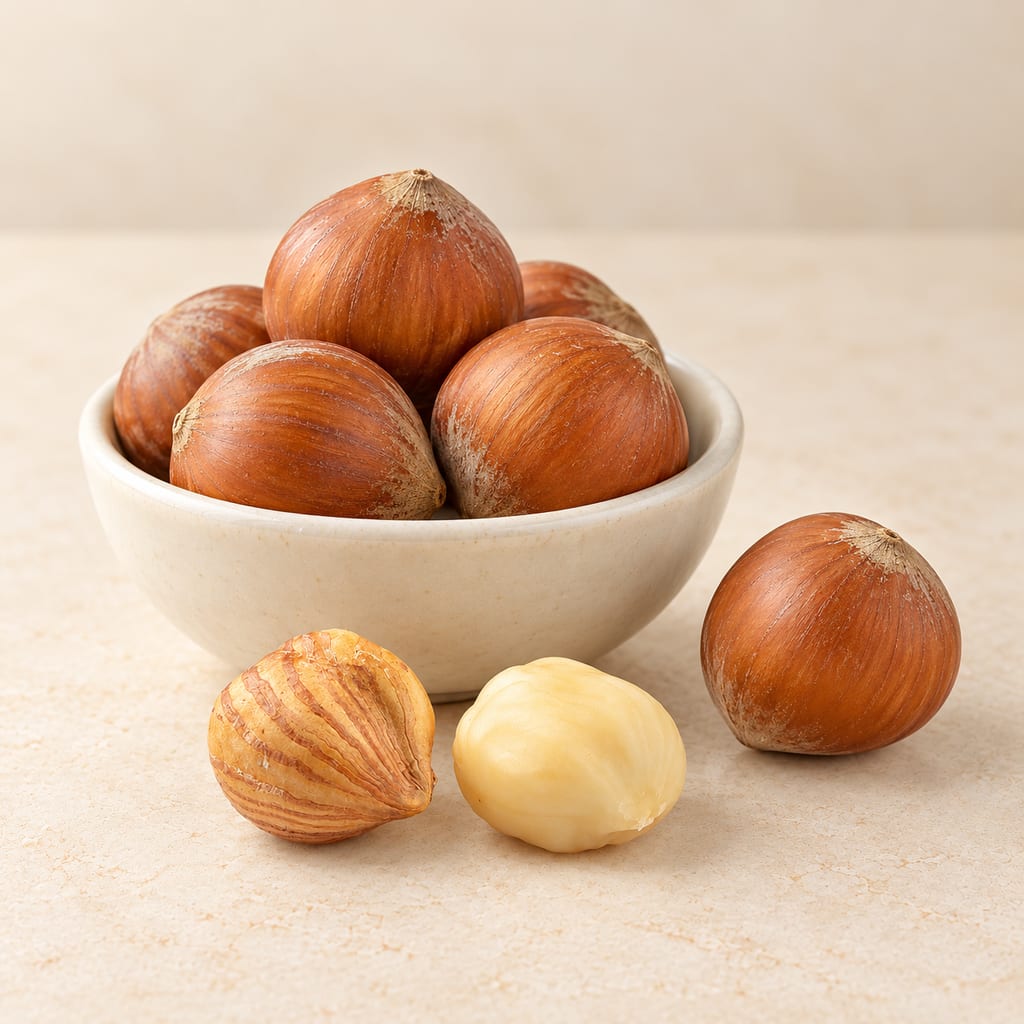
Hazelnuts from Corylus avellana, the common hazel, eaten raw, roasted or ground, with the Piedmont protected product and the limits of regional growing and storage advice.
No community contributions have been published for this entry yet.
Sign in to contribute. Published comments and photos are free to read.
Mycorrhiza / Springer NatureIngredient context · Geography
Sustainable cultivation of the white truffle (Tuber magnatum) requires ecological understandingReviews reported southern and southeastern European sites and host associations, including oaks, poplars and willows; warns that published distribution and host observations are incomplete.
Describes the species as ectomycorrhizal and discusses ecological limits and the difficulty of reliable cultivation.
Reports a fruiting season extending from late summer through early winter, with substantial local variation.
Cited in: An underground fungus with a distinctive aroma; A tree partner, not a compost crop; A patchy European range; Autumn and winter, under local rules; From truffle ground to market
INRAEIngredient context · Geography
Controlled production of white truffles Made in France: a global firstDescribes controlled mycorrhization and experimental orchard production in Nouvelle-Aquitaine, outside the species' recognized natural range.
Reports three truffles harvested in 2019 and four in 2020 from a four-year-old orchard; this demonstrates possibility, not routine or scalable supply.
Cited in: A tree partner, not a compost crop; A patchy European range
Emilia-Romagna RegionSeason · Geography
Regional truffle collection calendars, 2026–2030The regional calendar gives a legal collection period for Tuber magnatum from 1 October through 20 January in Emilia-Romagna; this is a jurisdiction-specific rule, not a Europe-wide biological season.
Cited in: Autumn and winter, under local rules
Order of Knights of the Truffle and Wines of AlbaIngredient context · History · Culinary use · Geography
The Alba White TruffleDescribes the Alba region's truffle habitat and local culinary customs, including raw shaving over tajarin, risotto, fonduta, eggs and raw beef.
Cites 1741 as an attestation of the truffle's local economic importance and 1929 as the founding of Alba's fair; these dates are regional attestations, not the origin of truffle use.
Cited in: A patchy European range; From truffle ground to market; A fresh finishing ingredient; Buying and identity matter
Centro Nazionale Studi TartufoSeason
Harvest calendarLists an Italian regional collection calendar for Tuber magnatum, 1 October through 31 January; calendar dates are legal and local, not universal fruiting dates.
Cited in: Autumn and winter, under local rules
Nordic Council of MinistersIngredient context
Nordic Food Composition / supplied white-truffle referenceRetained as a supplied catalogue reference for food identity and culinary context; no specific biological or geographic claim above relies on it.
Species Fungorum PartnershipTaxonomy
Species FungorumTaxonomic reference for the scientific name Tuber magnatum; nomenclatural sources do not establish food safety or provenance.
Cited in: An underground fungus with a distinctive aroma; Buying and identity matter
Encyclopedia / MDPIIngredient context
The Mysteries of the White Truffle: Its Biology, Ecology and CultivationSecondary synthesis on body form, aroma chemistry, ecology and cultivation; specific claims are framed cautiously and subordinate to the 2023 review and INRAE account.
Cited in: An underground fungus with a distinctive aroma