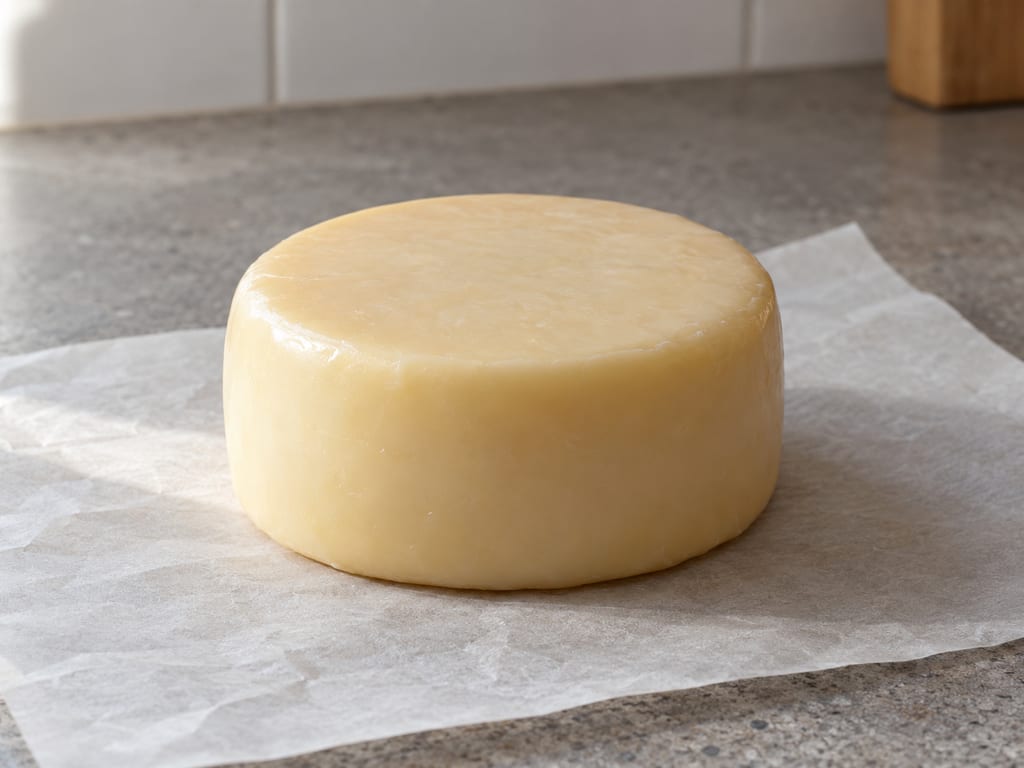
Semi-soft cheese
A mild whole-milk cheese set with starter and rennet, drained in a mould, dry-salted and ripened. This small-batch method appeared in Canadian home-dairy guidance.
 FermenteaWhere food goes to change
Processing aids
Paraffin wax is a solid mixture of hydrocarbons that cheesemakers melt and dip cheese in to slow moisture loss and keep surface mould off. Modern cheese waxes are usually blends.
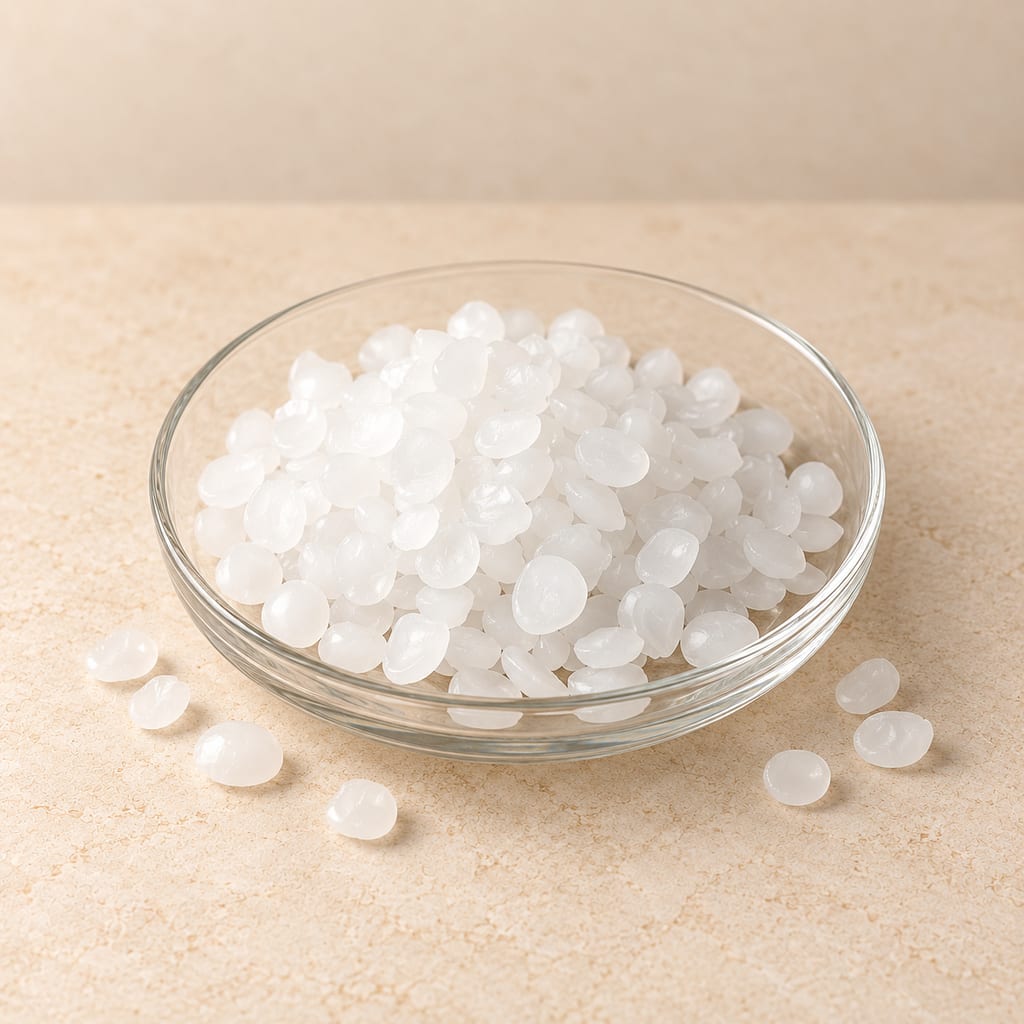
Dip a young cheese in molten wax and it comes out with a smooth, sealed shell. That shell is the job paraffin does in cheesemaking. Cheese is waxed to make a barrier against mould, to slow the rate at which it loses moisture, and to make it more attractive and easier to handle. The American Cheese Society's guide for cheesemakers says paraffin was the original coating for young cheese, and it adds that paraffin lets carbon dioxide through, which matters for a cheese that keeps ripening under its coat.
Paraffin does not flavour the cheese and does not take part in making it. A 1978 Agriculture Canada booklet on home-made dairy products, reprinted in 1981, shows where it comes in. A cheddar-type cheese and a semi-soft cheese are each pressed, dried at the surface and then coated in paraffin, as the last step after the cheese is made. The wax connects with drying and surface mould, not with starting a fermentation. The booklet, by J. A. Elliott and D. B. Emmons, names the material only as paraffin, without a grade, a producer, a quantity or a dipping temperature. The eater cuts the wax away and discards it, and wax is not the same thing as a natural rind. The same style of cheese can carry either: a Gouda-style cheese may be sold young or old, with a natural or a waxed rind, and the coating is a decision made about the cheese, not part of its identity.
Paraffin wax is a mixture, not a single molecule. It is made of long hydrocarbon chains, molecules built only from carbon and hydrogen, in which straight-chain paraffins predominate. The result is a colourless to cream, odourless, crystalline solid that is insoluble in water and melts at 50 to 57 degrees C, with a closed-cup flash point of 199 degrees C. Most of it is recovered from petroleum, though the same family of waxes can also be made from carbon monoxide and hydrogen by the Fischer-Tropsch process.
Wax for cheese is seldom plain paraffin. A patent for cheese coatings describes the composition of traditional cheese waxes as 50 to 70 percent crystalline paraffins, which solidify at 55 to 60 degrees C, blended with 30 to 50 percent microcrystalline waxes, which solidify at 65 to 75 degrees C, and sometimes up to 10 percent polymers. Microcrystalline wax is a different refined petroleum material, a mixture of saturated hydrocarbons in which branched chains predominate, and that structure makes it tougher and more flexible than paraffin. A coating sold as cheese wax is therefore a formulation, and the name of one ingredient does not describe it.
Paraffin was a nineteenth-century discovery. In 1830 the chemist Karl Reichenbach investigated a solid substance obtained from wood tar, and in the same year Laurent obtained paraffin by distilling bituminous schist. Reichenbach gave it a name that still describes it: from the Latin parum, too little, and affinis, affinity, because the substance was so chemically inert. Others found it in coal tar in 1835, and in 1850 James Young took out a British patent for obtaining paraffin oil, and paraffin, from bituminous coal by slow distillation. It was recovered from Scottish and other shales, coal, wood tar, a Saxon lignite, natural petroleum and the mineral ozokerite.
By the twentieth century the main source was crude petroleum. When oil is refined, it is divided into fractions, and wax is removed from the lubricating-oil fractions that contain it, then finished into commercial paraffin. A pale, translucent, waxy solid, odourless and tasteless, produced in volume as a by-product of an oil industry, was a convenient raw material for every trade that needed something water-resistant, from candles to the coatings on food.
Cheese needs protecting while it ripens. A hard cheese loses water to the air of a curing room, its surface can crack, and cracks and damp let moulds and cheese mites in. Cheesemakers have several answers. A natural rind is allowed to form, and some cheeses are wrapped in leaves of grape, fig, maple or walnut. Bandaging, used mostly for Cheddar, covers the whole wheel in muslin smeared with lard or bacon fat. It gives a drier, flakier body and a more robust flavour, because the moulds and mites that grow on the outside feed on the bandage fat instead of the cheese, and it needs regular brushing once mould begins to grow on the cloth after about a month.
A wax coat is a different choice. It seals the surface to keep mould out and moisture in, and it makes the wheel easier to handle, which suits a cheese that is meant to ripen without tending.
Cheesemakers adopted paraffin for the purpose, and the American Cheese Society's guide records that it was the original wax coating for young cheese. Sound paraffin coats keep cheese mites out, though cracks and nicks give them an opening, a point cheesemakers have had to learn from experience. By the late twentieth century home-dairy instruction in Canada taught cheddar-type and semi-soft cheeses to be dipped in paraffin, and in the United States the Code of Federal Regulations permits petroleum wax meeting its specifications on cheese as a protective coating under good manufacturing practice. No source read here dates the first waxed cheese or names who first tried it.
A professional waxer dips the cheese twice. The first dip is at 225 to 240 degrees F (107 to 116 degrees C), hot enough to flash off surface moisture and destroy surface moulds and bacteria. Further coats go on at 160 to 180 degrees F (71 to 82 degrees C). The patent literature gives traditional application temperatures of 95 to 115 degrees C, and about 70 degrees C for the peelable waxes. All of these are well above paraffin's melting point of 50 to 57 degrees C and below its flash point of 199 degrees C.
The coat is a physical barrier whose quality depends on its continuity. Hydrocarbon wax adheres poorly to a fatty surface, and fat can migrate from a rich cheese to the surface and lift the wax away. The coat is prone to cracking on sharp edges, and a soft cheese that deforms can crack it. In a study of Poro cheese coated with beeswax, candelilla wax and paraffin, and with blends, the paraffin and candelilla coatings were brittle and developed microcracks, while the beeswax coating did not crack under the conditions reported; cracking went with moisture migration, cheese shrinkage and weight loss. A nominal barrier performs poorly if it breaks while the cheese beneath it changes.
Wax is one of several systems. The American Cheese Society describes a flexible wax overlay on paraffin for young and long-hold cheese, which gives the lowest water transmission, a flexible low-temperature wax used as a temporary protective layer on ripening Blue or Brick cheese, and polyvinyl acetate (PVA) for cheese with a clean rind such as Gouda. Natamycin, a naturally derived anti-mycotic that inhibits mould, is commonly added to PVA, which allows a low-maintenance ageing process that slows moisture loss and lets carbon dioxide escape; PVA without added colour dries to a clear film. Vacuum packaging in barrier films goes the other way: the surface stays as it was when the cheese was packed, and the cheese must be dry enough to go in. Beeswax, a biological product, is a mixture of esters and other compounds as well as hydrocarbons, secreted as platelets by young honeybees and worked into comb, so a beeswax coating is a different material from a paraffin one.
The order of work follows from the properties of the wax. The cheese is formed and its surface dried first, because wax will not stick to a wet surface and a trapped film of moisture is where mould starts. The first dip is hot enough to drive off any remaining surface moisture and kill what is on the rind; the later, cooler coats build up thickness without scorching the cheese. Both smooth-rind and rindless cheeses may be waxed, and cheese wax now comes in many colours.
The wax chosen decides how the finished coat behaves. Peelable waxes, applied at about 70 degrees C, come away from the rind in one piece, while the traditional blend of paraffin and microcrystalline wax is applied at 95 to 115 degrees C. Wax holds poorly to cheeses that are too soft or whose surface is too fatty, and these are often foil-wrapped instead. A cheesemaker picking a coating is weighing the cheese itself, its fat, firmness and ripening plan, against the adhesion and flexibility of the wax.
Mites are the pest a wax coat is most often asked to hold off. They show first as a brown powder on the surface or in small cracks or breaks in the paraffin, and in time they burrow into the cheese, leaving a powder of dead and living mites, cheese debris and excreta with a sharp, pungent smell. There is no legal limit for cheese mites, but the FDA suggests that more than 6 mites per square inch of cheese surface is a basis for regulatory action. Mites prefer old, hard cheese to young cheese, and an old cheese left in a curing room is often the first point of infection.
A sound paraffin coat is not easily attacked, which is one of its practical advantages, but the protection ends where the wax does. Cracks and nicks from handling give mites an opening, and greasy shelves, dirty cheese boxes and unclean walls and floors encourage them. The wax is only as good as its integrity, which is why the condition of the coating matters as much as the material.
Paraffin is not interchangeable across uses. In the United States, 21 CFR 172.886 defines petroleum wax as a paraffinic solid-hydrocarbon mixture derived from petroleum and refined to prescribed specifications, and allows wax meeting those specifications on cheese as a protective coating. A candle or craft wax is not shown to meet them by the word paraffin on its label, so a buyer asks for documentation that the actual material is suitable for food contact in the market where the cheese is sold.
Wax has to be molten to form a dipped coating, and molten wax is a hot, combustible liquid. The International Chemical Safety Card for paraffin calls for ventilation, heat-insulating gloves and safety goggles, and gives an occupational exposure limit of 2 mg per cubic metre for the fume, which irritates the eyes, nose and throat. A wax that has set looks harmless, but the hazard returns when it is reheated.
A wax coat protects the surface; it does not make a cheese safe to keep at room temperature. Utah State University Extension separates the prevention of surface mould from the control of bacteria, and advises refrigeration for wax-covered cheese. The absence of visible mould on a waxed cheese does not show that the inside is free of hazards. When the cheese is served, wax and other sealing materials are removed or cut around, and a retailer can say whether a covering is wax or a natural rind.
No allergen is declared for the wax; the coating is removed before the cheese is eaten.
Agriculture Canada home dairy booklet describing paraffin-coated cheese; not the origin of the wax.
James Young's 1850 patent and the Scottish shale industry that supplied paraffin; a claim about the material, not about cheese.
A mild whole-milk cheese set with starter and rennet, drained in a mould, dry-salted and ripened. This small-batch method appeared in Canadian home-dairy guidance.
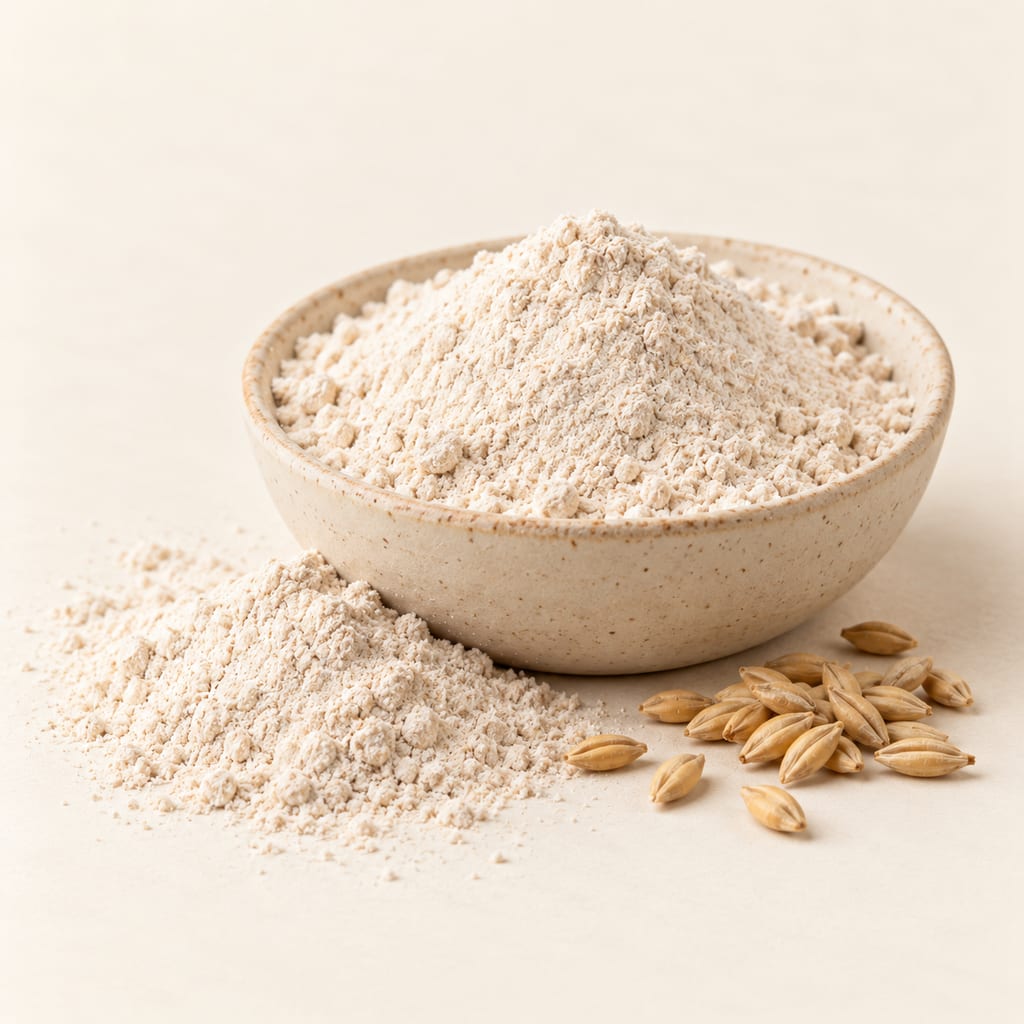
Barley flour is ground barley grain; whether it comes from pearled or hulless kernels, its milling and limited wheat-like gluten-forming ability shape the doughs and foods it can make.
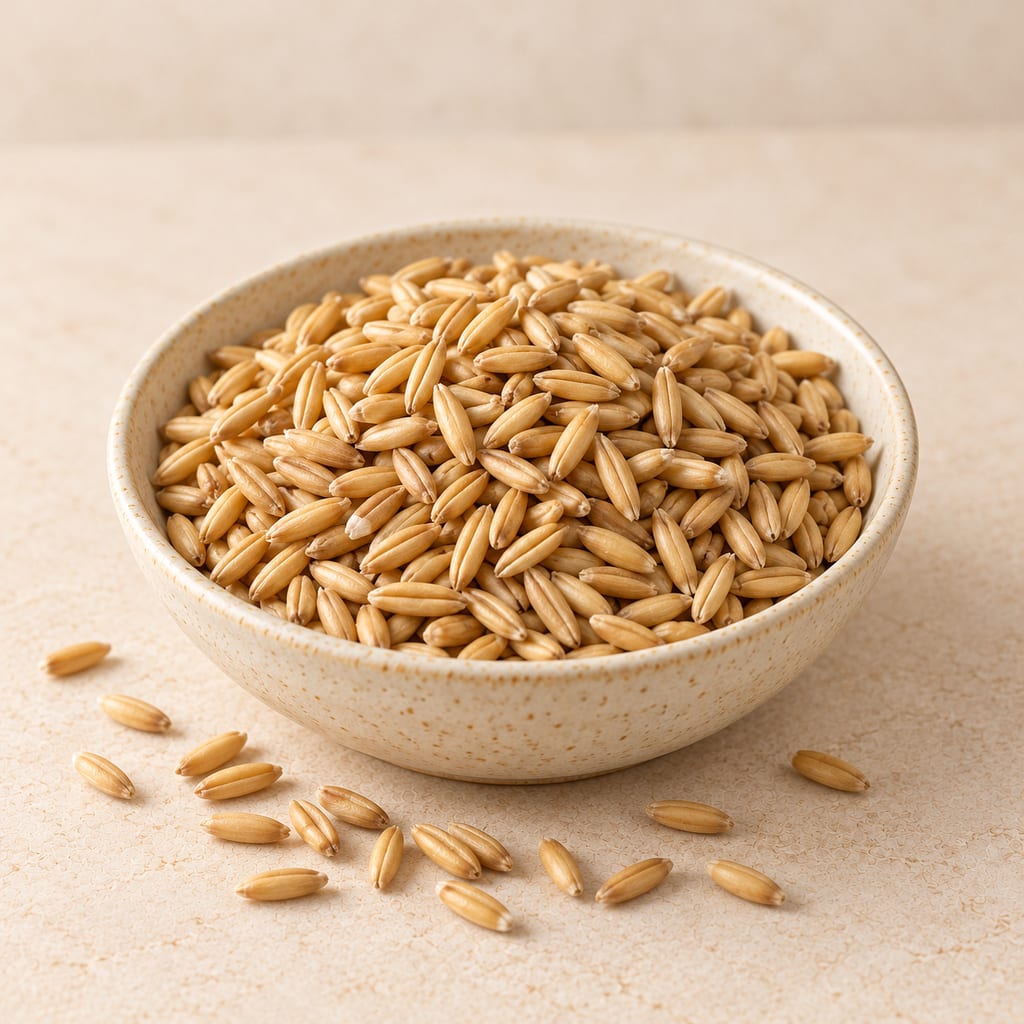
A cereal grain sold as groats, cut pieces, flakes, flour and malt. Oats shape porridge, bread and brewing differently as processing changes hydration, texture, starch, beta-glucan, protein and oil.
No community contributions have been published for this entry yet.
Sign in to contribute. Published comments and photos are free to read.
Agriculture CanadaRecipe use
Home-made dairy productsHome-made dairy products (1978, reprinted 1981): cheddar-type and semi-soft cheeses are coated with paraffin after the surface has dried; no grade or temperature is given.
Cited in: The wax on the rind; How it became a cheese coating; Applying wax in practice
US eCFRFood contact grade
21 CFR 172.886: Petroleum waxDefines petroleum wax and permits wax meeting its specifications on cheese as a protective coating under good manufacturing practice.
Cited in: How it became a cheese coating; Food-contact grade and handling the molten wax
American Cheese SocietyCoating practice · Dipping temperatures
The American Cheese Society’s Best Practices Guide for Cheesemakers, Second EditionSection 6.8.3: reasons for waxing, paraffin as the original coating for young cheese, CO2 permeability; initial dip 225 to 240 F and later coats 160 to 180 F; flexible overlays, low-temperature waxes and polyvinyl acetate; sound paraffin coats resist cheese mites.
Cited in: The wax on the rind; How it became a cheese coating; How the coating works, and how it fails; Applying wax in practice; Cheese mites and the sound coat
University of Connecticut College of Agriculture, Health and Natural ResourcesServing
Ask UConn Extension: All About CheeseRemove or cut around wax and sealing materials before eating; wax differs from a natural rind.
Cited in: The wax on the rind; A cover is not a preservation method
Utah State UniversityStorage
Hazardous Food Preservation and Storage AdviceWax-covered cheese is not a room-temperature preservation method; surface mould prevention is separate from bacterial control; refrigerate.
Cited in: A cover is not a preservation method
Cambridge University Press; digital transcription by WikisourceDiscovery and naming
Paraffin, Encyclopædia Britannica, 11th editionReichenbach investigated solid paraffin from wood tar in 1830 and named it from parum affinis; Laurent obtained it from bituminous schist the same year; Young patented its production from coal in 1850; sources include shale, coal, wood tar, lignite, petroleum and ozokerite.
Cited in: How paraffin was found and named
US Bureau of Mines / Government Printing OfficeModern source
Manufacture of Paraffin Wax from Petroleum, Bureau of Mines Bulletin 388, page 1Paraffin is obtained in refining crude petroleum; wax is removed from lubricating-oil fractions and finished into commercial products.
Cited in: How paraffin was found and named
USPRelated material
Microcrystalline Wax, USP-NF MonographMicrocrystalline wax is a refined mixture of saturated hydrocarbons from petroleum still-bottom fractions in which branched chains predominate.
Cited in: What paraffin is
FAOAlternative coating material
Value-added products from beekeeping, Chapter 4: BeeswaxBeeswax is secreted by young bees as wax platelets and worked into comb; waxes are mixtures that depend on origin; beeswax contains esters as well as hydrocarbons.
Cited in: How the coating works, and how it fails
Coatings 11(3), 261 (2021)Coating performance
Characterization of Beeswax, Candelilla Wax and Paraffin Wax for Coating CheesesPoro cheese coated with beeswax, candelilla wax, paraffin wax and blends: brittle paraffin and candelilla coatings microcracked; beeswax did not crack under the conditions tested; cracking went with moisture migration, shrinkage and weight loss.
Cited in: How the coating works, and how it fails
U.S. Department of EnergyDefinition
Glossary: WaxWax as solid or semi-solid hydrocarbon mixtures from petroleum or Fischer-Tropsch production in which straight-chain paraffins predominate.
Cited in: What paraffin is
International Programme on Chemical SafetyProperties · Handling
International Chemical Safety Card 1457: Paraffin waxMelting point 50 to 57 C, flash point 199 C closed cup, combustible; ventilation, heat-insulating gloves and goggles for molten wax; TLV 2 mg per cubic metre.
Cited in: What paraffin is; Food-contact grade and handling the molten wax
H.B. Fuller GmbH, patent filed 1984Wax composition · Application temperatures
US 4,585,658: Process for the coating of cheeseTraditional cheese waxes: 50 to 70 percent crystalline paraffins (solidifying at 55 to 60 C), 30 to 50 percent microcrystalline waxes (65 to 75 C), up to 10 percent polymers; application at 95 to 115 C, peelable waxes at about 70 C; poor adhesion to fatty surfaces and cracking at edges.
Cited in: What paraffin is; How the coating works, and how it fails; Applying wax in practice