
Programme
The yellow coat: how a sixth-century farm manual made jiang and shi
Around 544 CE, Jia Sixie wrote down how a Chinese farm turned soybeans into jiang paste and fermented shi beans: the winter start, the mould-coated wheat, the armpit-warm bean room and the hundred-day jar.
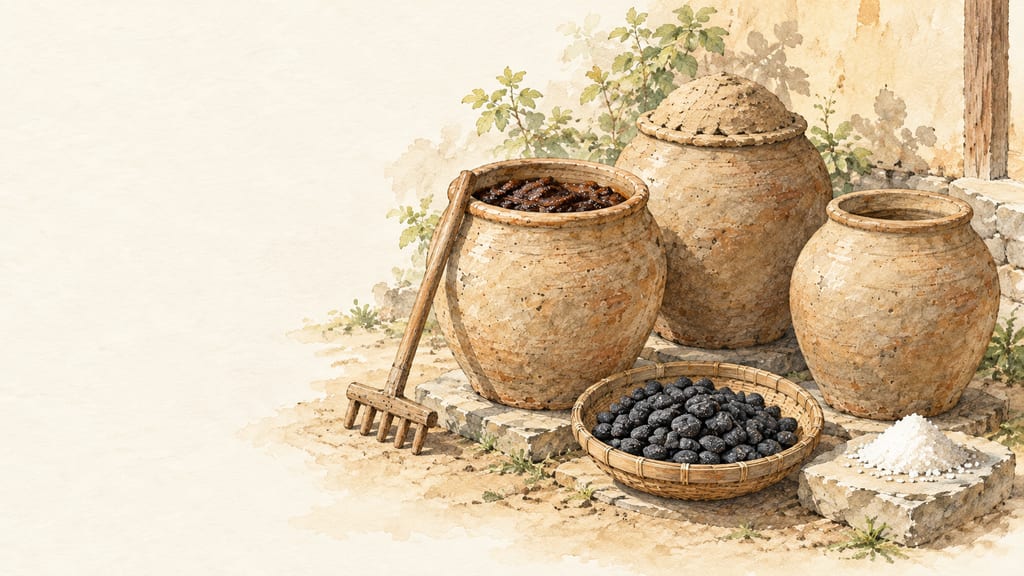
Jiang jars on stones in the sun, one still sealed with mud: a historical interpretation of the Qimin Yaoshu method.
A farm manual with a pantry inside
Around 544 CE, Jia Sixie, an official of the Northern Wei, finished a book about how to run a farm. The Qimin Yaoshu, usually translated as Essential Techniques for the Welfare of the People, covers crops, orchards and livestock in ten volumes and 92 chapters. Then, in its eighth volume, it walks into the kitchen.
Volume eight is a sequence of ferments. It opens with the mould-grown wheat that starts them, moves through salt, through jiang (醬), the fermented pastes, through vinegar and shi (豉), the fermented beans, and on to pickled fish. Read in order, it is a working manual for turning a harvest of soybeans and wheat into seasonings that last the year.
It is also one of the earliest detailed accounts of those foods anywhere. Soybean jiang is mentioned in Chinese documents centuries older than the book, but the Qimin Yaoshu is where the instructions survive: which month to start, which beans to use, how much salt, how often to stir and how to tell when it is done. Fermentation historians call it the earliest known set of instructions for making fermented black soybeans.
The yellow coat
Everything in the chapter depends on a starter, and the book makes it first. In the sixth month, wheat is soaked, steamed and spread about two cun thick on a mat, then covered with leaves cut the day before. By the seventh month it has grown a yellow coat, huangyi (黃衣), the spores of the moulds that will later break down beans and grain. A second starter, huangzheng (黃蒸), is made the same way from coarsely ground raw wheat.
Jia Sixie is firm about one detail. People in Qi, he writes, like to winnow the dried starter in the wind and blow the yellow coat away, and this is a great mistake: everything made with the starter depends on that coat. In other words, the farm manual already understood that the dusty yellow layer was the active part, more than a millennium before anyone could see a mould spore.
Starting jiang in the coldest months
Soybean jiang begins in winter. The twelfth and first months are the best time, the second month is middling and the third is the last. The beans are black soybeans sown in spring, which the book prefers because their grains are small and even, where late beans come large and mixed. They are steamed in a big steamer for about half a day, turned so that the top beans go to the bottom, and steamed again over a fire banked with ash so that it burns all night. A bean is ready when, bitten through, it is yellow-black and fully cooked.
Then comes careful work. The cooked beans are sun-dried, pounded to loosen the hulls, steamed and sunned again, winnowed and soaked in hot water so the black skins can be rubbed off. The hulled bean, douhuang (豆黃), is steamed once more and spread on a clean mat until completely cold. The water from washing the beans is not wasted: it can cook broken beans into a quick jiang for everyday use.
The proportions are given by volume. Three dou of hulled beans go with one dou of powdered qu (麴, the wheat starter), one dou of powdered huangzheng and five sheng of white salt, ten sheng making a dou, plus a three-finger pinch of a fragrant herb. Each part has a job the book names. Yellow salt makes the jiang bitter and damp salt spoils it. Huangzheng makes it red and fine; the herb makes it fragrant. With too little salt the jiang turns sour, and adding salt later never brings the flavour back. A stronger starter, shenqu (神麴), can stand in for the ordinary one, one sheng doing the work of three.
Sun, brine and a hundred days
The jar matters as much as the recipe. It must be one that does not leak, because a seeping jar spoils the flavour, and a jar that has held vinegar will not do. It stands in the sun, on a stone, in a high place, out of the reach of rainwater pooling under it.
The mixture is packed into the jar by hand until it is full; a half-full jar is hard to ripen. The mouth is covered and sealed with mud so that no air escapes, and the jar is left closed for five weeks in the twelfth month, four weeks in the first and second, three weeks in the third. When it is opened, the mass should have cracked across and lengthways and grown a coat of mould right to the bottom.
Now the paste is broken up and wetted. Before sunrise, water is drawn from the well, one shi (ten dou) of it mixed with three dou of salt, and the clear brine is poured off after it settles. More huangzheng is steeped in some of the brine and strained into the jar. The amount of brine is not fixed; the mixture should look like thin gruel. Then the jar stands open to the sun. For ten days it is stirred to the bottom several times a day with a rake, then once a day until the thirtieth day. When it rains the jar is covered, because water that gets in breeds insects, and after every rain the jar is stirred again. Twenty days after the brine goes in, the jiang can be eaten. It takes a hundred days to be truly ripe.
Nails, maggots and pregnant women
A practical manual is also a record of what people believed, and the jiang chapter keeps the beliefs alongside the method. The ingredients should be mixed facing the direction of Tai Sui, the year star, so that there will be no maggots. An iron nail set under the jar, the text says, means that even if a pregnant woman eats from it, the jiang will not spoil. If a pregnant woman does spoil a batch, thorny branches of a white-leaved bush put into the jar will restore it.
Jia Sixie records these without comment and moves on. To a modern reader they say less about microbes than about how much was at stake: a jar of jiang was months of work and a year of seasoning, and a household had every reason to protect it.
Shi: beans in a warm room
Shi, fermented whole soybeans, is made in a different way. Instead of a jar, the book calls for a room. It should be warm and shaded, with a floor dug two or three chi into the ground, a thatched roof, because tiles are poor, windows sealed with mud against wind, insects and rats, and a door just wide enough for a person, closed with a thick straw screen. The fourth and fifth months are the best time; from the twentieth day of the seventh month into the eighth is middling; other months are possible, but the great cold of winter and the great heat of summer are very hard to manage.
The rule for temperature is one of the most memorable lines in the book. The pile should be kept as warm as the inside of a person's armpit, and if the warmth cannot be held even, it is better to err cold than hot. A cold pile can be covered with straw and warmed again; a hot one stinks and spoils.
The beans are boiled until soft when pinched, cooled, and heaped in the room. Twice a day the maker pushes a hand into the heap. When the inside is armpit-warm, the pile is turned, cold beans from the edge brought into the middle. If the beans would scald the hand, the moment has been missed and they have overheated. After four or five turns a faint white coat appears. The pile is flattened into a round like a cartwheel two chi thick, then turned and thinned again, to one and a half chi, to one chi, to six cun, until every bean is covered in white. After that a yellow coat follows, the same yellow as the wheat starter.
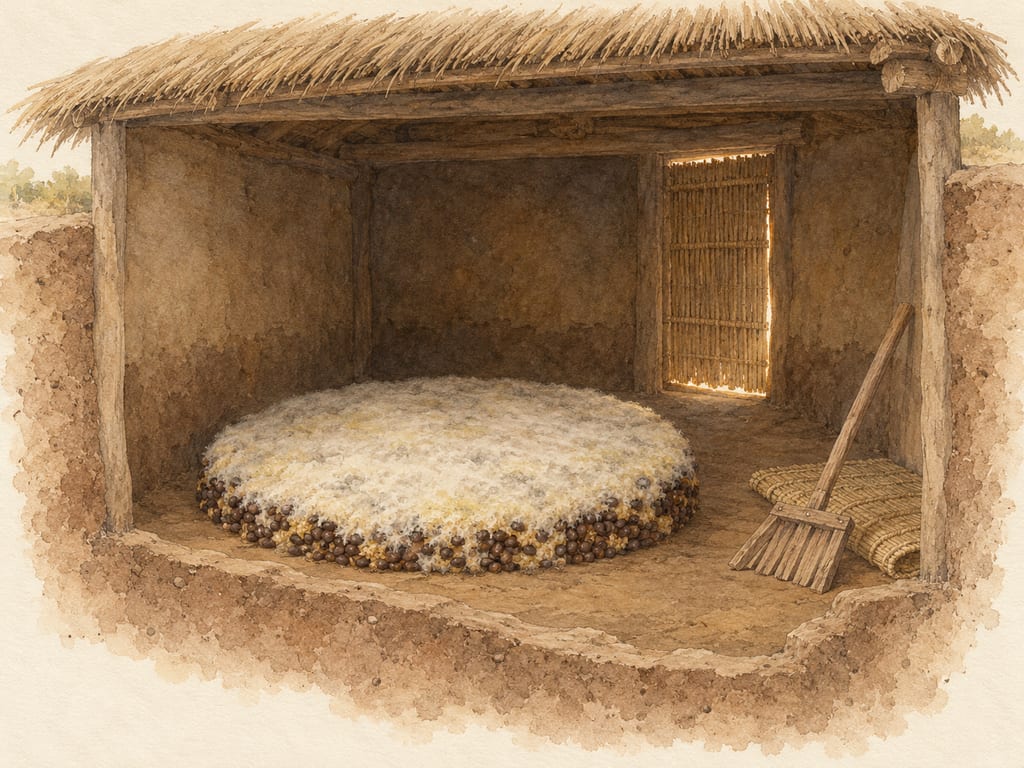
Scale was part of the method. A three-room building could hold a hundred shi of beans in heaps of twenty, and a household that worked continuously kept enough heat in the room to need no straw cover at all. Even a small maker needed ten shi to a heap: three or five shi of beans could not hold their own warmth. Old beans were better than new ones, which were still damp and cooked unevenly. In the version of the method translated by the historian H. T. Huang, the yellow-coated beans are then washed, packed into a pit lined with straw and millet husks, and left for about ten days in summer, twelve in autumn or fifteen in winter, before drying in the sun. Dried, they keep for a year.
From the farm to the kitchen shelf
The same chapter gathers smaller recipes from older books. A wheat jiang taken from an older cookbook, the Shijing, grows a yellow coat on whole wheat, pours a boiled salt brine over it and sets it in the sun for ten days. An elm-seed jiang blends ground elm-seed kernels with clear wine and soybean jiang and is ready in a month. The book also quotes the older farm calendar of Cui Shi, which sets the first month for making jiang of all kinds.
The fermented black beans sold today as douchi are close relatives of the shi in the warm room, and the jars of bean paste sunning in courtyards across East Asia still follow the outline of the jiang chapter: a cooked legume, a mould-grown starter, salt, a sealed start and a long, sunny, stirred finish. What the Qimin Yaoshu adds is the detail, written down by someone who had watched it done.
The text describes sixth-century practice, measured in units whose exact modern size is uncertain, and its beliefs are recorded as beliefs. It is a window into how a Chinese farm household made its seasonings, not a recipe to follow unchanged.
Related
Read more
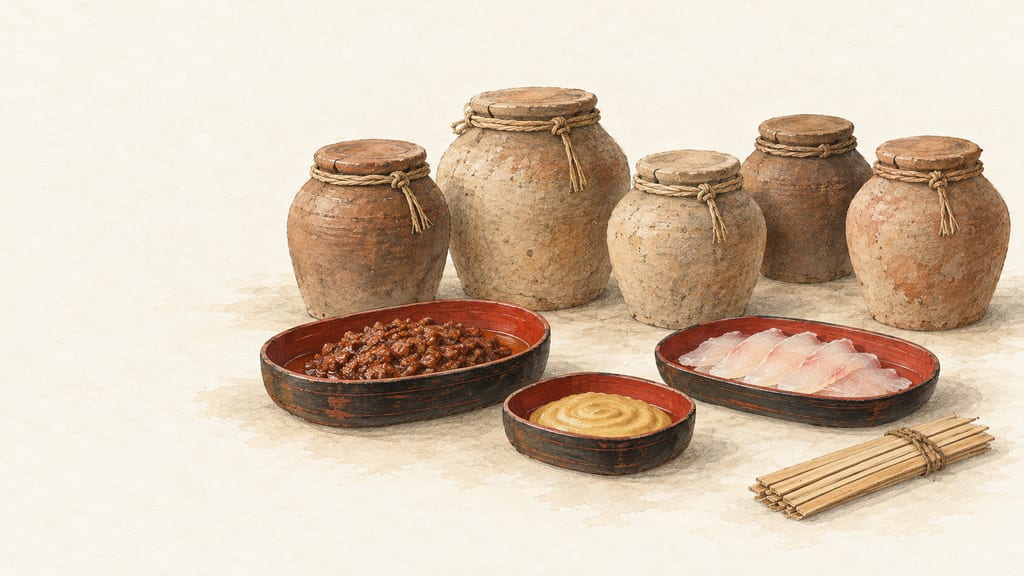
A hundred and twenty jars of jiang for the king's table
Chinese texts were counting jars of jiang, pairing it with raw fish and venison, and making it largely from meat long before anyone wrote down soy sauce. How a whole class of sauces narrowed to a bean paste.
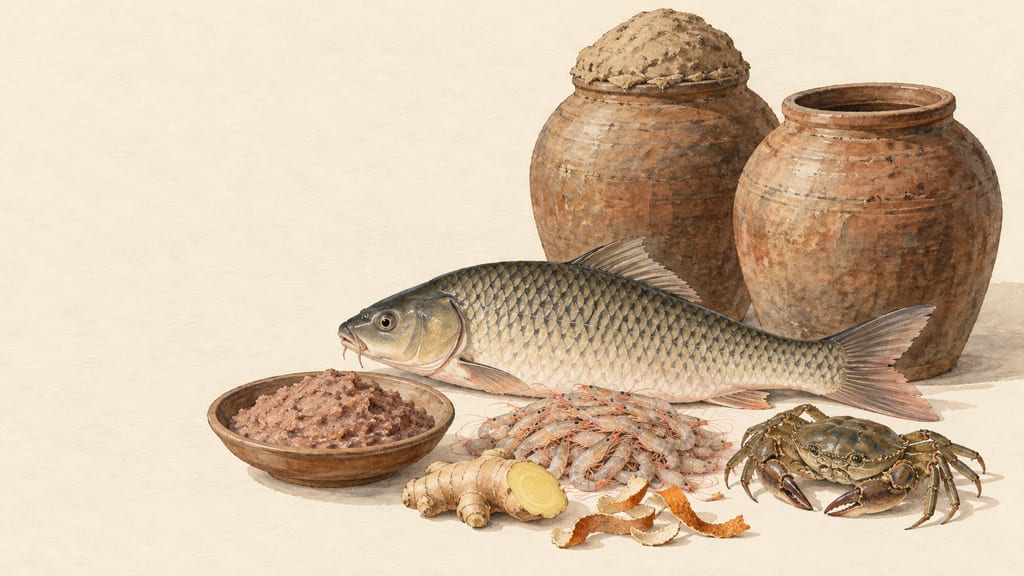
Fish guts in a pit: the animal sauces of a sixth-century Chinese kitchen
Long before soy sauce, Chinese cooks made jiang from venison, carp and shrimp. A farm manual of about 544 CE records how, from a fish-gut sauce with an imperial legend to fish pickled in rice.
Discussed in this article
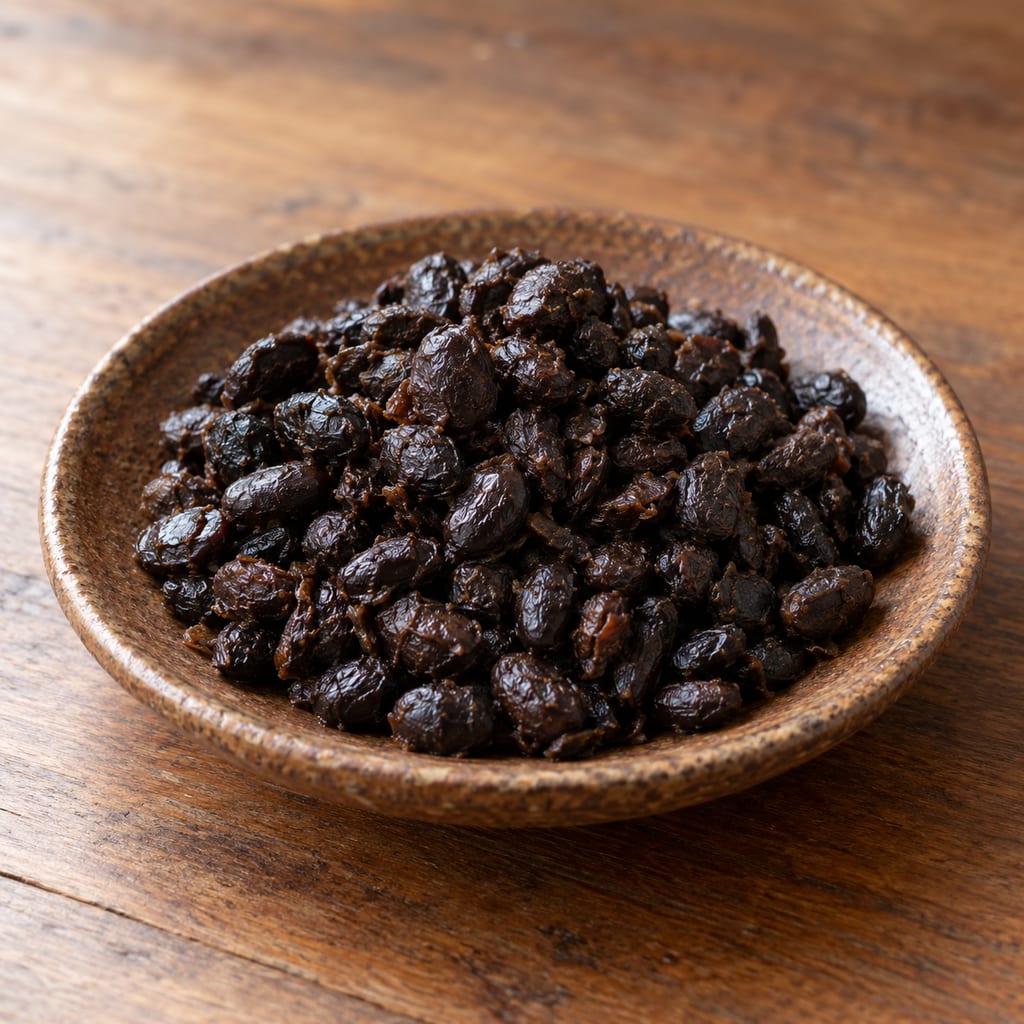
Mucor-type douchi
A Chinese fermented soybean condiment from Chongqing and Sichuan, made by growing Mucor-type mould on cooked beans, then salting and maturing them into dark, savoury, soft beans with a concentrated aroma.
Community
No community contributions have been published for this entry yet.
Share what you made
Sign in to contribute. Published comments and photos are free to read.
Sources
Wikisource (Chinese)
Qimin Yaoshu, volume 8 (Siku quanshu text): chapters 68, 70 and 72 on starters, jiang and shiCited in: A farm manual with a pantry inside; The yellow coat; Starting jiang in the coldest months; Sun, brine and a hundred days; Nails, maggots and pregnant women; Shi: beans in a warm room; From the farm to the kitchen shelf
Soyinfo Center
History of fermented black soybeans (165 B.C. to 2011) (Shurtleff and Aoyagi)Cited in: Shi: beans in a warm room; From the farm to the kitchen shelf
Gaps
- Northern Wei units of volume and length (dou, sheng, chi, cun) have no exact modern equivalent here.
- The herb added to soybean jiang is not identified.
Updated 2026-10-29