
Programme
A hundred and twenty jars of jiang for the king's table
Chinese texts were counting jars of jiang, pairing it with raw fish and venison, and making it largely from meat long before anyone wrote down soy sauce. How a whole class of sauces narrowed to a bean paste.
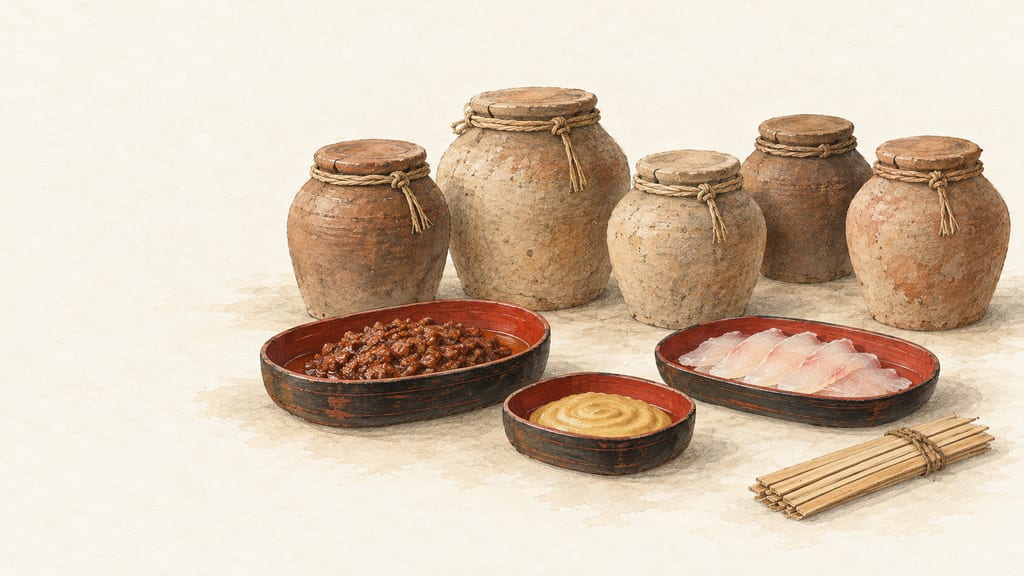
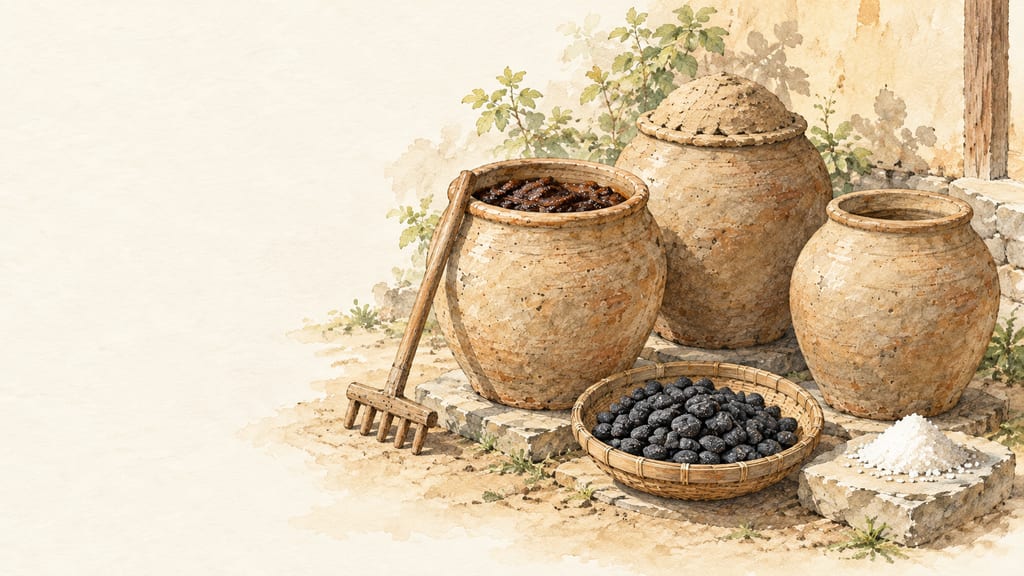
A historical interpretation: rows of lidded earthenware jars of the kind a royal storehouse would have counted, with a dish of minced meat sauce and sliced raw fish beside them.
The royal cook's quota
In the Zhou li, a text that lays out the offices of an ideal royal court, the royal cook keeps a list of what the king's table requires. It runs: six grains, six animals, six clear drinks, 120 kinds of delicacy, eight rarities and 120 jars of jiang. The list counts jars and gives no volume, so how much a jar held is unknown. What it does show is that jiang was supplied in quantity, as a line item beside the grain and the meat.
Two other offices in the same text handle sauces of their own. The office of the hai, the meat sauces, supplies 60 jars when the king holds a feast and 50 for the rites of receiving guests. The vinegar office supplies the same numbers, 60 and 50 jars, of vinegar and pickled goods. Scholars usually place the compilation of the Zhou li between the late Warring States and the Han period.
Two refusals in the Analects
The best-known mention of jiang is one short sentence. In the tenth book of the Analects, Xiangdang, two refusals sit side by side: the meat is not eaten if it is not cut square, and it is not eaten if it does not have its jiang (不得其醬,不食).
The sentence never says what jiang is. It treats jiang as something a dish can have right or wrong. The one gloss attached to it in the standard commentary, by Ma Rong, makes the point concrete: raw fish is not eaten without mustard jiang (芥醬). So the jiang here is a pairing, a sauce chosen for a dish. And a jiang named for mustard is plainly not a bean product.
The Li ji chapter on household rules, Neize, shows the same habit across a whole table. Sliced raw fish takes mustard jiang. A braised fish takes a jiang of its own. Raw venison takes hai-jiang, a compound that joins the two words. The chapter also hands each course a season, and jiang's is autumn. Among its dishes is chunao, hai that has been fried, set over upland rice and finished with a pour of fat.
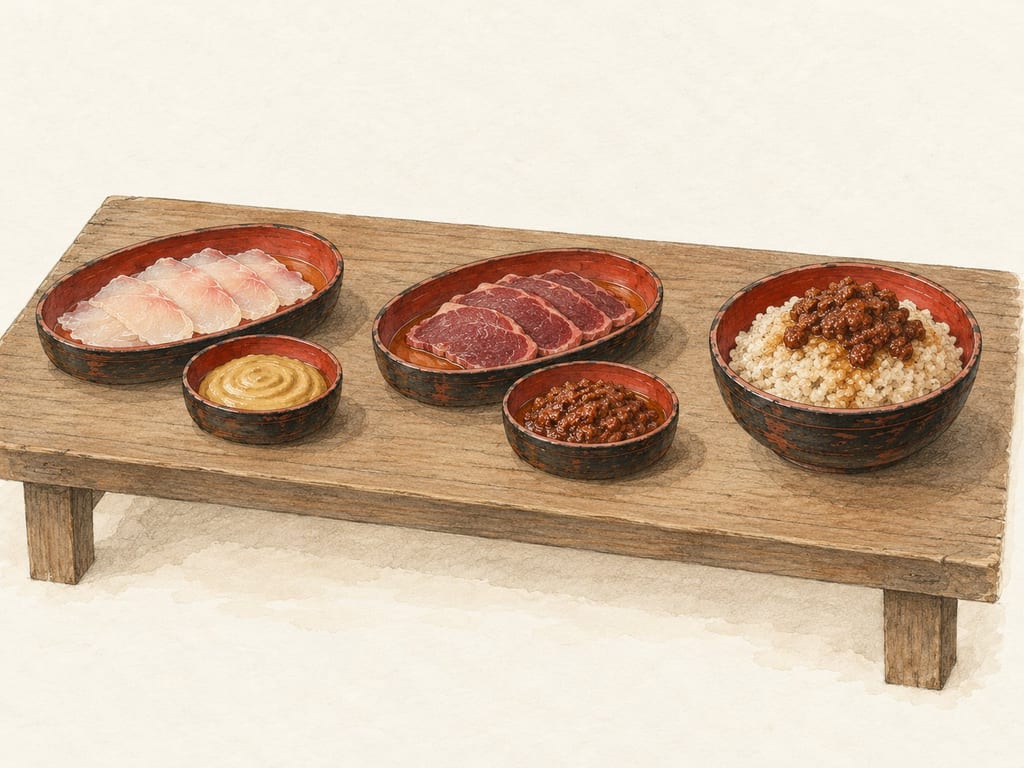
When jiang meant meat
In these early texts, hai and jiang lie close together, and the meat is in both. Duan Yucai's note on the character states it flatly: jiang is hai, and the meat component sits in the character because hai was never made without meat.
A dictionary from the late Eastern Han, Liu Xi's Shiming, separates the two by thickness. In Huang Hsing-Tsung's translation, when hai is soupy it becomes tan, so hai is the thick meat sauce, or paste, and tan the thin one. Whether that is a rule of the kitchen or a matter of words is not settled by the line, but it shows that Han readers saw a family of sauces graded from paste to liquid, with meat at its centre.
Beans enter the record
Beans show up in the written record later and in pieces. A line attributed to Wang Chong's Lunheng, written around 82 CE, says that people who made bean jiang (豆醬) feared thunder would spoil it. Some modern accounts read the same line as the earliest mention of soy milk; the characters themselves say bean jiang. The chapter of the Lunheng that holds it has not been located.
A clearer recipe survives in the Simin yueling, a month-by-month text by Cui Shi, who lived in the Eastern Han; its date is given as about 160 CE, and it survives only in a reconstructed edition. For the first month it says that one can make the various jiang. In the first ten days of the month beans are roasted, in the second ten days they are boiled, and chopped beans become modu (末都), described as a kind of jiang. The same passage goes on to fish jiang, meat jiang and qingjiang (清醬), clear jiang.
The text says dou, beans. Modern historians read that as soybeans, and read qingjiang as an early liquid soy sauce. These are their identifications, not words in the sentence. They are probably right, but they are the point where the story passes from a meat-and-mustard category to something close to the jiang of later centuries.
By the seventh century a commentator, Yan Shigu, glossing the Jijiupian, a primer of words, defined the sauce by its method: jiang is made by combining beans with wheat flour.
A sixth-century farm manual sorts the products
By the time Jia Sixie completed the Qimin Yaoshu, a farm manual of the Northern Wei, around 544 CE, bean products had their own vocabulary. The book treats soybean jiang (豆醬), jiangqing, shizhi and shiqing as distinct products, some of which appear together in the same recipe, and about 70 recipes call for the fermented black soybean called shi. Meat, fish and shrimp jiang are still in the book beside them. The older sense of the word has not been replaced by soy; it now sits next to it.
The compound that finally names soy sauce, jiangyou, is attested only in late Song works. The bean paste that most readers now mean by jiang separated only slowly from the broader class that the Zhou li counted in jars.
What to take from the word
Jiang in early China is best read as a function and a family, not a single product. It names the sauce matched to a dish, prepared by salting, fermenting or other means. In its earliest uses it was made of meat or flavoured with mustard; beans become visible in texts of the Han period; and the word settles on soy only as bean sauces multiply and gain their own names.
That matters when reading any one source. A mention of jiang in a Han or earlier text does not describe a soy product unless the text says beans. The same word can mean a pot of minced meat, a dipping sauce for raw fish or a bean paste, and the surrounding sentence is the only guide to which.
Related
Read more
A wedding list from 683, and the sauce it never describes
A Silla king’s bride was sent 135 loads of provisions, jang among them. The chronicle that says so was written 462 years later and never says what the jang was. What the record can carry, and what Korea added.
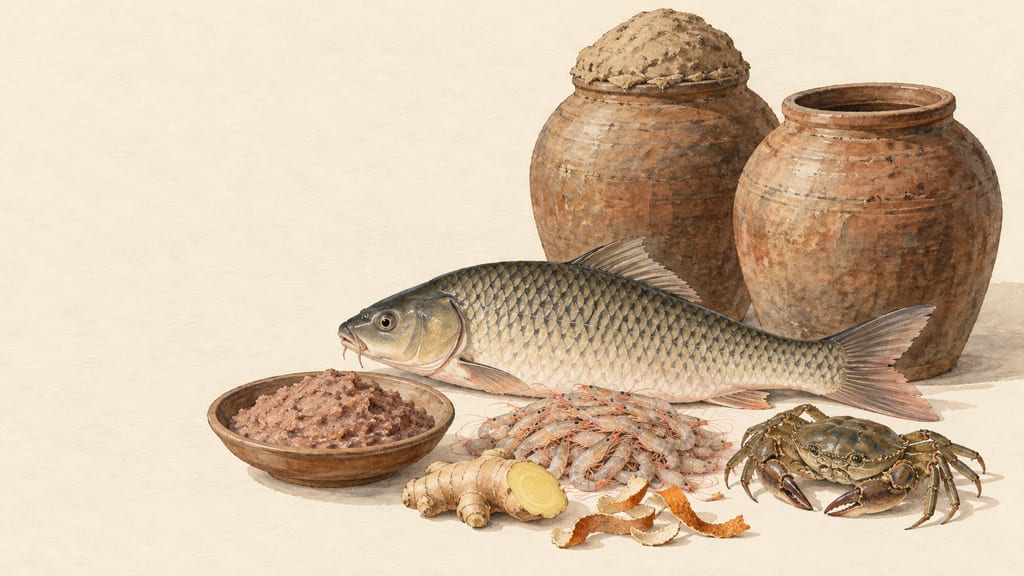
Fish guts in a pit: the animal sauces of a sixth-century Chinese kitchen
Long before soy sauce, Chinese cooks made jiang from venison, carp and shrimp. A farm manual of about 544 CE records how, from a fish-gut sauce with an imperial legend to fish pickled in rice.
The yellow coat: how a sixth-century farm manual made jiang and shi
Around 544 CE, Jia Sixie wrote down how a Chinese farm turned soybeans into jiang paste and fermented shi beans: the winter start, the mould-coated wheat, the armpit-warm bean room and the hundred-day jar.
Community
No community contributions have been published for this entry yet.
Share what you made
Sign in to contribute. Published comments and photos are free to read.
Sources
Wikisource (Chinese)
論語註疏 卷10 鄉黨第十 (Analects with commentary, book 10, Xiangdang)Cited in: Two refusals in the Analects; What to take from the word
Wikisource (Chinese)
周禮 (Zhou li), Tianguan: offices of the hai, the vinegar and the royal cookCited in: The royal cook's quota
Wikisource (Chinese)
禮記 內則 (Li ji, Neize)Cited in: Two refusals in the Analects; What to take from the word
Wikisource (Chinese)
四民月令 (Simin yueling, reconstructed edition)Cited in: Beans enter the record; What to take from the word
Soyinfo Center
History of Soy Sauce (160 CE to 2012)Cited in: When jiang meant meat; Beans enter the record; A sixth-century farm manual sorts the products; What to take from the word
Zdic (漢典)
醬 (character entry quoting Duan Yucai on the Shuowen and Yan Shigu on the Jijiupian)Cited in: When jiang meant meat; Beans enter the record
Gaps
- Modern histories say bamboo slips from Mawangdui, whose Tomb 3 dates to 168 BCE, list a soy paste, but the slip entry has not been identified, so this article does not rely on it.
- The Shiming and Simin yueling readings rest on Huang Hsing-Tsung's translations as quoted in a secondary history, and the Shuowen entry itself has not been compared with Duan Yucai's note.
- The date of the Qimin Yaoshu is given as both 535 and 544, and the Lunheng chapter with the bean jiang line is unlocated.
Updated 2026-10-29