
Programme
Fish guts in a pit: the animal sauces of a sixth-century Chinese kitchen
Long before soy sauce, Chinese cooks made jiang from venison, carp and shrimp. A farm manual of about 544 CE records how, from a fish-gut sauce with an imperial legend to fish pickled in rice.
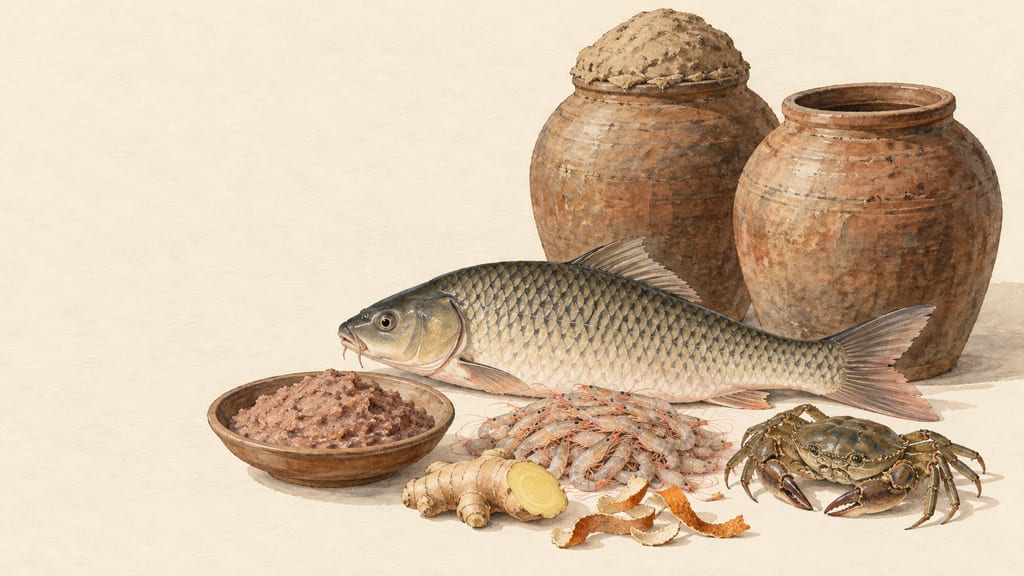
Carp, shrimp, crab, ginger and orange peel beside mud-sealed jars: a historical interpretation of the animal jiang.
A smell on the shore
The story goes like this. Long ago, Emperor Wu of Han was pursuing the Yi people to the edge of the sea when he caught a fragrance on the air and could not see where it came from. He sent men to look. They found that a fisherman had put fish guts into a pit and covered them with earth, and the smell was rising from the ground. They took it, ate it and found it delicious. Because it was found while chasing the Yi, the dish took its name from the chase: zhuyi (鱁鮧), which, the text adds, is simply fish-gut sauce.
The tale is told in the Qimin Yaoshu, the farm manual the Northern Wei official Jia Sixie completed around 544 CE, and it is a legend rather than history. But the recipe that follows it is entirely practical, and it sits in a chapter that is a surprise to anyone who thinks of Chinese jiang as a soybean food. Alongside the bean pastes, the book gives careful instructions for jiang made from beef and venison, from fish and shrimp, for crabs preserved in brine and for fish pickled with rice.
Fish guts, salt and the sun
The zhuyi method is short. Take the intestines, stomachs and swim bladders of three kinds of fish, among them the yellow croaker (shishouyu), and wash them clean. Salt them with white salt until they are a little more than salty, pack them into a vessel, seal it tightly and set it in the sun. In summer it is ready in twenty days, in spring or autumn in fifty, in winter in a hundred. It is eaten with ginger and vinegar.
Those timings are a lesson in how temperature drives a ferment. The same salted guts in the same sealed jar take five times as long in winter as in summer, because the enzymes in the fish and the microbes that tolerate the salt both work faster in the warmth. The sun is not decoration in these recipes; it is the heater.
Meat jiang, sealed with mud
The meat jiang can be made from beef, mutton, water deer, deer or hare. The meat must be good and freshly killed, with the fat removed, and finely chopped; old, dried meat will not do and makes the sauce greasy. For each dou of meat the book gives five sheng of powdered qu, the mould-grown wheat starter, two and a half sheng of white salt and one sheng of huangzheng, a second wheat starter, ten sheng making a dou. Meat with bone is pounded first, because the marrow makes the sauce rich.
Everything is mixed on a tray, packed into a jar, sealed with mud and set in the sun. In the cold months the jar is buried in a heap of millet straw to keep it warm. After fourteen days it is opened: when the sauce has come out and there is no smell of the starter left, it is ripe. Then it is loosened with broth from a freshly killed pheasant, simmered until the meat falls away, or chicken broth if there is no pheasant, or good wine, and set back in the sun.
Fish and meat jiang alike should be made in the twelfth month, the coldest of the year. Made then, the book says, they last through the summer without insects. In other months they can still be made, but they tend to breed insects and will not keep through the summer.
A jiang made overnight
For the cook who cannot wait two weeks, the chapter has a quick meat jiang that is ready the next day. It works with beef, mutton, deer, hare or raw fish. A dou of finely chopped meat is mixed with a dou of good wine, five sheng of starter, one sheng of huangzheng and one sheng of salt. It keeps for only thirty days, so it does not need to be salty, and salt would spoil the taste.
The method is a small piece of engineering. A pit is dug and a fire burned in it until the earth glows red; the ashes are cleared out, the pit sprinkled with water and lined thickly with straw. A sauce bottle is heated in boiling water until it is very hot, then dried and packed with the meat to within three cun of the mouth, because meat near the mouth would scorch. A bowl covers the mouth, sealed with cooked mud, and the bottle goes into the straw with seven or eight cun of soil on top. Over it, a fire of dried cow dung is kept burning all night. If the soil is too thin and the fire too hot, the sauce scorches, and the book is clear that it is better to be cold than scorched. By the next day the sauce has come out and it is done. To serve it, scallion whites are fried in sesame oil and mixed into the meat.
Fish and shrimp jiang
For fish jiang the book names two fish, written tai and ji, as the best, with carp also acceptable; the tai and the ji are used whole, but other fish are scaled, washed, dried and sliced thinly as for kuai, the raw-fish dish, with the bones removed. Each dou of fish takes three sheng of the yellow-coated wheat starter, one whole and two ground, two jin of white salt, a sheng of ground dried ginger and a little shredded orange peel. Yellow salt makes it bitter. The mixture is packed into a jar, sealed airtight with mud and set in the sun, and when it is ripe it is loosened with good wine.
There are faster versions. One mixes sliced fish with starter, wine, salt and orange peel in a sealed bottle and calls it very fine after a single day. Another, for dried knife-fish, soaks the dried fish for three days, changing the water three times a day, before it goes into the jar with starter and salt.
Shrimp jiang is the simplest of all: one dou of shrimp, three sheng of cooked rice worked into a paste, one sheng of salt and five sheng of water, mixed and set in the sun. It keeps, the book says, through spring and summer without spoiling. Here the rice plays the part the wheat starter plays elsewhere, giving the microbes something to eat while the salt holds back the rest.
Crabs in syrup and smartweed
The chapter that follows the jiang preserves crabs. In the ninth month, female crabs are chosen, told apart from the males by their wide, round abdominal flap. They are kept alive in water overnight so that their guts empty, but no longer, or they spit out their yellow. Then they spend a night in a jar of thin, cold malt syrup, and are moved into a very salty brine flavoured with smartweed, where they die.
The jar is sealed with mud for twenty days. Then each crab is taken out, a little ground ginger is tucked under its abdominal flap, and the flap is closed again. The crabs go back, a hundred to a jar, covered with the brine and sealed airtight. Above all, the book warns, they must be kept out of the wind, which spoils them. Like the fish-gut sauce, they are eaten with ginger and vinegar.
Zha: fish fermented with rice
The most detailed of the animal recipes is for zha (鮓), fish fermented in cooked rice. Spring and autumn are the seasons for it. In winter it is hard to ripen; in summer it needs so much salt to succeed that it has no flavour, and it breeds maggots. The fish is fresh carp, the bigger the better and lean rather than fat: fat fish tastes good but does not keep. Carp more than one and a half chi long, with skin and bones too tough for slicing raw, all suit zha.
The fish is cut into pieces two cun long, one cun wide and half a cun thick, each with its skin, washed of blood and sprinkled with white salt. The pieces are pressed under a board in a basket on a flat stone to drive the water out, a step called chasing the water. One piece is roasted and tasted to judge the salt. Rice is cooked firm, never soft, because soft rice makes the zha mushy, and mixed with zhuyu, an aromatic berry, orange peel and good wine: half a sheng of wine to a dou of zha, which the book says wards off bad influences and makes the zha taste better and ripen faster.
Fish and rice go into the jar in alternate layers until it is full, the fatty belly pieces on top because they will not keep and must be eaten first. Bamboo leaves, eight layers of them, cover the top, held down with split bamboo; in winter or spring, when there are no leaves, split reeds will do. The jar stays indoors. In the sun or beside a fire, the zha smells bad and tastes poor; in the cold months it is wrapped thickly so that it does not freeze. First a red liquid comes out, and that is poured off. When a white liquid comes and it tastes sour, the zha is ready. It should be torn apart by hand to eat. Cut with a knife, the book says, it tastes fishy.
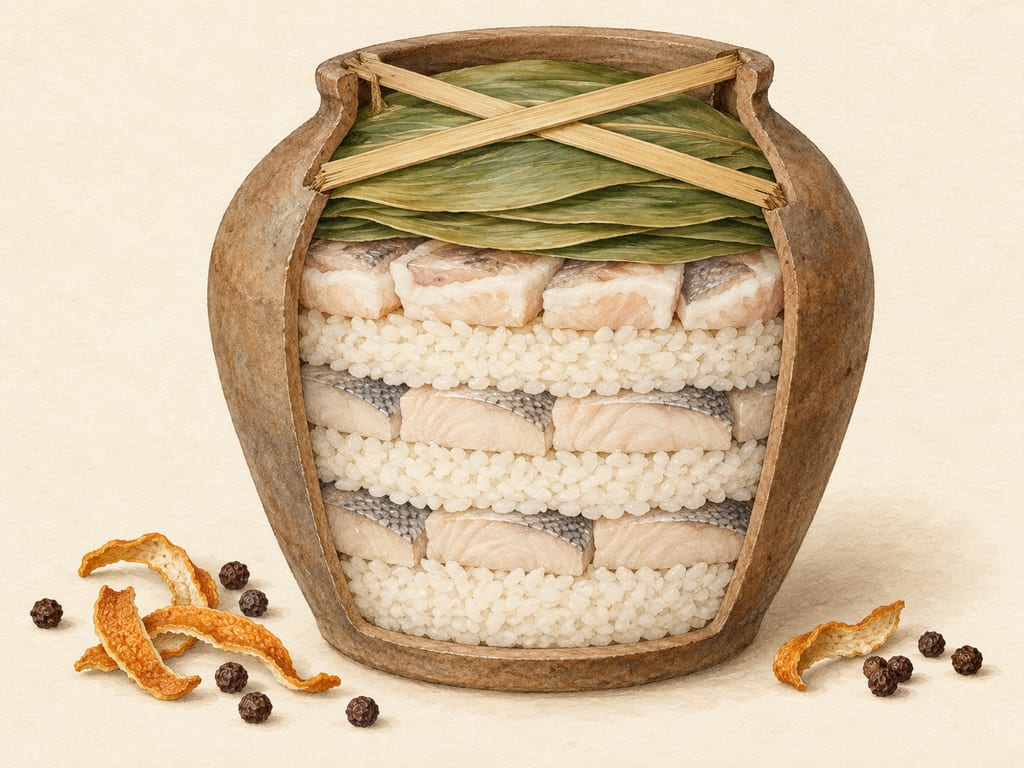
A quicker zha wraps salted fish and rice in lotus leaves, ten pieces to a parcel, and is ready in three days; the lotus leaves, the text notes, add a fragrance of their own.
Reading an old recipe
These recipes show a kitchen that already understood the logic of a salted ferment: fresh material, the right amount of salt, a sealed vessel, warmth from the sun or from straw and buried fire, and a seasonal calendar built around the risk of insects and spoilage. They also show how much of the meaning of jiang has been lost to the modern idea of soy sauce. In the sixth century, jiang could be made of venison, carp guts or shrimp as readily as of beans.
They are records of practice from fifteen centuries ago, not instructions to follow. The units of measure have no exact modern equivalent, several of the fish names cannot be matched with certainty to modern species, and salted, sealed animal foods made at room temperature carry real food-safety risks that the book could not know about.
Related
Read more
A hundred and twenty jars of jiang for the king's table
Chinese texts were counting jars of jiang, pairing it with raw fish and venison, and making it largely from meat long before anyone wrote down soy sauce. How a whole class of sauces narrowed to a bean paste.
The yellow coat: how a sixth-century farm manual made jiang and shi
Around 544 CE, Jia Sixie wrote down how a Chinese farm turned soybeans into jiang paste and fermented shi beans: the winter start, the mould-coated wheat, the armpit-warm bean room and the hundred-day jar.
Discussed in this article
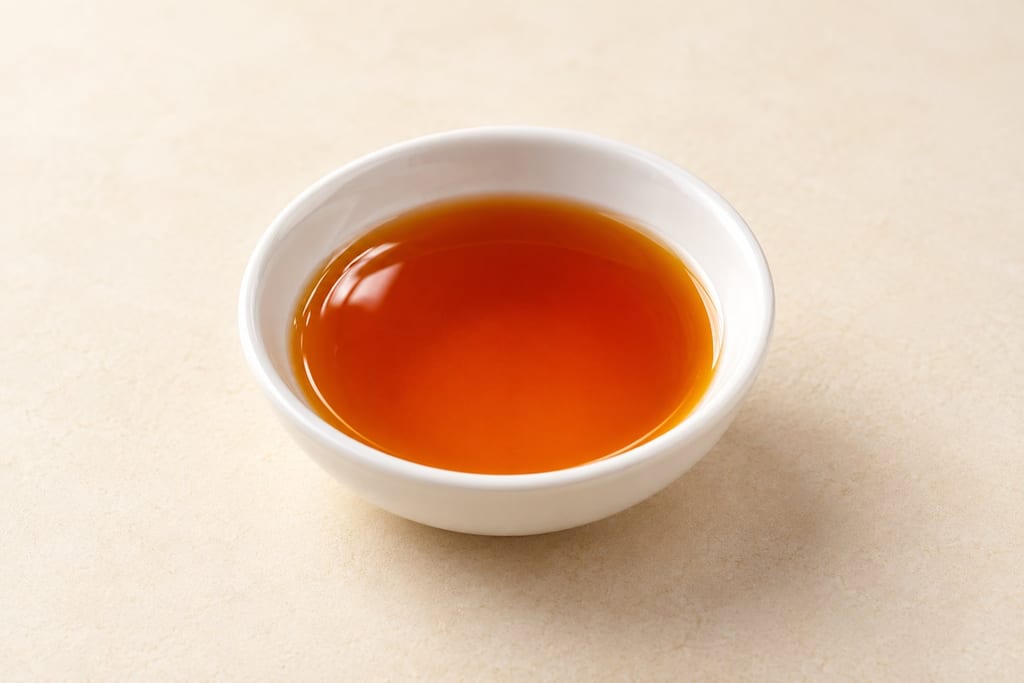
Fish sauce
Fish sauce is a clear, salty seasoning made by maturing fish with salt and drawing off the liquid. The broad family includes distinct regional sauces rather than one interchangeable method.
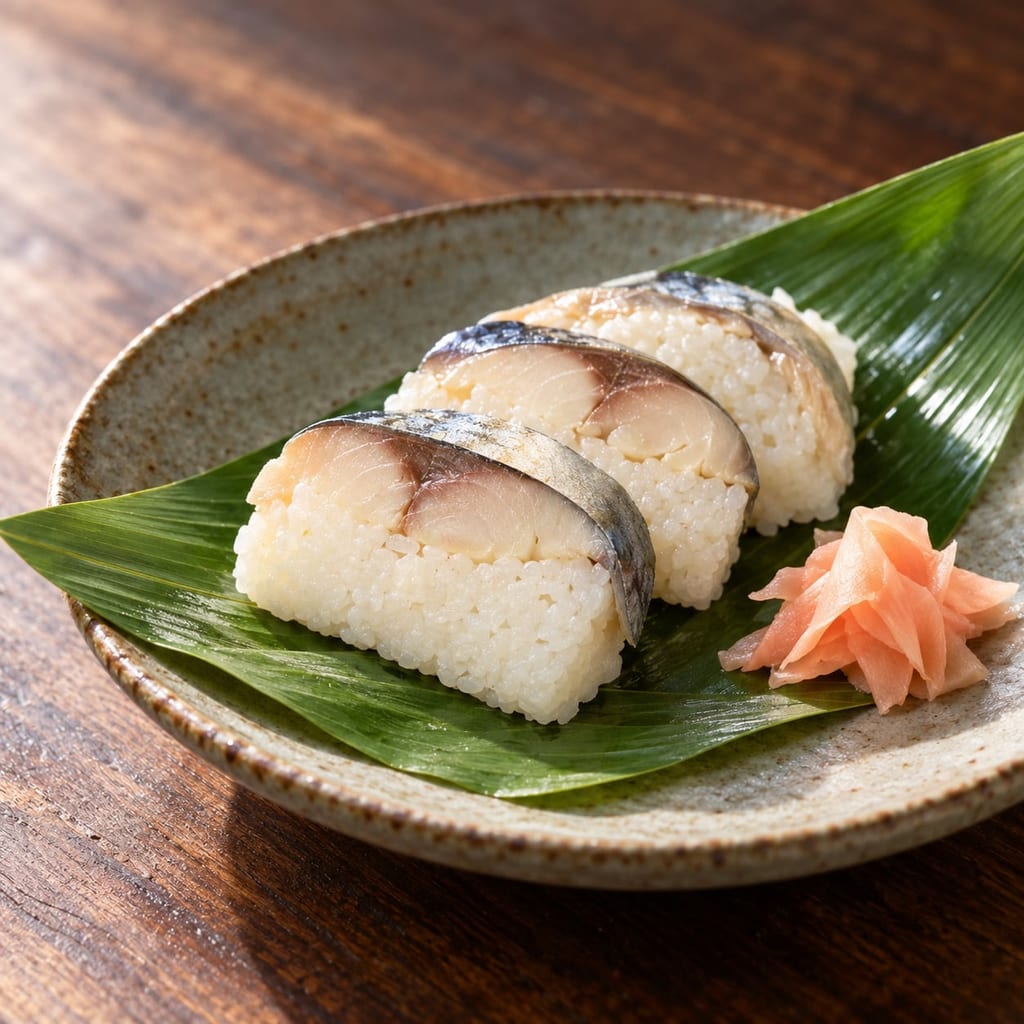
Narezushi
A documentary account of Japanese narezushi, a family of salted-fish and rice ferments. This entry preserves the East Kishu (Mie) source’s identity and regional context without providing a household preparation method.
Community
No community contributions have been published for this entry yet.
Share what you made
Sign in to contribute. Published comments and photos are free to read.
Sources
Wikisource (Chinese)
Qimin Yaoshu, volume 8 (Siku quanshu text): chapter 70 on jiang, the crab method and chapter 74 on zhaCited in: A smell on the shore; Fish guts, salt and the sun; Meat jiang, sealed with mud; A jiang made overnight; Fish and shrimp jiang; Crabs in syrup and smartweed; Zha: fish fermented with rice; Reading an old recipe
Gaps
- Several fish named in the text, including those used for zhuyi, cannot be matched with certainty to modern species.
- Northern Wei units (dou, sheng, jin, chi, cun) have no exact modern equivalent here.
Updated 2026-10-29