
Programme
A wedding list from 683, and the sauce it never describes
A Silla king’s bride was sent 135 loads of provisions, jang among them. The chronicle that says so was written 462 years later and never says what the jang was. What the record can carry, and what Korea added.
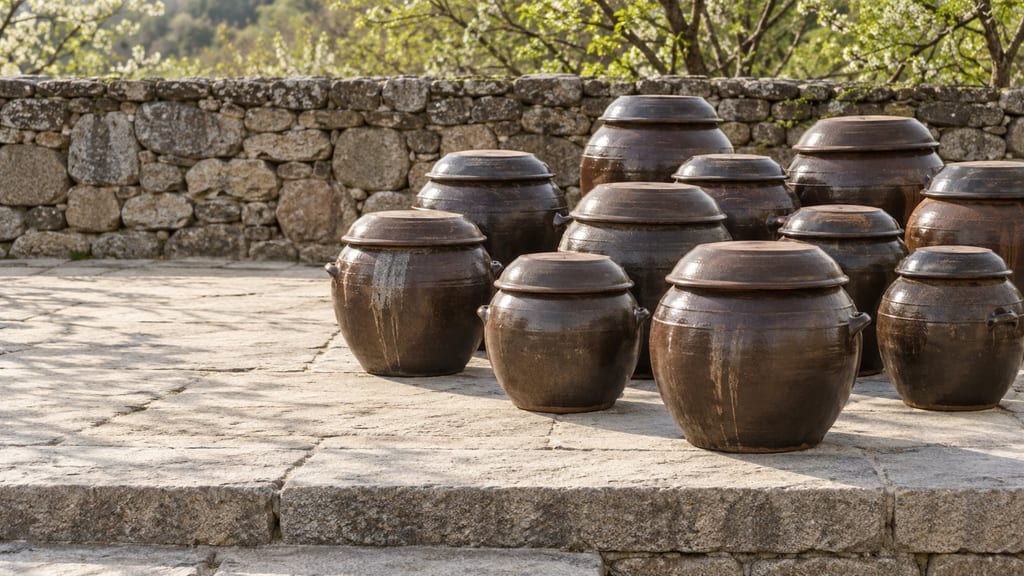
A jangdokdae of onggi jars, the way Korean households and palaces still keep jang; the seventh-century gifts are not known to have been stored like this.
The gifts for a king’s bride
In the second month of spring in 683, King Sinmun of Silla took a consort: the youngest daughter of Ilgilchan Kim Heum-un. The betrothal gifts were counted in loads. Fifteen loads were silk. A hundred and thirty-five were food and drink, and the list names them in order: rice, wine, oil, honey, 醬, 豉, dried meat and a salted meat or fish paste. On top of that went 150 carts of grain.
Two entries on that list matter here, the ones written with the characters 醬 and 豉. Later Korean tradition reads the first as jang; the second is read si. The entry explains neither. It does not say what either was made from, whether it was a paste, a sauce or a block, or how it was made, and the same silence covers the rest of the list.
That is all the evidence from 683: a line in a gift list. The rest of this story is about how much weight such a line can carry, and what Korean records from later centuries add around it.
A book written 462 years later
The list survives in the Samguk sagi, the history of the Three Kingdoms that Kim Busik and his colleagues completed in 1145 under King Injong of Goryeo. It runs to 50 books. The wedding took place in 683; the book that records it was finished 462 years afterwards. A history compiled that late can preserve older material, but anything said about 683 rests on a twelfth-century text, and has to say so.
A Korean food-history review cites a second entry in the same chronicle, dated 671: during a blockade on the road to Ungjin, salted si, yeomsi, was being eaten. Like the wedding list, it names a food and, as far as the review shows, goes no further.
Si, and an argument about it
Kwon, Chung and Jang (2019), researchers at the Korea Food Research Institute and the Academy of Korean Studies, argue that si, wherever it appears in records written in Chinese characters, is chongkukjang (also spelled cheonggukjang), a Korean soybean product, and that it has been in Korea for more than 2,000 years. Their case begins outside Korea, with Chinese sources: a text of 40 BCE that mentions salted si, and an origin story about a man named Kang Baik in the Bowuzhi of the 200s.
Inside Korea they lean on the chronicle entries above and read the 683 list as apparently including si among traditional wedding foods, a reading they credit to a 2018 Korean article by Chung. They add a Chinese record that calls Koreans good at making fermented foods; a nineteenth-century compilation that lists a “Chaeksong si” among the customs of Balhae (698–926); a 1241 collection from the Goryeo period; and a 1527 text that glosses chongkukjang with the character 豉.
The argument is contested, and the paper is openly polemical: it calls rival readings baseless and distorted. The wedding list cannot settle it. The entry carries one character and no description, so linking it to a particular Korean food is an interpretation laid over the chronicle. It is best held as one research group’s case, not as what the record says.
When jang went on the ledger
By the Joseon dynasty (1392–1910) jang is a line in the accounts. Ann Yong-geun’s 2012 survey of Joseon court and official documents drew on the dynastic annals, the Ilseongnok, the Seungjeongwon ilgi, the uigwe and the Kyujanggak papers. In them soybeans, salt and meju were collected as taxes or tribute, and a set of offices appears alongside them: Naejashi, Saseonseo, Sadoshi, Yebinshi and Bongsangshi.
Stocks were counted in pots. In the reign of Jeongjo (1777–1800) the royal store held 112 jang pots, with another 690 at Namhan-hill, where jang was made and returned each year. The palace storerooms, called janggo, were managed by court ladies.
Jang also turns up in hard times. The annals record about 20 large relief efforts that handed out jang, or grain and soybeans, with examples from 1423, 1424 and 1446, in the reign of Sejong. They list 19 kinds of jang, the most frequent being jang, yeomjang, gamjang, cheongjang, ganjang, sujang and maljang. Ann concludes that soybean jang was a staple of court and everyday life, and that jang of the Chinese kind appears in cookbooks rather than in royal or official records.
The terrace for the jars
A jangdokdae is a raised platform of stone, masonry or earth on which jars of different heights stand, each with an overhanging lid. Where the platform sits decides how much sun and rain reach the jars and where the water drains. Royal versions are described as yeomgo and are said to have been supervised by a court lady called janggo mama. Visitors can still see rows of jars on a jangdokdae at Gyeongbokgung palace in Seoul and at Naganeupseong Walled Town in Suncheon.
None of this dates the terrace to 683, and the building history of the palace versions is thinly documented. Its value for the story is the habit it shows: jang is something a household keeps for years, outdoors, in a row of vessels that someone tends.
What a block of meju does
The chronicle cannot say how the jang of 683 was made. Modern Korean practice starts with meju, a brick or loaf of fermented soybeans. Doenjang, the paste, and ganjang, the soy sauce, are made from the same meju, and new soy sauce is added to what is left from earlier years. None of that proves anything about the seventh century, but it shows what the word has covered since.
Oh and colleagues followed meju through its fermentation in 2024 using high-throughput sequencing, which reads the genetic material of every microbe in a sample. Around day 30 the microbial community changed and protease activity, the enzymes that cut soybean protein into smaller pieces, pushed the pH up. By day 70 the free amino acids had shifted. Bacillus, Lactococcus and Enterococcus changed significantly, and by the end the fungi were dominated by Monascus, Aspergillus and Scopulariopsis. The abstract gives no temperatures.
The amino acids matter beyond flavour. The committee that inscribed jang making in 2024 ties them to the nutritional balance of a rice-based diet.
A tradition kept in families
UNESCO inscribed knowledge, beliefs and practices related to jang making in the Republic of Korea on the Representative List of the Intangible Cultural Heritage of Humanity in 2024. The element covers soybean paste, soy sauce and red chili paste, and the whole sequence from preparing soybeans and other ingredients through fermentation, ageing and storage. Korea had already designated jang making a national intangible heritage in 2018.
The knowledge is carried mostly inside families, from mothers and mothers-in-law to daughters and daughters-in-law, with community groups, schools and universities adding their share. Households make jang differently, and the committee describes each family’s jang as embodying its history. Some families keep aged soy sauce for decades so that the flavour stays consistent. The committee also notes that making jang together gives the communities involved a sense of peace and belonging.
Press reports on the inscription say jang making goes back to the Three Kingdoms period, 57 BCE to 668 CE, without giving evidence. UNESCO’s own description names no period and no record.
What the record supports
A seasoning written 醬 was among the provisions sent for a royal bride in 683, in a chronicle compiled in 1145. That is a solid, narrow fact. Reading the character as jang is a later step. Whether 豉 was chongkukjang is an argument between scholars. How the seventh-century product was made, from what, and in what form is unknown, and a chilli paste is not on the list.
The firmer ground starts in the Joseon records, where jang is taxed, counted, stored in pots and sent out in famine, and in the households that still make it. The next time a source says jang is two thousand years old, or dates from the Three Kingdoms, it is worth asking which character, in which text, written down in which century.
Related
Read more
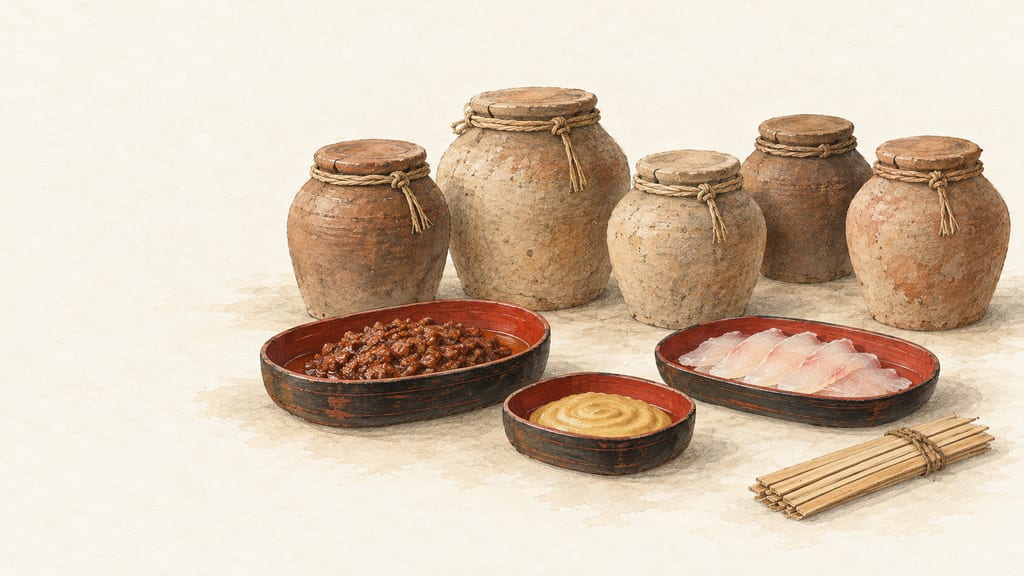
A hundred and twenty jars of jiang for the king's table
Chinese texts were counting jars of jiang, pairing it with raw fish and venison, and making it largely from meat long before anyone wrote down soy sauce. How a whole class of sauces narrowed to a bean paste.
Discussed in this article
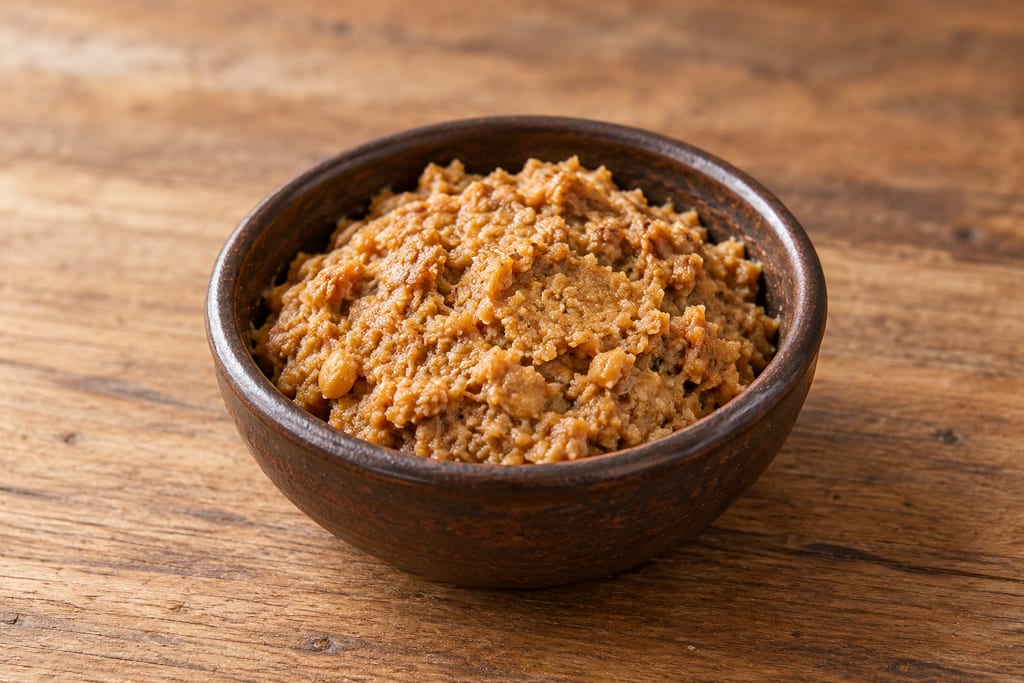
Doenjang
Doenjang (된장) is a Korean fermented soybean paste made by brining meju, separating ganjang, then mashing and aging the solids. This recipe follows one documented Sunchang processing study.
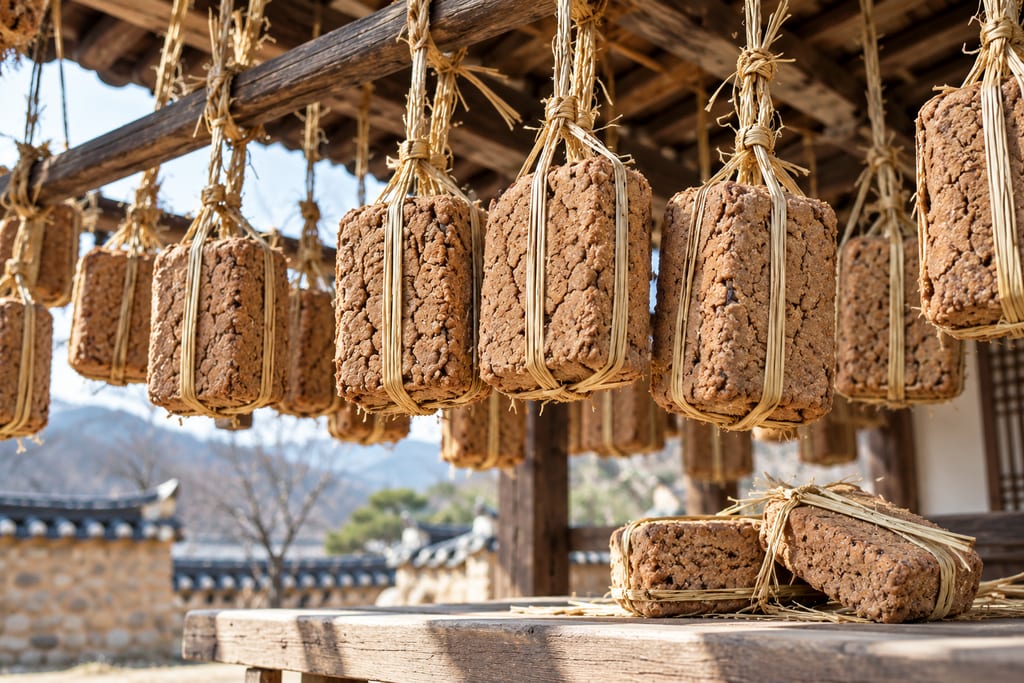
Doenjang meju
A cooked soybean brick, shaped and dried, that is fermented as a solid and later brined to make the Korean soy paste doenjang and the soy sauce ganjang.
Community
No community contributions have been published for this entry yet.
Share what you made
Sign in to contribute. Published comments and photos are free to read.
Sources
Korean Wikisource
Samguk sagi, volume 8: Silla annals 8, King SinmunCited in: The gifts for a king’s bride; A book written 462 years later; What the record supports
Journal of Ethnic Foods 6:5
The history and science of Chongkukjang, a Korean fermented soybean productCited in: A book written 462 years later; Si, and an argument about it; What the record supports
Korean Journal of Food and Nutrition 25(2):368–382
Jang (Fermented Soybean) in Official and Royal Documents in Chosun Dynasty PeriodCited in: When jang went on the ledger; What the record supports
UNESCO Intangible Cultural Heritage
Knowledge, beliefs and practices related to jang making in the Republic of KoreaCited in: A tradition kept in families
The Korea Times
Korean jang-making tradition earns UNESCO heritage statusCited in: When jang went on the ledger; What a block of meju does; A tradition kept in families
Food Science and Biotechnology 33(12):2815–2823
Microbial communities in the fermentation of Meju, a Korean traditional soybean brickCited in: What a block of meju does
Gaps
- The 683 entry was read from a Korean Wikisource transcription, not a critical edition, and the unit rendered here as loads is a word for a carrying frame whose size is unknown.
- The 671 entry and the 2018, 1527, 1241 and nineteenth-century references are known only through a later review, and the Joseon figures come from an abstract; no Joseon passage on famine relief was checked.
- The building history of palace jangdokdae is not documented in the sources used.
Updated 2026-10-29