
Home equipment crafts
Soy milk, tofu and yuba: why the pot's shape matters
Soybeans become a drink, a set curd or a lifted skin depending on how the hot milk is held: still in a deep container, broken and pressed in a mould, or spread wide in a shallow pan.
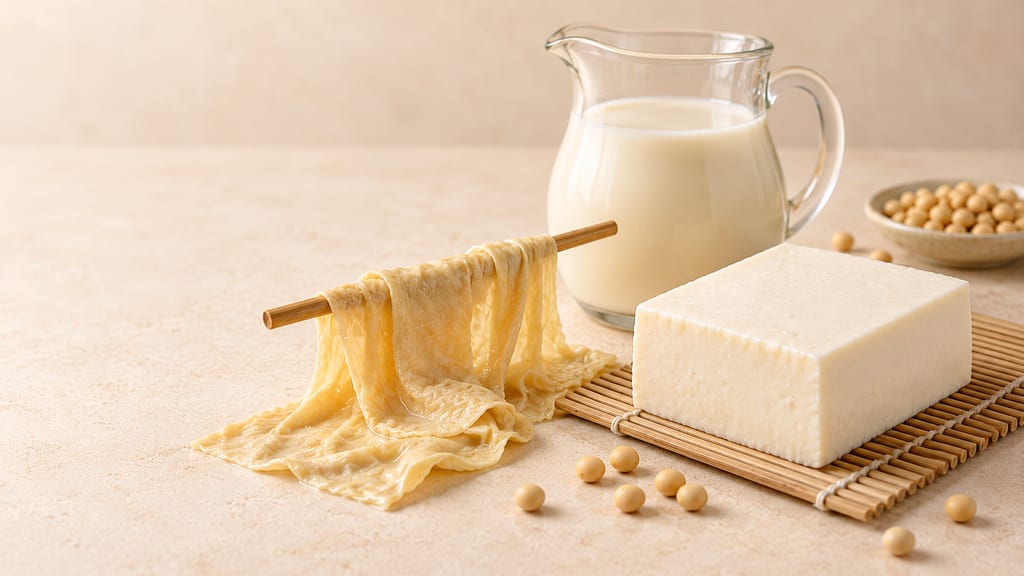
Soy milk, a block of fresh tofu and sheets of yuba: three foods from one pot of soybeans.
Three foods from one bean
Japan's Ministry of Agriculture, Forestry and Fisheries (MAFF) describes tofu in a way that also explains the other foods in this article. Ground soybeans are heated with water, the fibre and other insoluble matter are removed as okara, and the soy milk that remains is set with a coagulant. Yuba, in the ministry's words, is the film that forms on the surface of soy milk heated continuously, a food made only from soybeans in which their components are concentrated. Soy milk is the shared starting point. Tofu is that milk turned into a gel. Yuba is its surface, collected one sheet at a time. Okara, the pulp pressed out of the milk, is a fourth product.
The written history is thinner than the stories told about it. The soyfood historians William Shurtleff and Akiko Aoyagi place the earliest known mention of soy milk (doujiang) in Wang Ch'ung's Lun Heng of about AD 82, where its makers are said to fear that thunder will spoil their product. The earliest surviving document that uses the word for tofu is the Ch'ing I Lu, written by T'ao Ku in about 950. A legend credits Liu An, King of Huai-nan in the second century BC, with inventing tofu; Shurtleff and Aoyagi call that theory "probably the least likely to be true", since the book attributed to Liu An never mentions tofu and his name was attached to it centuries later. Some technical texts, including an FAO soybean bulletin of 1992, still say a written record dates from the second century BC, which matches the legend rather than any surviving text.
In Japan, MAFF says tofu arrived from China with Buddhism and was first eaten by nobles and priests, becoming everyday food in the Edo era. Its Kyoto page places the arrival in the Nara period, and Shurtleff and Aoyagi find the word tofu in a Japanese text by 1182. The ministry's regional pages show methods travelling with people. In Kanazawa, a man brought from Korea as a prisoner of war began making tofu in 1626, and the very firm katadofu of the Hakusan area is said to inherit his method. MAFF thinks the first tofu made in Japan was hard, like Okinawa's shimadofu or Ishikawa's katadofu, and that smooth kinugoshi came later, as makers learned to make a softer curd.
The three foods ask for different vessels: silken tofu sets as one still gel in its container, firm tofu is curdled, broken and pressed in a mould, and yuba needs as much open surface as possible.
Making soy milk: grind, heat, separate
Dry beans are soaked, then ground with water into a slurry, which Japanese makers call go. Shurtleff and Aoyagi record that Chinese makers traditionally filtered the raw purée first and boiled the milk afterwards, while Japanese makers boiled the slurry and then pressed the milk out of it, adding a few drops of shell ash mixed with vegetable oil to stop it boiling over. Both orders survive in one city in Ishikawa. MAFF describes the katadofu makers of Shiramine boiling the ground slurry for about 30 minutes before pressing it through cotton bags, while those of Kuwashima, also in Hakusan, squeeze the raw slurry by hand in a cotton bag laid on oak rods over a tub and then simmer the raw milk for about 30 minutes.
Heating does several jobs. Zeki Berk's 1992 FAO bulletin on soybean processing traces the "beany" taste to hexanals and heptanals formed when the enzyme lipoxidase oxidises soybean oil. These compounds are absent from sound dry beans and appear as soon as the beans are wetted and ground. Berk adds that heat also starts to inactivate the trypsin inhibitors in raw soybeans, which reduce digestibility. For tofu, heat is the first half of curd formation. A review of protein changes during tofu processing by Xiangfei Guan and colleagues calls denaturation a prerequisite: heating unfolds the soy proteins and exposes the hydrophobic and sulfhydryl groups tucked inside them, and the exposed proteins start to aggregate.
Two home recipes take another route. Maangchi's duyu, the Korean soy drink, soaks 2 cups (360 g) of dried soybeans for 10 to 12 hours, boils them uncovered in a large pot of water for 15 minutes, simmers them covered on very low heat for 5 more, then drains, rinses and cools them. For the drink she blends ½ cup of the cooked beans with 1½ cups of cold water, a teaspoon of toasted sesame seeds and a quarter teaspoon of salt for one to two minutes and serves it at once. She grinds the whole beans, skins and all, and the recipe has no straining step. Vitamix's soy milk follows the same order: soaked beans are steamed for 15 minutes, and 1½ cups (260 g) of them are blended with 4 cups (960 ml) of water and two dates for 60 seconds. Straining through a filtration bag or a fine sieve is offered only as an option.
These are drinks, not the milk used for tofu. In duyu the heat goes into whole beans before grinding, and the okara stays in the glass. Tofu milk is heated as a slurry, its okara is removed, and its strength is specified: Berk gives 5 to 6 per cent solids for regular tofu and 10 per cent for silken tofu, and notes that plain soy milk made at a bean-to-water ratio of 1:5 holds about 4 per cent protein. To make a tofu recipe behave as written, the cook has to match its milk, and the simplest control at home is to weigh beans and water every time. The blender replaces the stone mill (the article Mills, presses and extractors at home compares grinders), and heating is a separate job for a pot; cooking a large batch of beans in a brewing kettle is a reasonable idea that nobody has yet tried. Cooking whole beans first avoids heating a thick, foaming slurry, while the Japanese slurry route needs a vessel that can be stirred and has room to foam. A milk-like suspension cooked directly in a kettle can foam or scorch, so the safer course is to follow a specific recipe's sequence rather than improvise one.
How a coagulant sets the curd
Guan and colleagues describe salt coagulants as the most traditional and the most widely used: magnesium chloride, calcium chloride, magnesium sulfate and calcium sulfate. Setting happens in two steps, heat denaturation of the protein and then aggregation promoted by the metal ions, though researchers still debate exactly how the ions act. As the dose of a salt coagulant rises, the gel gets stronger and holds less water. Magnesium chloride dissolves easily and sets soy milk fast, and a curd that forms too fast has coarse particles and holds water poorly. Gypsum is the opposite: a small dose sets slowly, and a large one leaves a residue and a bitter taste.
Nigari, which Berk describes as a solution of magnesium salts, appears in several of MAFF's regional tofu pages. At Kuwashima the soy milk is warmed to 65–70 °C and nigari, described there as calcium chloride and magnesium chloride, is added while the milk is stirred with a wooden ladle; Shiramine warms its milk to the same range and adds sumashi-ko, which the page identifies as magnesium sulfate. In Berk's account of regular tofu, boiled soy milk is cooled to around 75 °C before a slurry of gypsum or a solution of nigari goes in. Kyoto's makers mostly use a coagulant they also call sumashi-ko, and MAFF's Kyoto page says that the timing, the amount and the way it is mixed in are where a maker's skill shows.
Glucono-delta-lactone, usually shortened to GDL, works differently. It is an acid coagulant: in soy milk it slowly turns into gluconic acid, and the acid lowers the pH toward the point where soy protein carries no net charge and clumps together. Guan's review notes that GDL sets more slowly than the salts and gives a soft tofu that does not stand up to frying. Yen Chang Tseng and Youling Xiong showed in 2009 how temperature drives this. They mixed GDL into protein-enriched soy milk and heated it from 20 to 90 °C at 1 °C a minute, or held it at 90 °C for 30 minutes. Their control samples began to gel at about 50 °C, by which time the pH had fallen to 5.95, and gelation depended on both the fall in pH and the heating temperature. A cold mix of soy milk and GDL sets slowly; warming it releases the acid faster and lets the denatured proteins aggregate.
The beans matter as much as the coagulant. In 2013 Aijun Yang and Andrew James made silken tofu from two soybean varieties, Bunya and Cowrie, using GDL or nigari at 1.5 to 5.0 g per kg. The firmest tofu came at 2.5 to 3.0 g per kg. Soaking the beans before grinding gave substantially firmer tofu than grinding them dry, and Bunya, which lacks one subunit of the storage protein glycinin, gave firmer tofu that lost less water. Those doses describe their soy milk and their test, not every bean and every coagulant.
Silken and firm: a still gel or a pressed curd
MAFF divides tofu into two main kinds. Momendofu is coarse-grained: the soy milk is set, the curd is broken, packed into a moulding box and pressed until it knits together again. Because water is squeezed out, momen is moderately firm and, weight for weight, carries more protein, fat, calcium, iron and fibre. Kinugoshidofu is fine-grained: thicker soy milk is simply set with a coagulant, nothing is squeezed out, and the tofu stays soft and keeps more potassium and B vitamins.
Silken tofu is the clearest case in this series where a home water bath copies an established factory process. Berk describes the factory method. Soy milk at 10 per cent solids is heated to 100 °C and cooled to room temperature, GDL is added, and the milk is filled into its retail containers and sealed. The containers are then heated in a water bath at 80–90 °C for 40 to 60 minutes, during which the GDL turns into gluconic acid and the protein sets as a single gel with no whey separating out. MAFF's Kyoto page describes the same principle as jūten tofu, in which soy milk and coagulant are sealed in a pack and the whole pack is heated until it sets. The container is the mould, and the gel never has to be moved.
Nobody has published a home version with stated doses, jar sizes and times. Setting small jars of soy milk and GDL in a sous-vide bath is an untested home version of the factory process; the bath arrangement itself is described in the companion article One bath, many small jars. The jars should be identical, the dose weighed and the probe placed in a jar rather than the bath; a deep jar heats through more slowly than a shallow one, so the time depends on the jar. Berk notes that silken tofu made this way is a pasteurised product that keeps well for only a few days under refrigeration.
Firm tofu needs different tools. In Berk's account of regular tofu, the soy milk is boiled and cooled to about 75 °C, the thin protein-lipid film on its surface is skimmed off, the coagulant is added, the whey is drained and the curd is pressed in perforated boxes into a coherent block. The block then sits in cold running water for several hours, to cool it and to leach out excess coagulant and trapped whey solids. The katadofu makers of Ishikawa pack the curd into an aluminium mould and press it with weights or a lever press. The result is so firm that a local story tells of a child hurt by bumping into the corner of a block.
So the two tofus ask different things of the pot. For silken tofu the whole volume must become one undisturbed gel in still, even heat. For firm tofu the pot only holds the milk at temperature while the coagulant is stirred in; then the curd leaves for a mould and a press. A stirrable inner pot in a water bath or a slow cooker could hold the milk for that step, but nobody has published a trial.
Yuba: a food made at the surface
MAFF's Kyoto page says yuba came from China in the Kamakura period and was used in Buddhist temple cooking, where Zen monks valued it for protein; the makers of Minobu in Yamanashi date their tradition to the monk Nichiren's arrival on Mount Minobu about 750 years ago. Shurtleff and Aoyagi, looking for documents, found the earliest Chinese reference in a text of 1695 that describes a firm layer floating on boiled soy milk "like wet paper". The Japanese word yuba first appears in 1813, Japan's oldest surviving yuba shop opened in 1716, and earlier arrival stories remain unconfirmed. In China the food is called doufupi, tofu skin, and a folded dried form is fuzhu.
The traditional methods use exactly the apparatus this series is about. In Kyoto, MAFF reports, soaked beans are ground in a mill and simmered over low heat to separate soy milk from okara. The milk goes into a pot fitted with a square wooden frame and is warmed either over a hot-water bath, yusen in Japanese, or over low heat. A thin film forms and is lifted off by hand or with a skewer; drying it gives dried yuba. At Minobu, strained soy milk goes into what MAFF calls a special flat pan, and each film is lifted carefully with a stick. Shurtleff and Aoyagi describe soy milk heated gently in shallow, open pans at 80–90 °C, and think early Chinese makers used shallow, round-bottomed pots over a bed of coals.
Food scientists now explain why the surface is everything. Weiyu Li and colleagues, writing in 2026, describe yuba as a protein-lipid film that assembles itself at the boundary between soy milk and air during heating. The proteins denature and link through disulfide bonds, oil bodies are caught in the growing network, and the continuous evaporation of water packs the structure tighter. Jicai Bi and colleagues add that heat splits the storage protein β-conglycinin into subunits whose exposed water-repelling regions drive aggregation. Because the film grows where water leaves and protein gathers, each sheet is as large as the exposed surface: a pan twice as wide makes twice as much skin at a time, while a deep kettle holds more milk but offers no more surface. A lid lets condensed water drip back, and a sealed bag removes the surface altogether.
Laboratories already use a water-bath pan. Li's team boiled soy milk of 7.0 per cent solids and pH 7.5 for three minutes, poured it into a stainless-steel pot, and stood the pot with its base fully immersed in a water bath held at 85 °C. They lifted a film every 20 minutes until no more would form, then dried the sheets at 60 °C for six hours; Junliang Chen's group also formed its films in a container in an 85 °C bath. With Kyoto's hot-water bath, that gives the shallow pan over controlled hot water both a traditional and a laboratory precedent. What has not been tested is a home version: a given pan in a given bath, the actual milk temperature, the time between sheets and the number of sheets per litre.
The same film appears whenever soy milk stands hot: in Berk's tofu process the skin on milk at about 75 °C is skimmed off as scum, and a cook making firm tofu can lift it and eat it. An electric skillet or shallow hotplate is the simplest home version. A hotplate method has been reported from a Japanese electric-cooking publication that has not been identified: unsweetened, unadjusted soy milk goes in as a shallow layer, the surface film is lifted again and again, the surface is kept still while each film develops, and the heat is turned down as the liquid level falls. The successive skins are used for wrapping or added to other dishes. The skillet's dial describes its heating control, not necessarily the milk's temperature, so a thermometer in the milk is still worth having. Fresh yuba can be eaten raw, MAFF notes, as sashimi at Minobu or with ponzu in Kyoto, where it also goes into hot pots and is wrapped around fish and fried.
Freezing tofu, and the dried kōri-dōfu
House Foods America, a tofu maker, tells customers that tofu can be frozen but "will become spongy in texture and oftentimes changes to a darkish caramel color". It advises draining off excess water, freezing the tofu in a plastic bag or container, and thawing it in the refrigerator or with a microwave's defrost setting. Used this way, the freezer makes a different ingredient: a firmer, more elastic and more porous block.
The change is physical and chemical. Rika Kobayashi and colleagues, studying tofu blocks during frozen storage in kōri-dōfu manufacture, found that ice keeps recrystallising after the block is frozen. That draws water away from the proteins, and the dehydrated proteins form new bonds with one another, especially the α and α′ subunits of β-conglycinin, so the curd hardens and turns elastic. In 2025 Lijuan Wang and colleagues froze tofu set with calcium chloride, calcium sulfate and magnesium chloride at −3 °C and at −21 °C for up to 21 days. Recrystallisation enlarged the pores and strengthened the protein bonds into a sponge-like honeycomb, and over the same time the tofu held at −3 °C hardened significantly more than the tofu at −21 °C. Holding the block just below freezing changes the texture more than freezing it hard, and that is what the Iwadeyama makers do; how a home freezer compares depends on its actual temperature. The starting tofu matters too. Akinori Ohisa and colleagues froze low-solids silken tofu at −10 °C and got a fibrous product unlike commercial kōri-dōfu; good kōri-dōfu needed a higher solids content, so firm tofu is the material to freeze.
Kōri-dōfu goes further. MAFF explains that fresh tofu is fragile and spoils easily, and that frying or drying makes it easier to handle and keep. Kōri-dōfu is the dried form, called kōya-dōfu in the Kansai region and shimi-dōfu in Tōhoku. The ministry's English page calls it freeze-dried, but its page for Iwadeyama in Miyagi describes freezing followed by drying in winter air, not drying in a vacuum chamber. Production there runs from December to March. Tofu made only from Miyagi soybeans and nigari is aged for about two weeks at a temperature just below freezing, then thawed, soaked to remove bitterness, tied with igusa rush and hung up. It is frozen a second time, a step the ministry calls particular to Iwadeyama, and dried in the cold, dry winter air for about a week. Local tradition dates the craft to 1842, when Saitō Shōgorō learned how to make its forerunner in Nara, and the product gained Japan's geographical indication in 2018. It holds its shape when simmered and soaks up dashi, so it goes into simmered dishes, oden, hot pots and the Sendai-style zōni eaten at New Year.
Industrial makers follow the same logic with machines. Berk describes tofu set with calcium chloride, cut into square tablets, frozen and kept frozen for up to three weeks, then thawed, pressed, air-dried and cured with ammonia gas before packing; traditionally, he adds, cold nights did the freezing. Maartje van den Belt and colleagues note that the modern product is dried to about 8 per cent moisture and cooks into a sponge that absorbs water and flavour.
The two products should not be confused. A home block frozen once is still wet tofu and must stay frozen or refrigerated. Kōri-dōfu is aged frozen, pressed, dried to low moisture and kept as a dry store food. A freezer can do the first stage; drying is a separate job with its own endpoint, and no tested home method for it has been published. The article Drying and freeze-drying at home explains why a dehydrator and a vacuum freeze-dryer are different machines.
Okara, the fourth product
Guan's review notes that okara, the pulp every batch leaves behind, is rich in dietary fibre, protein, fat and isoflavones, and that removing it loses those nutrients. Vayu Maini Rekdal and colleagues, in Nature Microbiology in 2024, describe okara as what remains after soluble protein and sugars are extracted into soy milk: mostly insoluble plant cell-wall polysaccharides, including pectin and cellulose.
In West Java that residue becomes food. Red oncom, oncom merah, is made from soy-milk okara, and black oncom, oncom hitam, from the presscake left after pressing peanut oil. Sampling small producers in Western Java, Maini Rekdal's team found the mould Neurospora intermedia dominant in red oncom. In their laboratory trials the fungus broke down the pectin and cellulose of okara, releasing sugars, and raised its protein content from 25 to 28 per cent. Oncom depends on that particular fungus and a proper incubation, not on whatever mould lands on wet okara; the incubation belongs to the article Fermentation cabinets.
A home soy workshop: what to try and what to measure
A useful afternoon's project divides one batch of tofu milk three ways: small identical jars for silken tofu, a pot for firm tofu, and a wide shallow pan standing in hot water for yuba. Soy milk has tested home recipes, and a hotplate yuba method has been reported; the jars, the inner pot and the bath-warmed pan are untested home versions of industrial, traditional and laboratory practice. The milks in these methods differ in strength, though. Berk gives 10 per cent solids for silken tofu and 5 to 6 per cent for regular tofu, and Li's yuba milk was 7 per cent, so a single batch suits one use best unless a thick milk is divided and diluted for the others.
The measurements that make results repeatable are simple. Weigh beans, water and coagulant, and express the coagulant per kilogram of soy milk, as Yang and James did. Put a probe in the food, not the bath: in the centre of a jar for silken tofu, in the milk for firm tofu, and just under the skin for yuba, because a bath setpoint or a skillet dial is not the food's temperature. For GDL tofu, note the temperature at which the jars set; Tseng and Xiong's samples began to gel near 50 °C. For yuba, log the time between sheets, the number of sheets and the volume of milk. For frozen tofu, note the freezer's actual temperature and the days held. Weigh the okara as well as the products.
Berk describes fresh tofu as a refrigerated perishable and says GDL silken tofu made his way keeps for only a few days in the refrigerator. For leftover tofu, House Foods advises keeping it covered with clean cold water in the fridge, changing the water daily and eating it within two or three days. No shelf life has been established for home-made silken tofu in jars or for home-made yuba, so treat both as fresh foods.
What the equipment cannot do
A controlled bath makes temperature repeatable, but it cannot change the beans: Yang and James found that variety and soaking method alone changed the firmness and water loss of silken tofu made with the same coagulant. A sealed jar heated in water is a pasteurised fresh food. Berk's shelf-stable tofu comes from soy milk heated to 130 °C and filled aseptically, and that is what lets it keep for months without refrigeration. A freezer supplies the cold nights of Iwadeyama but not its drying winter air, so it makes the first stage of kōri-dōfu, not the finished food. And no appliance makes yuba under a lid or inside a bag: the skin forms only where hot soy milk meets open air.
What is still unknown
No published home method sets silken tofu in jars in a water bath with stated soy milk solids, coagulant dose, jar size and time, so every number in such a trial has to be measured. The laboratory yuba pans ran at a bath setpoint of 85 °C with a fixed interval between sheets, but nobody has reported the milk temperature, evaporation rate or yield of a home pan in a home bath.
Home cooks also lack a simple way to measure the solids content of their soy milk, the number every tofu method depends on. Weighing beans and water keeps batches consistent, but it does not show whether the milk matches the 5, 7 or 10 per cent that the published methods assume.
Related
Discussed in this article
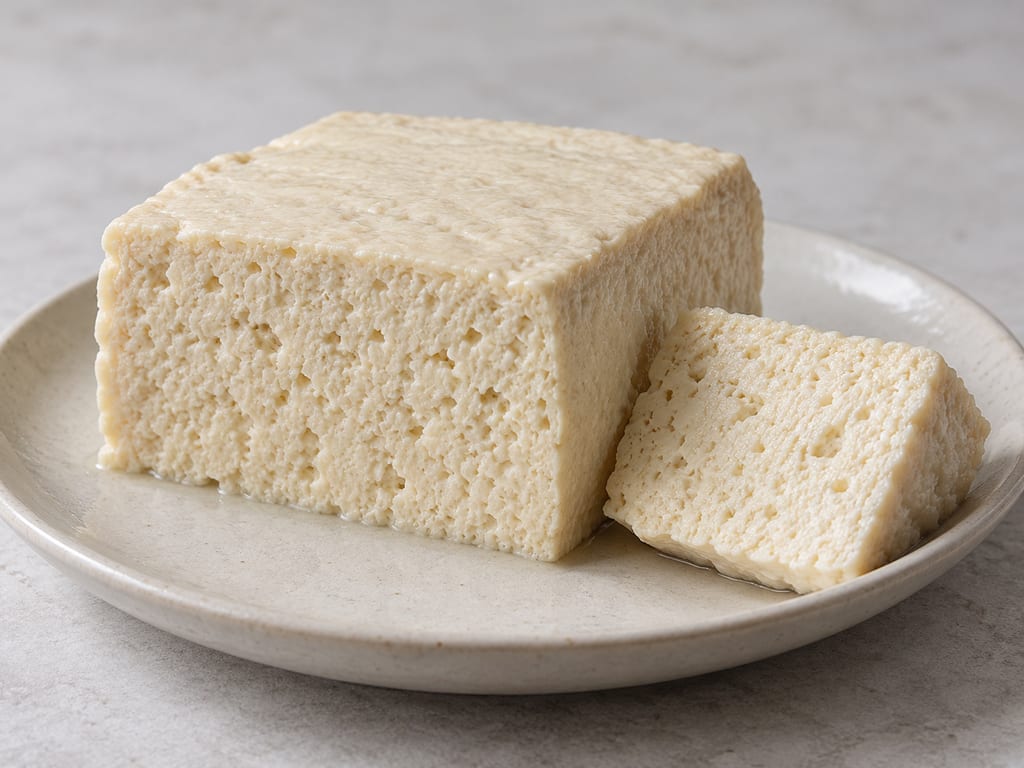
Frozen tofu (home freezer)
Drained firm tofu frozen in a home freezer so that ice reshapes the curd into a firmer, spongy, porous block for cooking; not the dried kori-dofu.
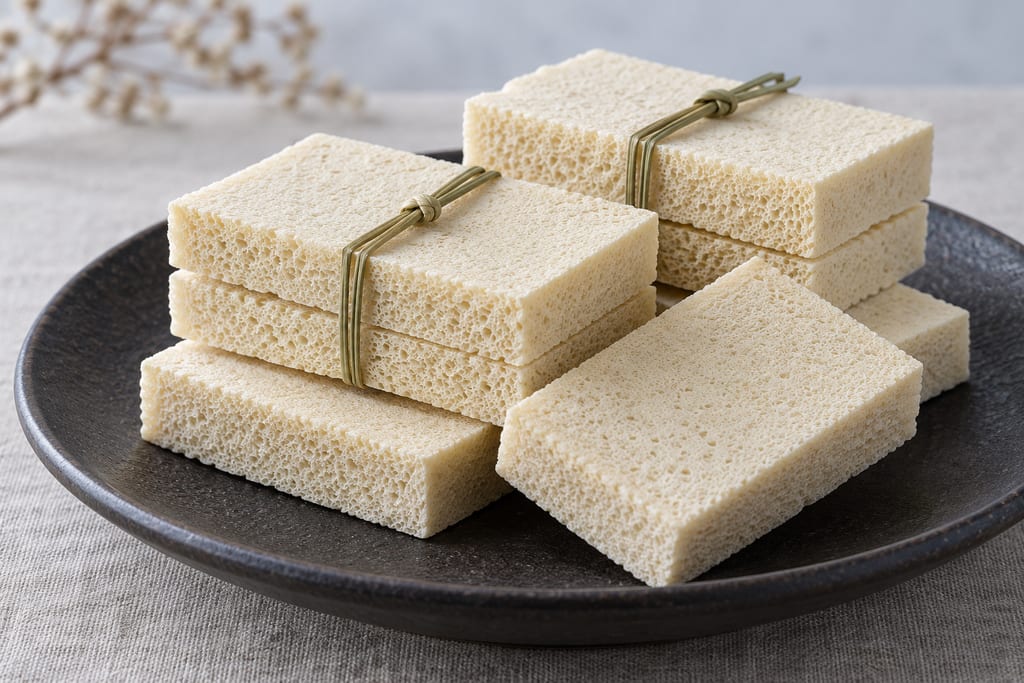
Kōri-dōfu (frozen and dried tofu)
Japanese tofu frozen, aged below freezing, thawed and dried to a light sponge that is simmered in dashi; Iwadeyama makes it in winter air.
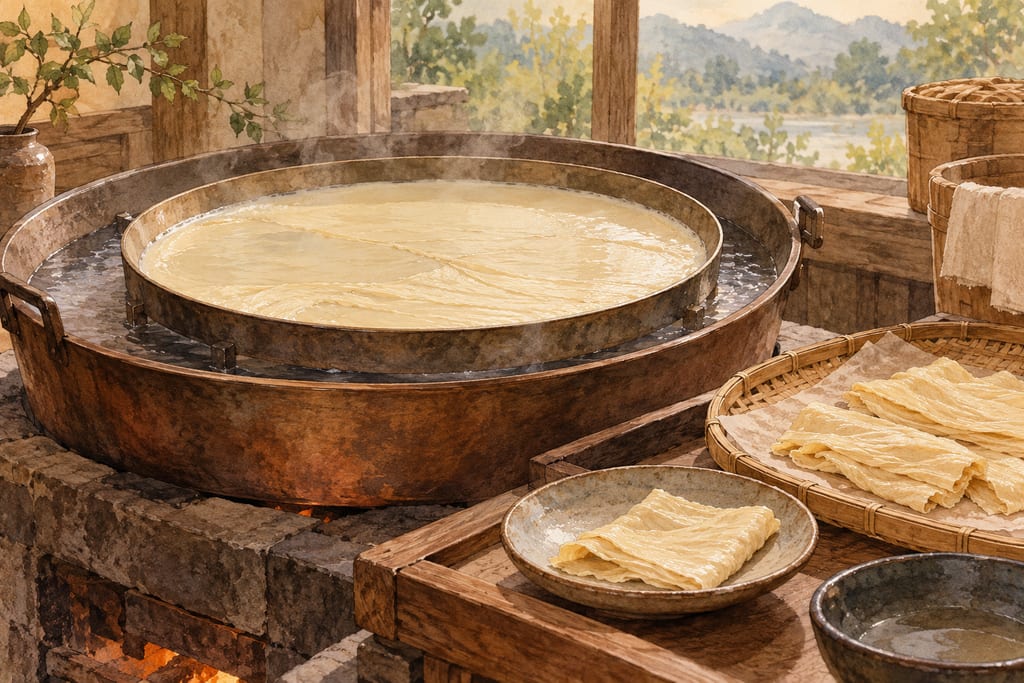
Shallow pan over controlled hot water (yuba pan)
A wide shallow pan of soy milk standing in a controlled hot-water bath, so that the bath heats evenly while the open surface forms film after film of yuba.
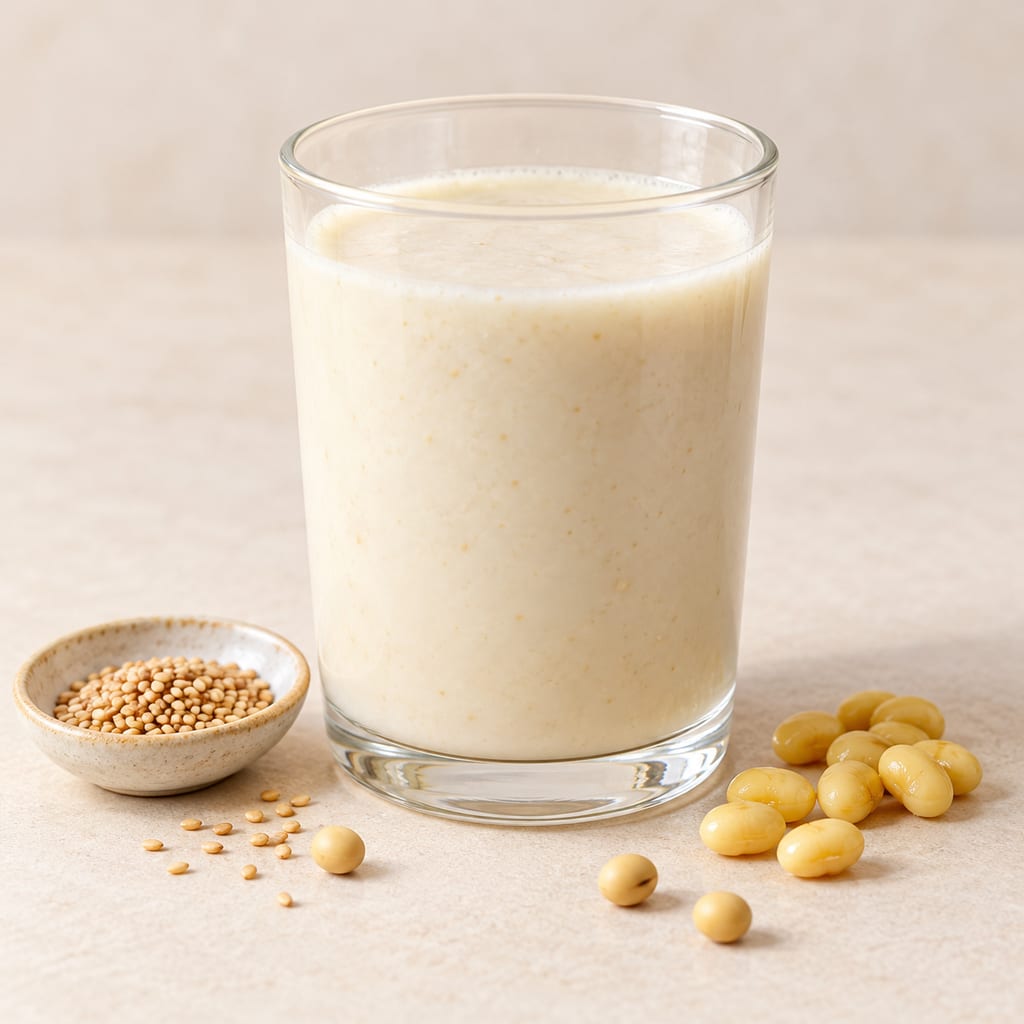
Soy milk (duyu)
A Korean-style soy drink of cooked whole soybeans blended with cold water, sesame and salt and served at once; tofu-making soy milk is a different, filtered milk.
Community
No community contributions have been published for this entry yet.
Share what you made
Sign in to contribute. Published comments and photos are free to read.
Sources
Ministry of Agriculture, Forestry and Fisheries (MAFF), Japan
Processed bean products | Traditional Foods in Japan : MAFFCited in: Three foods from one bean; Silken and firm: a still gel or a pressed curd; Yuba: a food made at the surface; Freezing tofu, and the dried kōri-dōfu
Soyinfo Center
History of Soymilk and Dairy-like Soymilk Products - Page 1Cited in: Three foods from one bean; Making soy milk: grind, heat, separate
Ministry of Agriculture, Forestry and Fisheries (MAFF), Japan
京豆腐(きょうどうふ・きょうとうふ)|にっぽん伝統食図鑑:農林水産省Cited in: Three foods from one bean; How a coagulant sets the curd; Silken and firm: a still gel or a pressed curd
Ministry of Agriculture, Forestry and Fisheries (MAFF), Japan
堅豆腐(かたどうふ)|にっぽん伝統食図鑑:農林水産省Cited in: Three foods from one bean; Making soy milk: grind, heat, separate; How a coagulant sets the curd; Silken and firm: a still gel or a pressed curd
FAO (Agricultural Services Bulletin No. 97, 1992)
Technology of production of edible flours and protein products from soybeans. Chapter 9.Cited in: Three foods from one bean; How a coagulant sets the curd; Silken and firm: a still gel or a pressed curd; Yuba: a food made at the surface; Freezing tofu, and the dried kōri-dōfu; A home soy workshop: what to try and what to measure; What the equipment cannot do; What is still unknown
FAO (Agricultural Services Bulletin No. 97, 1992)
Technology of production of edible flours and protein products from soybeans. Chapter 8.Cited in: Making soy milk: grind, heat, separate
Foods 10(7):1594 (MDPI), 2021
Changes of Soybean Protein during Tofu ProcessingCited in: Making soy milk: grind, heat, separate; How a coagulant sets the curd; Okara, the fourth product
Maangchi (maangchi.com)
Soy milk (Duyu: 두유) recipe by MaangchiCited in: Making soy milk: grind, heat, separate; A home soy workshop: what to try and what to measure
Vitamix
Soy MilkCited in: Making soy milk: grind, heat, separate; A home soy workshop: what to try and what to measure
Journal of Food Engineering 90(4):511–516 (record at University of Kentucky Scholars)
Effect of inulin on the rheological properties of silken tofu coagulated with glucono-δ-lactoneCited in: How a coagulant sets the curd; A home soy workshop: what to try and what to measure
Journal of the Science of Food and Agriculture 93(12):3065–3071, 2013
Effects of soybean protein composition and processing conditions on silken tofu propertiesCited in: How a coagulant sets the curd; A home soy workshop: what to try and what to measure; What the equipment cannot do; What is still unknown
Ministry of Agriculture, Forestry and Fisheries (MAFF), Japan
京湯葉(きょうゆば)|にっぽん伝統食図鑑:農林水産省Cited in: Yuba: a food made at the surface
Ministry of Agriculture, Forestry and Fisheries (MAFF), Japan
身延ゆば(みのぶゆば)|にっぽん伝統食図鑑:農林水産省Cited in: Yuba: a food made at the surface
Foods 15(6):1094 (MDPI), 2026
Microwave Pretreatment of Soybeans Prior to Soaking Enhances Mechanical and Rehydration Properties of YubaCited in: Yuba: a food made at the surface; A home soy workshop: what to try and what to measure; What the equipment cannot do; What is still unknown
Food Chemistry: X 24:101987, 2024
Quality variation analysis and rehydration kinetics modeling of yuba subjecting to three different drying processCited in: Yuba: a food made at the surface
Foods 14(16):2916 (MDPI), 2025
Characterization of Whey Protein Isolate–Soymilk Complexes Modified by Transglutaminase and Their Application in Yuba FilmCited in: Yuba: a food made at the surface
House Foods America Corporation
How To Store Tofu | House FoodsCited in: Freezing tofu, and the dried kōri-dōfu; A home soy workshop: what to try and what to measure
Food Hydrocolloids 104, 2020
Property changes of frozen soybean curd during frozen storage in “Kori-tofu” manufacturing processCited in: Freezing tofu, and the dried kōri-dōfu
LWT – Food Science and Technology 238, 2025
Effects of ripening conditions on protein conformation and quality of frozen tofu prepared by different coagulantsCited in: Freezing tofu, and the dried kōri-dōfu
日本調理科学会誌 (Journal of Cookery Science of Japan) 39(6):354–356, 2006
固形分濃度の低い絹ごし豆腐を用いた凍り豆腐の調整Cited in: Freezing tofu, and the dried kōri-dōfu
Nutrients 15(1):49 (MDPI), 2022
Effect of 4-Week Consumption of Soy Kori-tofu on Cardiometabolic Health Markers: A Double-Blind Randomized Controlled Cross-Over Trial in Adults with Mildly Elevated Cholesterol LevelsCited in: Freezing tofu, and the dried kōri-dōfu
Ministry of Agriculture, Forestry and Fisheries (MAFF), Japan
凍り豆腐(こおりどうふ)|にっぽん伝統食図鑑:農林水産省Cited in: Freezing tofu, and the dried kōri-dōfu; What the equipment cannot do
Nature Microbiology 9:2666–2683, 2024
Neurospora intermedia from a traditional fermented food enables waste-to-food conversionCited in: Okara, the fourth product
Gaps
- No published home method sets silken tofu in jars in a water bath with stated soy milk solids, GDL dose, jar size and bath time.
- The milk temperature and yield of the hotplate yuba method are unknown.
- No home water-bath yuba pan has reported milk temperature, evaporation rate or sheets per litre; the laboratory reports give only an 85 °C bath setpoint.
- Kōri-dōfu is described as freeze-dried on one MAFF page and as frozen and then dried in winter air on another.
- Berk's FAO bulletin repeats a second-century-BC written record for tofu that Shurtleff and Aoyagi do not support.
- Home cooks have no simple way to measure soy milk solids against the 5–6, 7 and 10 per cent the published methods assume.
Updated 2026-10-27