
Vegetables
Sauerkraut on the Baltimore Thanksgiving table
In Baltimore, sauerkraut goes beside the Thanksgiving turkey. The habit runs back through Pennsylvania German kraut tubs, the Bremen emigrant ships and an 1843 advertisement on Howard Street.
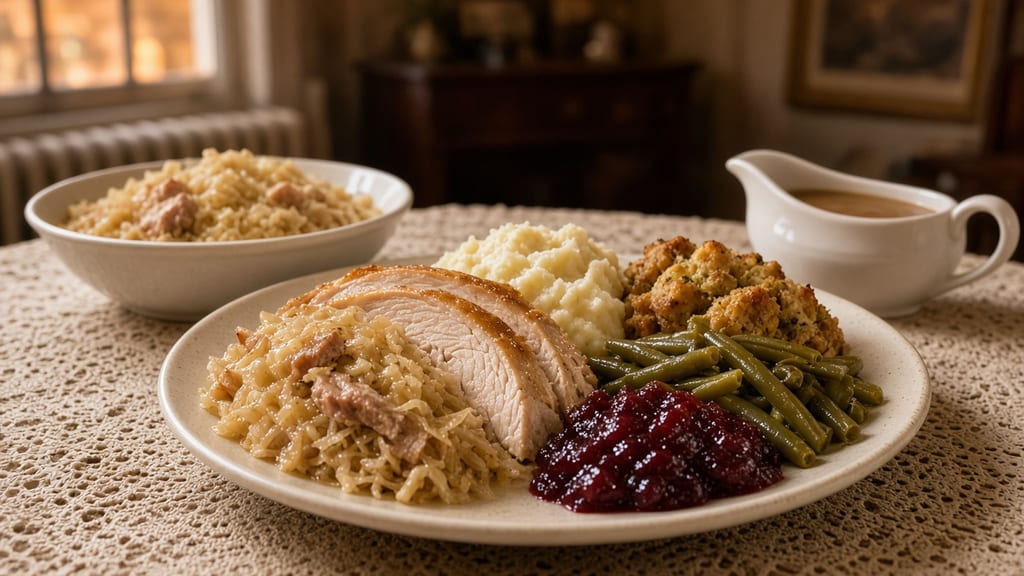
A generated still life of a Baltimore Thanksgiving plate, with sauerkraut stewed with pork beside the turkey.
A superior article of sauer-kraut
On 13 November 1843 the Baltimore Sun carried an advertisement from William Boddmann's pickling house and vinegar depot on Howard Street. It offered "a superior article of SAUER-KRAUT." The Banner's food writer Christina Tkacik traced it as the first mention of sauerkraut in the paper's archive, and she noticed the date. It fell just before Maryland's own Thanksgiving, a statewide holiday decades before the Civil War.
In November 2026 Tkacik joined a sold-out workshop at Hex Ferments in North Baltimore, where students rubbed salt into shredded cabbage and packed it into jars to take home. Tracy Douglass had come with her sister Wendy. "My mom cooks it every Thanksgiving and Christmas," she said. "It's been a tradition in our family since I was a kid." Most home cooks in the city buy their kraut in pouches at the grocery store. They still put it beside the turkey.
The chef and cookbook writer John Shields, owner of Gertrude's Chesapeake Kitchen at the Baltimore Museum of Art, grew up among Italian neighbours and remembers kraut next to ravioli and roast turkey. "Some people pile their plate up, but everybody feels like they have to put at least a tablespoon on their plate for Thanksgiving," he told Baltimore Magazine in 2022. Leaving it off, he said, could bring bad luck. Tonya Thomas, chef at the caterer H3irloom Food Group, told the food historian Kara Mae Harris: "No matter who you are and what your race, in Baltimore, sauerkraut is on the table at holidays." Thomas can trace the dish in her own family to well before the twentieth century.
In most of the United States, sauerkraut with turkey sounds like a mistake. In Baltimore it is ordinary. Three histories meet on that plate. One is the cabbage culture of the Pennsylvania Germans, carried across the Atlantic in the eighteenth century. One is the shipping trade that tied Baltimore to Bremen and landed hundreds of thousands of Germans in the city. The last is the shops, newspapers and cooks who sold, printed and served kraut until families with no German grandparents called it their own. Nobody has shown how the dish attached itself to Thanksgiving. The record does show how it reached the table.
Cabbage on the Pennsylvania farms
Sauerkraut reached the Mid-Atlantic long before the steamships. German-speaking immigrants settled southeastern Pennsylvania in the eighteenth century, and their descendants, the Pennsylvania Dutch, made kraut a staple. The Goschenhoppen historian Alan Keyser has gathered the early descriptions. In 1786 the Lutheran pastor John Frederick Ernst reported that his parishioners in "Dryland", Northampton County, ate both sauerkraut and Sieskraut. The Polish traveller Julian Ursyn Niemcewicz, in Lancaster County in 1797 and 1798, wrote that sour cabbage seasoned with salt pork, potatoes and a piece of smoked meat was the food of even the most well-to-do.
The physician James Mease wrote in 1804: "In Pennsylvania it is a very fashionable dish among the Germans, and when prepared with neatness, is highly palatable, especially when eaten with salt pork." The pork had a calendar behind it. Sauerkraut was ready to eat before butchering time in late November, Keyser explains, so families first ate it with salt pork kept from the year before and changed to fresh pork once the pigs were killed.
Kraut travelled with the people who made it. In 1774 the Lutheran pastor Henry Melchior Muhlenberg was visiting the congregation in Charleston, South Carolina, when a Philadelphia friend sent him a package of sauerkraut. Muhlenberg compared it to the "gift of a costly medicine" and admitted that he shared in the whole family's pleasure in it. Patrick Donmoyer, director of the Pennsylvania German Cultural Heritage Center at Kutztown University, writes that pork and sauerkraut is now known wherever Pennsylvania Dutch families have spread across North America. The folklorist Don Yoder defined their cultural hearth as about 15,000 square miles of southeastern and central Pennsylvania, roughly the size of Switzerland.
Plane, tub and stamper
The tools came from the German countryside, and German museums still keep them. The Hennebergisches Museum Kloster Veßra in Thuringia chose a cabbage plane, a Krauthobel, as its object of the month for October 2026. It is almost a metre long, with three blades set into the wood and a box that slides along grooved rails, and the front of the box bears the year 1786. The curator Meike Leyde explains that the year may mark the owners' wedding, because planes were classic wedding gifts for a new household, and that villages and neighbours shared them for the yearly kraut making. Shredded cabbage went into a barrel in layers with salt, each layer pressed down with a stamper. Juice that rose to the top was skimmed off, and the barrel was closed with a wooden lid held down by a stone.
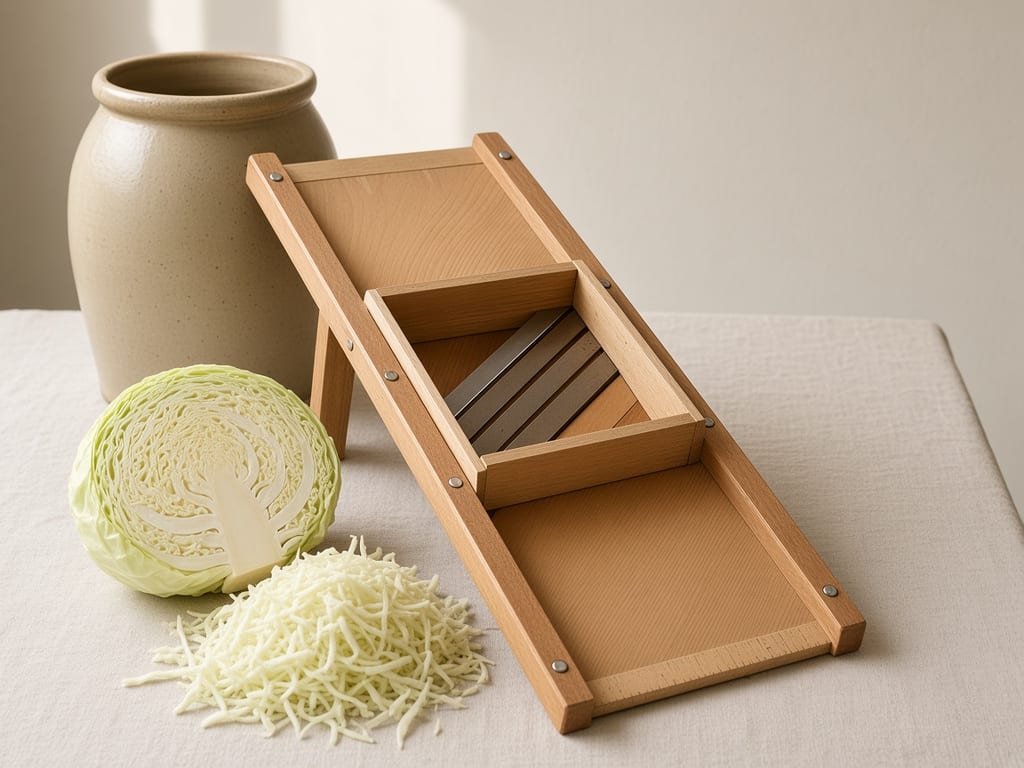
In the Palatine village of Thaleischweiler-Fröschen, the local heritage lexicon remembers cutters who went from house to house between September and Christmas with sharp planes and cut people's cabbage for them. For many years the cutter there was Willi Hoffmann of Biebermühler Straße. The cut cabbage went into a stoneware pot in layers strewn with salt and juniper berries. The pot was covered with a cloth and a two-part board, so the kraut could swell, then weighted with stones and left in a cool cellar until the middle of November. In 2016 the open-air museum at Hösseringen in Lower Saxony invited visitors to watch a team led by Wolfgang Fröhlich make Sauerkohl in a fermenting tub with a plane, salt, a little buttermilk and fine white cabbage.
Pennsylvania kept the same kit under dialect names. Keyser describes the Grauthowwel, a board with knives over a slot and a sliding box for the head, and the Grautschtenner, a tall cedar tub called a "krout stand" in period English. Victor Dieffenbach, writing in 1952 about his grandparents, remembered his grandmother trimming the heads, his grandfather cutting out the cores with a triangular cut, his father working the cutter and his sister spreading layers of about four inches into the tub with coarse salt. Then came what he called the fun of the entire job, ramming each layer with the kraut stamper until salt and juice rose and covered the cabbage.
German reference works describe the same chemistry today. The salt is about 2 per cent of the cabbage. Stamping bursts the cells so the juice runs out, and the brine has to cover the cabbage for about two to six weeks, depending on temperature, while lactic acid bacteria sour it. Until newer preserving methods arrived, sauerkraut was one of the main winter foods in Germany, Austria, the Netherlands and Poland.
Moon signs and the week of St Gall
Printed instructions appeared early in English. In 1819 the Albany paper The Plough Boy carried a method from southeastern Pennsylvania. Cut the cabbage fine, layer it in a strong cask, and salt and pound each layer until it is wet. Cover it with a cloth, a board and a heavy weight. About a week later a thick scum rises. The writer says to lift off the weight, board and cloth, wipe the cabbage with a wet cloth, "or it will smell," and wash the cloth before putting everything back. Families kept a large flat stone, usually from a local creek, washed and saved as the weight for the kraut tub. Two years later Anthony Willich's Domestic Encyclopedia, printed in Philadelphia, put "about a handful of salt and caraway seeds" between the layers.
Folk belief set the dates. Russell Gilbert, writing in the Allentown Morning Call in 1944, recorded that kraut made when the moon is in Pisces turns watery. Don Yoder, in his 1961 study of sauerkraut in Pennsylvania folk culture, reported that people avoided the week of St Gall's Day, 16 October, known in the dialect as die Gallewoch, because kraut made then would turn bitter. Yoder read the belief as a play on bitter gall, not devotion to the Irish missionary whose day it was. Early autumn stayed sauerkraut season. A 1934 Bethlehem cookbook said a filled tub had to stand about three weeks until it was done working.
Bremen and the tobacco ships
Baltimore's German story runs alongside Pennsylvania's and then outgrows it. German immigrants settled in Baltimore soon after the town was founded, and in 1755, led by the physician Charles Frederick Wiesenthal, German Lutherans founded the congregation that became Zion Church. The German-language Wikipedia notes that Zion has held German services at the same site without a break since 1755, the oldest such congregation in the United States. In 1783 the German Society of Maryland was founded to help new arrivals, a date the Deutsches Auswandererhaus in Bremerhaven gives in its own account of Baltimore.
Trade built the bridge. Nicholas Fessenden, writing for the Society for the History of the Germans in Maryland, shows that Baltimore merchants traded cotton and tobacco for Bremen linen and glassware from the 1790s, and that between 1794 and 1799 half of the American ships landing in Bremen came from Baltimore. Westbound ships carried little freight, so the space between the hold and the deck went to passengers. The emigrant trade turned out to pay better than German goods. Immigration to Baltimore rose from about 1,400 a year in the 1820s to about 6,000 a year in the 1830s.
Between 1830 and 1860, Fessenden writes, eighty per cent of the immigrants landing in Baltimore came from Germany, and most of the rest from Ireland. In Philadelphia, New York and Boston the Irish were the largest group. He puts the difference down to the close trade between Baltimore and Bremen. By the last third of the century, one Baltimorean in four had been born in Germany or had German-born parents. In 1880, 32,685 of the city's 56,354 foreign-born residents were Germans, and the foreign-born made up 16.9 per cent of the city. By 1894 the city's Germans had built thirty-two churches where they worshipped in their own language. The Bremerhaven museum puts the total who entered the United States through Baltimore at about two million, which made it the second immigration port after New York.
The pier at Locust Point
On 16 January 1867 the Baltimore and Ohio Railroad and the North German Lloyd of Bremen signed an agreement. The railroad would build an immigration pier at Locust Point and connect it to its network, and the Lloyd would send at least one immigrant ship a month. On 23 March 1868 the Lloyd steamer Baltimore passed Fort McHenry on its maiden voyage and docked at the new pier with 141 passengers. All but three had been born in Germany. Baltimoreans celebrated for three days, with a parade down Broadway in Fells Point. Fessenden counts 1.2 million immigrants landed at Locust Point before 1914. Germans were the largest group until 1890, and after that most came from Eastern Europe.
Many of the new arrivals boarded B&O trains for the Midwest. Those who stayed found a German city ready for them. Baltimore's Germans published eight German-language newspapers. Friedrich Raine, a nineteen-year-old from a Westphalian family of printers, founded Der Deutsche Correspondent in 1841. It started with eight subscribers, became a daily in 1848 and reached about 15,000 copies in the 1880s and 1890s. In 1904 the German Evangelical congregation in Locust Point built an Immigrant House five blocks from the pier, with room, board and job placement. The Baltimore Immigration Museum opened in the same building in 2016.
The later arrivals mattered for the cabbage too. After 1890 most of the passengers came from the Russian and Austro-Hungarian empires, and Poles settled in Canton, Fells Point and Highlandtown. Harris counts these Eastern European immigrants among the people who brought sauerkraut to Baltimore. She named her essay on Baltimore kraut after a 1974 recipe for kapusta and kilbash in the Loyola Mothers' Club cookbook: sauerkraut cooked with bacon, apple, brown sugar and Polish sausage. The Baltimore dish draws on several Central European kitchens, and the German one came first.
Sauer-kraut on Howard Street
Sauerkraut was a shop product in Baltimore early. Boddmann's 1843 advertisement is the first in the Sun's archive. Harris spells the name Bodmann. Abraham Lincoln made Thanksgiving a national holiday only in 1863, twenty years after the advertisement.
Cookbooks show the dish moving out of German households. Elizabeth Ellicott Lea's Domestic Cookery of 1845, a Maryland book, has two recipes for sauerkraut, both filed under "cabbage". The earliest Maryland recipe that uses the name is in Mary Lloyd Tyson's Queen of the Kitchen of 1870, and Harris notes that Tyson could have bought her kraut ready-made at Bodmann's. By 1886 the Baltimore County Union reported that sauerkraut, "instead of being tabooed, as formerly, had become quite a favorite dish upon our most fashionable tables."
Turkey without sauerkraut
By the early twentieth century the pairing had a public voice. In 1921 the Baltimore Sun quoted "Francois", head waiter at the Belvedere Hotel: "turkey without sauerkraut is like terrapin without champagne." Terrapin was the Chesapeake's luxury dish, so the comparison put kraut among the finest things on the table. Holiday sauerkraut also appeared wherever Germans had settled in western Maryland. Frederick newspapers advertised Thanksgiving specials of oysters, cranberries, turkeys and sauerkraut, and a 1930 advertisement in the Hagerstown Daily Mail offered homemade mincemeat and sauerkraut in late November.
The custom crossed the colour line as well. Harris found Christmas advertisements for sauerkraut in Baltimore's Afro-American by 1916, and in 1933 the paper printed a recipe for making it at home. Tonya Thomas's grandmother cooked hers with pigtails, which suited the practice of Black home cooks of using every part of the animal. Thomas later changed to smoked turkey, and she now also makes a version with vegetable stock and spices for H3irloom's vegan guests. Other Maryland recipes in Harris's database cook it with turkey neck bones, with noodles in a manuscript from Hoffmanville in Baltimore County, with pork, or with apples.
Liberty cabbage and a closed newspaper
The First World War put German food and German speech under suspicion. American dealers sold sauerkraut as liberty cabbage during the war. In January 1917 Der Deutsche Correspondent printed photographs and poems for the Kaiser's birthday, and a year later it was warning Baltimore Germans not to support his war policies. It closed on 28 April 1918 under anti-German pressure. Many of its staff moved to the Bayrische Wochenblatt, and the two papers merged into a German weekly, the Baltimore Correspondent.
German also disappeared from the curriculum of Baltimore's public schools. Zion Church answered in 1929 by founding a German Language School for children, which now teaches more adults than children. The language retreated into churches and clubs. The food went the other way. In the accounts Harris and Baltimore Magazine collected, Shields's Italian neighbours, Polish delis and Black family cooks all treat holiday kraut as their own custom.
New Year in Pennsylvania
Baltimore attached its kraut to Thanksgiving. The Pennsylvania Dutch put theirs on New Year's Day, and the reason was butchering. Donmoyer writes that families and neighbours gathered to kill hogs on one of the coldest days of the year. It was one of the rare times fresh pork was roasted on the farm, and it was served with sauerkraut as the customary New Year's dinner. Muhlenberg's diary for New Year's Day 1781 records a gift of "a pudding broth", the butcher soup called Metzelsupp that neighbours sent each other after the killing. Penn State Extension gives a plainer reason for the date: cabbage harvested in the autumn and made into sauerkraut finishes fermenting at the end of December.
The table explanation today is a proverb. The pig roots forward with its snout and the chicken scratches backward, so a year that looks forward begins with pork. Kraut with fresh pork at butchering time has a European twin. In Alsace the butcher's platter, the Schlachtplatte, is choucroute garnie, garnished sauerkraut.
The side dishes have their own lore. The folklorist Walter Hoffman wrote in 1889 that mashed potatoes usually went with sauerkraut and that apple butter was eaten on the bread, in the belief that its acidity cut the grease of cabbage and meat and prevented nausea from overeating. A Pennsylvania woman writing to the New York Evening Post in 1907 described kraut boiled with a good-sized piece of fresh pork and served with mashed potatoes and dumplings, Knep, cooked in the kraut liquid and covered with browned butter. A dialect proverb held that kraut only becomes good once it has been warmed up seven times. The Plough Boy of 1819 printed a cooking method from a "Woman of Philadelphia": squeeze the kraut in clean water, boil it two and a half hours with the pork in the middle, and lift it with a brass skimmer, since anything of iron would turn it black.
Why Baltimore
No source settles why the habit took root in Baltimore when other American cities with large German and Eastern European populations did not make kraut a Thanksgiving dish. Harris writes that nobody knows how or why sauerkraut became so cross-cultural in Baltimore in particular. Three partial explanations are on offer, and each is a theory.
The first is timing. Tkacik points out that many other American cities with large German populations lie further north, where the autumn cabbage harvest can come later. Cooks like Meaghan Carpenter's Minnesota grandmother, who said sauerkraut was still slaw until it was nine months old, may not have had a crock ready by late November. Penn State Extension's figure of about three to four weeks at 21–23 °C, or 21–24 °C, fits the idea, but Tkacik offers it as her own theory and nobody has tested it against harvest records.
The second is the calendar. Maryland kept a statewide Thanksgiving before the Civil War, and Tkacik suggests that German Baltimoreans may have marked an unfamiliar American holiday with a familiar food. Boddmann's advertisement shows a merchant expecting to sell kraut in the days before the feast. The third is numbers. Germans were the largest immigrant group in Baltimore through most of the nineteenth century, and Thomas points out that they were the largest when Lincoln made Thanksgiving national in 1863. Through shops, hotels, newspapers and neighbours their winter food reached people of every background. The Belvedere's head waiter shows that by 1921 the city's grand hotels treated kraut with turkey as normal.
Crocks in the basement now
Hex Ferments, which Meaghan Carpenter founded with her husband Shane, now runs autumn workshops where participants massage cabbage with salt and take home a jar to finish on the counter. Carpenter, a Minnesota native, had not heard of the Baltimore custom when the business started. Gertrude's holds an annual Krautfest in January, and for it Shields and his team ferment several hundred pounds of sauerkraut for dishes such as spaetzle casserole and vegan bratwurst.
For a holiday batch in a crock, the tested home method comes from the same Pennsylvania country where the tradition started. Penn State Extension's Let's Preserve guide says that a one-gallon crock holds five pounds of shredded cabbage and a five-gallon crock holds twenty-five, and it sets the ratio at three tablespoons of canning or pickling salt for every five pounds. It warns that changing the proportions could produce an unsafe product. The National Center for Home Food Preservation gives the same ratio and a yield of about nine quarts from twenty-five pounds. Fermentea's white cabbage sauerkraut records the one-gallon version. The five-gallon crock sauerkraut records the larger batch, held down with a sealed bag of brine and left alone until bubbling stops.
The plane, the tub, the creek stone and the stamper have mostly gone to museums in Thuringia and Pennsylvania. The salt is now measured by the tablespoon, where Dieffenbach's sister judged it by hand over each four-inch layer. The season has not moved. Pennsylvania farmers would not start kraut in the week of St Gall's Day, 16 October. A crock packed the week after and kept at 21–23 °C would finish in three to four weeks, around the date in November when Boddmann advertised his sauer-kraut on Howard Street.
Related
Discussed in this article
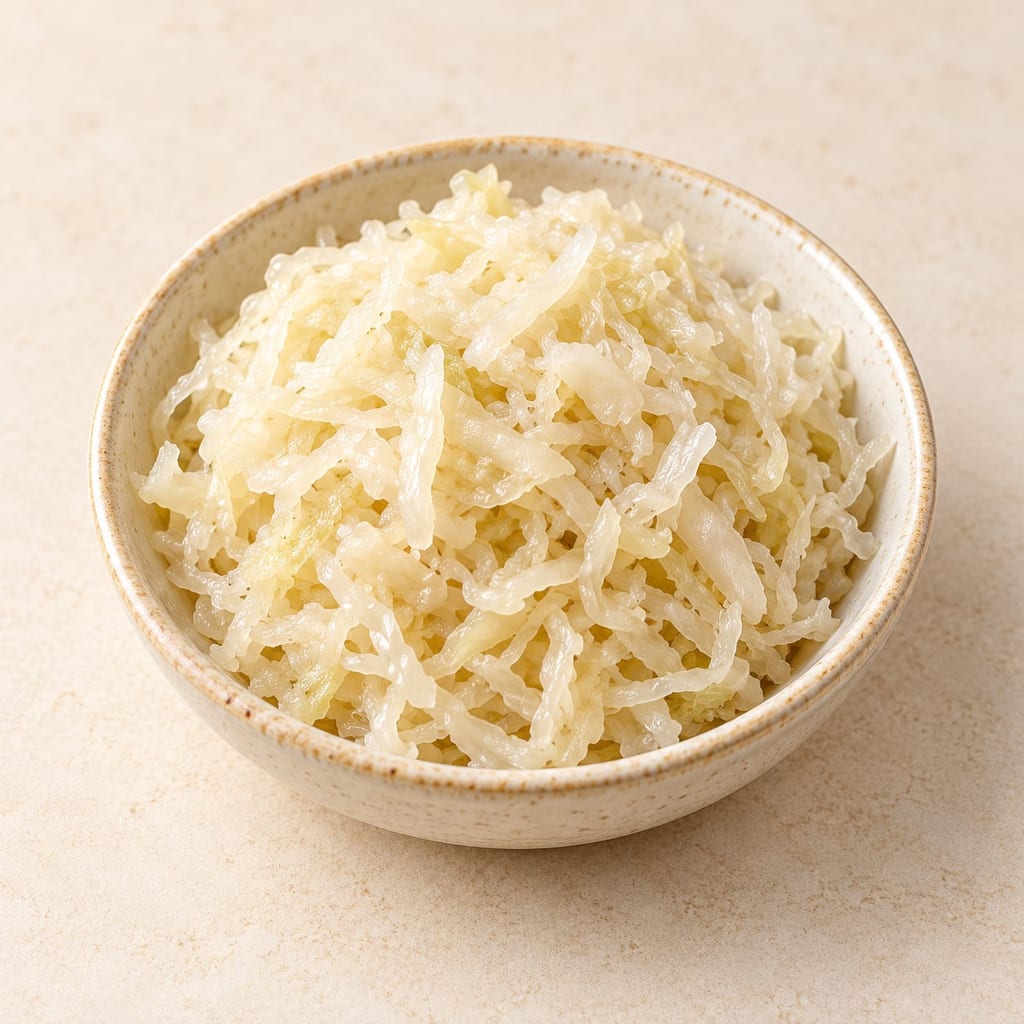
Choucroute d’Alsace
Finely cut cabbage fermented with salt in vats by natural lactic fermentation, a protected Alsatian product sold raw or cooked after fermentation.
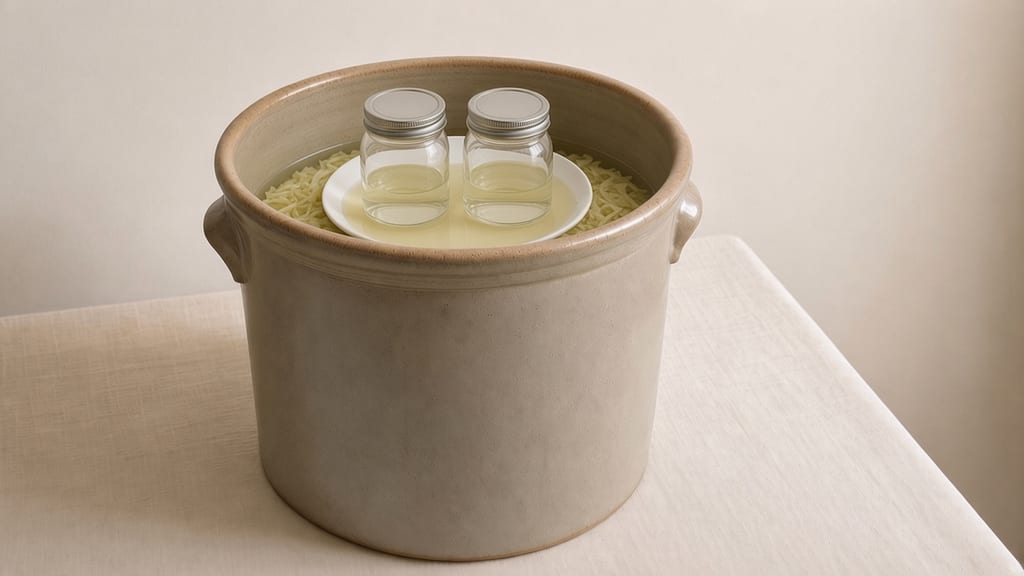
Pennsylvania German five-gallon crock sauerkraut
Twenty-five pounds of late cabbage salted at 3 tablespoons per 5 lb, packed in a five-gallon crock under a sealed brine bag and left alone until bubbling stops, about four weeks.
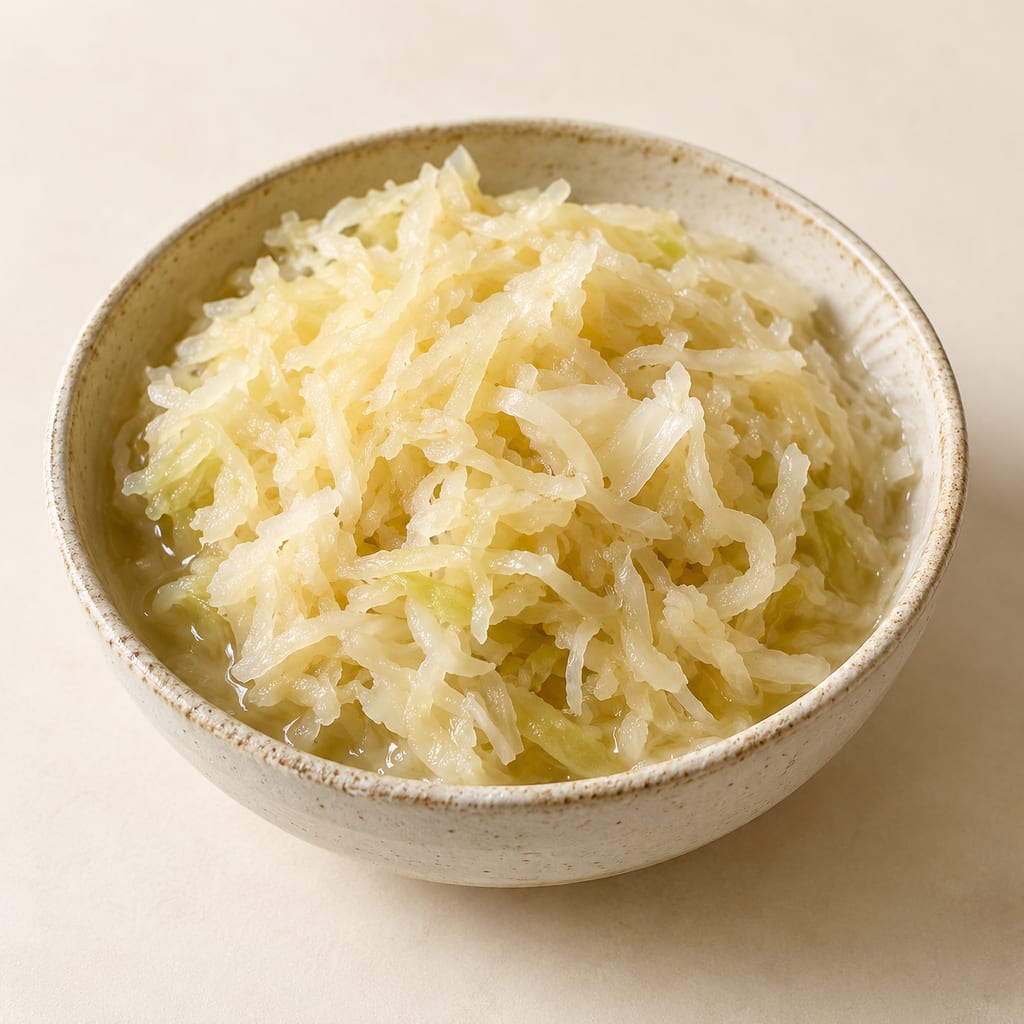
White cabbage sauerkraut
A Penn State Extension crock method mixes 5 lb of shredded cabbage with 3 tablespoons of canning or pickling salt, packs it under its own brine and ferments it in a covered container.
Community
No community contributions have been published for this entry yet.
Share what you made
Sign in to contribute. Published comments and photos are free to read.
Sources
Grace Hebron, Baltimore Magazine, 17 November 2022
How Did Sauerkraut Become a Staple on Baltimoreans' Thanksgiving Plates?Cited in: A superior article of sauer-kraut; Liberty cabbage and a closed newspaper; Why Baltimore; Crocks in the basement now
Kara Mae Harris, Old Line Plate, 21 November 2023
Kapusta And Kilbash (and Sauerkraut for Thanksgiving)Cited in: A superior article of sauer-kraut; The pier at Locust Point; Sauer-kraut on Howard Street; Turkey without sauerkraut; Liberty cabbage and a closed newspaper; Why Baltimore
Christina Tkacik, The Banner, 10 November 2026
Baltimoreans rediscover the joy of making Thanksgiving sauerkraut from scratchCited in: A superior article of sauer-kraut; Sauer-kraut on Howard Street; Why Baltimore; Crocks in the basement now
Alan Keyser, Pennsylvania Dutch At-Home Companion, Mennonite Heritage Center, 2020
SauerkrautCited in: Cabbage on the Pennsylvania farms; Plane, tub and stamper; Moon signs and the week of St Gall; New Year in Pennsylvania
Patrick J. Donmoyer, Pennsylvania Heritage, Winter 2023
A Wish, a Dish & a Fish: New Year's Rituals of the Pennsylvania DutchCited in: Cabbage on the Pennsylvania farms; New Year in Pennsylvania
Nicholas B. Fessenden, The Report 48, Society for the History of the Germans in Maryland
Norddeutscher Lloyd and Baltimore: a transatlantic partnershipCited in: Bremen and the tobacco ships; The pier at Locust Point; Why Baltimore
Wikipedia
Der Deutsche CorrespondentCited in: The pier at Locust Point; Liberty cabbage and a closed newspaper
Deutschsprachige Wikipedia
Zion Church of the City of BaltimoreCited in: Bremen and the tobacco ships; Liberty cabbage and a closed newspaper
Deutsches Auswandererhaus Bremerhaven
Die Spuren deutscher AuswanderungCited in: Bremen and the tobacco ships
Deutschsprachige Wikipedia
SauerkrautCited in: Plane, tub and stamper; Liberty cabbage and a closed newspaper; New Year in Pennsylvania
Meike Leyde, Hennebergisches Museum Kloster Veßra, 1 October 2026
Altbewährt: der KrauthobelCited in: Plane, tub and stamper
Penn State Extension, 2022
Let's Preserve: Fermentation - Sauerkraut and PicklesCited in: Why Baltimore; Crocks in the basement now
Penn State Extension, updated 14 September 2024
Fall Is the Time to Make SauerkrautCited in: New Year in Pennsylvania
Gaps
- Whether Der Deutsche Correspondent or Baltimore's other German-language papers advertised sauerkraut for Thanksgiving is not established.
- The 1843 Sun advertiser appears as Boddmann in The Banner and as Bodmann in Old Line Plate; the spelling in the original advertisement is unconfirmed.
- A line about kraut in every Baltimore basement, credited to H. L. Mencken by John Shields, has not been traced to any Mencken text and is left out.
- Why Baltimore, and not other cities with large German populations, made kraut a Thanksgiving dish is unknown; harvest timing and Maryland's early statewide Thanksgiving are journalists' theories.
Updated 2026-11-20