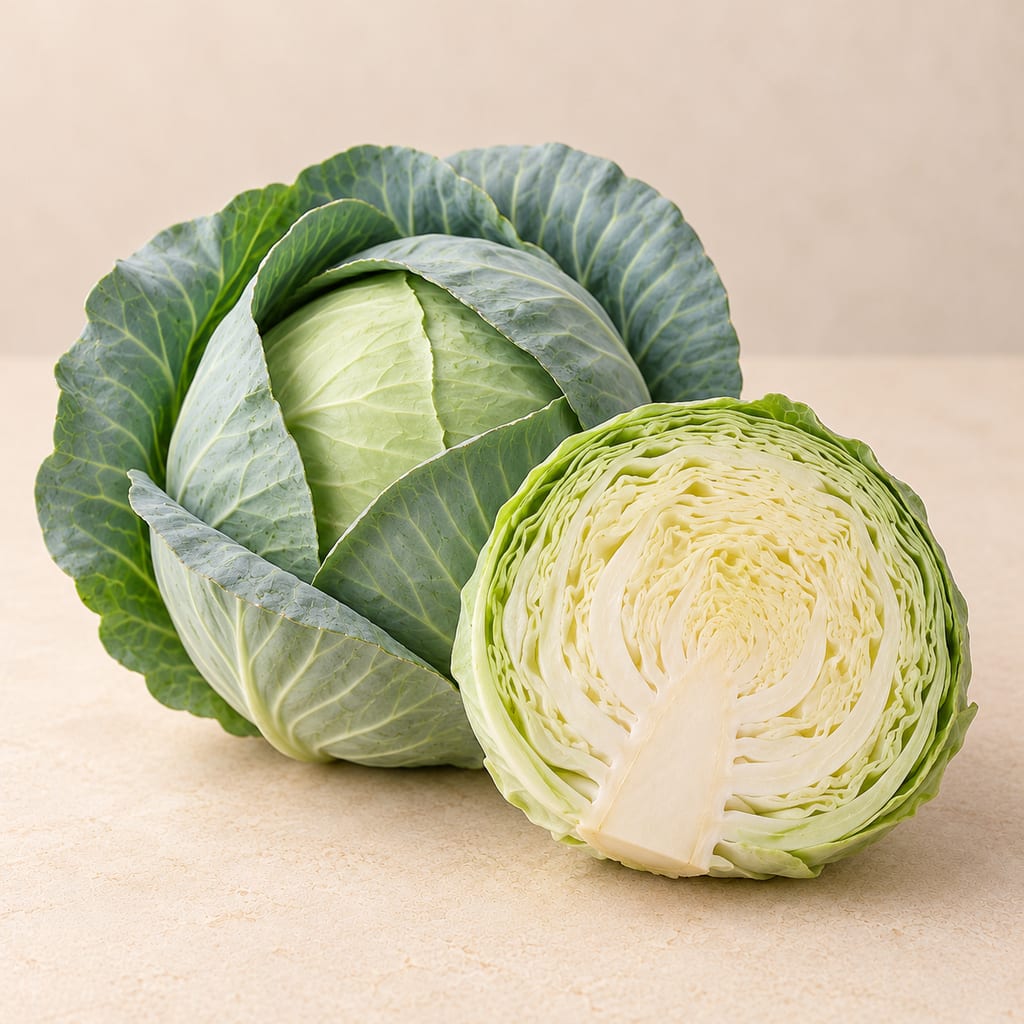
Cabbage
Cabbage is the dense leafy head of Brassica oleracea, a European vegetable that keeps for months and is the classic raw material for sauerkraut, with napa cabbage the base of kimchi.
 FermenteaWhere food goes to change
Traditional method
Sauerkraut
A Penn State Extension crock method mixes 5 lb of shredded cabbage with 3 tablespoons of canning or pickling salt, packs it under its own brine and ferments it in a covered container.
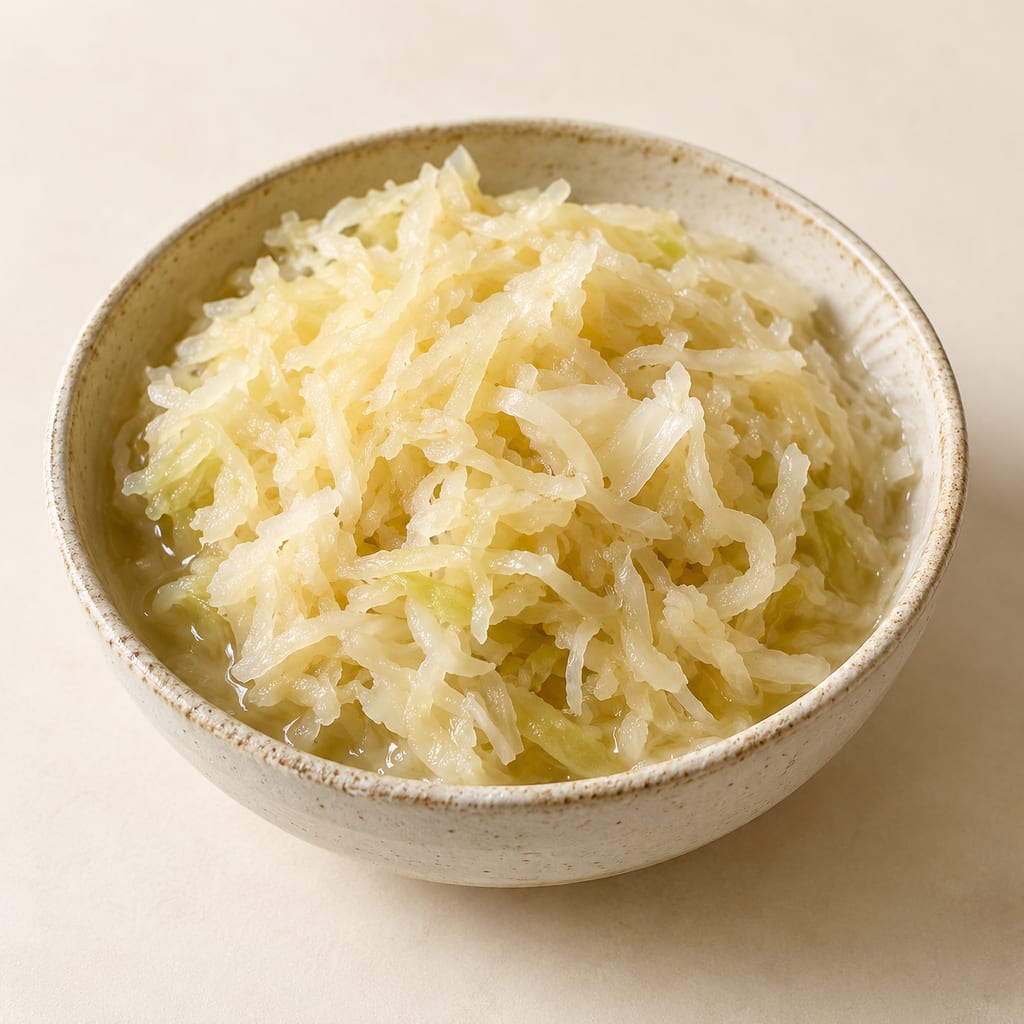
Sauerkraut is white or pale-green cabbage preserved through lactic acid fermentation. Fresh cabbage is shredded, mixed with salt and packed tightly so that its own juices form the surrounding brine.
The vegetables are kept submerged while naturally occurring microorganisms ferment some of the cabbage's sugars.
Over time, the mixture becomes acidic and develops the sour flavour associated with traditional sauerkraut.
The defining feature is that the initial liquid comes principally from the cabbage itself rather than from a separately prepared pickling vinegar.
Sauerkraut is not simply cabbage stored in salt. Its characteristic taste and preservation properties arise from the combined effects of salt, microbial activity and acidification.
A successful preparation retains some firmness while developing a clean, sour flavour.
German — Sauerkraut
Czech — Kysané zelí, kyselé zelí
Slovak — Kyslá kapusta
Polish — Kapusta kiszona, kapusta kwaszona
French — Choucroute
Dutch — Zuurkool
Hungarian — Savanyú káposzta
White cabbage belongs to Brassica oleracea Capitata Group.
The cultivated cabbage used for sauerkraut is a member of the wider brassica family.
Sauerkraut is especially associated with German-speaking Central Europe, but fermented cabbage traditions extend beyond modern national boundaries.
The Bundeszentrum für Ernährung (BZfE) names sauerkraut as a German fermented food and describes fermentation broadly as a way people prepared food for winter. This supports a German association and preservation context; it does not establish sauerkraut's origin or show that this National Center for Home Food Preservation batch is a German regional method.
Cabbage could be preserved in multiple ways, including brining, salting and lactic fermentation.
The history of the modern dry-salted shredded product should not be confused with every earlier example of pickled cabbage.
One important distinction concerns liquid.
In dry-salted sauerkraut, the cabbage releases enough juice to create much of its own brine.
In other cabbage preparations, a large quantity of separately prepared brine may be added.
The Oxford Companion to Food discusses the development of sauerkraut from earlier forms of pickled cabbage and suggests that the recognisable modern style became established by the seventeenth century.
Accounts proposing a direct origin in ancient China and transmission westwards exist, but that particular route should not be presented as a demonstrated continuous history.
Related fermentation techniques can develop in different agricultural cultures because the underlying chemistry is widely applicable.
The strongest historical conclusion is that sauerkraut belongs to a long European tradition of preserving cabbage through acidification, with especially strong associations across German-speaking and neighbouring Central European regions.
Cabbage has several characteristics that make it useful for fermentation.
Its leaves contain water, naturally occurring sugars and microorganisms acquired from the growing environment.
The dense head can be shredded into narrow pieces, providing a large surface area.
Salt helps draw water out of the damaged plant tissues.
The released liquid can then surround the cabbage and limit its exposure to air.
The sugars provide energy for microorganisms capable of fermentation.
Cabbage also contains fibrous cell-wall material, allowing the finished product to retain texture when the process is well controlled.
Late-season cabbage varieties are often favoured because mature firm heads can provide suitable structure and sugar content.
Poor-quality or diseased cabbage is not a suitable starting material.
Salt affects the process in several different ways.
First, it creates an osmotic pressure difference between the vegetable tissue and the surrounding environment.
Water moves out of the cabbage cells.
Second, salt changes which microorganisms can grow successfully.
Some microorganisms are more tolerant of salty conditions than others.
Third, salt influences texture and enzyme activity.
A correct measured quantity is therefore not merely a seasoning preference.
Too little salt can permit undesirable microbial growth.
Excessive salt may inhibit or slow the organisms needed for successful lactic fermentation.
Salt concentration, temperature and the available plant sugars act together.
This is why established home-preservation sources warn against changing the salt ratio casually.
Fresh cabbage carries a mixed microbiota.
During spontaneous fermentation, several kinds of lactic acid bacteria may become important.
Early fermentation often involves organisms belonging to Leuconostoc.
Species such as Leuconostoc mesenteroides can produce lactic acid, carbon dioxide and other metabolites.
As the environment becomes more acidic, different organisms can become dominant.
Lactiplantibacillus plantarum and related acid-tolerant bacteria are particularly important in many established sauerkraut fermentations.
Scientific studies also identify Pediococcus, Levilactobacillus and other genera.
The precise sequence is not identical in every batch.
Cabbage source, temperature, initial microbial populations and salt concentration all influence the community.
Some bacteria perform heterolactic fermentation, producing multiple metabolites, including acids and gas.
Others convert available sugars principally into lactic acid.
This changing microbial community is responsible for much of sauerkraut's development.
As lactic acid accumulates, the pH decreases.
The environment becomes progressively less suitable for many undesirable microorganisms.
The cabbage's flavour changes from fresh and relatively mild to distinctly sour.
Acidity also influences the texture and behaviour of plant tissues.
However, acidification alone is not a complete explanation of preservation.
Salt, correct fermentation conditions, submersion and hygienic handling all remain important.
A low pH may be an important safety parameter in fermented vegetables, but the National Center for Home Food Preservation's sauerkraut recipe does not provide one mandatory measured pH endpoint.
An arbitrary number should therefore not be inserted into the recipe as though it were part of that tested formulation.
This structured recipe records Penn State Extension's crock batch: 5 lb shredded cabbage and 3 tablespoons of canning or pickling salt.
Penn State states that the exact ratio controls pathogen growth and that changing the proportions could result in an unsafe product.
The National Center for Home Food Preservation separately lists 25 lb cabbage, ¾ cup canning or pickling salt and an estimated yield of about 9 quarts. In its method, it also instructs the reader to use 3 tablespoons per 5 lb portion.
Five 5 lb portions at 3 tablespoons each total 15 tablespoons; ¾ US cup is 12 tablespoons. These source quantities conflict. This recipe uses Penn State's independently documented 5 lb crock formula and does not reconcile or substitute a salt quantity for NCHFP's 25 lb entry.
Penn State's separate small-jar procedure uses 3½ tablespoons of salt per 5 lb cabbage. That is a different method and is not the batch recorded here.
Use a food-grade fermentation container, a large knife or cabbage shredder, a clean bowl, suitable weights and a covering that allows fermentation gases to escape.
A ceramic fermentation crock or appropriate food-grade plastic container can be used.
Avoid reactive metal containers and unsuitable plastics.
Containers must be clean and free from residues of non-food chemicals.
The weights must hold the cabbage beneath its liquid.
A brine-filled food-safe bag is one documented approach.
Choose firm, fresh, mature heads.
Begin processing within 24–48 hours after harvest where possible.
Remove unsuitable outer leaves and reject damaged or decaying tissue.
Rinse under cold running water.
Drain and cut each head into quarters.
Remove the core.
Slice the cabbage into narrow strips.
The tested guidance describes a thickness approximately that of a US quarter coin.
Penn State provides a more specific thin-cut suggestion of approximately 1⁄16 inch (1.5 mm).
Even cutting helps create a consistent texture and allows salt to distribute throughout the mixture.
Weigh 5 lb of shredded cabbage.
For this Penn State crock batch, thoroughly mix in 3 tablespoons of canning or pickling salt.
Do not combine this batch with NCHFP's separate 25 lb and ¾ cup total as if the aggregate quantities agreed.
Pack, pound or squeeze the cabbage with clean hands until natural juice covers its surface.
Penn State says to add boiled and cooled brine at 1½ tablespoons of salt per quart of water if the natural juice does not cover the cabbage.
Pack the prepared cabbage into a fermentation container, continuing only in 5 lb cabbage portions mixed with 3 tablespoons of canning or pickling salt per portion.
Penn State describes a 1-gallon crock as holding 5 lb of shredded cabbage; that capacity is not a yield estimate.
The natural juice should cover the cabbage.
If it does not, Penn State specifies boiled and cooled brine made from 1½ tablespoons of salt per quart of water.
Place a suitable plate and weight over the cabbage.
Keep all vegetable material below the brine.
Cover the container with a clean cloth or suitable fermentation cover.
Allow fermentation gases to escape without admitting unnecessary contamination.
Penn State gives two temperature and time schedules for this crock method.
70–75°F (21–23°C) — about 3–4 weeks.
60–65°F (15–18°C) — about 6 weeks.
Below 60°F (15°C), sauerkraut may not ferment; above 80°F (26°C), it may become soft and spoil.
These source schedules do not establish a universal completion date or a measured safe endpoint.
Where a suitable brine-filled bag maintains coverage, the recorded method recommends leaving the crock undisturbed until normal fermentation is complete.
With other weighing methods, it describes inspection 2–3 times weekly and removal of surface scum as appropriate.
Normal bubbling eventually diminishes.
The finished cabbage should have developed an appropriate clean sour flavour and retain a suitable texture.
Do not taste suspicious or mouldy batches.
Penn State Extension documents a separate small-batch jar procedure.
It uses a different ratio: 3½ tablespoons of canning salt per 5 lb of cabbage, mixed and left to wilt for 10 minutes before packing.
The procedure specifies approximately 2 inches (5 cm) headspace, weighting the cabbage beneath brine and checking the jars two or three times per week.
This jar procedure is not the 3 tablespoons per 5 lb crock batch recorded above.
German sauerkraut is frequently cooked with pork, sausage or other savoury ingredients.
In Alsace, choucroute garnie is associated with a substantial assembly of sauerkraut and meats.
Czech kysané zelí can be served cooked alongside roast pork and dumplings.
Polish kapusta kiszona appears in soups, stews and dishes such as bigos.
Slovak sour cabbage is used in dishes including kapustnica.
These culinary traditions share fermentation as a foundation but differ in later preparation.
Some cooks add caraway, juniper or other seasonings.
Such additions should be presented as variants rather than silently incorporated into the tested plain-cabbage preservation recipe.
The cabbage releases liquid after salting.
Bubbles may appear as microorganisms produce gas.
The aroma changes from fresh cabbage towards a clean sour smell.
The cabbage may gradually lose some of its vivid fresh colour.
A successful batch should not be slimy or show unacceptable mould growth.
The absence of visible bubbling at a particular moment does not necessarily mean fermentation failed, especially in a covered container.
Temperature and stage of fermentation affect gas production.
Soft cabbage: Excessive warmth or unsuitable fermentation conditions may be involved.
Insufficient brine: The vegetables are exposed to air and spoilage risk. Restore coverage using the recorded method's documented method.
Visible mould: Do not taste the affected batch. The conservative course is disposal.
Slimy texture: Treat as a failure rather than evidence of successful fermentation.
Strong rotten odour: Reject the product.
Fermentation remains inactive: Conditions may be too cold, or other factors may have inhibited desirable microbial activity.
Do not reduce the prescribed salt for dietary reasons while assuming the tested process remains valid.
Finished sauerkraut can be refrigerated, frozen or canned using an established processing schedule.
The NCHFP provides different boiling-water processing times for raw and hot packs, jar sizes and altitudes. These must be followed directly rather than replaced with a single universal canning duration.
Sauerkraut may be eaten cold as a side dish or cooked into other foods.
When cooked, its acidity becomes part of the wider dish.
Pork and other fatty meats are particularly compatible with its sourness.
In soups, the cabbage contributes both texture and acid.
In Central Europe it can accompany potatoes, dumplings, bread or sausages.
Raw unpasteurised sauerkraut may contain living microorganisms, but that does not automatically make every batch a clinically validated probiotic food.
Cooking or canning changes the survival of those organisms.
The NCHFP source documents a contemporary U.S. home-preservation recipe, not an origin. BZfE's 2023 German article names sauerkraut as German and describes fermentation broadly as a way of preparing winter provisions; this supports a bounded association and context, not a date of origin or a regional identity for the NCHFP batch.
Scaling: source batch only
Poor brine coverage or inadequate acidity monitoring can allow spoilage; recipe-specific validated limits are not established.
Hazard sourceUse the source's measured salt-to-cabbage ratio, clean food-grade equipment, and keep the cabbage submerged beneath brine.
Control sourceIf natural juices do not cover the cabbage, Penn State specifies boiled and cooled brine made with 1½ tablespoons salt per quart of water.
Control sourceThe National Center for Home Food Preservation lists 25 lb cabbage with ¾ cup salt, while its method also specifies 3 tablespoons per 5 lb portion; the aggregate quantities conflict. This structured batch follows the distinct Penn State 5 lb crock recipe.
Penn State gives no measured pH endpoint for this batch; do not infer one.
Do not taste a batch with surface mold, slimy texture or a bad odor.
Professional process validation is not recorded for this Fermentea transcription.
Unknown documented geographic association. The inspected recipe and safety sources document a process but do not establish its regional origin.
Cabbage is the dense leafy head of Brassica oleracea, a European vegetable that keeps for months and is the classic raw material for sauerkraut, with napa cabbage the base of kimchi.
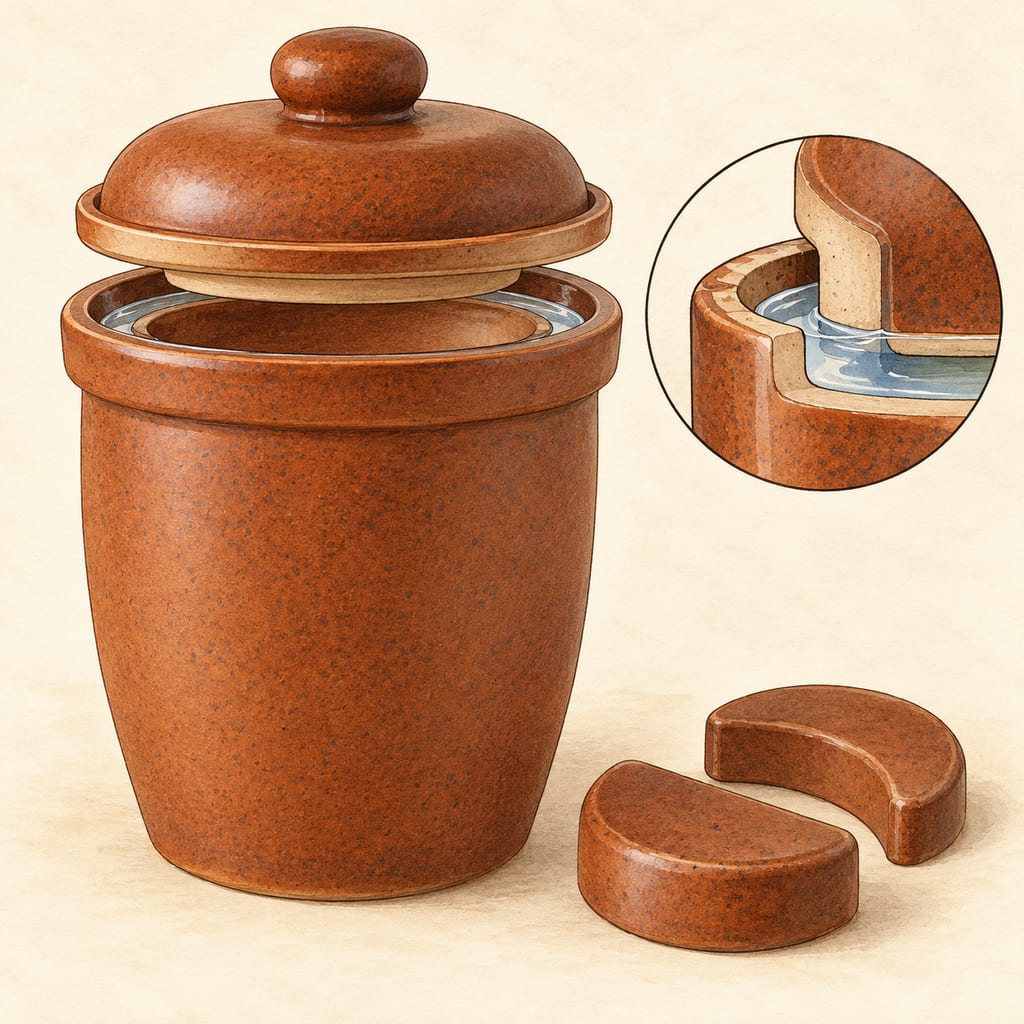
A movable stoneware sauerkraut crock with a fitted lid, ceramic weights and a water-filled rim channel. German sources call it a Gärtopf; Czech sources document the related zelňák or nádoba na kvašení zelí.
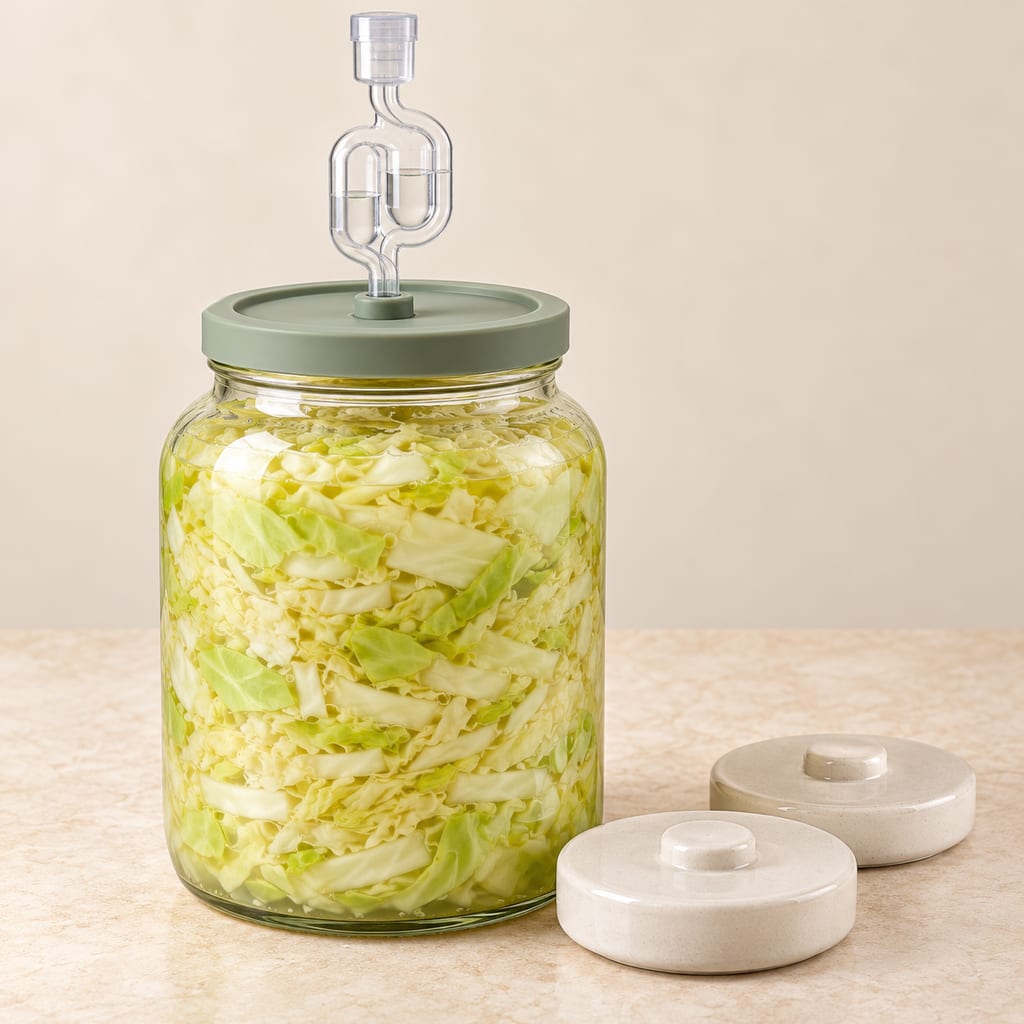
A modern wide-mouth glass jar for vegetable fermentation, often paired with a gas-release lid or airlock and follower weights. This accessory arrangement distinguishes it from general preserving jars and stoneware crocks.
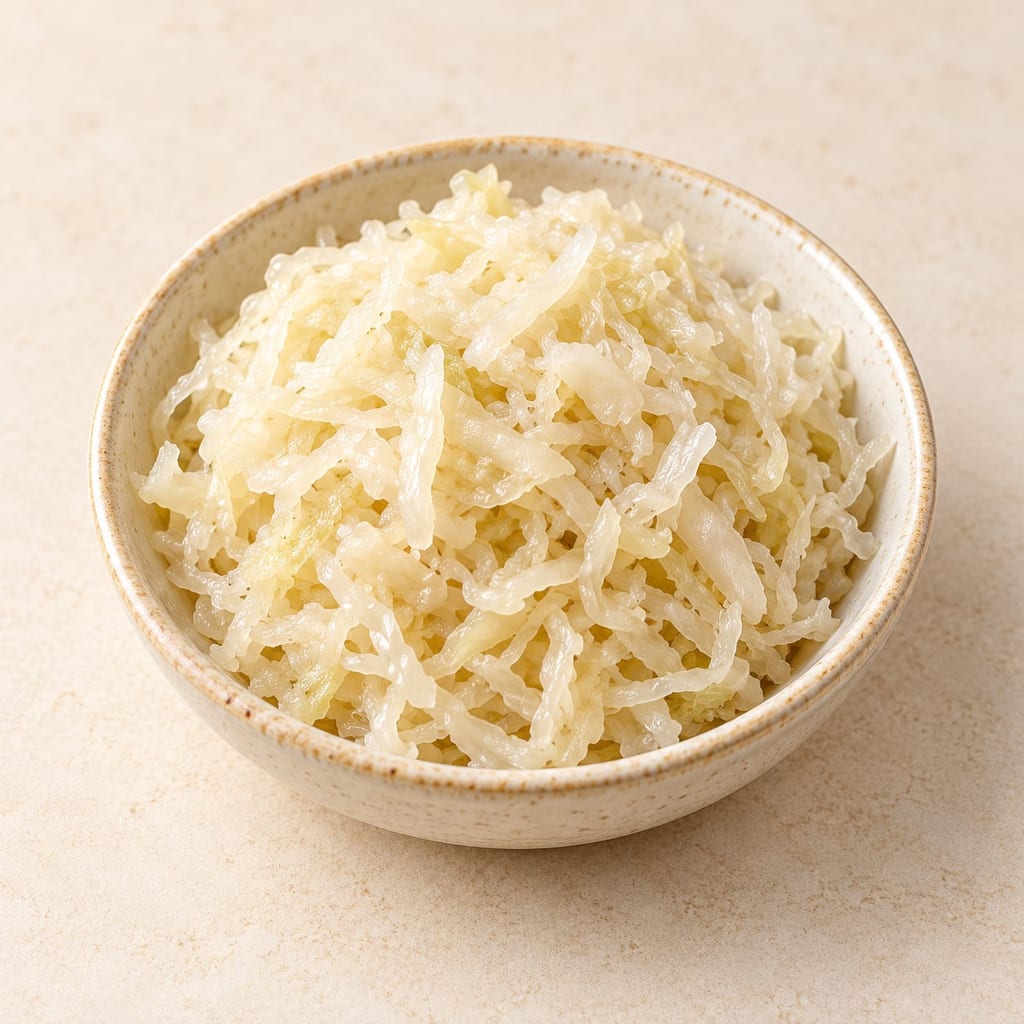
Finely cut cabbage fermented with salt in vats by natural lactic fermentation, a protected Alsatian product sold raw or cooked after fermentation.
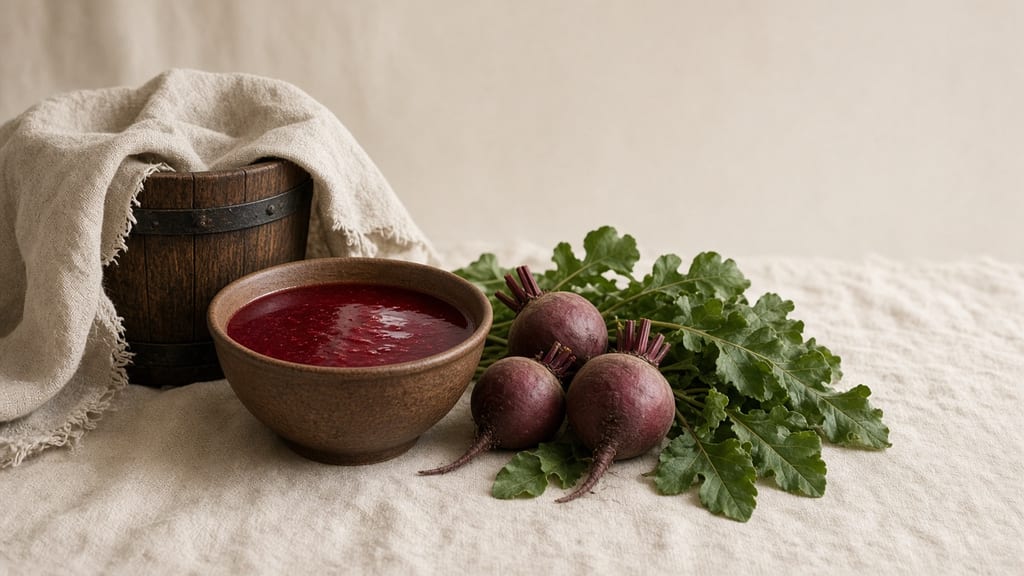
Before beetroot, Polish barszcz was a soup of soured hogweed leaves. Herbals, menus and an old cookbook show how a rye sour and then the beet barrel took over its name.
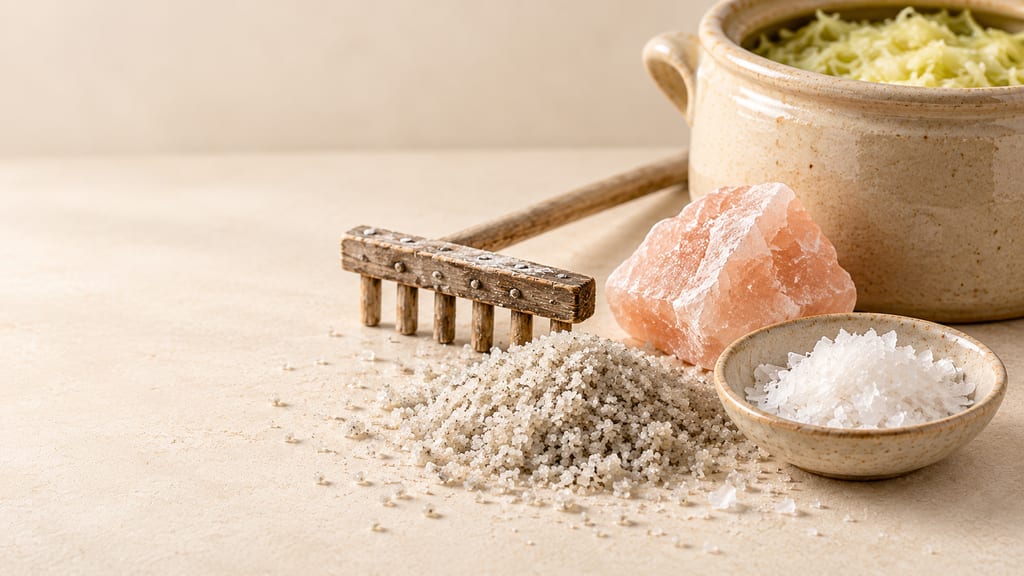
Salt seasons a meal, shapes fermentation and preserves food. Its history follows the people who mine, harvest, trade and transform it, and the choices hidden inside an ordinary packet.
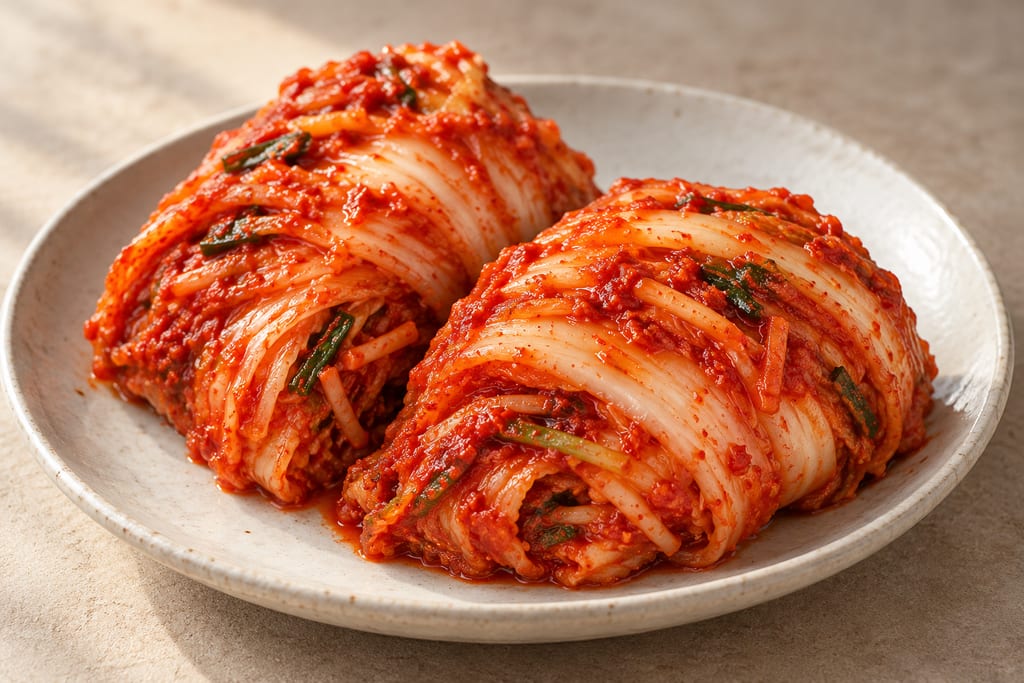
Napa cabbage salted, seasoned with a paste of gochugaru, garlic, ginger and salted seafood, and left to sour through lactic fermentation; Korea's everyday winter preserve.
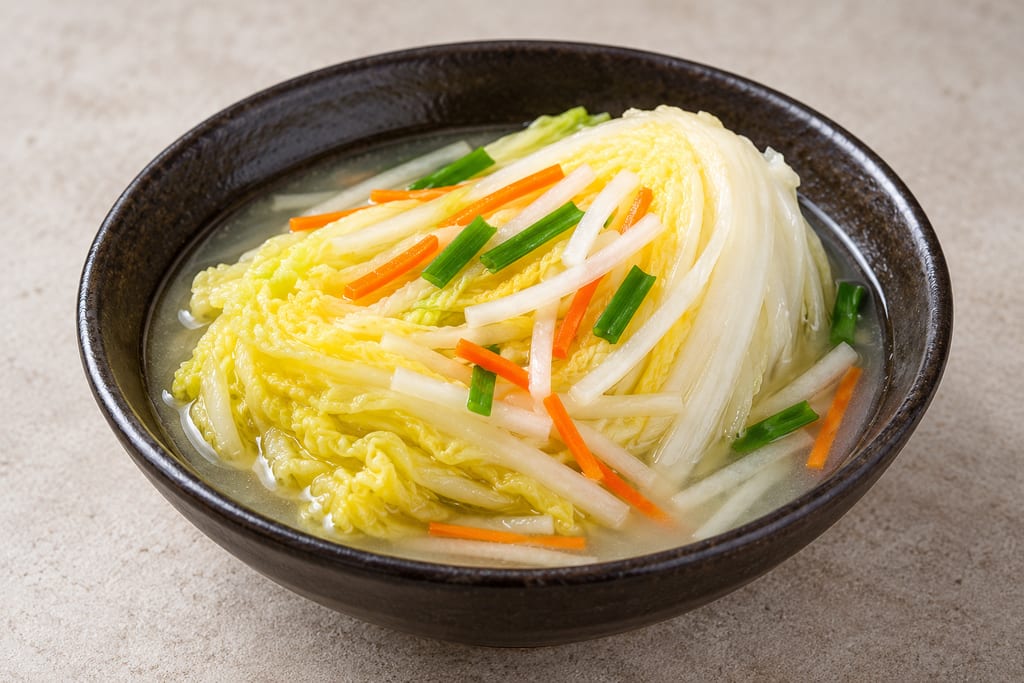
Napa cabbage is brined and filled with pear, radish, alliums, chives and fruit; this Korean kimchi omits red pepper flakes.
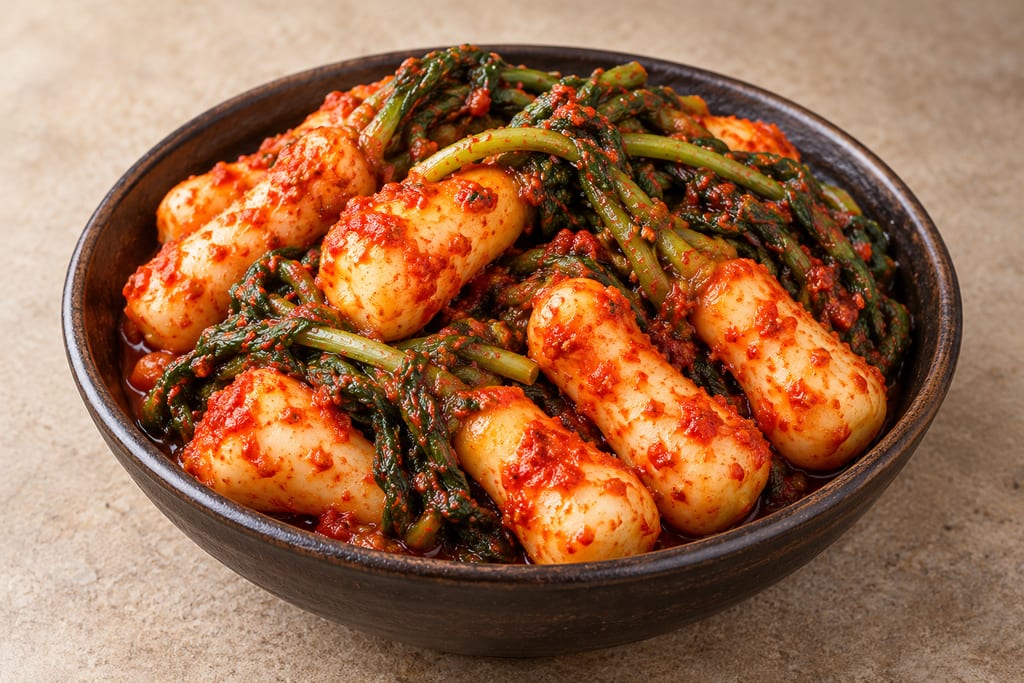
Small ponytail radishes keep their greens attached and ferment in a flour-and-chile seasoning paste.
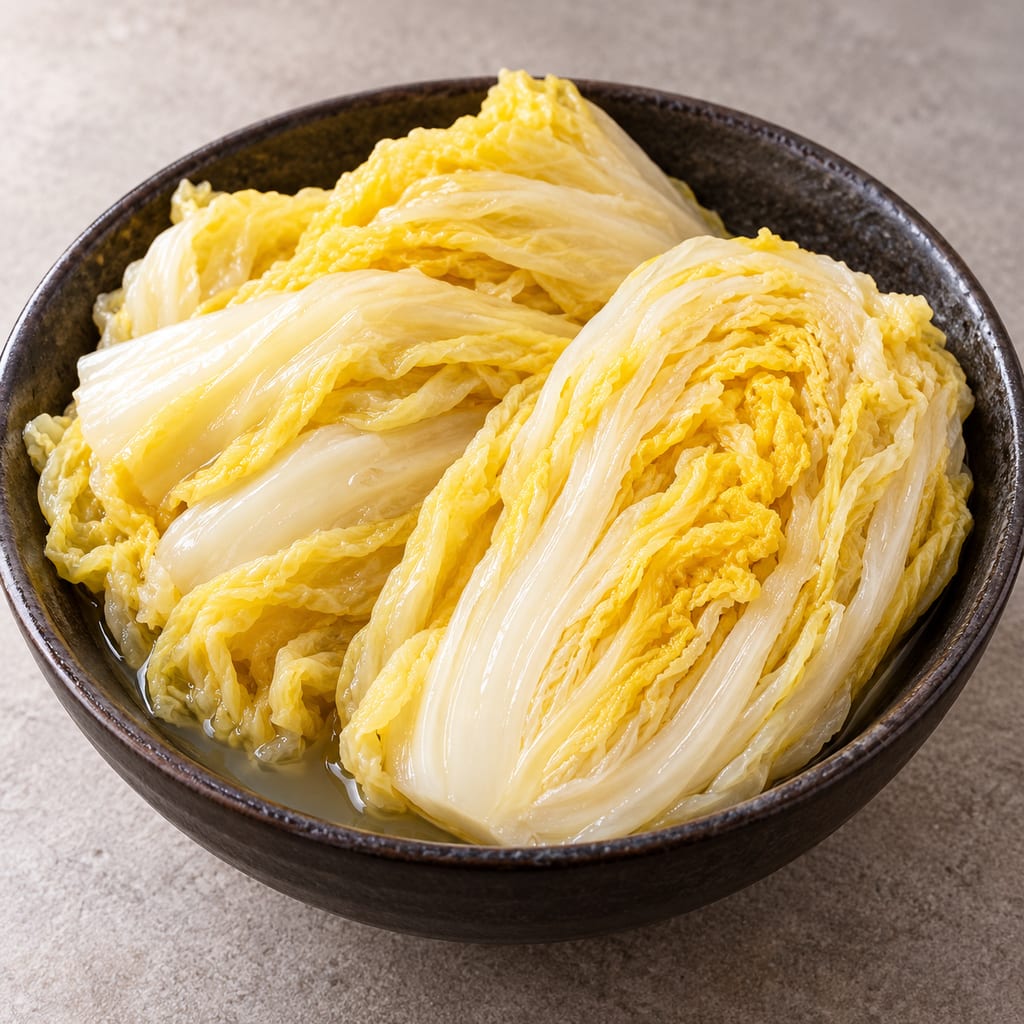
Napa cabbage fermented in a salt brine in Northeast China, traditionally in large ceramic or glass jars, until it turns sour.
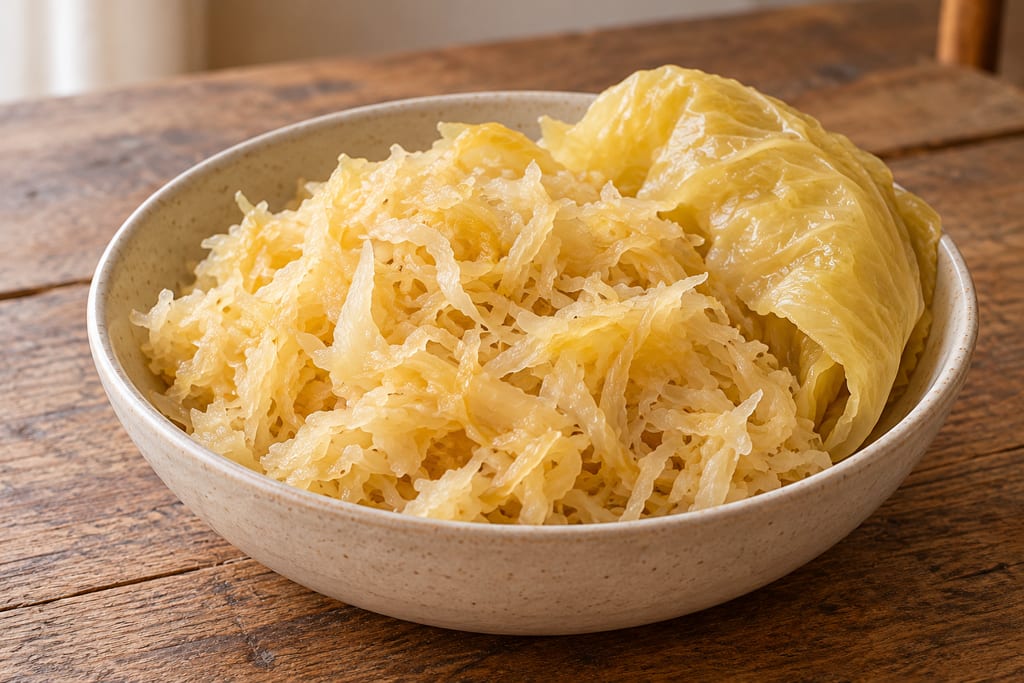
Serbian sour cabbage from the Futog area, made from the autochthonous Futoški cabbage population and registered as a protected product in 2008. It is a subset of general Serbian kiseli kupus.
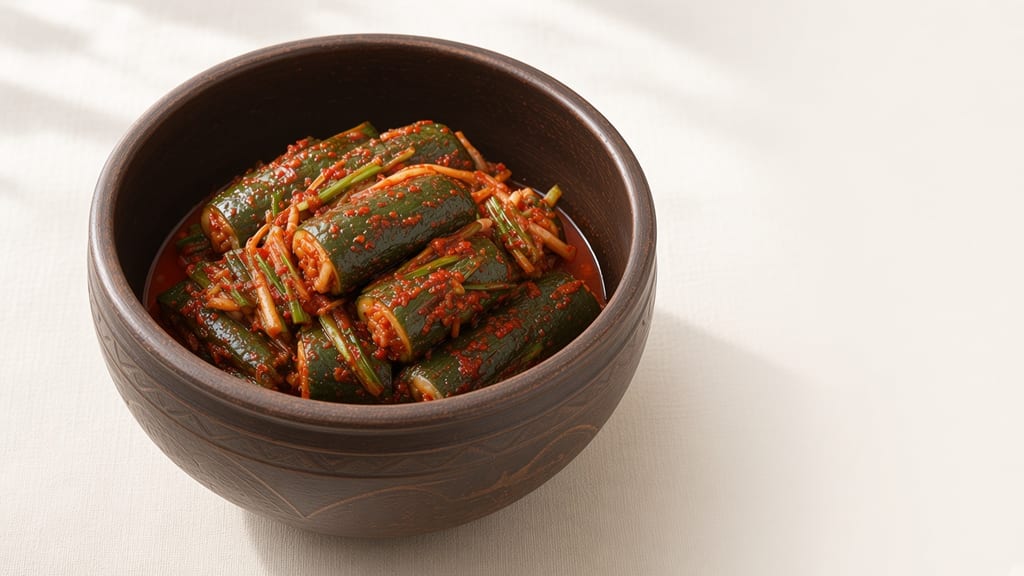
Hwanggwa damjeo is a cucumber kimchi from Yu Jung-rim's Jeungbo sallim gyeongje of 1766. Slit cucumbers are packed with chilli powder and garlic, scalded with hot salted water and sealed overnight.
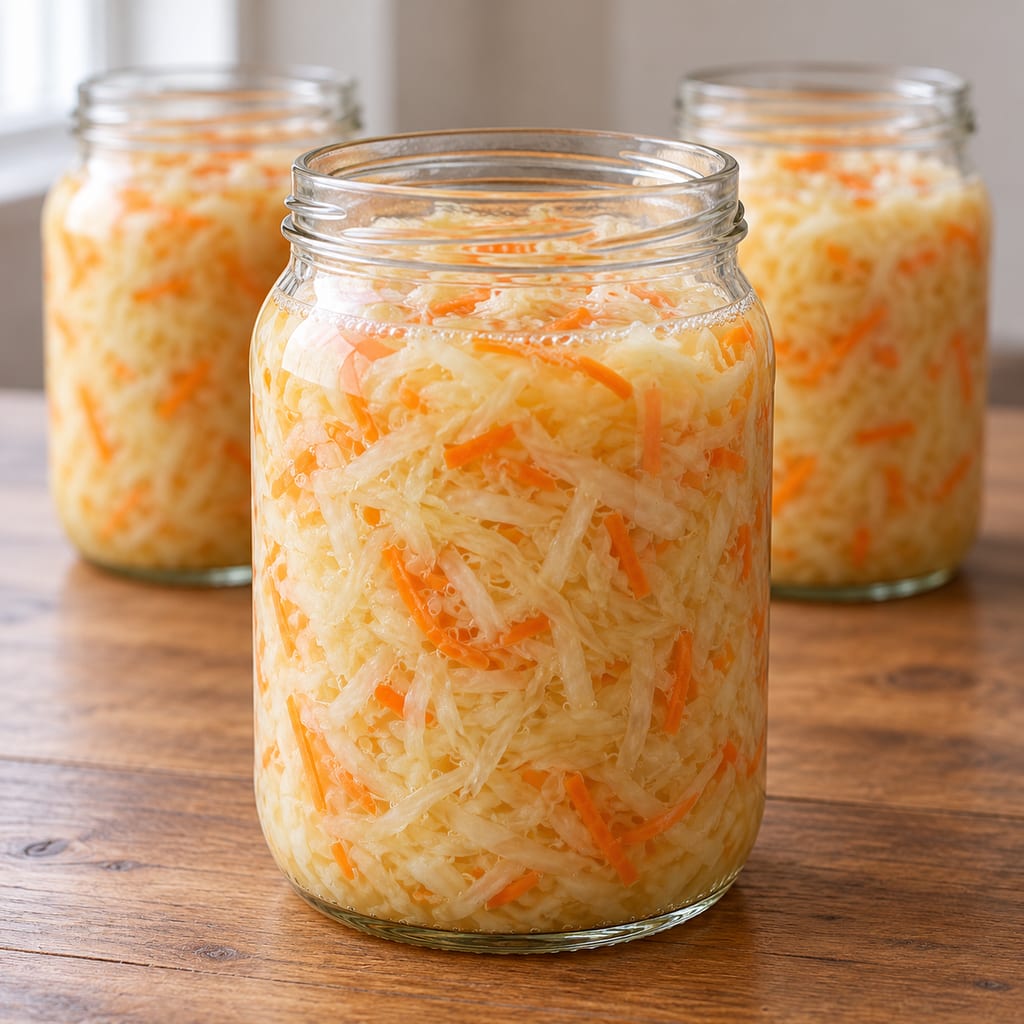
Shredded cabbage and grated carrot are salted to 20 g/kg, rested, packed into three jars and monitored during a creator-reported eight-day fermentation; measured temperature is not given.
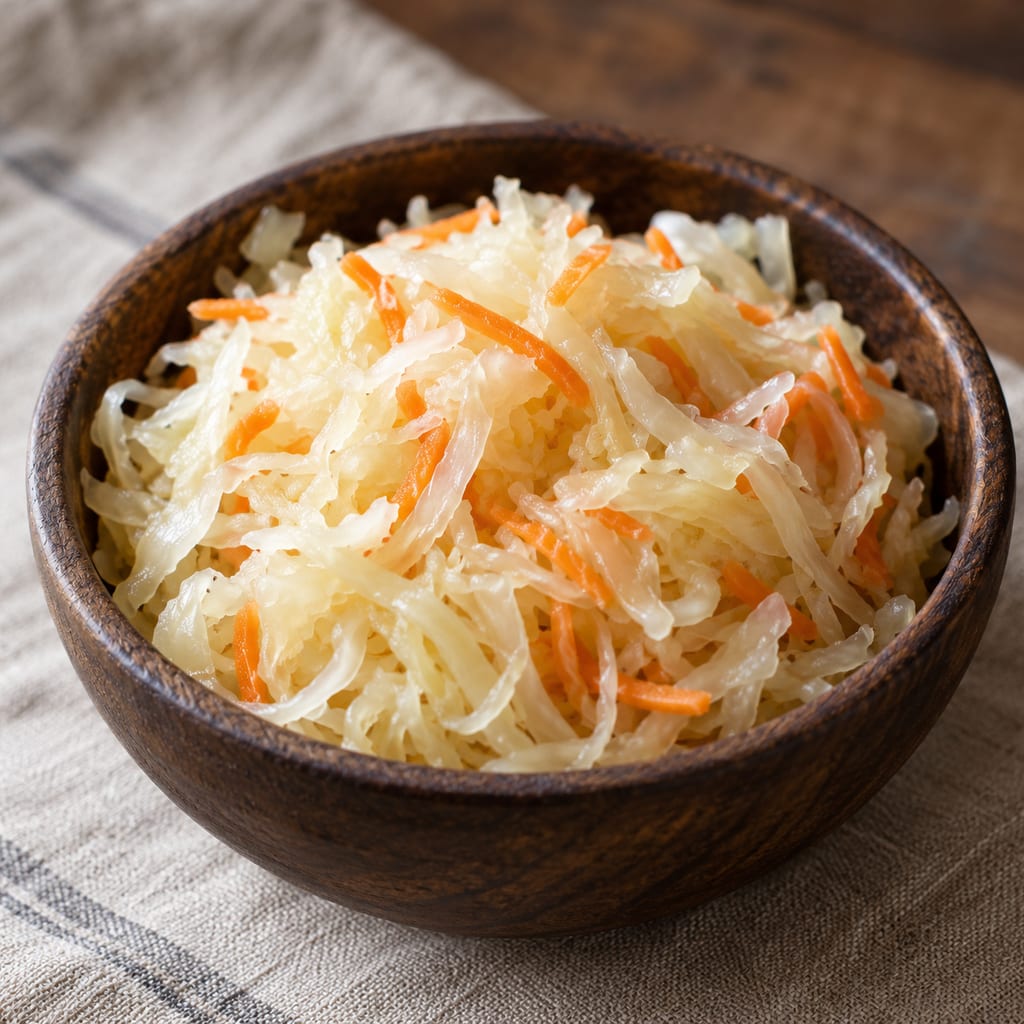
Kapusta kiszona z beczki is barrel-fermented cabbage from the Kołobrzeg area, entered on Poland’s List of Traditional Products in 2008. It is salted and fermented, with raw grated carrot added after souring.
No community contributions have been published for this entry yet.
Sign in to contribute. Published comments and photos are free to read.
NCHFPInspiration
Sauerkrautcabbage quantities, process, yield, time and temperature
Cited in: What is white cabbage sauerkraut?; Ingredients; Equipment; Stage 1 — Select the cabbage; Stage 2 — Wash and quarter; Stage 3 — Shred; Stage 4 — Work in measured portions; Stage 8 — Weight and cover; Stage 10 — Inspect and finish; Regional variations; How sauerkraut is eaten
University of Minnesota ExtensionSafety
Preserving food at home: FermentationProduce fermentation equipment, acidity monitoring and submersion controls.
Cited in: Equipment; Stage 1 — Select the cabbage; Stage 2 — Wash and quarter; Stage 3 — Shred; Stage 8 — Weight and cover; Stage 10 — Inspect and finish; Regional variations; Signs of a healthy fermentation; Problems and safety; How sauerkraut is eaten
Penn State ExtensionMethod · Safety
Let's Preserve: Fermentation—Sauerkraut and PicklesA 1-gallon stone crock holds 5 lb of shredded cabbage.
For the crock procedure, mix 5 lb of shredded cabbage with 3 tablespoons of canning or pickling salt, pack until natural juice covers, and keep submerged.
If the natural juice does not cover the cabbage, use boiled and cooled brine made with 1½ tablespoons salt per quart of water.
Penn State gives schedules of about 3–4 weeks at 70–75°F or about 6 weeks at 60–65°F; it says below 60°F may prevent fermentation and above 80°F may soften and spoil the cabbage.
Penn State documents a separate small-jar method using 3½ tablespoons salt per 5 lb cabbage.
Cited in: Ingredients; Equipment; Stage 1 — Select the cabbage; Stage 2 — Wash and quarter; Stage 3 — Shred; Stage 4 — Work in measured portions; Stage 5 — Release the juices; Stage 6 — Pack the container; Stage 7 — Check brine coverage; Stage 8 — Weight and cover; Stage 9 — Ferment; Stage 10 — Inspect and finish; Small-jar variation; Regional variations; Signs of a healthy fermentation; Problems and safety; How sauerkraut is eaten
National Center for Home Food PreservationReference
National Center for Home Food Preservation — Sauerkrautquantities, process and temperatures. National Center for Home Food Preservation
Cited in: Equipment; Stage 1 — Select the cabbage; Stage 2 — Wash and quarter; Stage 3 — Shred; Stage 8 — Weight and cover; Stage 10 — Inspect and finish; Regional variations; How sauerkraut is eaten
Penn State ExtensionReference
Penn State Extension — Tips for Making Sauerkrautquality and spoilage guidance
Cited in: Ingredients; Equipment; Stage 1 — Select the cabbage; Stage 2 — Wash and quarter; Stage 3 — Shred; Stage 8 — Weight and cover; Stage 10 — Inspect and finish; Small-jar variation; Regional variations; Signs of a healthy fermentation; Problems and safety; How sauerkraut is eaten
International Scientific Association for Probiotics and PrebioticsReference
International Scientific Association for Probiotics and Prebiotics — Fermented foods consensusmicrobial context. PMC
Cited in: Why cabbage is suitable; How salt works; The microorganisms; What acidification does
Microbiology SpectrumReference
Microbiology Spectrum — Microbiome composition during sauerkraut fermentationbacterial succession
Cited in: Why cabbage is suitable; How salt works; The microorganisms; What acidification does
Oxford Companion to FoodReference
Oxford Companion to Food — Sauerkrauthistorical background
Cited in: Names; Historical background
Bundeszentrum für Ernährung (BZfE)History
Foodtrend FermentationThe 2023 article names Sauerkraut as a German fermented food.
The article places fermentation broadly in the historical preparation of winter provisions; this does not date sauerkraut's origin or identify the NCHFP batch as a German method.
Cited in: Historical background