
Seaweeds intake
Seaweeds: a kitchen shaped by the coast
Nori, laverbread, Korean seaweed soup and carrageen pudding all begin as algae used for different jobs. This account covers seaweed names, coasts and farms, their histories, cooking, fermentation and composition.
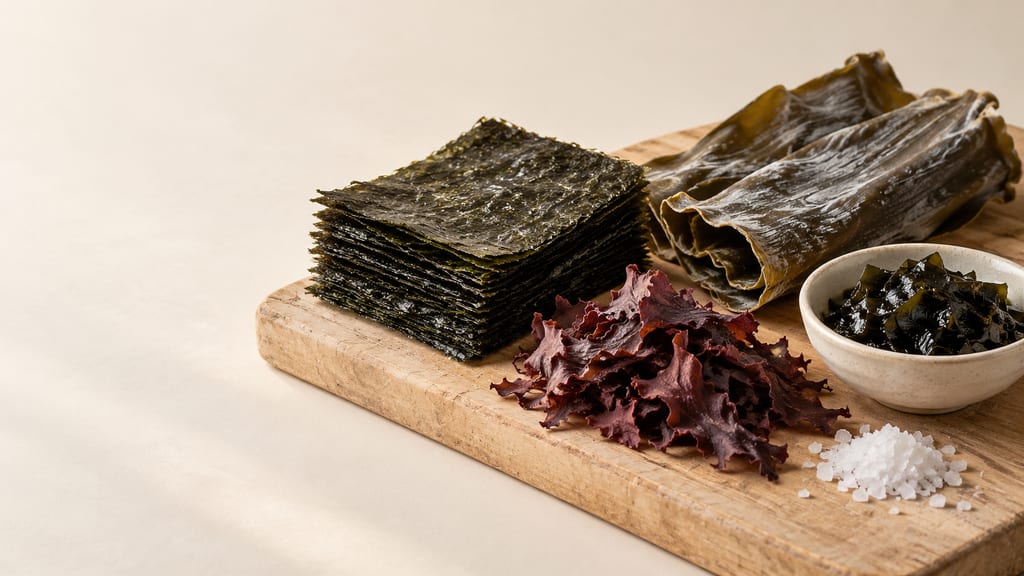
Dried kelp, sheets of nori and dulse: three seaweeds that coastal kitchens use for different jobs.
Introduction
A sheet that crackles around rice, a dark spoonful of Welsh laverbread, a bowl of Korean seaweed soup and a milk pudding set with carrageen have something in common. Their ingredients began as algae, but the cooks wanted different things from them: a wrapper, a soft vegetable, a broth ingredient, a gel. Understanding those differences makes seaweed much easier to cook with. It also reveals a food history far larger than the familiar packet of sushi nori.
Seaweeds connect shore and kitchen through skilled work. Someone must know the growing place, distinguish the material, choose the part, bring it ashore and decide what will survive the journey to the table. Drying, washing, chopping, salting and cooking are not incidental preliminaries. They help create the ingredient itself. A botanical name tells only part of that story; the name a household gives its food tells another.
Reading a seaweed name
The broad division into red, brown and green seaweeds is useful in a pantry. Red algae supply lavers, dulse, many fleshy salad ingredients and several important gelling materials. Brown algae include the kelps used for stock and vegetables. Green algae include leafy sea lettuces and the bead-bearing Caulerpa foods sold as sea grapes. These groups contain very different textures, and their colours after processing need not resemble their colours underwater. They are an introduction to ingredients, never a way to identify a wild harvest.
Three identities should travel together: the organism, the local food name and the product form. Nori is a good example. A nori sheet is a manufactured food, made by forming and drying processed blades. It is not the natural shape of one universal “nori species.” Neopyropia yezoensis is an important cultivated laver; older studies call it Pyropia yezoensis or Porphyra yezoensis. Those earlier names help readers find the research. They do not make every sheet, every laver and every regional red-algal food identical.
Kombu presents a related problem. Saccharina japonica, also recorded historically as Laminaria japonica, is one important kelp associated with it. The wider kombu repertoire contains other kelps, regional forms and processing grades. A name can distinguish a commercial ingredient without representing another species. “Sea moss” is broader still. North Atlantic Irish moss, Chondrus crispus, and tropical crops sold under sea-moss names cannot be assumed to have the same organism, composition or cooking behaviour. In Dominica, for example, Gracilaria-based production and the introduction of a different commercial crop belong to the same developing industry.
Uncertainty in a scientific name is useful information. A Tawi-Tawi market survey retained Caulerpa cf. macrodisca ecad corynephora and Caulerpa cf. racemosa alongside more definite identifications. Here, “cf.” signals a tentative comparison, while “ecad” describes a form associated with environmental conditions. Dropping those words would turn a qualified observation into false certainty. Likewise, an older record of Gracilaria or Porphyra does not automatically identify a modern species merely because it grew in the same country.
The boundary also matters. Kawa-nori, Suizenji-nori and Lao river-algae sheets belong to a wider history of edible algae, but they are not interchangeable with marine laver. Some organisms called algae are cyanobacteria. Seagrasses are flowering plants; a terrestrial sea-grape tree is not Caulerpa. A food catalogue must keep these neighbours visible without quietly turning them into marine vegetables.
Shores, farms and food routes
The coast is not a single growing environment. Seaweed beds occupy places with different depths, exposure, light and water movement. A rocky shore uncovered by the tide presents a different harvesting problem from a submerged kelp forest. Those differences affect access and the structures people bring home: a thin blade, a branching tuft, a thick midrib or a hollow stipe. Even one alga can supply several ingredients. Bullwhip kelp, Nereocystis luetkeana, has blades, a stipe and a bulb; an instruction for one part cannot simply be applied to all three.
Cultivation adds another layer of skill. Laver farming works with life stages that look unlike the edible blade. Its microscopic conchocelis stage and the production of spores make it possible to seed nets, rather than depend entirely on whatever settles naturally. Kelp farming likewise involves nursery work and the movement of young material onto lines. A photograph of nets or ropes is therefore a picture of managed biological cycles, not just an alternative harvesting tool.
Korean cultivation illustrates the range hidden by a single word such as “seaweed farm.” Gim, miyeok and dasima are major foods, but farms and food industries also work with green algae such as Capsosiphon and Codium. Breeding, nursery methods, harvest and product development differ among them. Cultivation history must not be mistaken for the beginning of consumption: a community can have eaten a wild food long before a modern industry develops around it.
Three maps are needed to describe these foods honestly. One shows where an organism occurs; another shows where it is cultivated; the third shows where people prepare and eat it. Trade can carry a dried ingredient far from its habitat. An introduced population may grow on a coast without becoming a local dish. An export crop can support livelihoods where whole-seaweed eating is uncommon. None of these relationships is adequately described by giving the food one country of origin.
Several histories, not one discovery
Ancient seaweed use is difficult to reconstruct because soft plant material does not preserve like a pot or a stone tool. Dental calculus offers a different kind of evidence. Research published in 2023 identified chemical traces consistent with ingestion of seaweeds and other aquatic resources in archaeological European samples. The marine and freshwater findings span different places and periods. They challenge the idea that farming necessarily displaced these foods, but do not reveal a recipe, a serving size or an uninterrupted tradition at every site.
Monte Verde in southern Chile supplies another important, contested record. A 2008 paper reported marine-algal remains from archaeological features and interpreted their use as food and medicine. In March 2026, a new study challenged the age and formation of the site; an August response defended occupation about 14,500 years ago. The two teams disagree about the chronology and how the deposits formed. Those remains should not be converted into an unqualified date for the world's first seaweed meal, nor should a proposed medicinal use be treated as a demonstrated treatment.
Japan's seaweed history is also a history of processing and inland distribution. Seaweeds appear in accounts of offerings and taxation, while transport networks helped dried products circulate more widely during the Edo period. Methods developed around particular materials: plain drying, drying with ash, cooking before drying, sheet forming and salting. Their differences survive in the foods. A dry sheet, a salted vegetable and a shaved kelp product reach the cook in quite different states.
Ita-wakame from the San-in region makes the distinction tangible. Washed fronds are arranged to dry as thin sheets. The resulting food is crisp enough to eat as it is or crumble over rice; the same broad ingredient name, wakame, also appears on products intended for soups and dressed vegetables. The work of arranging and drying the fronds has selected a culinary use. It is not merely removing water from an otherwise unchanged food.
In Niigata's hegi soba, seaweed is less visible. Funori acts as a binder in buckwheat noodles, helping give them a smooth, elastic texture. Small loops of noodles are arranged in a wooden hegi tray. The local origin account connects funori's use with textile work; that is a regional explanation, rather than a securely dated invention event. The dish asks the cook to think of seaweed as structure, just as a cook making stock thinks of it as flavour.
Korean miyeok-guk brings seaweed into a different social setting. The soup is associated with birthdays and meals after childbirth. Beef, seaweed and soy seasoning form one documented version, with seafood variations also recognised. Its birthday role recalls the mother as well as the person celebrating. This cultural history deserves to stand without being made to prove that soup treats postpartum illness or that everyone should consume a prescribed amount of seaweed.
The Philippine market is another useful place to learn. Tawi-Tawi vendors sell several Caulerpa forms alongside fleshy reds including Eucheuma, Kappaphycus and Solieria. The foods belong to a local repertoire with its own names and preferences. Calling them all “sushi seaweed” would lose both their identity and the ways they are eaten. Market records also reveal what a botanical checklist cannot: which organisms are actually exchanged as food in a particular community.
In South Sulawesi, women's processing groups distinguish inherited dishes from new products. Lawara, or sango-sango salad, combines Gracilaria with ingredients including grated coconut, mango, shallot and chilli. Songkolo sango sango brings seaweed into a rice dish. The Makassar cookbook places such foods beside noodles, crackers, brownies and drinks developed for contemporary markets. These are different histories within the same coastal economy. Innovation need not acquire an invented antiquity to deserve a place at the table.
Atlantic foods and Indigenous coastal knowledge
Welsh laverbread is cooked laver, not a loaf. The protected Welsh product uses Porphyra umbilicalis gathered on the Welsh coast and cooked with water and salt into a dark, soft food. It may be finely minced or left coarser. Long cooking turns the delicate-looking blades into a substantial paste, while careful washing removes the grit that would spoil it. The familiar breakfast with cockles and bacon, or the addition of oatmeal before frying, belongs to serving and further preparation rather than to the identity of the alga.
Commercial production under the protected specification requires traceability, controlled cooking and cooling, chilled storage and microbiological testing. That matters when an old food is adapted at home. A descriptive account of how a product is made does not confer its commercial shelf life on an improvised saucepanful. Buying cooked laverbread allows the cook to explore its savoury softness without reconstructing a preservation system from a few lines of culinary history.
Ireland's dulse or dillisk, Palmaria palmata, offers a different pleasure: dried fronds with a chewy, salty character, or flakes incorporated into soup and bread. Carrageen contributes body to cooked liquids, while sea spaghetti, Himanthalia elongata, offers long strips as a vegetable. These foods should not be bundled into a single account of coastal hardship. Nor does the appearance of a newly marketed kelp prove that it has the same local history as a familiar dried dulse snack. Across the Atlantic, the Bay of Fundy's dulse trade supplies another regional strand of the same species' food history.
On the Pacific coast of what is now Canada, First Nations food knowledge locates seaweed within family harvesting, sharing and meals. Red laver is dried and toasted, added to soups, cooked with salmon eggs or eaten with eulachon grease. Wit’suwet’en cooks use it as a seasoning; open-air drying and smoking are among the coastal preservation practices. Harvesting, preserving and eating connect families with places and other foods. The details of drying and smoking still depend on the identified material and local conditions; they cannot be transferred wholesale to an unfamiliar harvest.
Hawaiian limu names carry similarly precise distinctions. Limu kohu, Asparagopsis taxiformis, is a penetrating seasoning, traditionally prepared by soaking, salting and pounding. Limu manauea, Gracilaria coronopifolia, is a different ingredient. Codium edule, limu wawae‘iole, is chopped or pounded and served with other foods. Their place alongside fish, poi, stews and relishes is far more informative than a claim that Hawaiians “eat seaweed.” Older accounts sometimes promise indefinite storage after salting; those statements should remain historical descriptions, not become modern shelf-life advice.
In Aotearoa New Zealand, karengo refers to edible blade-forming red algae. Drying made it portable; during the Second World War, dried karengo was sent to members of the Māori Battalion overseas. Rimurapa, or bull kelp, had another food-related role. Ngāi Tahu pōhā are containers made by opening kelp blades into pouches, with protective materials including tōtara bark. Graham “Tiny” Metzger learned the craft within his whānau and passed it on. Pōhā belong to the history of storing and carrying tītī. The container is not an edible preparation called “pōhā.”
Southern Chile has its own coastal routes. René Alfredo Llancapan recalls taking cochayuyo home for a family salad, and journeys to sell or exchange it for household provisions. For his family, cochayuyo was both a meal and something to trade. Cochayuyo, luche and the part called ulte need separate identities in any recipe. The word cochayuyo must not turn every southern brown alga into the same ingredient, and ulte must not be counted as another species simply because it has its own name.
Caribbean sea moss connects traditional drinks with changing cultivation. Dominica's Gracilaria crop has supplied drinks and gels, while cultivation initiatives have introduced other material to address supply. A commercial substitution changes more than a label: different red algae can produce different textures. In Tanzania, the modern farming industry developed into a major export activity after commercial cultivation began in 1989. Its history documents coastal livelihoods and ingredient production; it does not by itself establish ancient, widespread whole-seaweed consumption throughout Africa. The food history needs local testimony as well as production statistics.
What the ingredient does in the pot
Start with the intended result. A crisp wrapper needs a dry sheet. A soup vegetable needs a suitable cut and texture after hydration. A stock draws soluble material into water. A thickener may disappear as a recognisable plant while still determining the dish. These roles are related, but an ingredient successful in one can be unsuitable in another.
Kombu is valued for savoury extraction. Removing the blade from a stock does not remove everything extracted from it: flavour compounds and iodine can remain in the liquid. Wakame in soup, by contrast, is usually meant to be eaten as a vegetable. Its product form determines whether it needs desalting, rehydration or cooking. “Dried seaweed” is too vague an instruction when one packet contains a ready-to-eat roasted sheet and another contains a cooking ingredient.
Texture also depends on the part. A blade can soften differently from a central rib; a hollow kelp stipe can become a ring-shaped pickle. Crushing a crisp sheet over rice is a different operation from cooking a tough strip until tender. Chopping changes size, not necessarily tenderness. When substituting, ask what the seaweed contributes to the dish and what its label says about preparation, rather than exchanging equal spoonfuls of two dry products.
Agar, carrageenan and alginate explain another set of differences. These are hydrocolloids: materials whose interactions with water can thicken a liquid or form a gel. Agar is extracted from certain red algae. Heating, separating the insoluble seaweed and cooling the extract are distinct operations; the gel is not produced by microbial fermentation. Commercial extraction and drying create an ingredient that can be measured more predictably than an unspecified handful of whole seaweed.
Carrageenan is a family. Kappa commonly gives a firm gel under suitable conditions; iota gives a more elastic one; lambda thickens without forming the same kind of gel. Salts and the surrounding food matter, including interactions with milk proteins. Whole Irish moss and purified carrageenan therefore need different handling. A drink thickened with one sea-moss crop may not set when made from another, even if both packages use the same English name.
Alginate comes from brown algae. Sodium alginate dissolves in water, while calcium can link its molecules into a gel. That distinction underlies food techniques such as spherification. A measured food-grade alginate product is not equivalent to blended kelp. Likewise, agar sold for food, bacteriological agar and purified agarose are different specifications. Ingredient choice precedes technique; buying the right material is part of the method.
Keeping food, and calling fermentation by its name
Preservation starts with a defined product. Drying reduces available water; freezing slows deterioration; salting changes the water available to microorganisms. Cooking, acidification and packaging each do other work. A process can combine several of these, but none can be inferred from a dark colour, a strong marine smell or a sealed jar.
Drying thin blades requires attention to airflow and loading. Folded, overlapping or thick material behaves differently from an exposed sheet. A crisp surface alone does not describe the water available inside every piece. Bullwhip kelp needs different handling for its blades and for its stipes and bulbs. A drying method for those parts cannot supply one temperature and duration for every seaweed, dryer, load and climate.
Rehydration reverses a useful part of drying. A dry pantry ingredient becomes a wet food again, and the original packet's shelf life does not transfer to a salad, spread or gel made from it. Freezing can be convenient for some prepared foods, but it does not make different products equivalent or remove a chemical contaminant accumulated before harvest. The precise preparation and storage instructions for the named product remain essential.
Salted wakame likewise arrives with a processing history. Rinsing and desalting change the finished food; the salt visible in a packet cannot establish a general home-preservation ratio. Vinegar introduces a different distinction. A vinegared salad is an acid-dressed dish, while an acidified canned pickle needs its own formulation and heat process. Published bullwhip-kelp pickle instructions apply to that product. They do not authorise substitution of another species, a dense paste or a weaker vinegar mixture.
True fermentation depends on organisms transforming the substrate. A controlled study of Alaria esculenta and Saccharina latissima found that spontaneous fermentations ended at pH 4.8–5.2 and failed the researchers' safety assessment. In one Alaria treatment, deliberately inoculated Listeria monocytogenes persisted. Adding a selected Lactiplantibacillus plantarum starter improved acidification, but performance differed between the seaweeds and further optimisation was still needed. The result is evidence against assuming that any salted seaweed will behave like cabbage.
The reasons are practical as well as microbiological. Seaweed brings its own microorganisms, salts and carbohydrate mixture. A starter must find a usable substrate and grow quickly enough under the actual conditions. Available sugars, pretreatment and buffering can change the acidification course. A final pH alone does not describe everything that happened before it, and bubbles do not identify the organisms responsible.
Koji offers another route. Experimental nori koji used Aspergillus oryzae to produce enzymes, including proteases and glycosidases. These help break down components of the substrate; in sauce trials, nori koji improved recovery of liquid and nitrogen-containing compounds. Separate research characterised high-salt fermented nori sauces. These findings explain a plausible sauce-making technology. They are not a domestic preservation recipe reconstructed by borrowing a salt percentage from one paper and a maturation time from another.
Adding prepared seaweed to finished kimchi or mixing it with miso is simpler cooking, but the new mixture does not inherit the original product's tested storage conditions.
Drinks, sauces and the hidden ingredient
Kombu-cha is kelp tea, distinct from the fermented sweet-tea drink generally called kombucha in English. Gyokuroen dates the sale of its powdered kelp beverage to 1918. That is a company's product history, not a date for the invention of every kelp infusion. Powdered, sliced and seasoned products also differ from one another; a cup's composition follows its actual ingredients.
Sea-moss drinks use another property: body. A hydrated or cooked red-algal ingredient can thicken a drink even when its taste is softened by other ingredients. Agar can enter drinks as separate jelly pieces rather than as a whole seaweed. The organism that supplied a purified gelling powder may be unknown to the drinker, and the place where the drink is popular need not be where its raw seaweed grew.
Alcoholic drinks require three separate questions. Was seaweed added for flavour? Did an extracted material help clarify the drink? Or were algal carbohydrates converted into the alcohol itself? Isle of Harris Gin uses sugar kelp as a botanical. Irish moss in brewing performs a different task: carrageenan helps aggregate protein-rich material during wort boiling so it can settle out. That need not produce a drink that tastes of seaweed. Neither use proves that ordinary brewing yeast fermented the seaweed's structural carbohydrates.
Condiments make the same distinctions visible on a smaller scale. Dry flakes, a cooked nori paste, a vinegar dressing and a fermented sauce can all deliver seaweed flavour. Their processes are different. Reduction concentrates a sauce; it does not automatically make it shelf-stable. Adding wet aromatics to a dry blend changes the food. A spoonful of strong seasoning can also be more relevant to a local culinary tradition than a large bowl of undifferentiated “sea vegetables.”
Composition matters as much as freshness
A nutritional comparison needs the food’s serving mass and its wet or dry basis. A high protein percentage in dry powder does not make a few grams of seasoning a substantial protein portion. Rehydration adds water and weight, not nutrients. Added oil, salt or sugar can also change the profile of a packaged snack. Compare the named product as it is eaten, rather than treating a dry analytical sample as a meal.
Food-grade supply begins before the kitchen. Species, harvest site, batch and handling can all affect what arrives in the bag. Traceability is useful because a familiar food name cannot reveal exposure to contaminants or the conditions of harvesting. A clean appearance cannot replace knowledge of the water, and drying cannot undo everything the organism accumulated while growing.
Iodine is particularly variable. Analysis of commercial seaweed foods and supplements found large differences between products, including inadequate or inaccurate declarations. A small dry mass of some kelps can contain a substantial amount. Hydration changes weight by adding water; it does not create a predictable iodine dose. There is no defensible universal spoonful of kelp or sea-moss gel to recommend as a daily supplement.
Blanching can reduce iodine in the solid seaweed, but the result depends on the process. One sugar-kelp experiment reduced dry-weight iodine concentration from an average 4,605 to 293 mg/kg with an 80 °C, 120-second water treatment. These are experimental conditions and measurements, not a universal kitchen instruction. Species, starting composition and water volume matter. If the cooking liquid is consumed, iodine transferred into it remains part of the meal. Studies that measured both prepared seaweed and its liquid make that distinction especially clear.
Hijiki, Sargassum fusiforme, needs an explicit caution. It has documented culinary use, but the UK Food Standards Agency advises people not to eat it because of high inorganic arsenic. It belongs in food history with that warning, rather than among ordinary dish recommendations. Total arsenic and inorganic arsenic are different measurements; a supplier's undifferentiated arsenic result may not answer the relevant question.
Roasted purple laver also raises a specific nutritional question: can its vitamin B12 be absorbed? In a 2024 open-label randomised trial, 30 vegetarians who were not using supplements received no nori or one of two amounts of the tested product for four weeks. Several blood markers of vitamin B12 improved with nori. Methylmalonic acid, another marker, showed no significant difference in change between groups, and the two nori amounts did not differ significantly in their effects. This small, short trial supports B12 availability from that preparation under those conditions. It does not establish every seaweed or nori brand as a dependable long-term B12 source, or a treatment for deficiency.
Wet seaweed dishes also need ordinary food hygiene and product-specific control. A gel holding its shape is still a wet food. A pleasing smell cannot establish microbiological safety. The practical questions are the same ones a careful cook asks of other ingredients: what exactly was purchased, how must it be prepared, and what handling instructions apply after opening or cooking? Seaweed's reputation as a mineral-rich food does not answer them.
Remedies, extracts and what a meal can establish
Seaweed's medicinal history deserves attention without making dinner into a prescription. Traditional materia medica, a laboratory experiment, a human trial and a formulated medicine establish different things. Digenea simplex, historically associated with vermifuge use and the neurochemical kainic acid, belongs in that context, not in a culinary pantry. The materia-medica mentions of Ecklonia kurome and Sargassum pallidum likewise do not establish ordinary food recommendations.
Dried and powdered bladderwrack has a defined place in European herbal regulation. The European Medicines Agency recognises traditional use of the specified preparation, while finding insufficient clinical-trial evidence for a firm efficacy conclusion. That designation does not establish that a seaweed salad causes weight loss.
Human food trials also resist a single “superfood” story. In a crossover study of adults without high cholesterol, consuming wakame for 17 days did not improve the measured cholesterol absorption markers, blood lipids, glucose or blood pressure. That is a result for its participants, preparation and duration. It neither makes wakame nutritionally worthless nor proves that every extract or dose will behave identically. Conversely, a promising result with a purified compound would not establish the same effect from an ordinary bowl of soup.
Keeping the coast in the account
Seaweed production can avoid some demands of terrestrial agriculture, but a farm still needs materials, access, labour, handling and processing. An environmental life-cycle study found drying and cultivation infrastructure to be major contributors to the impacts of the systems it examined. A wet local ingredient and a dried export product therefore need separate assessments. A crop's uptake of carbon while growing is not, by itself, a complete claim about lasting climate benefit.
Wild harvesting has different questions. Kelp beds provide habitat as well as biomass, and removal can affect regrowth and the organisms living among the blades. Sustainable practice must account for species, place, season and scale. Local permissions and community rights belong in that decision. A general percentage or a claim that “seaweed grows back” cannot replace knowledge of the bed.
The most useful next research is specific: identify the crop inside a sea-moss product; document a local name with its community and preparation; measure what moves from kombu into a stock; test a drying process with its actual packaging; follow a ferment through acidification and storage. Those questions improve cooking as well as evidence. They allow a seaweed to remain what it is: a particular food, made through particular knowledge, from a particular coast.
Related
Discussed in this article
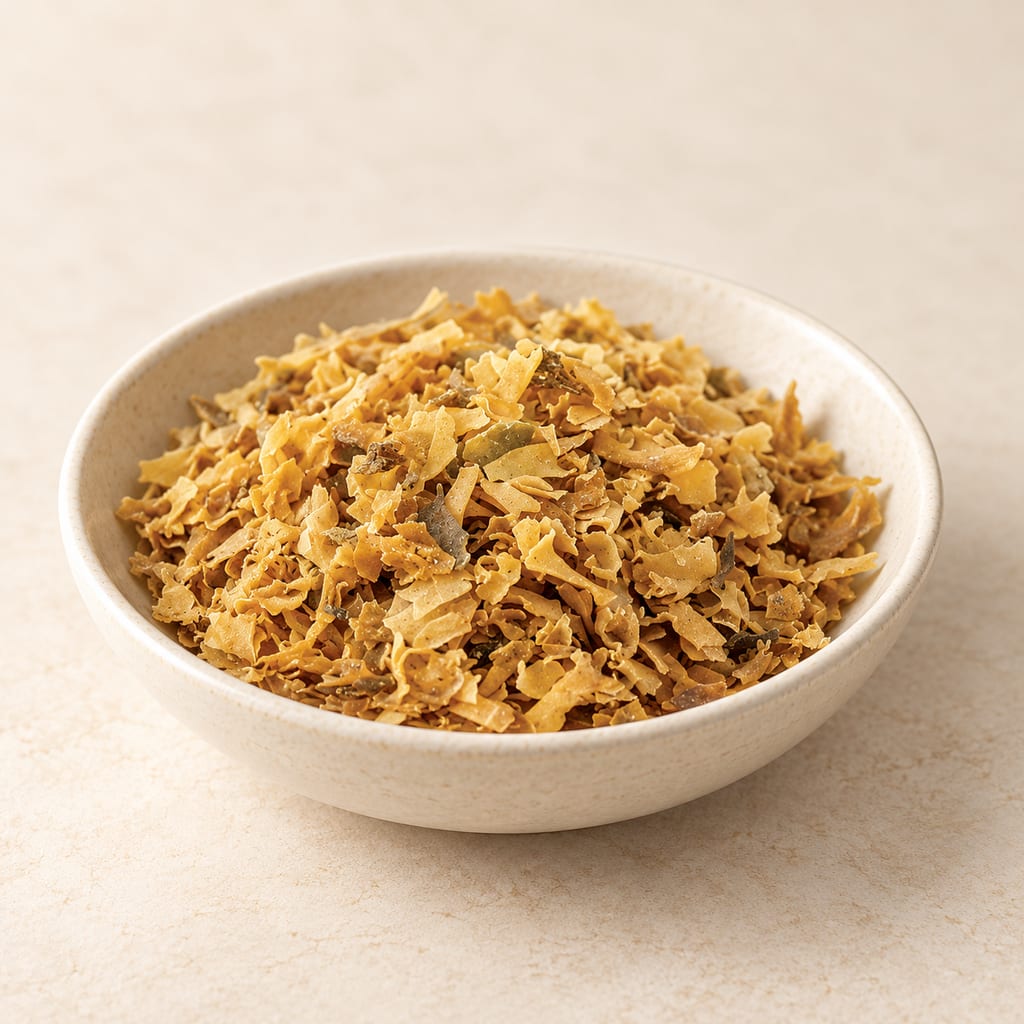
Irish moss
Red seaweed sold as dried material or a concentrated fining, connecting carrageen desserts and coastal trade with the separation of protein material in brewing wort.
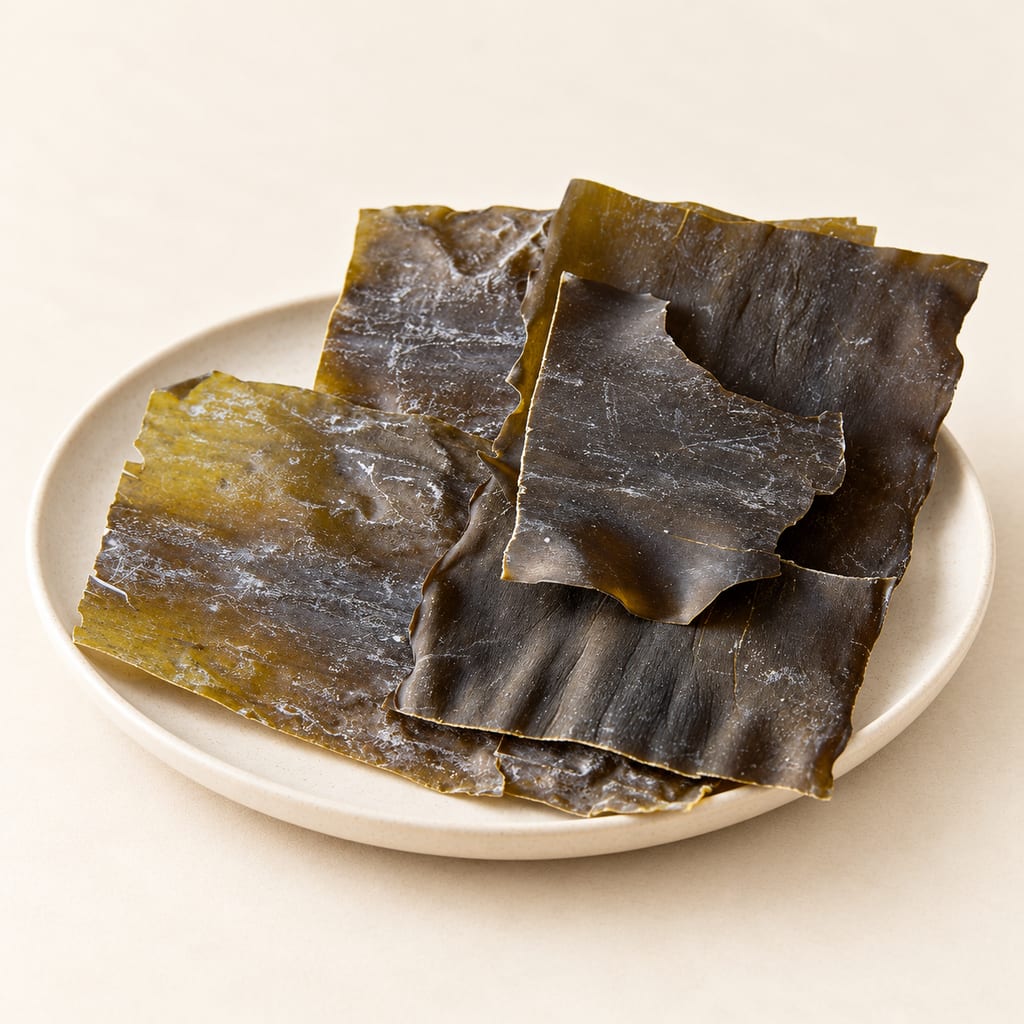
Kombu
Kombu is a group of edible brown kelps, chiefly harvested around northern Japan or cultivated in East Asia, used for umami-rich stocks, simmered dishes, seasonings and preserved foods.
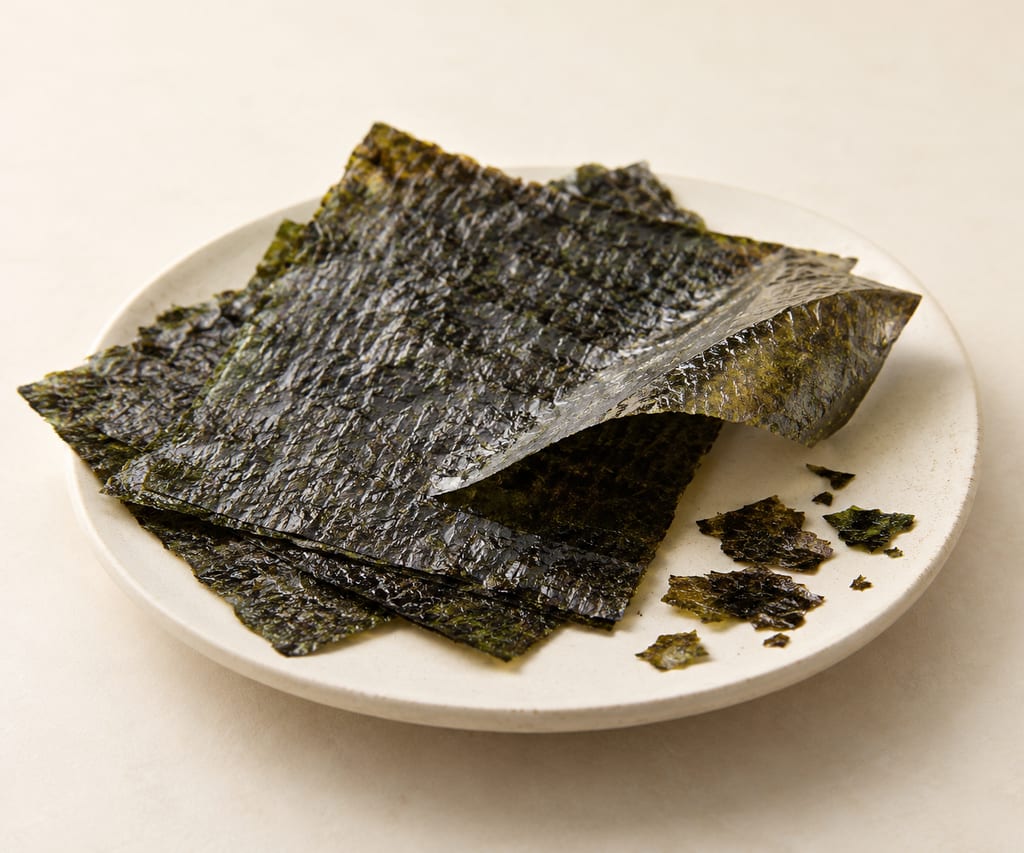
Nori
Nori is a red seaweed farmed in East Asia and dried into thin sheets, prized for its savoury flavour and crisp texture when roasted and used with rice, in soups and as a seasoning.
Community
No community contributions have been published for this entry yet.
Share what you made
Sign in to contribute. Published comments and photos are free to read.
Sources
David J. McHugh; FAO
A guide to the seaweed industryCited in: Introduction; Reading a seaweed name; Shores, farms and food routes; Atlantic foods and Indigenous coastal knowledge; What the ingredient does in the pot; Drinks, sauces and the hidden ingredient
Ministry of Agriculture, Forestry and Fisheries, Japan
Seaweed productsCited in: Several histories, not one discovery; Keeping food, and calling fermentation by its name
Ministry of Agriculture, Forestry and Fisheries, Japan
Ita Wakame (Menoha)Cited in: Several histories, not one discovery; What the ingredient does in the pot
Ministry of Agriculture, Forestry and Fisheries, Japan
Hegi SobaCited in: Several histories, not one discovery; What the ingredient does in the pot
Richard V. Dumilag; Philippine Journal of Science
Edible Seaweeds Sold in the Local Public Markets in Tawi-Tawi, PhilippinesCited in: Introduction; Reading a seaweed name; Several histories, not one discovery
Eun Kyoung Hwang and Chan Sun Park; ALGAE
Seaweed cultivation and utilization of KoreaCited in: Shores, farms and food routes
Buckley et al.; Nature Communications
Human consumption of seaweed and freshwater aquatic plants in ancient EuropeCited in: Several histories, not one discovery
Dillehay et al.; Science
Monte Verde: Seaweed, Food, Medicine, and the Peopling of South AmericaCited in: Several histories, not one discovery
Surovell et al.; Science; US Geological Survey record
A mid-Holocene age for Monte Verde challenges the timeline of human colonization of South AmericaCited in: Several histories, not one discovery
Dillehay et al.; PaleoAmerica
Archaeological and Geological Evidence at Monte Verde II, Chile, Supports a Human Occupation at ∼14,500 Years AgoCited in: Several histories, not one discovery
Swanepoel, Hakim, Larson, Fachry and Paul; ACIAR
Makassar Seaweed Recipe BookCited in: Several histories, not one discovery
UK Government / Welsh Laverbread producer specification
Protected food name: Welsh Laverbread specificationCited in: Atlantic foods and Indigenous coastal knowledge
Business Wales / Food and Drink Wales
Welsh Laverbread (PDO)Cited in: Atlantic foods and Indigenous coastal knowledge
Jim Morrissey, Stefan Kraan and Michael D. Guiry; Bord Iascaigh Mhara / Irish Sea Fisheries Board
A Guide to Commercially Important Seaweeds on the Irish CoastCited in: Atlantic foods and Indigenous coastal knowledge
First Nations Health Authority
Traditional Food Fact SheetsCited in: Atlantic foods and Indigenous coastal knowledge
Linda Preskitt; University of Hawai‘i Botany; drawing on Isabella Abbott
Edible Limu of HawaiiCited in: Atlantic foods and Indigenous coastal knowledge
Maggy Wassilieff; Te Ara Encyclopedia of New Zealand
Traditional use of seaweedsCited in: Atlantic foods and Indigenous coastal knowledge
Mark Revington; Te Rūnanga o Ngāi Tahu, Te Karaka
The Ninth TreeCited in: Atlantic foods and Indigenous coastal knowledge
Chile, Ministerio de las Culturas, las Artes y el Patrimonio; community contributors
La ruta del cochayuyo, relatos y dibujosCited in: Atlantic foods and Indigenous coastal knowledge
FAO
Nurturing the nature island’s sea moss industryCited in: Introduction; Reading a seaweed name; Atlantic foods and Indigenous coastal knowledge; Drinks, sauces and the hidden ingredient
Flower E. Msuya; SARNISSA / Aquaculture Compendium, CAB International; University of Dar es Salaam repository
Development of seaweed cultivation in Tanzania: the role of the University of Dar es Salaam and other institutionsCited in: Atlantic foods and Indigenous coastal knowledge
University of Alaska Fairbanks Cooperative Extension
Bullwhip KelpCited in: Shores, farms and food routes; What the ingredient does in the pot; Keeping food, and calling fermentation by its name
Sørensen, Madsen, Bang-Berthelsen and Hansen; Food Research International
Quality and safety aspects in fermentation of winged kelp (Alaria esculenta) and sugar kelp (Saccharina latissima) by the natural microbiota with or without addition of a Lactiplantibacillus plantarum starter cultureCited in: Keeping food, and calling fermentation by its name; Composition matters as much as freshness
Uchida et al.; Journal of Bioscience and Bioengineering
Characterization of fermented seaweed sauce prepared from nori (Pyropia yezoensis)Cited in: Keeping food, and calling fermentation by its name; Drinks, sauces and the hidden ingredient
Uchida, Hideshima and Araki; Journal of Bioscience and Bioengineering
Development of koji by culturing Aspergillus oryzae on nori (Pyropia yezoensis)Cited in: Keeping food, and calling fermentation by its name; Drinks, sauces and the hidden ingredient
Isle of Harris Distillery
Harris Gin, Sugar Kelp and the Kelp ManCited in: Drinks, sauces and the hidden ingredient
American Homebrewers Association
Take the Luck Out of Clear Beer with Irish MossCited in: Drinks, sauces and the hidden ingredient
Aakre et al.; Food & Nutrition Research
Commercially available kelp and seaweed products – valuable iodine source or risk of excess intake?Cited in: What the ingredient does in the pot; Composition matters as much as freshness
Nielsen et al.; Foods
Reducing the High Iodine Content of Saccharina latissima and Improving the Profile of Other Valuable Compounds by Water BlanchingCited in: What the ingredient does in the pot; Composition matters as much as freshness
UK Food Standards Agency / GOV.UK
Importing fruit and vegetablesCited in: Composition matters as much as freshness
European Medicines Agency
Fucus - herbal medicinal productCited in: Remedies, extracts and what a meal can establish
Chekan et al.; Angewandte Chemie International Edition
Scalable Biosynthesis of the Seaweed Neurochemical, Kainic AcidCited in: Remedies, extracts and what a meal can establish
van den Driessche et al.; European Journal of Nutrition
Effects of spirulina and wakame consumption on intestinal cholesterol absorption and serum lipid concentrations in non-hypercholesterolemic adult men and womenCited in: Remedies, extracts and what a meal can establish
van Oirschot et al.; Algal Research
Explorative environmental life cycle assessment for system design of seaweed cultivation and dryingCited in: Keeping the coast in the account
NatureScot
Seaweed harvestingCited in: Shores, farms and food routes; Keeping the coast in the account
FAO and WHO
Report of the expert meeting on food safety for seaweed – Current status and future perspectivesCited in: Keeping food, and calling fermentation by its name; Composition matters as much as freshness; Keeping the coast in the account
World Register of Marine Species
WoRMS - World Register of Marine SpeciesCited in: Introduction; Reading a seaweed name
Qian-Ni Huang, Fumio Watanabe, Kyohei Koseki, Rui-En He, Hui-Ling Lee and Tina H. T. Chiu; European Journal of Nutrition
Effect of roasted purple laver (nori) on vitamin B12 nutritional status of vegetarians: a dose-response trialCited in: Composition matters as much as freshness
Gaps
- The atlas includes 25 untested formulations for foods such as dressings, soups, crackers and desserts. Their quantities are not validated preservation methods or safe daily seaweed servings. Clinical evidence is not established for acute wakame-and-rice responses, dulse in people with high cholesterol, calcium-treated wakame powder or fucoidan capsules for prostate symptoms.
- No efficacy or edible-dose claims are made for historical medicinal entries.
- Composition after cooking varies with batch, product and consumed liquid. No tested household preservation recipe is given.
- Longer-term nutritional adequacy is not established, and no vitamin B12 serving recommendation is given.
Updated 2026-10-27