
Dairy
Smoke in the gourd: mursik and Kenya's highland milks
Kalenjin mursik is milk soured in a calabash lined with charcoal from chosen trees. Here are its 1909 rules, the farmers' tree rankings, its smoked-milk neighbours, the cancer studies and the 2026 push to save it.
On no account boiled
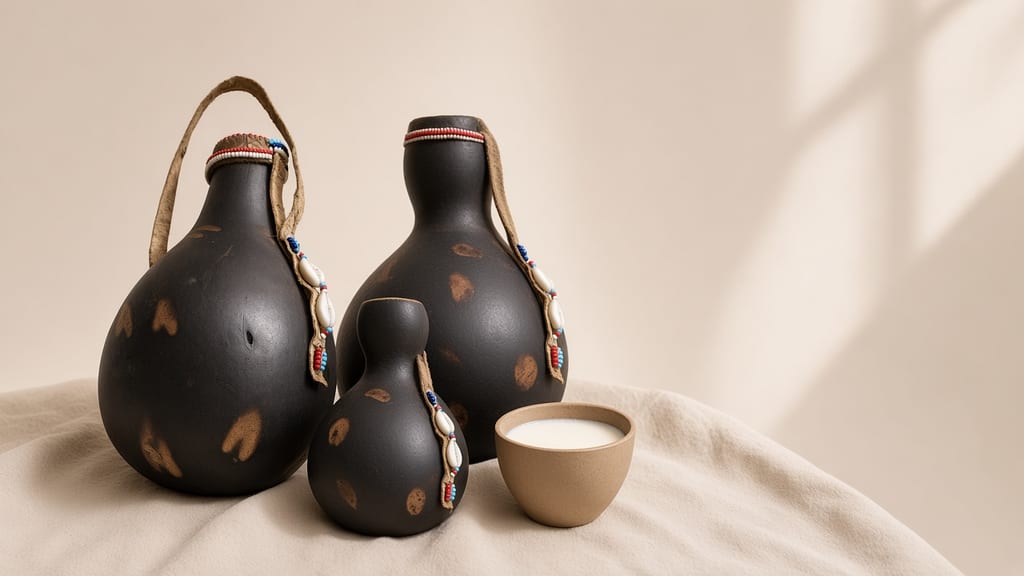
In his 1909 book The Nandi, A. C. Hollis set down the milk rules of the Nandi, one of the Kalenjin peoples of the western Kenyan highlands. Milk could be drunk fresh or sour, he wrote, "but it may on no account be boiled". It went only into gourds. Each gourd was fumigated with a burning stick of the itet tree every time after milk had been put in, because "the smoke gives the milk a flavour without which it is not palatable to the taste of the Nandi."
More than a century later the smoke is still there and the rule about boiling has gone. Modern descriptions of mursik, the Kalenjin sour milk, begin with milk that is boiled and cooled before it goes into a gourd blackened inside with charcoal. In March 2026 an elderly woman told a UNESCO field team that she now boils her milk too. Mursik was traditionally made with fresh milk; she changed when livestock vaccination came in.
Between those two kitchens lies most of what is known about mursik: the trees burnt for it, the microbes that sour it, the cancer studies that shadow it and the government effort to keep it alive.
The Nandi gourd in 1909
Hollis's account of Nandi dairy is short and exact. Boys and girls did the milking, and sometimes milked straight into their mouths. The only vessels allowed for milk were gourds or calabashes; anything else, people believed, would harm the cattle. Fumigating and cleaning the gourds was women's work. When milk had stood for a while, the gourds were washed out with cow's urine and then with boiling water.
The gourd was personal property. Each owner burnt a private mark onto it, warriors decorated theirs with cowries, and no warrior could drink from a new gourd. Milk and meat were kept apart: after drinking milk a man ate no meat for 24 hours, and after meat he waited 12 hours and swallowed salt water before he drank milk again.
Hollis does not use the word mursik, and his itet tree is not identified to species in the passage. What his notes fix is the order of things: a gourd, a burning stick, smoke on the milk every time.
Sixty farmers and a palm-leaf stalk
The fullest account of how the charcoal goes in comes from Trans-Nzoia, a farming district in the western highlands, where William Mureithi and colleagues spent August to October 1996 with 60 farmers. Selling milk was hard in 1995 and 1996. The Kenya Cooperative Creameries was the only commercial buyer in the area and paid late, and treating milk at home had become more important as a result.
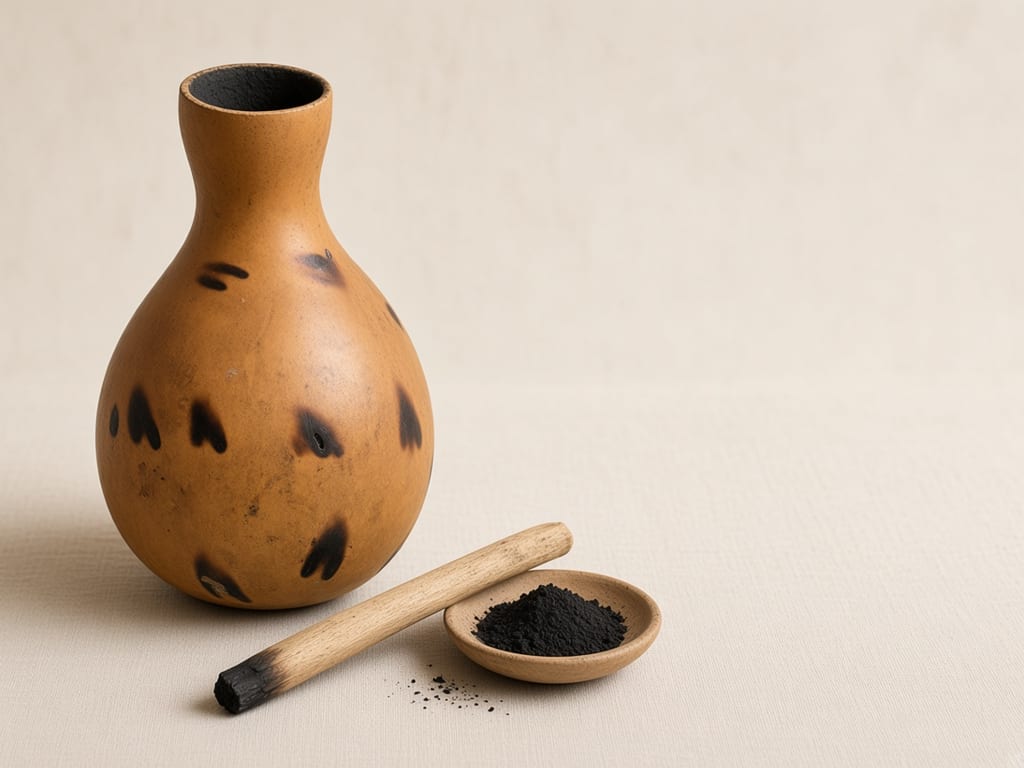
The work starts with the vessel. Women scrape the inside of the gourd with the stalk of a palm leaf, the central rib, to lift old fat and milk solids that washing will not move. A few days before the milk is treated, a branch about as thick as a thumb is stripped of its bark and left to dry. One end goes into the fire. When that end has burnt completely it is crushed gently against the sides and bottom of the clean gourd, turning to charcoal dust. The burning and crushing are repeated until the inside is coated, the excess is shaken out, and the gourd is ready.
Farmers judged the result by colour, smell and taste, and said their own treated milk was better than untreated milk or the factory milk sold by the creameries. Asked when the method began, workshop participants argued it out using oral history and age sets and settled on about 300 years. The researchers note that nothing written can confirm it.
A 2017 medical review adds two details from Kalenjin households. The scraping tool is a bow-shaped stick, usually palm, called a sosiot. A new gourd tastes bitter and has to be "sweetened" first: fresh bark of Ozoroa insignis, Pappea capensis or Ficus thonningii goes inside, the gourd is filled with water, and it cures for three days.
A league table of trees
Mureithi's farmers ranked the trees they burnt. Senna didymobotrya, the African senna, came first. Then came Lippia kituiensis, known locally as mwokiot, then Prunus africana, the African wild olive, Croton macrostachyus, Olea capensis and Rhus natalensis. Euclea divinorum and a few others were used by fewer households.
Olive was the farmers' favourite, and it was running out. Most said milk treated with Olea tasted best, but few trees were left. Households that still had an olive guarded it and allowed no more cutting; the survivors stood on grazing land and riverbanks. One Gikuyu farmer told the team that her husband had brought a piece of olive wood from Kiambu District, more than 600 km away, and that she had made it last nearly a year.
Senna is the tree women keep close. Sixty per cent of the farmers had planted it at the homestead, where livestock could not browse it, where a branch could be lopped whenever mursik was made without a long walk, and where it kept out of the way of crops and ploughing. They pollard and thin it so it throws many small branches. Fifty-seven per cent kept Lippia in their fields. The trees ranked lowest for milk, eucalyptus and black wattle, were the commonest on the farms, because men planted them to sell as fencing posts, timber and charcoal. Black wattle was abandoned for milk because people blamed it for blocking the urinary tract in men, and eucalyptus gave the milk a taste some farmers likened to cold medicine. In some communities nobody may step over wood cut for treating milk.
The 2017 review gives a slightly different list for the Kalenjin charcoal, which it calls suteiywo: senna again, with Juniperus procera, Plectranthus barbatus, Olea europaea and wattle. Thirty years after the Trans-Nzoia fieldwork, the 2026 UNESCO mission heard a related worry: traditional materials and the plants behind them are getting harder to find.
Why smoke the milk
The farmers' reasons were practical. Eighty-six per cent treated milk for its taste and flavour, 75 per cent to make it pleasant to drink and 73 per cent to keep it. Fresh milk, they said, smells and tastes like cow urine. White milk looked wrong to them; they prized the bluish-grey colour the charcoal gives. Many people cannot digest fresh milk well, they added, and fermenting it helps.
The gourd itself was part of the problem. Gourds are cheap and easy to grow, but they give milk a bitter taste, are hard to clean and can smell. Treating the milk was meant to cover the bitterness and the smell. An earlier study of Tugen milk in Baringo, summarised by Mureithi, gave three reasons for the lining: the milk keeps longer, sour milk is a strong meal on its own, and the charcoal gives colour and scent. The crushed charcoal also stops the gourd wearing out fast and removes its natural smell.
Charcoal works on flavour as well as colour. A study Mureithi cites describes the finely divided charcoal as having a wide surface that absorbs flavours from the milk, while adding a taste of its own. The Mbeere smoke their gourds to sterilise them, and Mureithi notes that crushed charcoal may still smoke inside the gourd and do the same work.
Kept this way, milk lasts. A 1987 source cited by Mureithi put the shelf life of treated milk among Kenyan pastoralists at up to three months. Pokot farmers told the 1996 team about chekha mwaka, a specially treated milk that keeps for more than a year.
Neighbours along the Rift and beyond
Mursik has relatives across Kenya, and the details change from one community to the next. The Meru coat their gourds with charcoal of the African wild olive for iria ri matii, and the smoke aroma is the point of it. Maasai in Kajiado treat gourds with Olea for osaroi. An older study of maziwa lala, Kiswahili for sour milk, describes Maasai gourds rubbed with the burnt ends of sticks from a tree called mutamayio that nobody has yet identified. The Mbeere, south of Mount Kenya, smoke their gourds instead of coating them.
Maasai kule naoto is made from raw milk in a gourd rubbed with burnt olive wood, sometimes with blood added, and is kept up to five days. A 2004 study of 22 samples isolated 300 lactic acid bacteria strains, about 60 per cent of them Lactobacillus plantarum, and found no Enterobacteriaceae in 15 samples. The Gusii make amabere amaruranu from boiled milk started with a little of the previous batch, called enduranerio, and mix boiled blood into it for omokoora.
Across the border in southern Ethiopia, herders smoke their milk vessels too. Borana households in Yabello clean and smoke the milk vessel, wait one to three days for the first curd and pour off the whey. Borana told researchers that "boiled milk is dead". In West Guji, a 2024 survey of 120 households named four smoking plants, among them African olive and Rhus natalensis, and three ways of smoking the vessel. In laboratory tests the team smoked upturned vessels for at least 20 minutes, and smoke from Rhamnus staddo held microbes back best. The authors were careful: fewer microbes do not make milk safe, and the hydrocarbons in the smoke still need study.
What is in the milk
Lactic acid bacteria sour mursik, and yeasts live alongside them. The tighter picture comes from a 2013 study that took eight starter cultures from Kalenjin families, fermented milk with them and measured what came out. Yeasts were present in every sample, between 7 and 90 per cent of the microbes counted. Seven of the eight produced acetaldehyde above 100 µmol/L, the level the authors treat as mutagenic, and four went beyond 1,000 µmol/L. The four strongest averaged 79.4 mmol/L of ethanol. The highest acetaldehyde came where the yeast Candida krusei grew with the bacterium Lactobacillus kefiri.
The 2017 review put those figures beside commercial yogurt: acetaldehyde above 1,800 µg/L in some mursik, about four times the yogurt level, and ethanol above 100 mmol/L. The 2013 authors named acetaldehyde as a possible cause of the region's high rate of cancer of the gullet. Household cultures are back-slopped, each batch started from the last, and mursik is sometimes kept for more than a year.
The cancer question
Western Kenya has high rates of oesophageal cancer, and mursik is one suspect. A Kenyan hospital study summarised in a 2023 meta-analysis found mursik drinkers at higher risk, with an odds ratio of 3.72. In 2025 Mutai and Mweu published a case-control study from two hospitals in Kapsabet, Nandi County, comparing 33 patients with 131 controls seen between November 2023 and January 2024. People who drank mursik often had about nine times the odds of the cancer, and occasional drinkers about three times. By the authors' estimate, up to 65 per cent of cases in that population might not occur if mursik were not drunk.
Those figures come with limits the authors state themselves: a small study and the chance of confounding they could not remove. The kitchens where mursik is drunk also serve very hot tea. At Tenwek Hospital, 99 of 100 participants in one study preferred their tea hotter than 65 °C, which is a risk in its own right. A 2017 review weighed the charcoal, the acetaldehyde, possible mould toxins in stored milk and the tea, and called the case against mursik inconclusive.
The question reaches children. A survey of 383 Kalenjin families found 32 per cent gave mursik to children under five, about 250 mL a week. The 2025 study ends by asking for "safe, community-owned alternatives for fermenting milk".
A gourd at the airport
In 2008 Pamela Jelimo came home to Eldoret as Olympic 800 m champion. Crowds started arriving at the airport from 6.30am in hired school buses, and security closed the door to the lounge. She was due at Eldoret airport at 8am and landed at 10.33am in a Kenya Police helicopter. Relatives pushed through the cordon, students from her old school sang, and the family had brought flowers, special beads, a decorative plant called sinendet and a wrapper made from cowhide. Then she was handed a gourd of mursik, decorated with flowers and the wrapper. Kipchoge Keino, chairman of the national Olympic committee, was there, with Daniel Komen and other runners.
The scene is a ritual, and the 2017 review lists athletic success beside marriage and weddings among the occasions mursik marks. UNESCO's 2025 workshop called it the energy drink of many of the region's athlete heroes. Whether it does anything for runners is another matter; the medical review notes the idea as a hypothesis, nothing more.
Mursik from a cooperative
Mursik is also a dairy product with a price. In Kuresoi North, the Chemare Dairy Farmers Cooperative, with about 1,800 members, makes mursik from pasteurised milk. Instead of burning sticks inside a gourd, it uses activated charcoal, wosek, made from African senna. Its value-added milk sold at KSh 130 a kilo in 2025, against KSh 42 for raw milk, and the cooperative holds a Kenya Dairy Board licence.
Pasteurising first deals with the raw-milk risk and keeps the senna. Whether factory charcoal changes the acetaldehyde or hydrocarbon picture is still an open question.
Ten in hospital
Home mursik can go wrong. In January 2026 ten members of one family in Chepseon, Kipkelion East, aged from 3 to 60, were taken to hospital in Londiani after sharing about 3 litres. Kericho's acting public health officer said early findings pointed to colostrum, the first milk after calving, and warned makers not to add yeast to speed up fermentation.
Saving it
The Kenyan government now treats mursik as heritage at risk. In December 2025 more than 150 people met in Uasin Gishu for a UNESCO inventory workshop, with fieldwork in Kimumu, Sambut and Kaptagat. They put mursik forward as a candidate for future nomination to UNESCO's intangible heritage lists. Participants said changing farming and environmental damage threaten it, and the workshop recorded mursik made from cow or goat milk in the sotet. In January 2026 the culture ministry said it was preparing the inventory needed to list mursik as heritage in need of urgent safeguarding.
In March the field mission went to Kipsigis, Ogiek, Tugen and Pokot homes in Kericho, Nakuru and Baringo. Women showed how they treat gourds with burning wood. The terms changed from one community to the next, the gourds' names among them. A Tugen woman said some young people no longer want to drink it because of how it looks and tastes. One participant said mursik is served when dowry negotiations end, to seal the agreement between two families. In homesteads across the three counties, elder women still pour milk into soot-lined gourds while the young watch, some of them recording on their phones.
Related
Discussed in this article
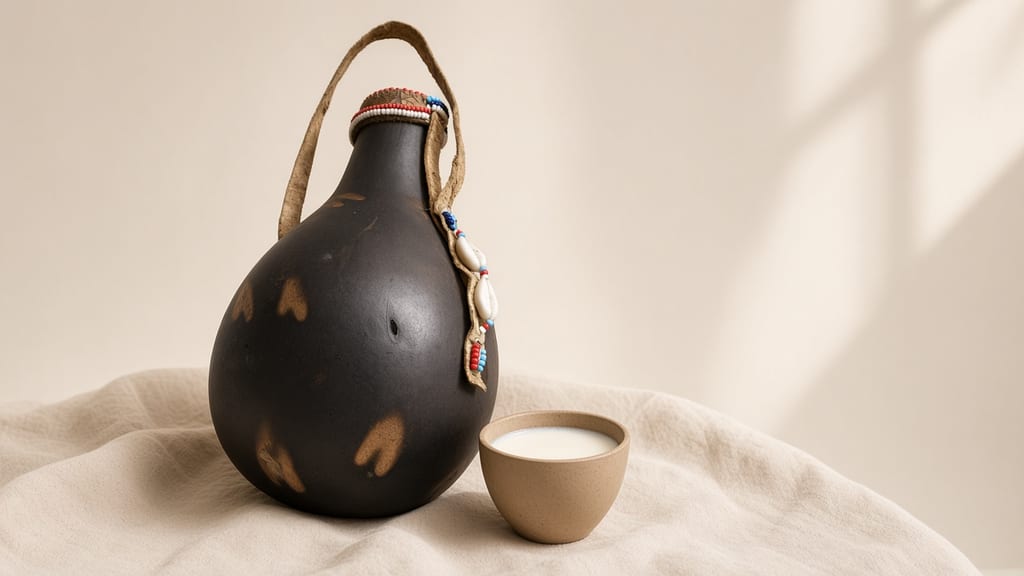
Mursik (Kalenjin smoked-gourd fermented milk)
Kalenjin sour milk soured in a gourd lined with senna charcoal, with the safety warning first, pasteurised milk and a pH check, and the trees and lab work behind it.
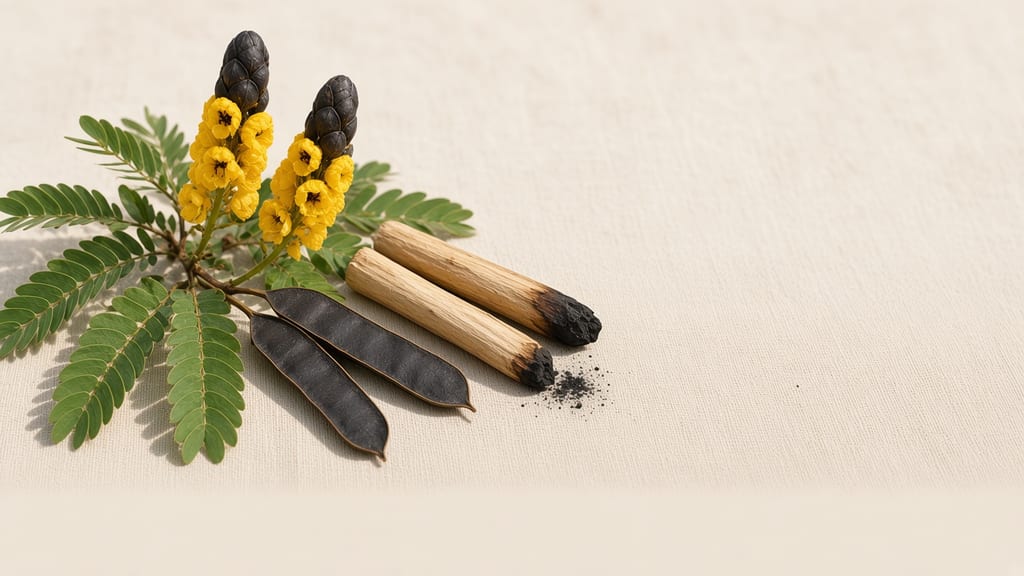
Senna didymobotrya
Senna didymobotrya is an African shrub whose wood is burnt to charcoal and rubbed into Kalenjin milk gourds for mursik. The leaves, bark, roots and pods are poisonous and are never eaten.
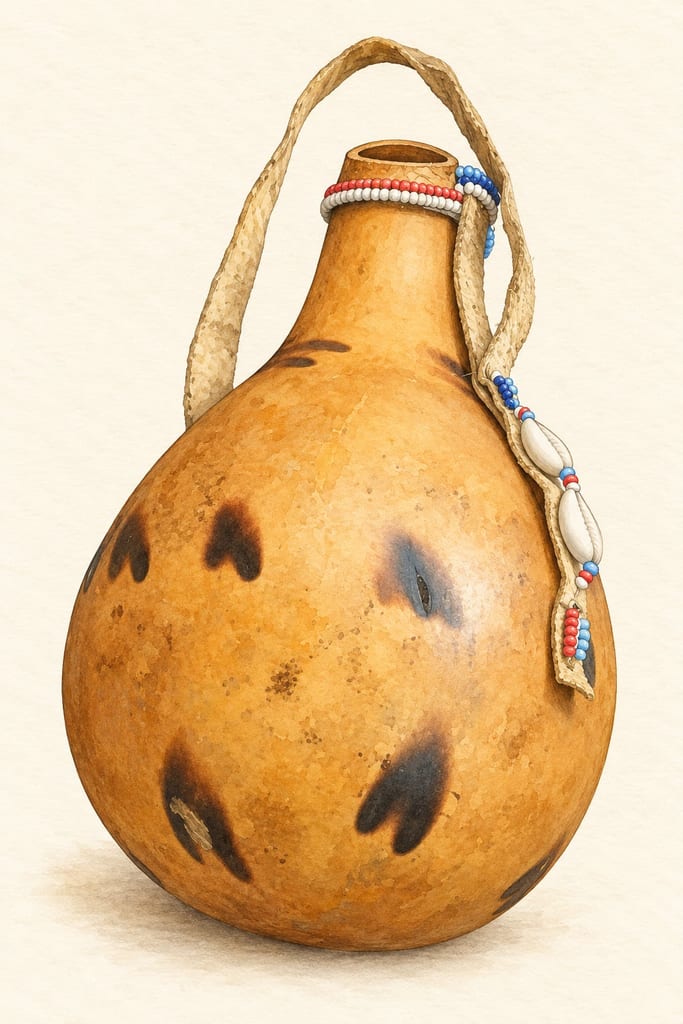
Smoked milk gourd
A dried gourd used in documented Kalenjin and Nandi practices to hold and serve mursik. Sources describe different ways to prepare its interior, so sotet is a family of locally shaped vessels rather than one standard design or treatment.
Community
No community contributions have been published for this entry yet.
Share what you made
Sign in to contribute. Published comments and photos are free to read.
Sources
Clarendon Press (Internet Archive scan)
The Nandi: their language and folk-loreCited in: On no account boiled; The Nandi gourd in 1909
Journal of Ethnobiology 20(1):75–91
Management of trees used in mursik (fermented milk) production in Trans-Nzoia District, KenyaCited in: Sixty farmers and a palm-leaf stalk; A league table of trees; Why smoke the milk; Neighbours along the Rift and beyond
African Journal of Food Science
Spontaneously fermented Kenyan milk products: a review of the current state and future perspectivesCited in: On no account boiled; Neighbours along the Rift and beyond; What is in the milk; A gourd at the airport
Academic Journals
Spontaneously fermented Kenyan milk products (full text)Infectious Agents and Cancer
Factors associated with the high prevalence of oesophageal cancer in Western Kenya: a reviewCited in: Sixty farmers and a palm-leaf stalk; A league table of trees; The cancer question; A gourd at the airport
Cancer Epidemiology, Biomarkers & Prevention 22(1):69–75
Alcohol and acetaldehyde in African fermented milk mursik: a possible etiologic factor for high incidence of esophageal cancer in western KenyaCited in: What is in the milk
International Journal of Food Microbiology
Isolation, identification and characterisation of the dominant microorganisms of kule naoto, the Maasai traditional fermented milk in KenyaCited in: Neighbours along the Rift and beyond
PLOS One 20(9):e0324412
Association between traditional fermented milk (mursik) consumption and oesophageal carcinoma among patients presenting to two referral hospitals in Nandi County, Kenya: a case-control studyCited in: The cancer question
BMC Public Health
Environmental and life-style risk factors for esophageal squamous cell carcinoma in Africa: a systematic review and meta-analysisCited in: The cancer question
International Journal of Cancer
Research on esophageal cancer: with personal perspectives from studies in China and KenyaCited in: What is in the milk; The cancer question
Heliyon
Indigenous knowledge on the practice of milk container fumigation and its effect on microbial safety of milk among pastoral communities in west Guji zone, southern EthiopiaCited in: Neighbours along the Rift and beyond; Mursik from a cooperative
Journal of Health, Population and Nutrition
Milk handling practices and consumption behavior among Borana pastoralists in southern EthiopiaCited in: Neighbours along the Rift and beyond
UNESCO
Supporting communities to safeguard Kenya's mursik: a taste that nourishes and unites peopleCited in: A gourd at the airport; Saving it
UNESCO (26 March 2026)
Keeping mursiik alive: communities unite to safeguard Kenya's heritage at riskCited in: On no account boiled; A league table of trees; Saving it
The Star (Kenya), 14 January 2026
Ministry wants mursik on menu for UNESCO safeguardingCited in: Saving it
The Standard (Kenya), January 2026
Traditional mursik under scrutiny after family suffers food poisoningCited in: Ten in hospital
SNV (16 January 2025)
Ecosystem sustainability through dairy intensificationCited in: Mursik from a cooperative
Gaps
- No published measurement of polycyclic aromatic hydrocarbons in mursik is known.
- Hollis's itet tree is not identified to species.
- Little is published on commercial mursik makers other than Chemare, or on a Kenyan standard for mursik.
- No published study compares mursik made with activated charcoal and mursik made with gourd charcoal.
Updated 2026-11-09