
Vinegar intake
Vinegar: the craft of making acidity
Vinegar forms when bacteria and oxygen turn alcohol into acetic acid. This reference follows wine, fruit, grain and sap through that change, the ways of supplying oxygen, the measurements and the choices that finish a bottle.
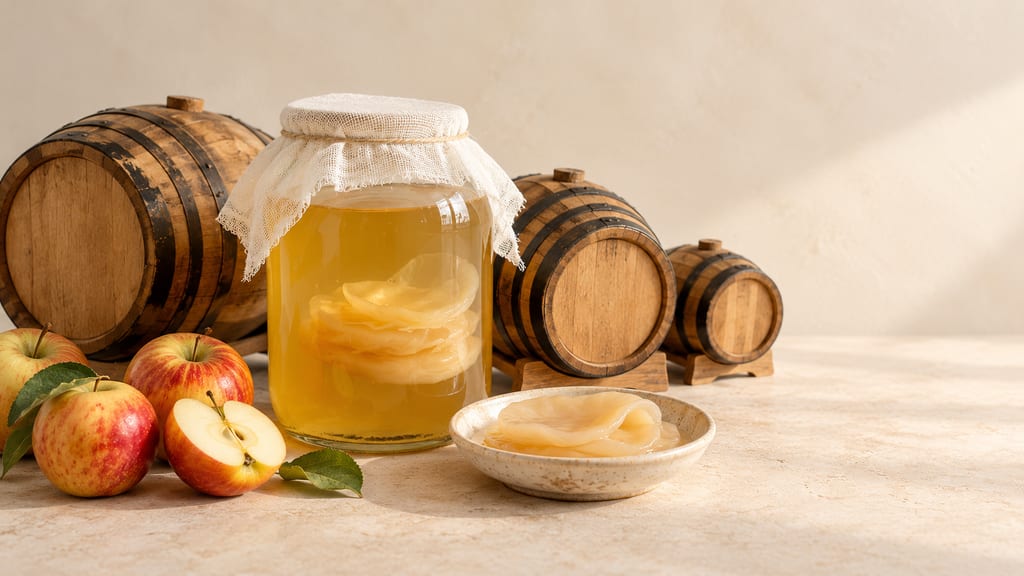
A vinegar mother, small casks and jars of fruit turning to vinegar: the craft of making acid by fermentation.
Introduction
Vinegar begins where an alcoholic drink changes direction. Given suitable bacteria and oxygen, alcohol becomes acetic acid: the sharp, volatile acidity familiar in a dressing, a pickle or a spoonful of wine vinegar. Across different food cultures, people have organised that change around wine, fruit, grain, sap and the remains of other fermentations. Understanding vinegar means following those materials through their transformations, rather than treating every sour bottle as the same ingredient.
A history of managing a familiar change
There is no secure single invention story for vinegar. Alcoholic liquids exposed to air provide repeated opportunities for acetification, but a plausible biological sequence cannot establish when someone first recognised or deliberately managed it. Nor does an old word necessarily describe a product with the composition of a modern labelled bottle. The useful historical questions are more specific: what did people call the liquid, what did they put into it, and what did they expect it to do?
Cato's On Agriculture, section 104, describes a winter drink for farm workers containing grape must, sharp vinegar, boiled must, water and seawater. He also anticipates the remainder becoming vinegar. It is an unusually concrete glimpse of the movement between drink and condiment. It does not establish that this mixture made contaminated water safe, and its old measures and storage promises are not modern household instructions.
The Chinese Qimin Yaoshu, attributed to Jia Sixie, preserves a whole chapter of vinegar-making, 作酢第七十一. In the transmitted text, cooked grains, grain preparations, alcoholic liquids and brewing residues appear in different combinations. Some instructions specify cloth-covered jars; others describe stirring, staged additions, pressing or pouring liquid back over a bed of material. There is close attention to heat, vessel placement and the condition of the mash. Practical observations coexist with ritual dates and beliefs about spoilage that cannot be adopted as microbiology. This is evidence of a varied written craft, not one ancient formula from which every Chinese vinegar descends.
By the nineteenth century, explaining the craft experimentally had become a separate project. Louis Pasteur's Études sur le vinaigre, published in 1868, brought together an earlier memoir and a lecture delivered in Orléans in 1867. Its opening argument connects alcohol's conversion with oxygen and the activity of the vinegar film. The book addresses makers already practising an established trade. Pasteur was investigating vinegar production, not inventing vinegar. His experiments also belong to their period: the language used to describe organisms, and the equipment available to supply oxygen, should not be mistaken for present taxonomy or modern submerged fermentation.
These records make a better history than a procession of origin legends. They show vinegar serving labourers, entering agricultural instruction and becoming an industrial research subject. They also show why recipes deserve to be read in context. A historical instruction can reveal resourcefulness, taste and workshop practice without proving a current preservation method.
What belongs in the vinegar family
For culinary purposes, fermented vinegar is an acidic food whose characteristic acetic acidity comes from microbial conversion of alcohol. The liquid may also contain other acids, sugars, pigments, minerals and aromatic compounds. Its base and subsequent treatment matter. A clear spirit vinegar begins with distilled alcohol but still undergoes acetification. It is not simply a solution of purchased acetic acid.
Spirit vinegar and diluted acetic acid also have different labelling identities under US Food and Drug Administration guidance. Cider vinegar made from apple juice is distinguished from vinegar made from dried apples, cores or peels. These are jurisdiction-specific definitions, not a worldwide law setting one acidity or one naming system for all products.
The material named on a bottle can play several roles. A raspberry might supply sugar for the original fermentation, be steeped in an existing vinegar, or enter later as juice. The first route makes a fermented fruit base; the others make a flavoured vinegar or mixture. A seasoning made by combining vinegar with sugar, salt, stock or soy sauce is useful cooking, but the combination does not establish a new vinegar-producing organism or fermentation family.
Some neighbours are further away chemically. Okinawa's Ryukyu Moromisu, sold in a category translated as a vinegar drink, is made from awamori brewing residue and has citric acid as its principal sour component. It therefore cannot be understood by assuming that every su product is an ordinary acetic vinegar. Likewise, a quick pickle acidified with vinegar differs from a pickle in which microorganisms generate acid during fermentation. The final foods may both taste sour, while the processes and their controls differ.
The most useful description of a bottle answers several questions together: its fermented base, production system, later additions, declared acidity and intended use. Colour, a visible film and words such as “traditional” answer only fragments of that description.
Kachampuli, a sour condiment associated with Karnataka, is made from Garcinia gummi-gutta juice. The juice ferments slightly before it is simmered to a dark syrup. Its familiar English name includes vinegar, but that name does not establish its acid composition or a conventional alcohol-to-acetic-acid process. Juice collection, some fermentation and concentration by cooking each contribute to the finished condiment.
Ingredients determine the route
Wine and cider offer a comparatively direct starting point because alcoholic fermentation has already taken place. Fresh juice introduces an earlier job: producing a suitable alcoholic liquid. Grain introduces another. Its starch must first be made available as sugars that the fermenting organisms can use. Malt and cultivated grain starters are therefore functional ingredients, not decorative signs of authenticity.
In Japanese rice-vinegar production, rice koji contributes enzymes from Aspergillus oryzae. The enzyme action that releases sugars is distinct from the yeast activity that produces alcohol and the bacterial activity that produces acetic acid. Those jobs can occur in a connected vessel system, but they remain different transformations. Pouring vinegar over cooked rice supplies acid; it does not by itself reproduce this sequence.
Raw-material identity also matters within apparently simple names. Coconut water comes from inside the nut; coconut toddy comes from tapped sap. They take separate routes to vinegar: a documented coconut-water formulation includes added sugar before alcoholic fermentation, whereas the toddy route begins with sugary sap. A “coconut vinegar” comparison that ignores this distinction misses both the source of fermentable sugar and the work done before acetification. Palm-wine vinegar documented in West Africa further demonstrates that vinegar-making cannot be reduced to the European wine trade.
Brewing residues connect vinegar to the economics of another food. Japanese kasuzu uses sake lees, and matured lees contribute to the red appearance and flavour of some styles. In Ghana, a cocoa by-product development programme included vinegar among the possible uses of cocoa pulp juice or sweatings. That is a route from a particular processing stream, not evidence that cocoa butter or a chocolate bar can be treated like fruit juice.
Whey poses a different biological question. In a published experiment, lactose-supplemented cheese whey was fermented with the yeast reported as Kluyveromyces fragilis, followed by bacteria identified as Acetobacter pasteurianus. The meaningful detail is the matched substrate and culture. “Use any wine yeast” would discard the reason that experiment worked. It would also hide the dairy origin relevant to ingredient and allergen assessment.
The living conversion, and the mother
The central acetification reaction can be written as:
ethanol + oxygen → acetic acid + water
The conversion releases heat. “Acetic fermentation” is the customary production term, although this central step is an oxidation requiring oxygen. For the maker, that requirement explains more than the terminology: air supply and heat removal must work together. A vessel suitable for retaining an alcoholic drink is not automatically suitable for converting it to vinegar.
The mother is the visible film or mass associated with some vinegar cultures. Bacteria also occur in the liquid. A large disc is consequently neither the whole culture nor a measurement of its performance. In a study of three traditionally fermented rice vinegars, isolates from surface films were identified as Acetobacter pasteurianus; microscopy and the authors' interpretation linked film formation to bacterial cellulose. That finding concerns those samples. It does not identify every film in a household jar, and a photograph cannot establish a culture's species or purity.
A vinegar culture is also not a universally interchangeable ingredient. Studies of commercial and traditional fermentations investigate communities rather than a single organism common to every bottle. In Zhenjiang aromatic vinegar, monitoring across seasons combined microbial sequencing with measurements of organic acids, aroma compounds and the fermenting environment. Such work helps explain why raw materials, temperature and the production environment belong in the same account. Associations between organisms and flavour compounds are research clues; they are not proof that adding an isolated organism will reproduce the finished flavour.
For a cook, the useful consequence is to choose a food-use culture suited to the intended process and keep its instructions with the batch record. A bottle bearing a “mother” claim may describe sediment or living material, but neither the word nor the size of the deposit states how actively that particular bottle will acetify a new feed.
Different ways to supply oxygen
Surface production puts an alcoholic liquid beneath an air-exposed surface. The arrangement can be simple, but its geometry matters: the interface is where air meets the culture. A larger quantity in a deeper vessel does not preserve the conditions of a smaller shallow batch merely because the ingredient proportions match. This is a process-design consequence of supplying oxygen at the surface, not a universal jar-sizing rule.
The Orléans method manages that surface in wooden vessels. A working barrel needs room for air, protected openings and a way to introduce liquid without needlessly disrupting the film. Feeding through a tube that extends below the surface protects the film from the incoming liquid. Martin-Pouret's present-day Sauvignon vinegar is fermented in oak. Wood, feed composition and subsequent maturation contribute separate decisions; “barrel fermented” is not an age statement.
Packed generators solve the contact problem differently. Liquid is distributed over material colonised by bacteria, while air passes through the packing. The liquid can be recirculated. The support supplies a large working surface, but distribution, cleanliness and air movement become equipment problems. The presence of wood packing does not make this the same operation as holding vinegar in an ageing barrel.
Submerged systems distribute bacteria through aerated liquid. Commercial acetators combine an aerator, cooling, sampling and process controls; some also monitor alcohol continuously. In a FRINGS repeated-batch system, part of the vinegar is removed and fresh alcoholic feed enters material retained from the preceding batch. Measurements guide each cycle. Simply topping up a household crock whenever wine is left over loses the information that makes those cycles interpretable.
Moist-solid grain vinegar presents another arrangement. The fermenting material, often called pei, is a solid–liquid matrix rather than a clear alcoholic drink. Sampling must account for a heterogeneous mass, and the temperature of the fermenting material can differ from the surrounding room. The Zhenjiang seasonal investigation explicitly measured both. This is why a vat of grain vinegar cannot be converted into a jar recipe by copying only a reported room temperature or number of days.
Kagoshima jar vinegar shows how several stages can share one vessel. Rice koji, steamed rice and water enter outdoor pots; sugar release and microbial activities follow one another within that setting, before further maturation. The protected Kagoshima product is associated with Fukuyama and Hayato in Kirishima. Its registered production includes more than six months of fermentation followed by another six months of ageing. Those periods belong to this regional product. They are not a promise that any rice jar left outdoors for a year becomes equivalent vinegar.
None of these systems is a simple ranking from inferior to superior. Each solves oxygen supply, material handling and product consistency differently. A claim about flavour must concern the resulting vinegar, not merely the romance or size of the vessel.
What a household project can reasonably establish
Starting with a sound alcoholic liquid separates acetification from the earlier work of extracting sugars and making alcohol. That makes it easier to understand what changed. It still requires a compatible starter and a complete method. In professional wine acetification, the base wine's alcohol, acidity and sulphur dioxide are assessed before inoculation. A leftover wine may need adjustment before it becomes a suitable base.
The household equipment should make observation and cleaning straightforward: a vessel intended for acidic food contact, an insect-excluding cover compatible with the method's air requirement, a thermometer, accurate measuring equipment and a clean means of sampling. Glass is useful because the liquid remains visible. Taps, seals and lids need the same food-contact scrutiny as the main vessel. An attractive jar is of little use if its fitting corrodes or cannot be cleaned.
Fruit-scrap projects add several uncertainties at once. Extraction, added sugar, the alcoholic stage and acetification all influence the result. If substantial sugar is added, some of the resulting acidity comes from that sugar, even when the fruit supplies the name and aroma. This can be a legitimate experiment, but it is not chemically interchangeable with cider vinegar made from pressed juice.
Use sound food ingredients. Mouldy apples raise a specific concern about patulin, a fungal toxin that ordinary juice pasteurisation does not remove. Fermentation can reduce patulin, and it is not typically found in fruit vinegar or alcohol; that observation does not validate an uncontrolled household treatment of rotten fruit. Selecting suitable raw material remains part of the process rather than a fault to repair at the end.
A useful record identifies the base, starter, vessel, starting volume and any known alcohol or acid measurements. It then records temperature, additions, withdrawals, sampling, measurements and finishing. If acidity appears to fall, the record helps distinguish a new dilution from a biological change or a measurement problem. If a batch differs from the previous one, changing one planned variable at a time makes the comparison more informative.
The endpoint must match the question. Pleasant flavour is a culinary observation. A stated acid content requires analysis. A claim about residual alcohol requires a separate measurement. A household project does not acquire a shelf-stable preservation specification merely because it has reached a date on the calendar.
Four measurements that are often confused
pH measures hydrogen-ion activity. It describes an aspect of the acid environment, not the total amount of acid in the bottle. Because acetic acid dissociates only partly, and real vinegars contain other acids and buffering substances, there is no universal conversion from a pH reading to “percent vinegar acidity.” A calibrated meter improves the measurement of pH; it cannot turn that measurement into a different quantity.
Titratable acidity measures neutralisation to a defined endpoint. In the OIV vinegar method, a standard alkali solution neutralises the sample and the result is expressed as grams of acetic acid per litre. The expression is an equivalent basis: other neutralised acids contribute too. A mixed-acid vinegar's total acidity is therefore not automatically a selective measurement of acetic acid.
The units must travel with the result. Grams per litre, grams per 100 millilitres and grams per 100 grams are different expressions. An educational titration based on a weighed vinegar sample reports a mass basis; it should not be copied into a volume-based label without the necessary information. “Five percent” alone is an incomplete analytical record when the method and basis are unclear.
A specific acetic-acid assay answers a narrower question. Enzyme-based laboratory methods can measure acetic acid selectively. Their selectivity comes from the assay chemistry, not from the use of the word acidity. Sample preparation, dilution, interfering substances and the working range still matter. Buying a reagent does not remove the need to follow its validated procedure.
Residual ethanol measures alcohol left after acetification. It requires an analysis separate from acid measurement. Neither sourness nor a low pH establishes its absence. An uncorrected sugar-scale refractometer reading or a direct density reading in a complex fermented liquid cannot simply be relabelled alcohol by volume: sugars, acids and alcohol all affect the physical properties being measured. A suitable analytical method must address the actual sample.
Titration is valuable for understanding a process, but it is not a way to certify an improvised pickle. It measures the sampled liquid under particular conditions. It does not establish acid distribution through a food, the correctness of the ingredient proportions or the adequacy of heat processing.
Finishing is another set of decisions
Clarification, maturation, microbial stabilisation and flavouring do different work. Settling or straining removes visible material; it should not be described as sterilisation. Pasteurisation is a defined heat treatment, not a synonym for briefly warming a bottle. It does not set acidity or turn an arbitrary sweetened mixture into the product for which a heat schedule was written.
Finished wine vinegar is heated to 60–71 °C, approximately 60–71 °C, and held there for at least 30 minutes in the preservation method described by NC State Extension. That treatment belongs to the finished vinegar in that method. It is not a schedule for vegetables, meat, sweet drinks or an unfamiliar sauce, and it does not justify an unlimited shelf-life claim for homemade products. A thermometer must measure the liquid, rather than only the surrounding water or oven setting.
Ageing can change clarity, aroma and the relationship between the liquid and its vessel. In Capirete's Jerez criaderas and solera system, vinegar drawn from an older group of barrels is replenished from younger groups. Repeated transfers create a mixture of ages. The date a barrel system was founded is consequently different from the age of every portion eventually bottled from it.
Wood maturation also differs from leaving an active culture indefinitely exposed to air. Finished coconut-water vinegar needs protection from oxygen to prevent further oxidation of acetic acid. The maker therefore needs to distinguish the air required during acetification from the conditions intended for the finished product.
Adding fruit, herbs or sugar starts another formulation. Fruit and herb infusions made with commercial vinegar need suitable containers and clean ingredients; refrigeration helps retain their quality. Discard an infusion that develops mould or signs such as bubbling or sliminess, without tasting it. These handling recommendations concern infusions of commercial vinegar, not every fermented liquid carrying a vinegar name.
For home canning, follow a research-tested recipe and its specified commercial vinegar, strength and proportions. Do not replace that vinegar with a homemade batch. Water and food change the final mixture, and the required acidity must reach the food as well as the surrounding liquid. A favourable home titration cannot validate those other parts of the preservation process.
Choosing vinegar for food and drink
In ordinary cooking, the first choice is often between a vinegar whose aroma should be evident and one that mainly supplies acidity. Compare sweetness, salt and ingredient lists as well as sourness. A seasoned rice vinegar may change the seasoning balance of a dish even when its colour resembles an unseasoned bottle. A dense sweet product can taste less sharp while still contributing substantial acid.
Regional use is a guide to purpose. Japanese rice vinegar seasons rice and enters mixtures with stock, soy sauce and other ingredients; sake-lees vinegar has a documented association with Edo-style sushi. Martin-Pouret's Sauvignon wine vinegar also seasons dressings and mayonnaise served with fish and seafood. These examples concern flavour and serving. They do not mean vinegar makes raw fish safe, or that equal volumes of any vinegar are interchangeable in preservation.
Infusion is another useful culinary operation. Herbs and fruit transfer aroma to an existing vinegar, producing an ingredient for dressings, marinades or drinks. The flavouring material should be described as such rather than credited with a fermentation that did not happen. Similarly, mixing vinegar into sweetened water makes a drink, not a new base vinegar.
For comparison, try contrasting food vinegars in the same simple dish and record the labels. The point is to notice what each contributes: fruit, cereal, wood, sweetness or a relatively neutral acid note. Keep the serving format comparable. A vinegar tasted in a rich sauce and another tasted alone cannot offer a useful test of their relative sharpness.
Drinking vinegar deserves a different exposure assessment from using a small amount in food. Acidic drinks, including vinegar mixed with sparkling water, raise a concern about enamel erosion. Dilution and a fashionable “healthy” label do not remove the acid. Prolonged or repeated sipping is not a reason to infer a health benefit from a condiment.
Health, allergens and religious use
Vinegar's medical history and its modern clinical evidence answer different questions. Historical use establishes that people used it as a remedy. Chemical antioxidant assays establish behaviour in an assay. Neither establishes treatment of disease in humans, and living organisms in an unpasteurised product do not by themselves demonstrate a probiotic benefit.
A small randomised crossover study in people with type 2 diabetes examined glucose metabolism after a meal and reported changes including increased forearm glucose uptake. Its eleven participants and short observation period define the scale of the result. It does not establish a long-term treatment, a weight-loss programme or the special efficacy of any bottle sold “with the mother.” A separate, widely publicised apple-cider-vinegar weight-loss trial was retracted by BMJ in 2025 after concerns about its data, analysis and reporting. Its results should not continue to support efficacy claims.
Dietary suitability also follows the actual product. Malt-derived ingredients raise barley and gluten questions; whey-derived ingredients raise dairy questions. Wine vinegar can carry a sulphite declaration, as the Sauvignon product discussed here does. Seasonings may add soy, sesame, mustard or fish ingredients. Fermentation is not a general exemption from checking the finished label, and advice for coeliac disease is not automatically advice for barley allergy. Product-specific evidence matters more than a broad vinegar category.
Religious assessment should identify the authority as well as the material. Egypt's Dar al-Ifta, in its published answer of 30 December 2013, permits wine transformed into vinegar, whether the transformation occurs spontaneously or is manufactured. That is a named ruling, not universal certification of every product. The starting material, transformation, added ingredients and requirements of the relevant certifier remain distinct questions. Analytically measured residual ethanol is another question again; the word vinegar does not promise a zero result.
What vinegar research is still opening up
Authentication asks whether a bottle's composition supports its claimed origin. Isotope methods can investigate the provenance of the acetic acid or water alongside routine acidity and alcohol analysis, but interpretation needs appropriate comparisons. A visible mother cannot prove geographic origin, a particular fruit substrate or the absence of undeclared blending.
Microbial research increasingly examines communities and their activity rather than selecting a culture by appearance. Comparisons between seed pei from different Chinese production settings have investigated microbial membership and potential functions. The practical research question is which organisms and conditions reliably create the desired product, not which list of organisms sounds most impressive on a label. Sequencing, culture isolation and chemical measurement supply different evidence and should be used together.
Bacterial cellulose creates a connection to both food and materials science. Nata de coco is a deliberately produced cellulose food; researchers have also used nata-derived cellulose in experimental forward-osmosis membranes. Those membranes were formulated and tested as materials. The experiment does not make a household vinegar film a water purifier, nor make a random mother equivalent to a controlled nata preparation.
By-product vinegar offers possibilities only when the stream is identified precisely. Cocoa pulp juice, whey and sake lees present different sugars, nutrients and handling demands. A project showing that a usable vinegar can be produced does not establish its environmental advantage. That further question must include yield, energy, water, transport, packaging and what would otherwise happen to the material.
The same discipline applies to accelerated ageing. A treatment that changes selected compounds is not automatically equivalent to years in a particular barrel system. The useful comparison must specify what matched: an analytical marker, a sensory result, storage behaviour or a protected production requirement. Vinegar rewards close observation because the familiar sourness is only one part of the food. Its history and variety become clearer when each ingredient, organism and operation is given the work it actually does.
Related
Discussed in this article
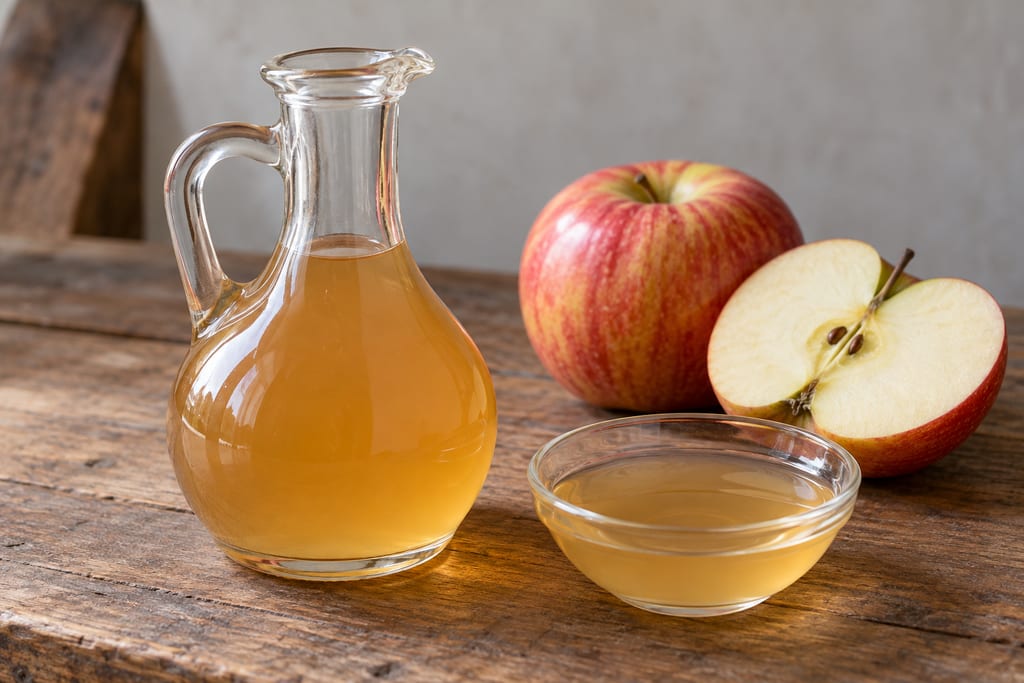
Cider vinegar
Cider vinegar is made when acetic-acid bacteria use oxygen to turn the alcohol in dry apple cider into acetic acid. This historical cask method begins with fermented cider and differs from apple-scrap vinegar made with sugar and water.
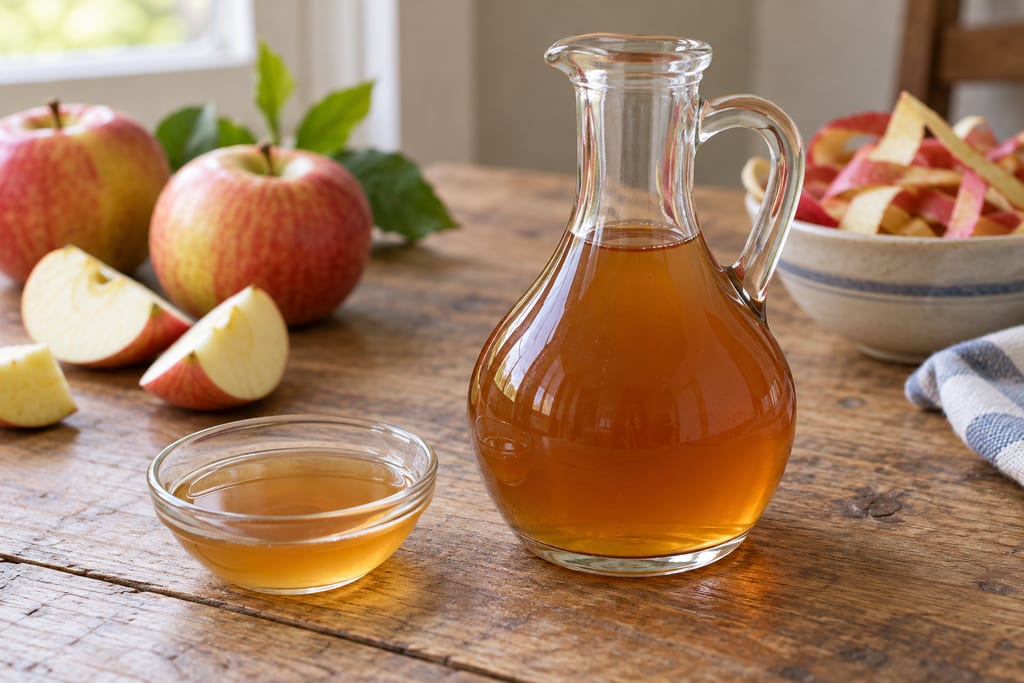
Sugar-based apple cider vinegar
Apple vinegar made at home from whole fruit or peelings and cores, sugared and fermented first to alcohol by yeast and then to acetic acid by bacteria in open air.
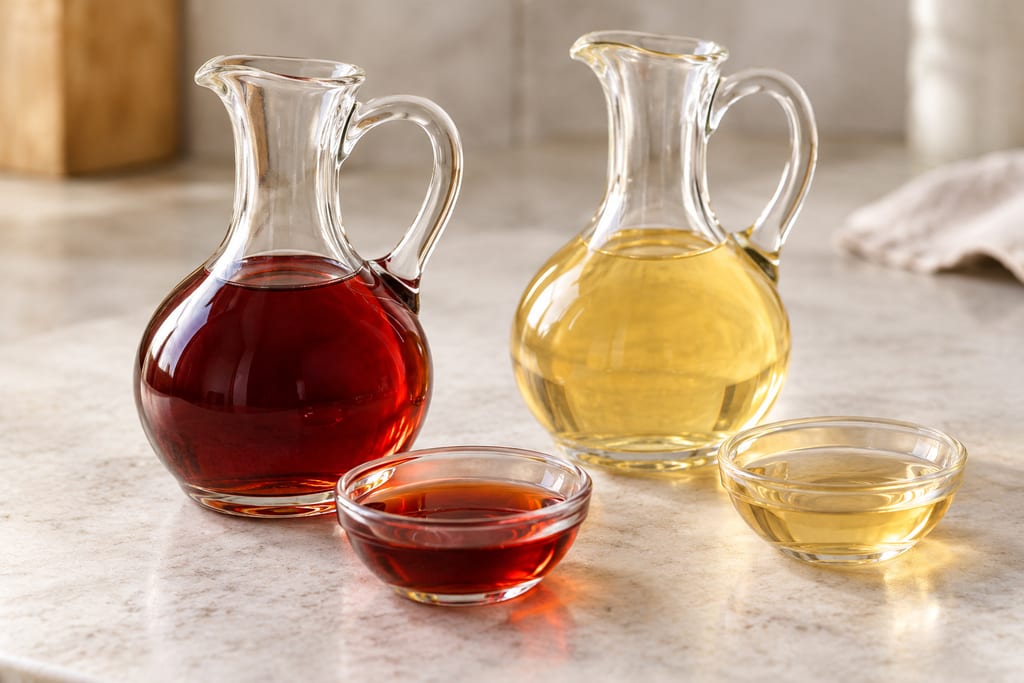
Wine Vinegar
Wine vinegar is made by the aerobic oxidation of wine's alcohol into acetic acid by bacteria, producing a sour, wine-derived condiment used in dressings, sauces, marinades and preserved foods.
Community
No community contributions have been published for this entry yet.
Share what you made
Sign in to contribute. Published comments and photos are free to read.
Sources
Marcus Porcius Cato; Loeb translation hosted by LacusCurtius, University of Chicago
On AgricultureCited in: A history of managing a familiar change
Jia Sixie, transmitted text; Wikisource
齊民要術 (四庫全書本)/卷08Cited in: A history of managing a familiar change
Louis Pasteur; Gauthier-Villars / Victor Masson; Wellcome Collection
Études sur le vinaigre : sa fabrication, ses maladies, moyens de les prévenir; nouvelles observations sur la conservation des vins par la chaleurCited in: A history of managing a familiar change
US Food and Drug Administration
CPG Sec 525.825 Vinegar, Definitions - Adulteration with Vinegar EelsCited in: Introduction; What belongs in the vinegar family; What a household project can reasonably establish
US Food and Drug Administration
CPG Sec 562.100 Acetic Acid - Use in Foods - Labeling of Foods in Which UsedCited in: What belongs in the vinegar family
Japan Ministry of Agriculture, Forestry and Fisheries
Product Summary (Registration No.44)Cited in: What belongs in the vinegar family
Slow Food Foundation for Biodiversity; Ark of Taste nomination by Unisg India 2016
Kachampuli VinegarCited in: What belongs in the vinegar family
Japan Ministry of Agriculture, Forestry and Fisheries
An Introduction to Japanese fermented foodsCited in: Ingredients determine the route; Different ways to supply oxygen; Choosing vinegar for food and drink; What vinegar research is still opening up
Mike Battcock, Sue Azam-Ali; Food and Agriculture Organization of the United Nations
Fermented fruits and vegetables: a global perspectiveCited in: Ingredients determine the route; Finishing is another set of decisions
J. Parrondo, M. Herrero, L. A. García and M. Díaz; Journal of the Institute of Brewing
A Note - Production of Vinegar from WheyCited in: Ingredients determine the route; Health, allergens and religious use; What vinegar research is still opening up
International Cocoa Organization
Pilot Plants to Process Cocoa by-products in Ghana.Cited in: Ingredients determine the route; What vinegar research is still opening up
Australian Wine Research Institute
Vinegar production – inoculation of a base wine with live acetic acid bacteriaCited in: The living conversion, and the mother; Different ways to supply oxygen; What a household project can reasonably establish
NC State Extension
Vinegar MakingCited in: The living conversion, and the mother; Different ways to supply oxygen; What a household project can reasonably establish; Finishing is another set of decisions
Heinrich FRINGS GmbH & Co. KG
ESSIGTECHNIK / VINEGAR TECHNOLOGYCited in: Introduction; The living conversion, and the mother
Heinrich FRINGS GmbH & Co. KG
TREND-SETTING SOLUTIONS FOR VINEGAR PRODUCTIONCited in: Different ways to supply oxygen
Martin-Pouret
Vinaigre de cépage sauvignon 25clCited in: Different ways to supply oxygen; Choosing vinegar for food and drink; Health, allergens and religious use
Ye et al.; Frontiers in Microbiology
Seasonal environmental factors drive microbial community succession and flavor quality during acetic acid fermentation of Zhenjiang aromatic vinegarCited in: The living conversion, and the mother; Different ways to supply oxygen
Yun, Kim and Lee; Mycobiology
Surface Film Formation in Static-Fermented Rice Vinegar: A Case StudyCited in: The living conversion, and the mother
Japan Ministry of Agriculture, Forestry and Fisheries
Product Summary (Registration No.7)Cited in: Different ways to supply oxygen
US Food and Drug Administration
MycotoxinsCited in: What a household project can reasonably establish
International Union of Pure and Applied Chemistry
pHCited in: Four measurements that are often confused
International Organisation of Vine and Wine
Determination of total acidity content in vinegarsCited in: Four measurements that are often confused
Institute of Chemical Research of Catalonia
The acidity of vinegarCited in: Four measurements that are often confused
International Organisation of Vine and Wine
Determination of the residual alcohol content in vinegarsCited in: Four measurements that are often confused; Health, allergens and religious use
National Center for Home Food Preservation, University of Georgia
General Information on PicklingCited in: What belongs in the vinegar family; What a household project can reasonably establish; Four measurements that are often confused; Finishing is another set of decisions
Penn State Extension
Advice about VinegarCited in: Four measurements that are often confused; Finishing is another set of decisions
Oregon State University Extension
Flavored Vinegars (SP 50-736)Cited in: Finishing is another set of decisions; Choosing vinegar for food and drink
Capirete / Vinagres de Jerez
Proceso de envejecimientoCited in: Finishing is another set of decisions; What vinegar research is still opening up
Mitrou et al.; Journal of Diabetes Research
Vinegar Consumption Increases Insulin-Stimulated Glucose Uptake by the Forearm Muscle in Humans with Type 2 DiabetesCited in: Health, allergens and religious use
BMJ Group
BMJ Group retracts trial on apple cider vinegar and weight lossCited in: Health, allergens and religious use
American Dental Association
TikTok’s Alternative Soda Trend Could Be Tough on TeethCited in: Choosing vinegar for food and drink
UK Government
Food labelling and packaging: Ingredients listCited in: Health, allergens and religious use
Egypt's Dar al-Ifta
Can I use red wine vinegar in cooking?Cited in: Health, allergens and religious use
International Organisation of Vine and Wine
Methods of analysis for vinegarsCited in: What vinegar research is still opening up
International Organisation of Vine and Wine
Method for 18O/16O isotope ratio determination of water in wine vinegar using isotopic mass spectrometry (Type II)Cited in: What vinegar research is still opening up
Han et al.; Frontiers in Microbiology
Metagenomics profiling of the microbial community and functional differences in solid-state fermentation vinegar starter (seed Pei) from different Chinese regionsCited in: What vinegar research is still opening up
Bautista-Patacsil et al.; Taiwan Water Conservancy; University of the Philippines Los Baños repository
Fabrication of forward osmosis membrane using nata-de-coco as raw materials for desalinationCited in: What vinegar research is still opening up
Gaps
- No earliest date, translation or archaeological origin is established for the Mesopotamian record.
- No complete validated home recipe or product release specification is given.
Updated 2026-10-27