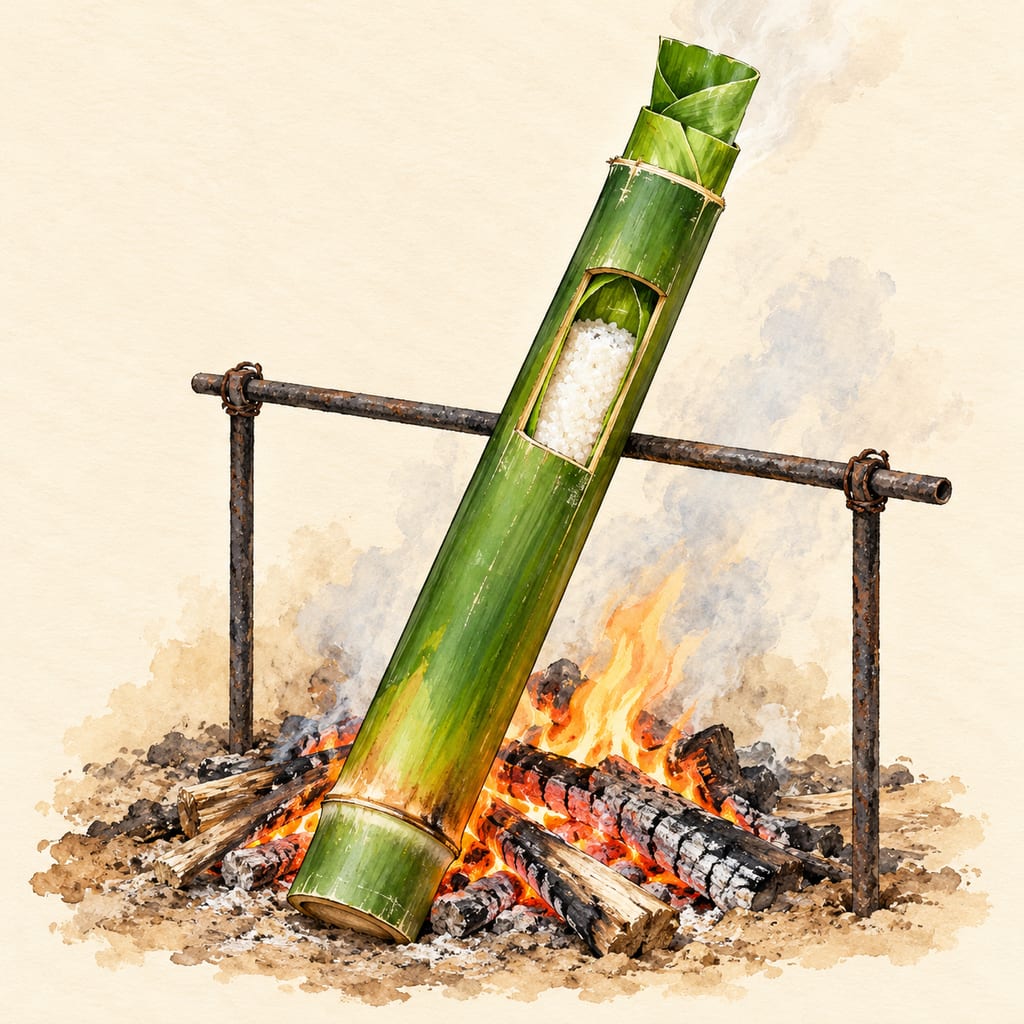
Bamboo cooking tube
A bamboo internode can serve as the cooking vessel itself: its natural node closes one end while the open end holds food, often with a leaf lining or plug. Regional preparations differ in filling, fire arrangement and handling.
 FermenteaWhere food goes to change
Equipment · Bamboo, leaf and wraps
A short, open-topped segment of bamboo holds buffalo milk while it ferments into dadih, a Minangkabau food of West Sumatra. Its natural lower node forms a closed base; banana leaf often covers the mouth.
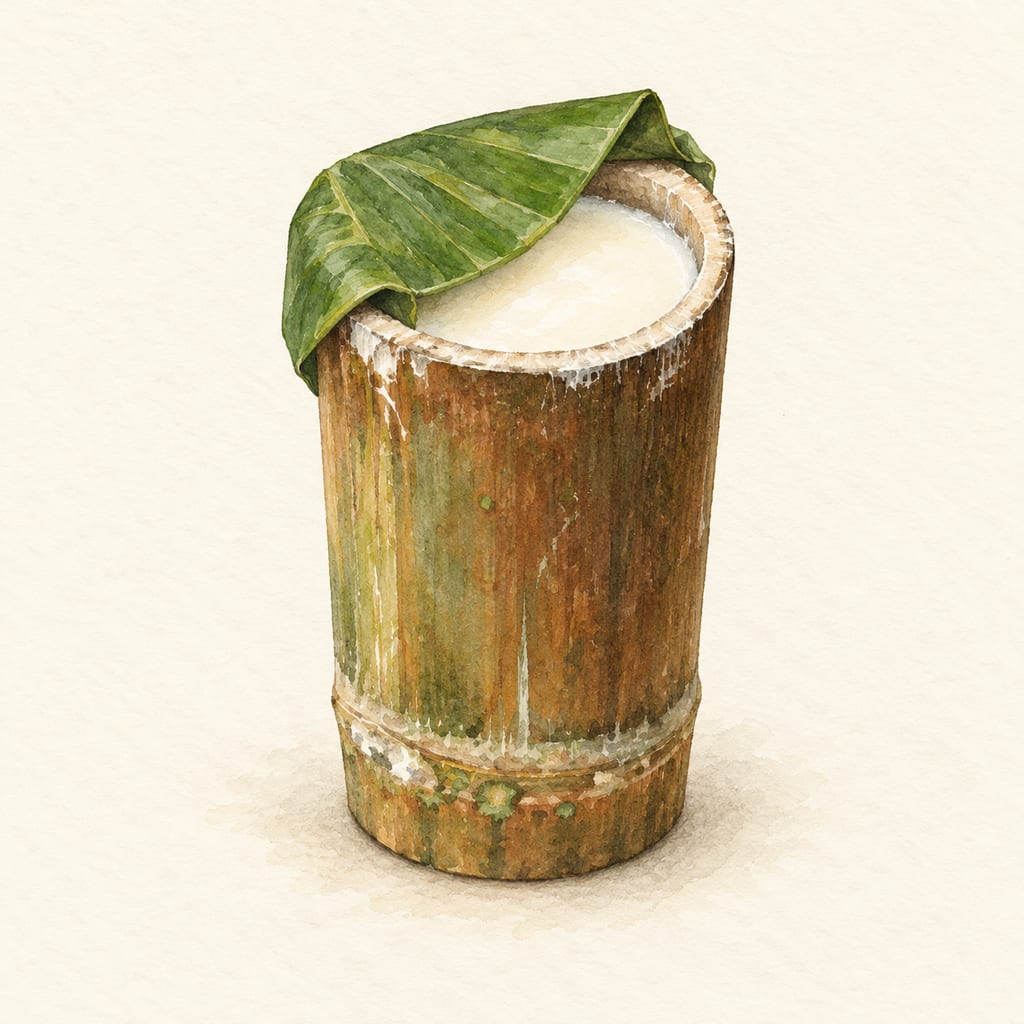
Dadih is a fermented buffalo-milk food associated with the Minangkabau of West Sumatra. The vessel is not simply a package added after the food is made: milk is poured into a short bamboo tube and ferments there. The tube has a naturally closed lower end where the bamboo node crosses the hollow culm, while the upper end is cut open for filling. A folded banana leaf commonly covers the mouth. This simple form makes the bamboo itself the direct-contact vessel throughout fermentation.
The food is described as smooth, glossy and creamy-white, with a thick curd and a gently sour taste. Dadih is eaten with rice or with emping, crisp rice crackers; accounts also describe it alongside chili and onions and at weddings or customary ceremonies. Some makers use spontaneous fermentation, while studies also document back-slopping, in which a portion of an earlier ferment is mixed into fresh milk. Those are variations in process, not different names for the tube.
The vessel begins with a length of bamboo culm, the hollow stem divided by solid joints. A segment kept with a node at its lower end becomes a tube with a built-in floor; the upper end is cut open. The outer skin, vertical fibers and node ring distinguish it from a turned wooden cup or a length of pipe open at both ends. A photograph of dadih in its tube shows the short, upright form and the pale curd at the opening.
There is no single standard size. A 2021 account reports fill amounts from roughly 120 to 300 millilitres according to the bamboo length used, and describes tubes about 35 centimetres long in the process it observed. These figures describe that production context, not a rule for all makers. A 2024 review lists several bamboo species used for dadih, including ampel, gombong, lengka tali, ater and betung. The selected culm therefore affects the tube's diameter, length, wall, and the amount it can hold.
Banana leaf is a common cover for the open mouth. It closes the top without changing the vessel into a sealed jar with a manufactured lid. Sources also report other covers, including taro leaf and plastic in some settings, and describe banana bark or rubber bands as ways of securing a cover. These alternatives should be understood as variations in actual practice rather than assumed features of every tube.
Bamboo remains in contact with the milk as it acidifies and thickens. A review discusses moisture absorption by bamboo as one factor that may help limit whey separating from the curd, while noting the effects of tube type and size. The source does not establish a single mechanism that explains every batch. The microbial community also varies: milk is identified as a major source of lactic-acid bacteria, while bamboo, cover leaves, and handling may contribute. In a study of samples from Kamang and Gadut, researchers found different bacterial diversity between spontaneous and back-slopped batches.
Dadih is made across several parts of West Sumatra, and published accounts name production areas including Agam, Solok, Tanah Datar, Sijunjung, Lima Puluh Kota, Bukittinggi and Padang Panjang. Research in Kamang and Gadut shows that even nearby production communities can use different fermentation approaches. The records support a regional family of practice, not one uniform shape, one microbial profile, or a fixed bamboo specification.
The 2024 review reports local preference for ampel and gombong bamboo in some places and attributes it to their bitter taste, which is said to deter ants. Other species are also recorded. Such statements describe reported local selection, rather than proving that bitterness is the purpose of every bamboo choice. Tube dimensions and the type and thickness of bamboo are among factors discussed as sources of variation in the resulting dadih.
Traditional dadih production is often described as using fresh buffalo milk without a heat-treatment step or added starter. That does not make every bamboo tube a reliable safety control. Research on spontaneous dadih points to variation in the microbes present, initial contamination, sanitation and handling. Lactic-acid fermentation changes the milk, but it does not guarantee that a particular batch is safe. The vessel's traditional use should not be treated as a substitute for tested food-safety practice.
No general method is given for preparing a new tube, cleaning it between batches, drying it, or choosing how many times to reuse it. Nor is one correct length, diameter, bamboo age, or wall thickness specified. These details remain matters for particular makers and local practice rather than details to infer from a photograph.
Recent studies document bamboo-tube dadih production in West Sumatra, but they do not provide a dated first use or a history of this vessel form.
The bamboo tube is one part of a spontaneous fermentation system. Research identifies buffalo milk as a major microbial source and also discusses bamboo, leaves, and handlers; the vessel alone does not determine the ferment's organisms or safety.
Source →A study's tube sizes or bamboo species do not define one standard. Published accounts report several species and variable tube length and fill.
Source →Traditional production may use raw, unheated milk and has documented hygiene and contamination concerns; the presence of fermentation does not by itself establish food safety.
Source →Dadih in bamboo tubes is documented as a Minangkabau practice in West Sumatra; this region-level record does not assign the vessel to a more specific locality.
A bamboo internode can serve as the cooking vessel itself: its natural node closes one end while the open end holds food, often with a leaf lining or plug. Regional preparations differ in filling, fire arrangement and handling.
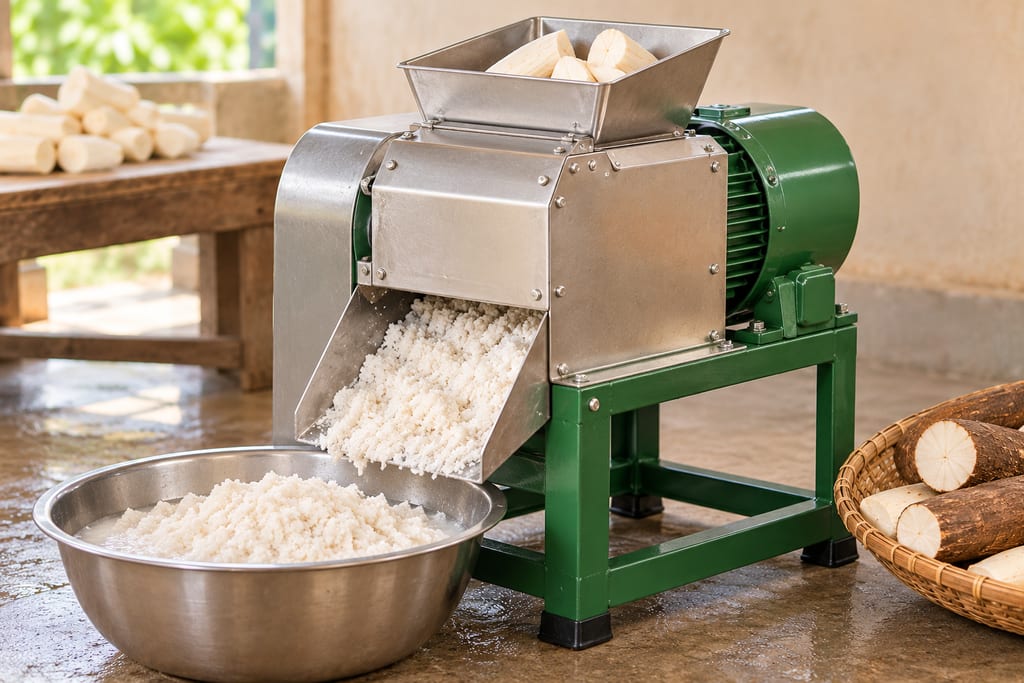
Graters, motorized rasping drums and processor grating discs reduce cassava or coconut to shreds or mash. They perform the grating stage only; later processing determines texture, extraction and cassava safety.
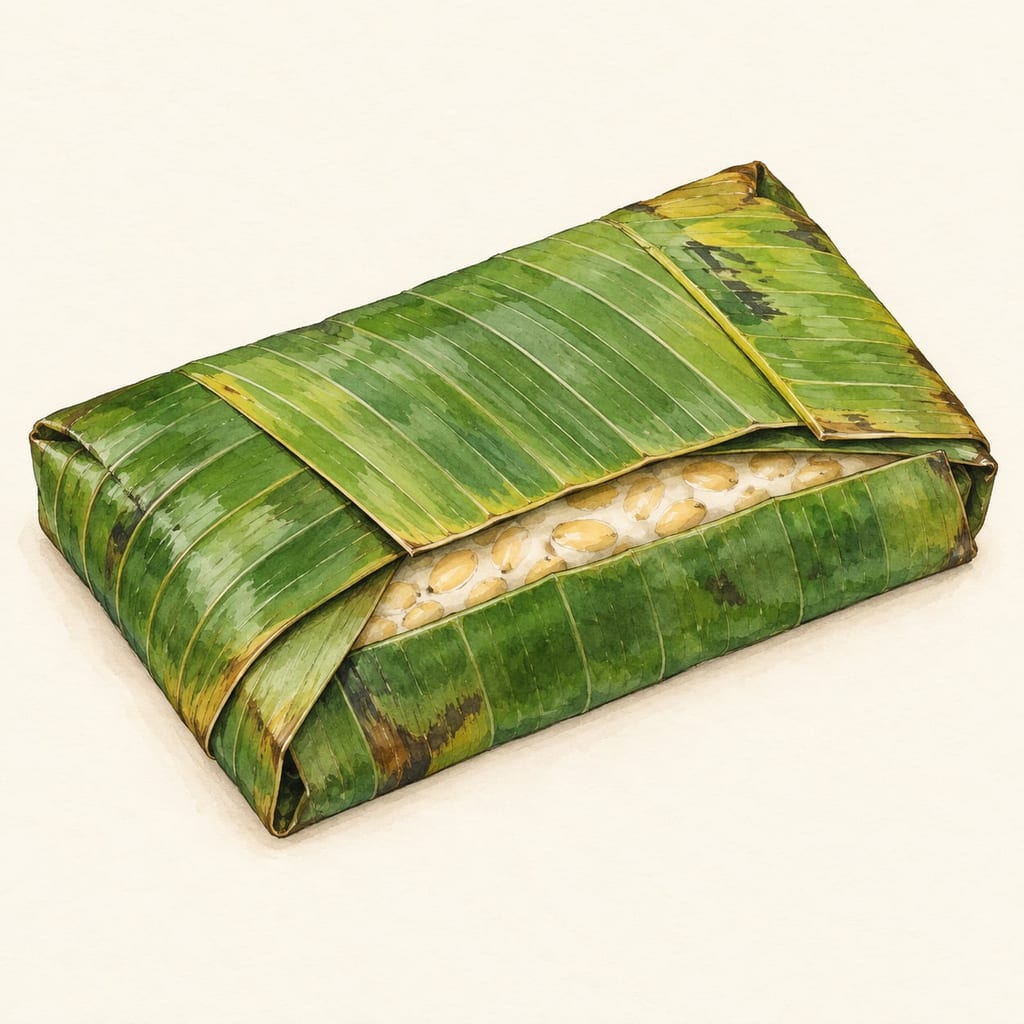
A broad banana leaf folded around beans forms the flat packet in which tempeh ferments. It shapes the cake while allowing air exchange; Indonesian producers also use plastic wraps.
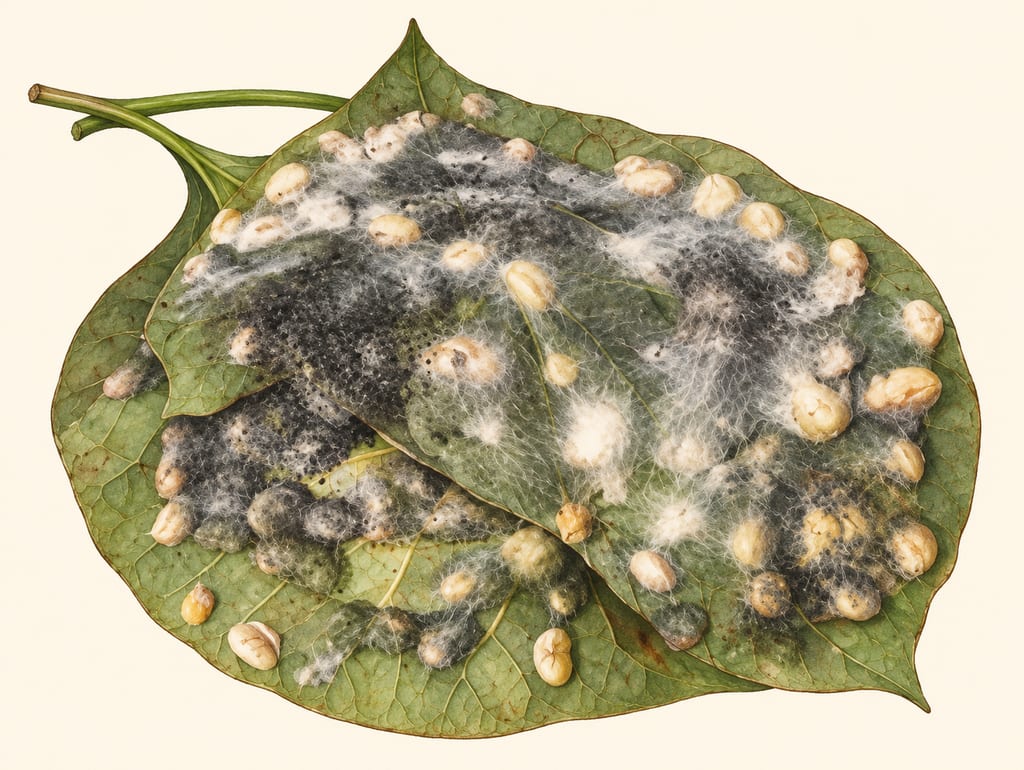
Usar is a traditional Indonesian inoculum carrier: leaves such as waru hold Rhizopus growth for transfer to tempeh beans. It carries starter between stages; it is distinct from the leaf packet used for bulk fermentation.
No community contributions have been published for this entry yet.
Sign in to contribute. Published comments and photos are free to read.
Vika Tresnadiana Herlina and R. Haryo Bimo Setiarto, Journal of Ethnic Foods 11, article 21Equipment form · Materials · Cover · Bamboo species · Geography · Culture · Safety · Image rights
From tradition to innovation: dadih, the Minangkabau tribe's traditional fermented buffalo milk from IndonesiaDadih is a Minangkabau fermented buffalo milk food associated with West Sumatra, with regional centres listed.
The preparation uses bamboo tubes and commonly banana-leaf covers; the article also reports other cover materials and fastening methods.
It lists several bamboo species used for dadih and discusses variability in bamboo and curd.
Its Figure 2 shows dadih in bamboo vessels; the article states photos in Figures 2 and 4 are the corresponding author's personal documentation and the article is CC BY 4.0.
Cited in: A vessel that carries the ferment; One bamboo segment, closed at its natural node; A leaf cover and a living environment; Where bamboo choice and practice vary; Limits, hygiene and what the sources leave open
Chandra Utami Wirawati, Mirnawati Bachrum Sudarwanto, Denny Widaya Lukman, Ietje Wientarsih and Eko Agus Srihanto, Veterinary World 12(6), 2019Fermentation context · Geography · Microbial variation · Safety
Diversity of lactic acid bacteria in dadih produced by either back-slopping or spontaneous fermentation from two different regions of West Sumatra, IndonesiaThe study compares dadih from Kamang and Gadut in West Sumatra and documents both spontaneous and back-slopping fermentation.
Its introduction describes bamboo tubes covered with banana leaves and incubation around room temperature for roughly 24–48 hours.
It identifies milk and the environment, including bamboo, banana leaves and handlers, as possible sources of microorganisms and discusses contamination and sanitation risks.
Cited in: A vessel that carries the ferment; A leaf cover and a living environment; Where bamboo choice and practice vary; Limits, hygiene and what the sources leave open
R.B. Wirdahayati, WARTAZOA 17(4), 2007Regional context · Traditional method · Use
Upaya Peningkatan Produksi Susu Kerbau untuk Kelestarian Produk Dadih di Sumatera BaratThe article describes naturally fermented buffalo milk held in bamboo at room temperature without an added starter and names West Sumatra.
It describes dadih as a white curd with a tofu-like texture and yoghurt-like taste, served as a side dish and at customary ceremonies.
The English abstract reports fermentation in bamboo for about two to three days.
Cited in: A vessel that carries the ferment; Limits, hygiene and what the sources leave open
Ramaiyulis, Debby Syukriani, Nilawati, Eva Yulia and I Ketut Budaraga, Livestock Research for Rural Development 33(7), 2021Observed dimensions · Regional practice · Materials
Potential and development of incubation technology to improve the quality of dadih as a specific food of MinangkabauThe authors describe production centres in several West Sumatran districts and fresh buffalo milk filled into bamboo tubes.
In their observed process, tube length is about 35 cm and fill ranges from 120 to 300 ml depending on the tube length.
The article names bamboo species used for dadih and says local covers include leaves or paper in the described process.
Cited in: One bamboo segment, closed at its natural node; Where bamboo choice and practice vary