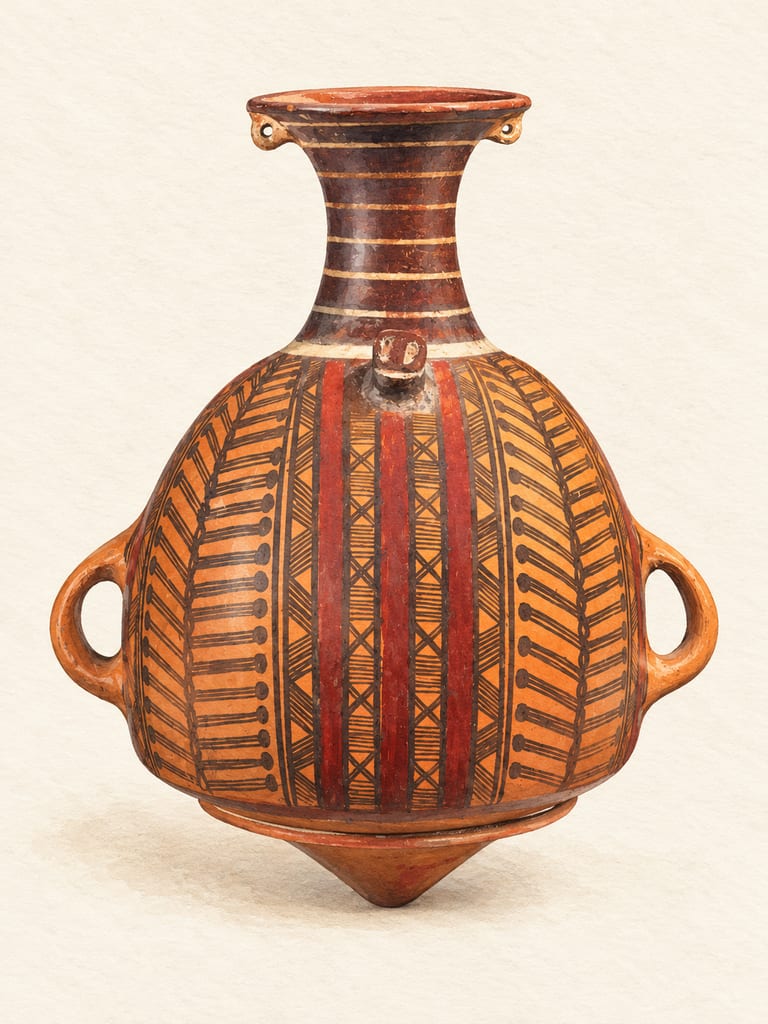
A feast jar from the Ucayali region
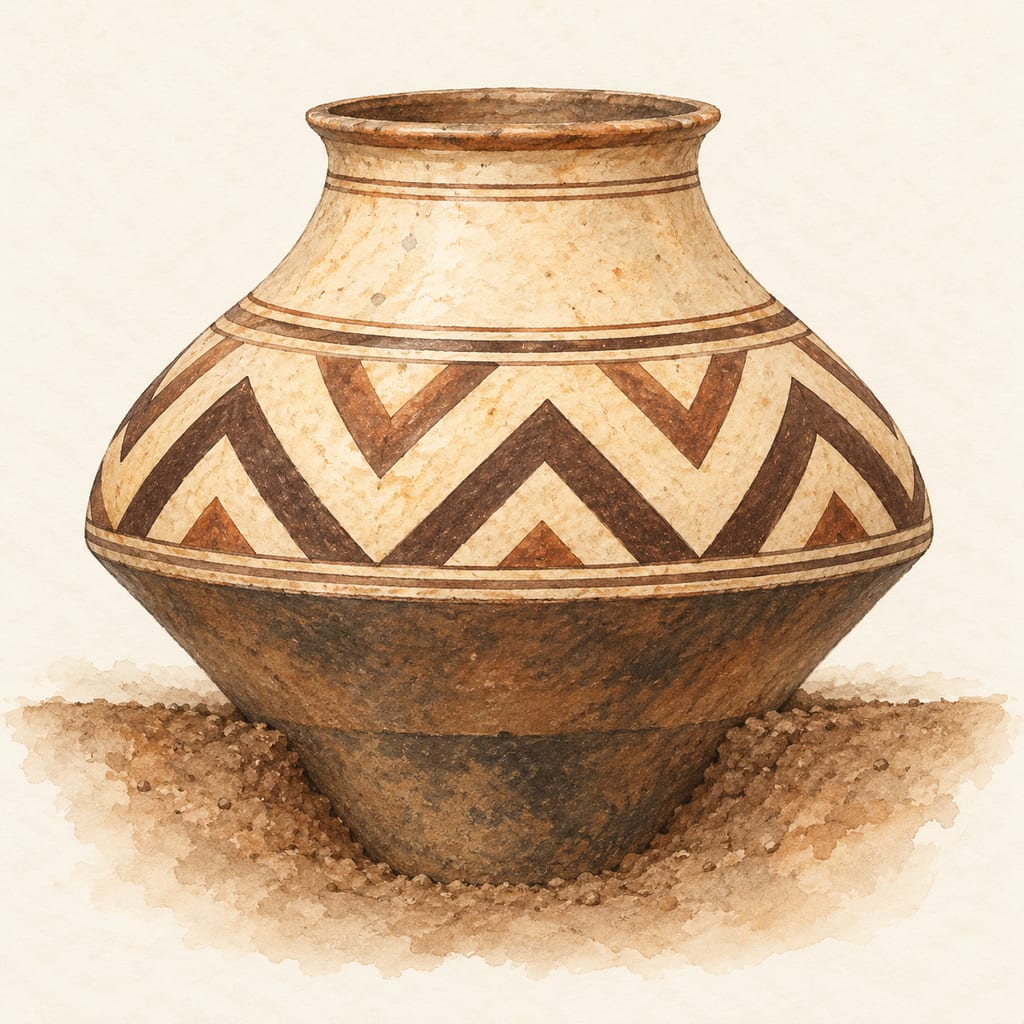
The Cleveland Museum of Art’s “Beer Container (Máhuetan)” is a large Shipibo ceramic vessel dated to about 1940. Its record places it in the Ucayali River region of Peru and gives it a height of 68 centimetres and a diameter of 79 centimetres. Those measurements describe that museum object; they are not a standard specification for all Shipibo-Conibo jars. The vessel has a broad, sharply angled belly, a tapering brown lower section, a short sloping neck and a flared rim. Cream and dark geometric bands cover the body and neck.
Cleveland identifies it as a beer keg used during festivals. It describes jars like this as part of multi-day feasts, where a large vessel could hold enough drink to serve a gathering. In a study of Panoan and Tacanan vessel terms, Andrzej Karwowski reports that Shipibo-Conibo pottery includes several classes: chomo jars, drinking vessels, bowls and cooking pots. Large chomo were used mainly at feasts in the classification he summarizes. The word helps identify a jar class, but it does not by itself tell us the contents or process of any one object.
Sources for this section
Holding beer is not the same as fermenting it
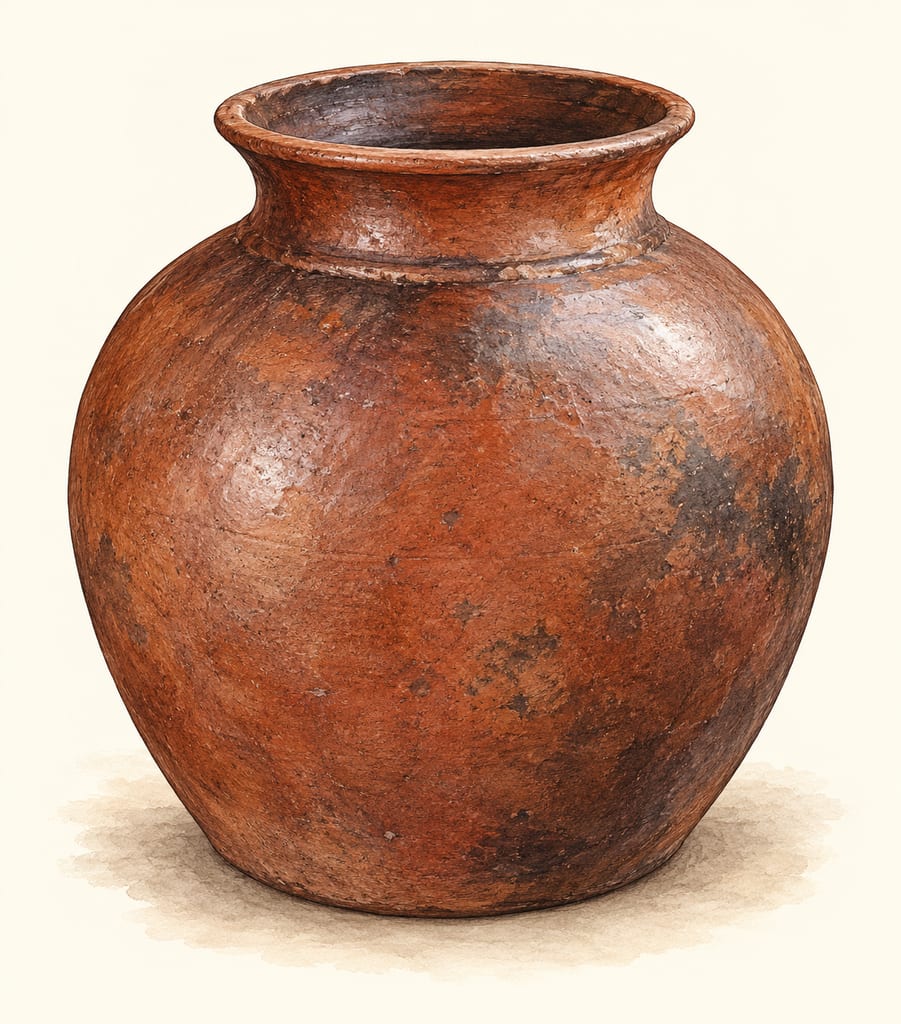
Museum descriptions leave an important distinction open. Cleveland calls the object a festival beer keg and says that the tapered base is buried to cool what it holds. The Museum of the Red River describes a separate Shipibo jar from about 1960 and says it may have been used to ferment a grain beverage. Its account mentions chewed grains collected in jars and their natural fermentation into a low-alcohol drink, but it is a possible use of that collection object, not evidence about the Cleveland vessel.
A Shipibo-Conibo “ani-chómo” in the University of Tübingen collection provides another documented role: its record says that the jar was used at three feasts and served to store masato beer. Taken together, the sources show that large decorated jars could be associated with festive beer and that at least one held masato. They do not establish that every jar was a primary fermenter, or that the same beverage and production method applied to each object.
Sources for this section
The base below ground
The Cleveland record says the brown, tapered base of its vessel is buried in earth, perhaps to keep the contents cool. This gives the jar a second relationship to its setting: it stands partly within the ground rather than only on a floor. The source does not give a depth, a prepared pit design or a measured temperature effect. The illustration’s cutaway therefore shows only the documented relationship—a portion of the lower taper below the soil line—with no invented pit construction or cooling data.
The same museum suggests that the jar’s colors and shape may refer to a tiered cosmos. Its wording is tentative. This page treats that as one interpretation attached to this object record, not a key that explains all Shipibo-Conibo pottery. A historical vessel illustration can show its visible painted bands and its documented placement without turning a possible reading into a universal symbol.
Sources for this section
A named object, not a template for every design
The Cleveland jar is a particular museum object and no potter is named in its record. Other examples show related but not identical forms and patterns. The Museum of the Red River’s painted earthenware jar is broader and lower, while the Cleveland vessel has a more sharply angled body and tapering base. The Tübingen record describes a polychrome Shipibo-Conibo masato jar from Charashmanan used at three feasts.
Luisa Elvira Belaunde’s study of Shipibo-Conibo kené describes women’s work with decorated objects and the changing character of these designs. The geometric bands visible on the Cleveland jar can be described as part of its specific surface, but their maker, name and intended meaning are not supplied by the object record. They should not be mixed with unrelated Andean motifs or presented as a fixed pattern vocabulary.
Sources for this section
History
Cleveland dates its Shipibo beer container to about 1940. Museum of the Red River records a Shipibo jar from about 1960, and the University of Tübingen describes a Shipibo-Conibo masato jar used at three feasts in 1981. These dates describe individual collection objects, not the origin of the vessel form.
Equipment details
CapacityThe cited collection records give dimensions for individual jars but no volume.
Size68 cm tall, 79 cm across Dimensions of Cleveland Museum of Art object 1992.129 only; not a standard size.
PowerNo power This vessel has no powered mechanism.
How you get oneNot established Museum records do not establish a general route for obtaining or making this type.
CareThe inspected museum records do not provide traditional preparation, cleaning or repair instructions.
Made of
- Ceramic / earthenware — Vessel body
Cleveland records ceramic with slip; Museum of the Red River describes a comparable painted earthenware jar. - Slip — Surface decoration
Recorded in the Cleveland object's material description; no recipe or pigment composition is given.
Limits
Cleveland Museum of Art describes its beer container as used for festival beer and says the tapered brown base was partly buried to keep contents cool. The record does not specify burial depth or claim this for every chomo.
Source →The Museum of the Red River says a comparable jar may have been used to ferment a grain beer; the University of Tübingen documents another chomo as storage for masato beer. These records do not establish that the Cleveland object was a primary fermenter.
Source →The Cleveland record suggests the vessel's shape and colors may reference a tiered cosmos; this is the museum's qualified interpretation, not a universal reading of Shipibo-Conibo designs.
Source →Places
Ucayali River region
Traditional use · Region evidenceMuseum records place documented Shipibo examples in Peru's Ucayali region; no narrower locality for the Cleveland object is supplied.