← Equipment

Equipment · Wooden food-storage vessels

Wooden bog-butter container

Loading ratings…

Irish bog-butter finds include wooden containers in several forms, from kegs and tubs to bowls and a mether. The Rosberry museum example is a carved open vessel; no single design or reason for depositing butter in bogs is established.

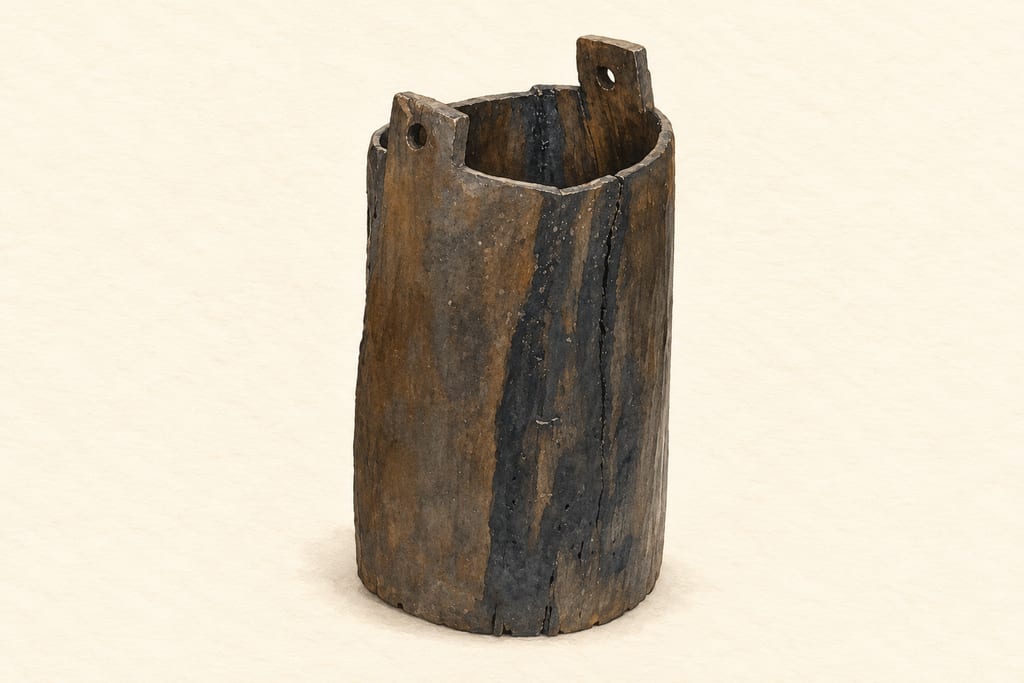
Watercolor illustration of the open wooden vessel associated with the Rosberry bog-butter find, with paired rim projections.

A group of vessels, not one design

Wooden containers are one part of the archaeological record of Irish bog butter. The term describes what finds were associated with, not a single standardized vessel that every community used. The 2019 study of 32 Irish bog-butter samples lists kegs, tubs, a bowl, a mether, a stave tub, and other wooden containers alongside bark, animal bladders, wicker and finds with no recorded container. The National Museum of Ireland's archaeologists describe carved wooden vessels such as the one found with bog butter at Rosberry, County Kildare.

That Rosberry object is shown as a dark, open, upright wooden vessel beside its associated pale deposit. The 2019 paper's table calls the associated form a keg with cord. The photograph is useful for this particular specimen; its silhouette and rim projections should not be treated as a template for every wooden container in the record. The sources do not give a common capacity, dimensions, lid design or construction method for the wider group.

Sources for this section

Wood, carving and the examples in the record

The shared feature in this entry is a wooden container associated with a bog-butter deposit. In its 2019 study, the research team records different forms across Ireland: the Rosberry sample in a keg with cord, Rosmoylan in a keg, Killeenan More in a bowl, Tawnagh Beg in a mether, Ards Beg in a tub, and Rosdoagh in a stave tub. The table also marks two bladders inside a wooden container at Ballyguin. These records describe a range of containers and coverings, not a universal vessel shape.

The National Museum of Ireland account calls the Rosberry example a carved wooden vessel. The reported species for the Rosberry keg is Alnus sp.; that identification belongs to this object and cannot be generalized to other containers. Nor does the evidence establish that every wooden vessel was hollowed from a single trunk, assembled from staves, sealed with a lid, or fitted with a cord. Where the record does not name those details, this page leaves them open.

Sources for this section

A deposit context with an uncertain purpose

Bog butter is found as large pale, waxy deposits in peat. In 2019, researchers combined stable-isotope analysis with radiocarbon dating on 32 Irish samples and concluded that most were dairy fats; the study dates associated butter deposits across several millennia. These are dates for the sampled butter or deposit, not a uniform manufacture date for the wooden containers. The paper specifically warns that the age of a butter sample and its wooden vessel can differ, and reports that Rosberry's butter is several centuries younger than its container.

The reason for placing butter in bogs remains unresolved. The National Museum of Ireland archaeologists describe proposed explanations that include practical storage, safeguarding food, developing a particular taste, and votive deposition. The archaeological finds do not show one purpose applied to every place and period. Wooden containers also sit alongside bark wrappings, animal membranes and baskets in the record; a deposit may have no surviving covering at all.

Sources for this section

What this equipment record can establish

A wooden bog-butter vessel is equipment because it was made as a portable object and then placed with a deposit; the peatland itself is not part of the vessel. The material and form matter to identifying the find, but the available sources do not support a modern recipe, cleaning method, food-safety claim or reconstruction of every vessel's construction.

This entry therefore uses the Rosberry photograph as one documented example and the broader study to show variation. County-level find locations record where containers were associated with bog butter, not where their makers worked. The object class remains open to further archaeological records, and each newly documented form should be described at its own source-supported precision.

Sources for this section

History

The study dates associated bog-butter samples across a long span and cautions that the date of a container can differ from the butter. It does not establish a common first or last date for wooden bog-butter vessels.

Equipment details

PowerNo power These are passive storage vessels and need no power.
How you get oneNot established The sources identify carved wooden examples but do not establish how a user acquired these vessels; this class has no supported acquisition route.
CareThe sources document archaeological finds and museum interpretation, not modern-use or maintenance instructions for these vessels.

Made of

  • Wood — Container body
    This record covers wooden examples only. The Rosberry keg is identified as Alnus sp.; the sources do not identify a single wood species for the wider class.

Limits

This entry covers a varied group of wooden containers, not a standardized vessel shape. The study lists kegs, tubs, a bowl, a mether, a stave tub and other wooden containers among the associated forms.

Source →

The Rosberry bog-butter sample is dated to 360–200 BCE, but the study notes that associated wooden containers may have a different, sometimes older, date than the butter.

Source →

The sources do not settle why butter was deposited in bogs; practical storage, security, taste and votive offering have all been discussed.

Source →

Bog-butter deposits also occur in bark, animal membrane, wicker, other coverings, or without an identified container; those are outside this wooden-container entry.

Source →

Places

Ireland

Historical attestation · Country evidence

The study covers 32 Irish bog-butter samples from multiple counties; this records the find context, not a single manufacturing origin for all wooden vessels.

Rosberry, County Kildare

Historical attestation · Region evidence

The National Museum of Ireland account identifies the 1970 Rosberry find and its wooden vessel; no exact manufacture site is given.

Rosmoylan, County Roscommon

Historical attestation · Region evidence

The study's sample table records a keg associated with bog butter from Rosmoylan; it does not identify the vessel's manufacturing location.

Killeenan More, County Galway

Historical attestation · Region evidence

The study records a bowl associated with the Killeenan More bog-butter sample; it is one example of the varied wooden forms, not a class-wide design.

Related

Community

No community contributions have been published for this entry yet.

Share what you made

Sign in to contribute. Published comments and photos are free to read.

Sources