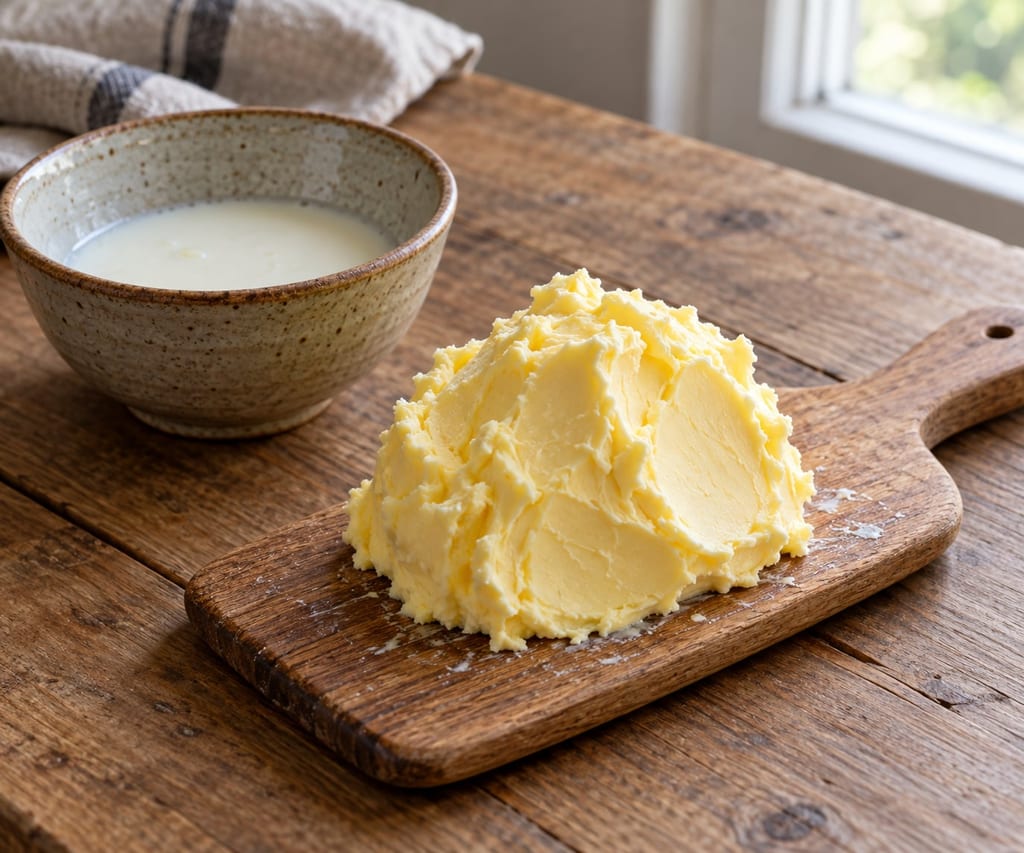
Viking Age butter
Cream agitated until its fat globules join into a solid mass and release buttermilk, the dairy fat a northern household could concentrate, salt and keep when milk itself would not last.
 FermenteaWhere food goes to change
Equipment · Historical object · Churns, agitators and drums
Dublin churn dasher · wooden churn dash
A wooden dasher found in Viking-period Dublin is direct evidence of butter-making in the town. The published evidence names a churn dash but does not give this particular object's dimensions or a full churn reconstruction.
The National Museum of Ireland includes a wooden churn dash among the finds from Viking Dublin. The museum's short account makes a clear interpretation: this object is evidence that butter-making took place within the town. That is stronger than inferring dairy work from cattle or milk alone, because it identifies a tool associated with the operation itself.
The evidence has limits. The museum overview does not provide an inventory number, find context, dimensions, wood species, photograph or detailed description of this dash. It does not date this individual object more closely than its Viking Dublin context. It should therefore be read as a documented archaeological implement, not as a complete recovered churn or a fully specified design.
A churn dash is the implement moved through cream; the churn is the vessel that contains it. The Dublin source identifies the wooden dash, but it does not describe the container in which this particular one was used. No vessel capacity, lid, body shape or fastening can safely be assigned to the Dublin find from the museum's summary.
Archaeological literature on wooden churn equipment explains how a perforated wooden disc on a staff can agitate liquid as it moves through a churn. In the comparative examples discussed by Carole A. Morris, liquid passes through the disc's holes as well as around its edge. Morris reports that the Dublin dasher had six holes, while other examples had different patterns. This helps explain a possible working principle, but it is a comparative description rather than a full technical record of the museum's Dublin object.
The churn dash links dairy work to urban life in Viking Dublin. The National Museum places it among evidence for the town's crafts and household activities and notes the agricultural hinterland that sustained the settlement. The find supports butter-making in the town; by itself it cannot show how much butter was made, who operated the tool, how often churning took place, or whether the cream was fresh or soured.
Churning mechanically agitates cream until its fat separates into butter and a liquid phase. The Dublin find supports the presence of equipment for this transformation, not a particular recipe, fat content, temperature, batch size or preservation method. It should not be used to claim that Dublin butter was salted, stored for a stated period, or made from cultured cream unless separate evidence supports those details.
Morris's study of Anglo-Scandinavian and medieval woodworking discusses archaeological dashers from York, Christchurch Place in Dublin, Lund, Elisenhof and Winchester. The pieces vary in hole number and form. The York disc illustrated in that discussion is a York find, not the Dublin artefact; its measurements and oak identification must not be transferred to Dublin.
The comparison helps explain a class of tool and the action of a perforated dasher, but it does not prove that every churn in Dublin had the same dimensions or that the town used one uniform design. A reconstruction based on the published six-hole description would be interpretive art, not a photograph or exact facsimile of the excavated object.
Wood normally decays in many archaeological settings. The National Museum notes that waterlogged conditions in parts of Dublin preserved wood and other organic materials alongside structures and everyday objects. That preservation helped make the town's working life unusually visible in the archaeological record.
This survival also shapes what the record represents. A wooden implement can appear because a deposit preserved it; its presence does not mean wooden tools were the only tools used, and the absence of a similar object from a drier site would not prove that churning equipment was absent there. The Dublin dash is evidence from a specific archaeological setting.
The National Museum identifies a wooden churn dash but gives no object number, dimensions, wood species or full container description in its Viking collections overview.
Source →The six-hole Dublin description is comparative published evidence; the figure and measurements of the Coppergate dasher belong to York and cannot be transferred to the Dublin object.
Source →The National Museum of Ireland identifies a wooden churn dash from Viking Dublin; Morris places similar finds at Christchurch Place in Viking-period levels. This is a historical attestation, not a claim that the dash was manufactured in Dublin or that its precise excavation context and date are established here.
Cream agitated until its fat globules join into a solid mass and release buttermilk, the dairy fat a northern household could concentrate, salt and keep when milk itself would not last.
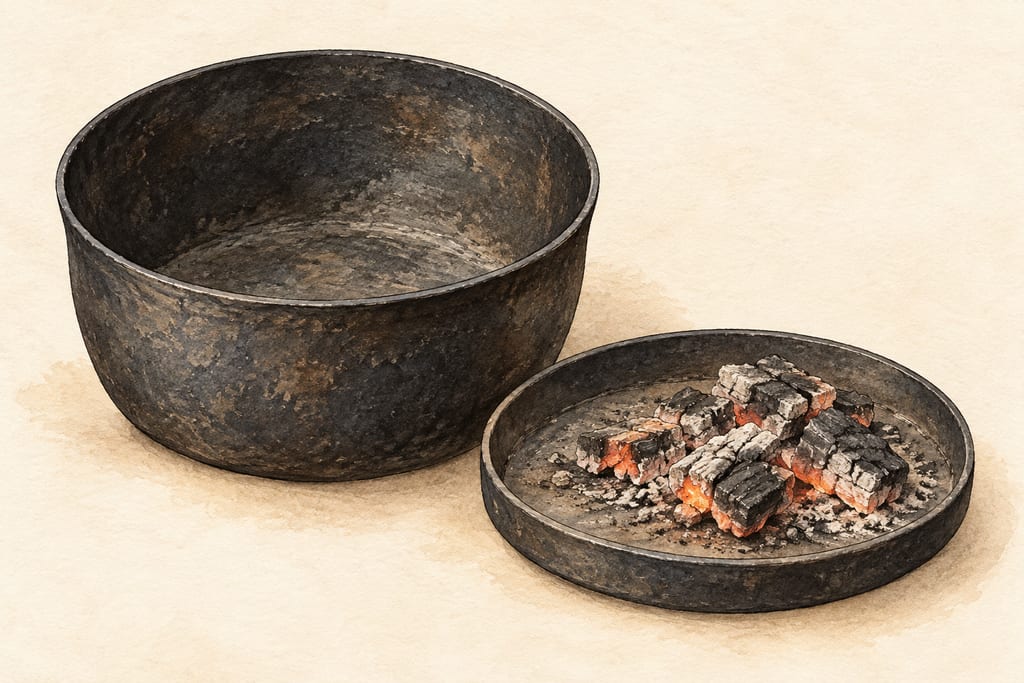
A portable cast-iron Irish hearth pot that became a small oven when embers were placed on its lid, baking bread, meat and poultry.
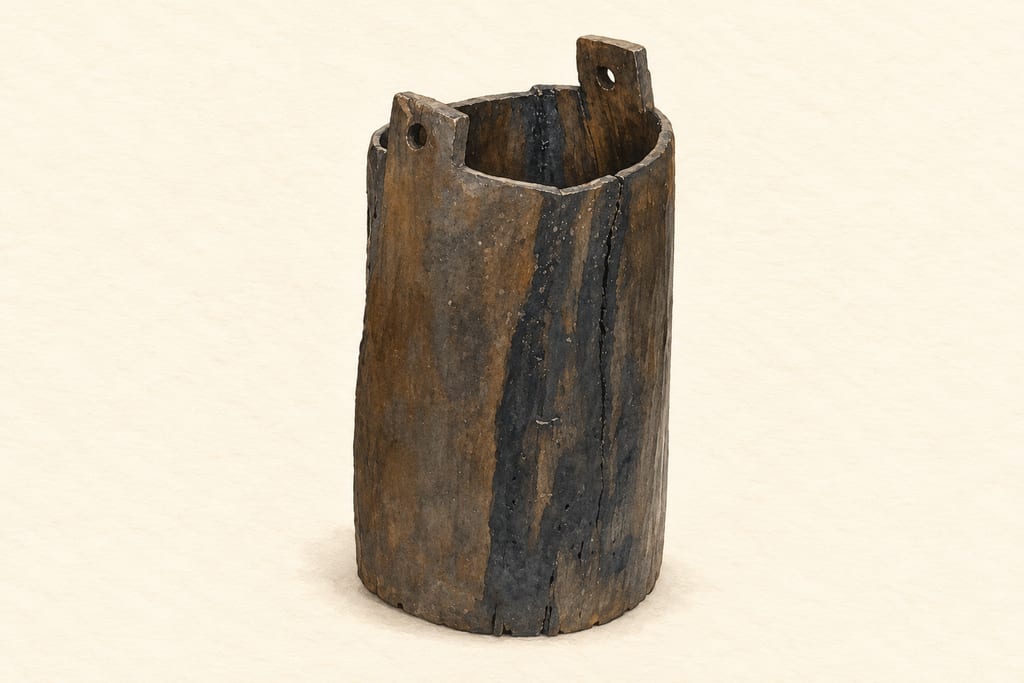
Irish bog-butter finds include wooden containers in several forms, from kegs and tubs to bowls and a mether. The Rosberry museum example is a carved open vessel; no single design or reason for depositing butter in bogs is established.

Protected Italian vinegar made only from cooked grape must, fermented and aged in a battery of wooden barrels for at least 12 years: sweet, sharp and syrupy.

Airag is Mongolia’s fermented mare’s-milk drink, traditionally churned with saved starter in a reusable cowhide khokhuur.

Appam, or hoppers, are South Indian and Sri Lankan rice pancakes made from a fermented coconut-and-rice batter and cooked in a curved pan to a crisp lacy rim and a soft, spongy centre.

Auricularia tremellosa is a wood ear fungus of the genus that supplies most dried wood ear sold in China; its own food record is thin, and the culinary practice described here comes from the closely related wood ear species.

Ayran is Turkey’s cold, savoury yogurt drink: plain yogurt is loosened with water and lightly salted, then whisked smooth or aerated into a soft cap of foam.
A thin stone griddle used over an open hearth. Norwegian archaeology documents the established tradition from the early Middle Ages; a Viking-period origin is only a cautious suggestion linked to Shetland.

Crushed or milled barley cooked in water until the starch softens and the mixture thickens, the plainest way a northern household turned stored grain into a meal, here with apple and hazelnut.

Black carrot is the anthocyanin-pigmented Eastern carrot (Daucus carota var. atrorubens), the purple root that preceded orange types and still colours kanji and şalgam.
No community contributions have been published for this entry yet.
Sign in to contribute. Published comments and photos are free to read.
National Museum of IrelandForm · Use · History · Geography · Archaeology
VikingThe museum states that discovery of a wooden churn dash shows butter-making took place in Viking Dublin.
The museum describes waterlogged Dublin excavation conditions as preserving wood and other organic materials.
The museum account does not give a specific object number, dimensions, wood species, photograph or detailed churn reconstruction for the dash.
Cited in: The Dublin find and what it establishes; Butter-making in the town; Why the wooden evidence survives
York Archaeological TrustComparative form · Mechanism · Archaeology
Craft, Industry and Everyday Life: Wood and Woodworking in Anglo-Scandinavian and Medieval YorkMorris discusses multiple-hole wooden dashers from several archaeological sites, including Viking-period levels at Christchurch Place, Dublin.
The passage reports six holes for the Dublin dasher and explains that holes let liquid pass through the disc during its movement.
The illustrated and measured Coppergate example is from York; its measurements and material identification do not describe the Dublin object.
Cited in: A dash is the moving part, not the vessel; Butter-making in the town; What comparisons can and cannot show