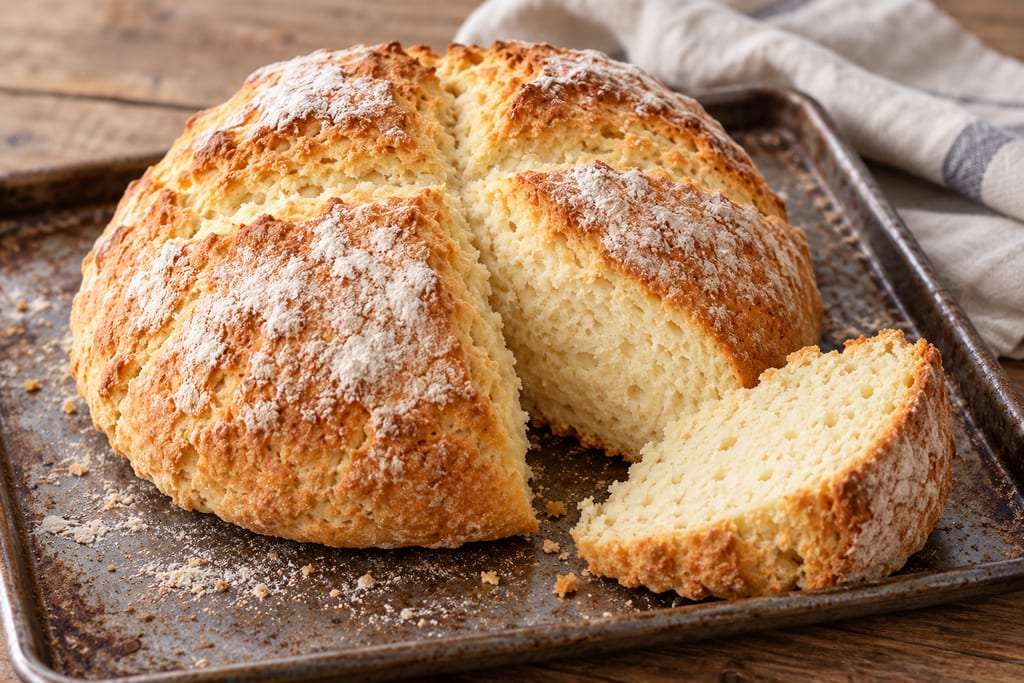
Irish white soda bread: Bord Bia version
A source-specific Irish quick loaf of plain flour, bicarbonate of soda, buttermilk, egg and butter, mixed briefly and baked as a cross-marked round.
 FermenteaWhere food goes to change
Equipment · Covered pot ovens
A portable cast-iron Irish hearth pot that became a small oven when embers were placed on its lid, baking bread, meat and poultry.
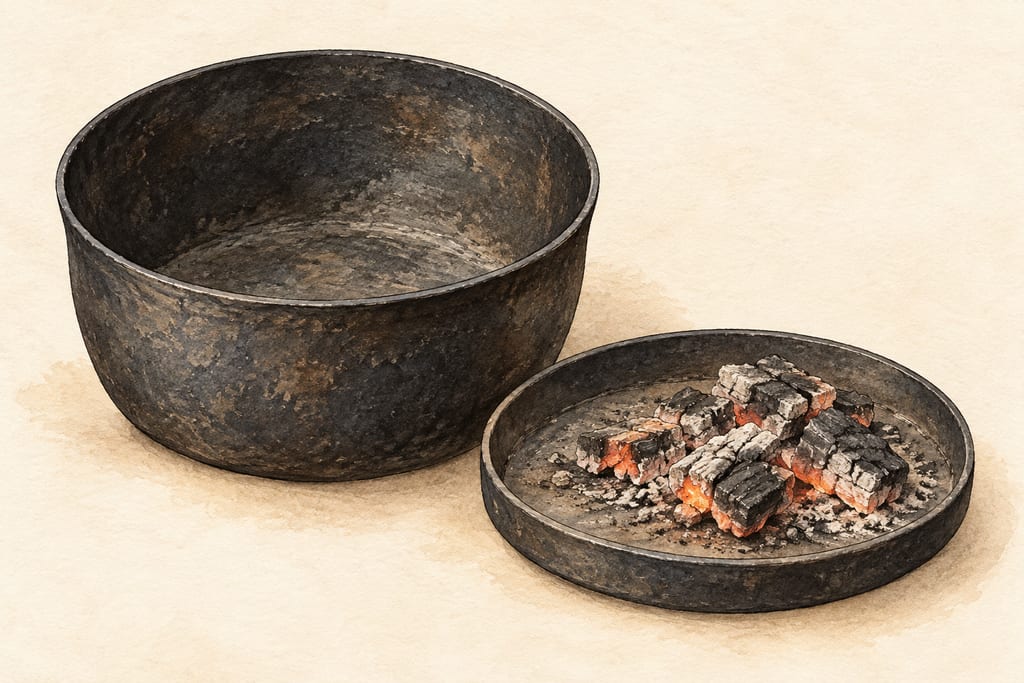
A bastible is a cast-iron household pot used over or beside an open hearth. Put embers on its lid and the covered pot acts as a small oven: heat reaches the food from below through the pot and from above through the ember-covered lid. Irish descriptions place bastibles in nineteenth- and early twentieth-century domestic cooking, where the same vessel could bake bread and cook meat or poultry.
This arrangement made baking possible without a separate built oven, but it did not regulate itself. The cook had to balance heat above and below; too much heat at the base could burn the outside while the centre stayed raw. The source material records a working skill, not a fixed temperature or standard firing schedule.
The bastible belongs to a wider Irish household tradition organised around the open hearth. The National Museum of Ireland describes hearth cooking and the adoption of pot ovens by the end of the nineteenth century, alongside other ways of boiling, grilling and baking. That wider account gives context; it does not mean every iron cooking pot was a bastible or that hearth practice changed at the same pace in every household.
A Bantry Museum digitisation project describes bastibles among the covered cast-iron pots used in an Irish farmhouse fireplace reconstruction. Its account of brown soda bread notes greasing the inside before baking and turf embers on the lid. This is one local description, not a universal recipe or proof that every bastible had an identical shape. The sources do not establish a standard capacity, measured dimensions or a single maker.
A 2025 account from rural Cork and Kerry describes a fruit-rich New Year's Eve cake baked in a round bastible over a turf fire, with the pot lid set over glowing embers. The report gives an approximate duration for that particular cake and says the custom continues in some places. It is a useful example of a covered hearth pot in use, not a timing to transfer to other foods or vessels.
A contemporary photograph accompanying the report shows cake in a dark cast-iron pot, with no lid visible. It documents a modern food-and-vessel scene rather than a nineteenth-century artefact. The historical account and the recent local report together support the pot's continued place in Irish memory and practice, but they do not supply a complete chronology.
The evidence supports cast iron, a hearth, a pot and a lid carrying embers. It does not settle one universal profile or lid design, nor does it give a standard size, temperature, capacity or general cooking time. Reports about one particular cake should remain attached to that example.
The sources do not establish present-day availability, so this record does not recommend a modern substitute or imply that a new product is made to the same form. They also do not describe a general cleaning or seasoning method. Greasing before baking is preparation for food, not evidence of a maintenance schedule.
An Irish cultural-heritage account dates household bastible examples to the nineteenth and early twentieth centuries. A National Museum of Ireland account places covered pot ovens within the changing practice of Irish hearth cooking. A 2025 report from Cork describes a round bastible used for a New Year cake and says the practice continues in some places; it does not date the tradition's beginning.
Upper and lower heat need balancing: the supplied source warns that an over-heated base can burn while the centre remains raw.
Source →No source gives a standard capacity, dimensions, temperature or duration for a bastible; the reported New Year cake timing is specific to that local account, not a general instruction.
Source →The sources document Irish household hearth use at country level; they do not establish a single place of invention.
The article describes a regional cake-baking custom; it does not locate every bastible practice in these counties.
A source-specific Irish quick loaf of plain flour, bicarbonate of soda, buttermilk, egg and butter, mixed briefly and baked as a cross-marked round.
A wooden dasher found in Viking-period Dublin is direct evidence of butter-making in the town. The published evidence names a churn dash but does not give this particular object's dimensions or a full churn reconstruction.
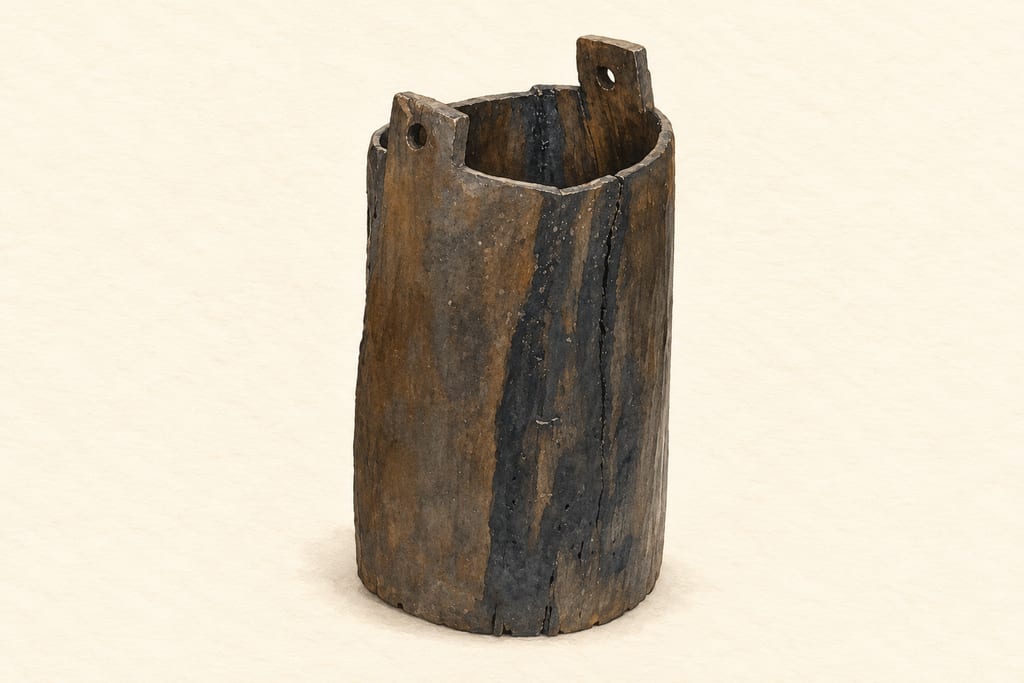
Irish bog-butter finds include wooden containers in several forms, from kegs and tubs to bowls and a mether. The Rosberry museum example is a carved open vessel; no single design or reason for depositing butter in bogs is established.

A Cap-Pelé boucanière is an Acadian herring-smoking building. The documented Willie Niles example is a one-storey wood-frame structure with a ridge smoke vent and interior bays for hanging fish-bearing cannes.

Achcharu is a family of Sri Lankan vinegar pickles made with mixed vegetables or seasonal fruit and a piquant spice dressing. This version is a quick, refrigerated, non-fermented mixed-vegetable pickle.

The acocote is a long, hollowed and dried gourd used to draw aguamiel from a mature maguey. It is a harvesting tool: the sap is transferred to a separate vessel before it ferments into pulque.

Adrak murabba preserves young ginger in sugar syrup, a sweet South Asian preparation recorded in Indian cookery and food-processing sources.

Parkia biglobosa seeds are fermented into regional West African seasonings, including nététou, iru, dawadawa and soumbala. The yellow fruit pulp is a separate food, and names and methods vary by place.

Japanese reddish-brown vinegar from sake lees matured about three years, turned to vinegar by acetic bacteria; the vinegar of Handa and Edomae sushi rice.

A refined common-wheat flour blended for a broad range of baking; its protein and behavior vary with wheat, milling and market.

The almond mushroom, Agaricus subrufescens, was cultivated in eastern North America in the 1800s, lost its market, and returned as a cultivated mushroom from Brazil, where it is grown under several names.
No community contributions have been published for this entry yet.
Sign in to contribute. Published comments and photos are free to read.
Ask About IrelandForm · History · Use
BastibleIrish examples are described as cast-iron household pots used as ovens when embers were placed on the lid.
The account dates examples to the nineteenth and early twentieth centuries and notes the need to balance upper and lower heat.
Cited in: A pot that works as a small oven; What is and is not established
National Museum of IrelandHistorical context · Hearth use
Feeding the FamilyIrish household hearth cooking included multiple pot and baking practices; the Museum describes pot ovens being adopted by the end of the nineteenth century.
Cited in: Hearth practice and local forms of use
Bantry Historical & Archaeological SocietyLocal use · Baking
Bantry Museum Digitisation Project 2022The project describes covered cast-iron bastibles used for baking brown soda bread, with the pot greased inside and turf embers placed on the lid.
Cited in: Hearth practice and local forms of use; What is and is not established
Echo LiveDocumented use · Modern example
‘Hunger out, plenty in’: New Year’s Eve traditions and lore in CorkThe article describes a round bastible pot used for the rural New Year's cake in Cork and Kerry and says the practice continues in some places.
The approximate baking duration is specific to that reported cake.
Cited in: A cake baked over embers