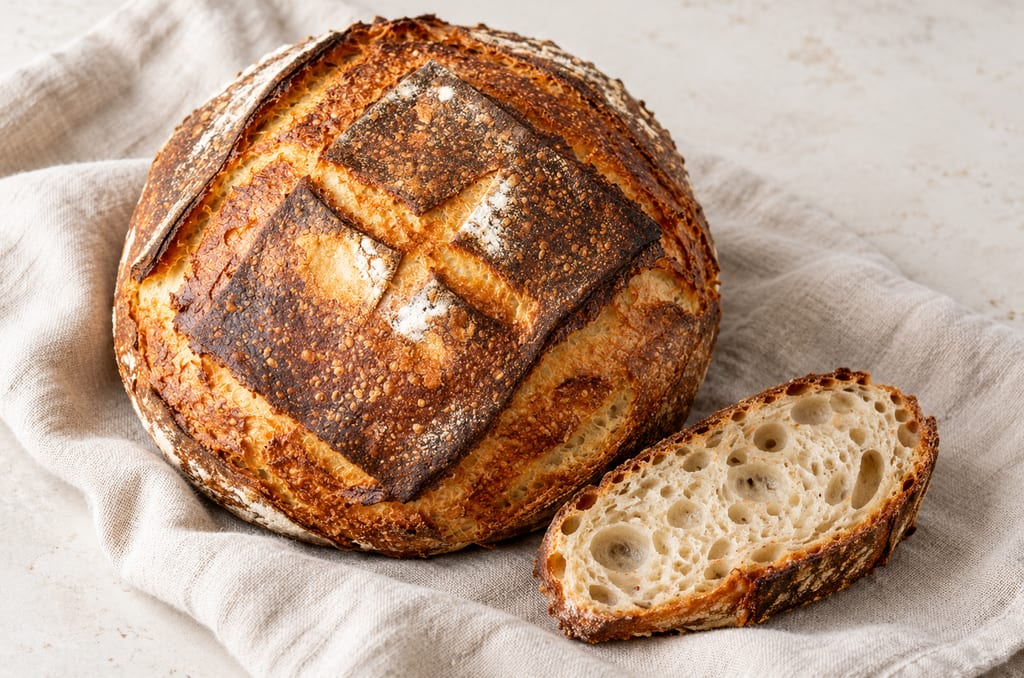
No-knead sourdough loaf
A ripe sourdough starter leavens this modern low-handling loaf. Three hourly folds organize the sticky dough before a long refrigerator rest, final proof and covered bake.
 FermenteaWhere food goes to change
Enzyme sources
Diastatic malt powder is milled sprouted grain with active starch-converting enzymes. Bakers use it in small, formula-specific amounts to influence fermentation and crust browning.
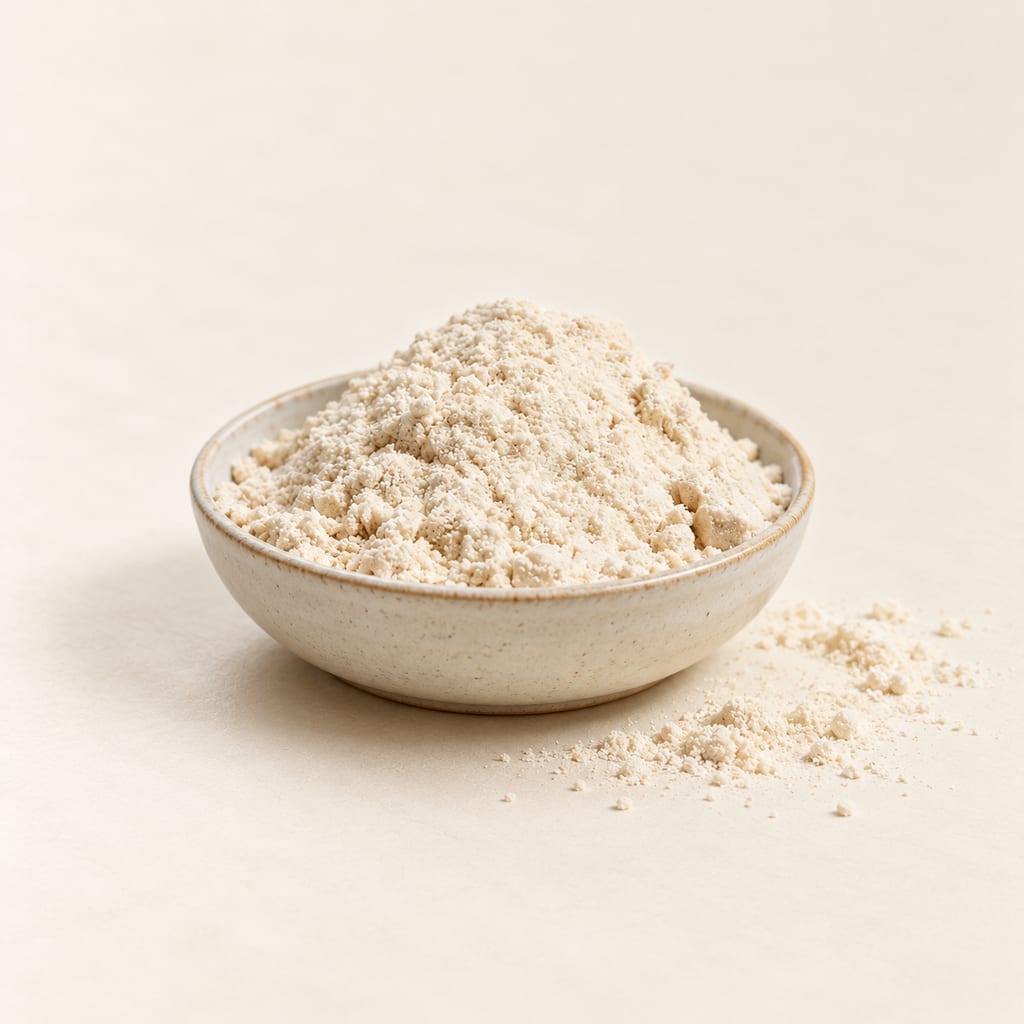
Diastatic malt powder is finely milled malted grain whose starch-converting enzymes remain active. Many baking products use barley malt, while wheat and rye malts also exist. In the jar it is a pale, flour-like powder; the exact colour and aroma depend on the grain and how it was kilned. Its contribution can be nearly invisible: unlike a spoonful of sugar or syrup, a small addition may change how dough ferments and browns without making the loaf taste distinctly malty.
The word *diastatic* describes this enzymatic power. It comes from diastase, an older collective term for starch-digesting enzymes. Bakers use the powder as a process aid: it gives dough enzymes that can make some of the flour’s starch available as sugars during mixing, fermentation and early baking. It is not yeast, a sourdough starter, or a guarantee of a higher loaf. The result depends on the flour’s own enzyme activity, the malt’s strength, the dough and the recipe.
A cereal grain is a living seed with a store of food for a future plant. When barley is steeped and allowed to germinate under managed conditions, the seed begins mobilising that reserve. Enzymes already present in the grain become active and others are produced. They dismantle parts of the endosperm—the starchy tissue that feeds the young shoot—so the seedling can use its stored energy. Malting captures this transition at a useful point, then dries the sprouted grain in a kiln. The dried malt can be stored, milled and used as an ingredient.
Malting is not simply soaking grain until it sprouts. In commercial production the maltster manages water uptake, germination and drying to produce a chosen enzyme profile and flavour. Germination also modifies cell walls and storage proteins; malt is therefore a complex grain ingredient, not a purified enzyme. The temperature and duration of kilning influence flavour and how much enzyme activity survives. A lightly dried, functional malt can retain substantial activity. Further heating develops toastier, biscuit-like or nutty notes but reduces enzyme levels; roasting can remove them altogether.
At Eberdingen-Hochdorf in southwest Germany, early La Tène ditches of the fifth–fourth centuries BCE held many evenly germinated hulled barley grains. Their unusually pure concentration and archaeological setting support deliberate malting. The ditch may have served for germination, for drying the sprouted grain, or for both; the exact arrangement is uncertain. The barley was probably intended for beer. This is evidence for malt at a particular place and period, not a claim that malting began there. Modern diastatic powder carries the same useful grain chemistry into a baker’s flour bin, without turning bread dough into beer.
The powder is sold to households in small jars or bags and to bakeries in larger sacks. Some products are malted barley flour alone; others are standardized blends that may include wheat flour or dextrose. Those additions can make the product easier to handle or provide a consistent commercial specification. The label matters: “malt powder,” “malt flour,” “malt extract” and “malted milk powder” do not all mean the same thing, and the name alone does not establish whether enzymes remain active.
Flour already contains starch: long chains of glucose packed into granules. In wheat dough, the relevant malt enzymes include alpha-amylase and beta-amylase. Alpha-amylase cuts starch chains at internal points, making shorter dextrins and new chain ends. Beta-amylase works from suitable ends and releases maltose, a sugar made of two glucose units. Other grain enzymes can contribute to the breakdown of branched starch structures. This is a coordinated set of reactions, not one enzyme turning every starch molecule directly into simple sugar.
The released sugars have several possible destinations. Baker’s yeast can ferment some of them, producing carbon dioxide and ethanol. Carbon dioxide inflates the dough’s gas cells, which expand as the dough proofs and enters the oven. Yeast activity is one reason an appropriate malt addition may help a dough ferment efficiently. Sugars that remain available at the surface and in the dough also contribute to browning in the oven. Malt can therefore affect fermentation and crust colour through linked but distinct pathways.
Enzyme action is conditional. The enzymes need accessible starch and an environment in which they remain active; their work changes with flour composition, dough moisture and temperature. Baking heat eventually stops enzyme activity, but before that point, excessive starch breakdown can leave a loaf’s interior tacky or gummy and interfere with structure. A weak rise is not automatically evidence that dough needs more malt: yeast health, fermentation conditions, mixing, flour strength and shaping also matter. Malt is a small adjustment to a system, not a substitute for understanding it.
Flour itself may already contain malted barley flour or enough natural amylase for the intended bake. Whole-grain, organic or other flours may differ, but those labels do not by themselves quantify enzyme activity. Commercial mills and malt suppliers sell products with different diastatic power, sometimes expressed in degrees Lintner. This is a measure of starch-converting power, not a universal household dose. A product rated at one activity is not necessarily interchangeable gram for gram with another.
Non-diastatic malt powder is malt that has been heated enough to deactivate its starch-converting enzymes. It still brings malt sugars, colour and flavour, but it does not perform the same enzyme-assisted function in dough. It is often chosen when the intended purpose is sweetness or malt character—for example, in a bagel dough or a boiling solution—rather than increased conversion of flour starch. A recipe that specifies non-diastatic malt should not be casually converted to diastatic powder: the active enzymes can over-soften the crumb if used in excess.
Malt extract is made by extracting soluble material from malt; it is commonly sold as a syrup or dried sweetener. Many malt extracts are non-diastatic, because processing uses heat, though products can be made to retain and standardize some enzyme activity. Read the specification rather than assuming. Malted milk powder is another different product: it combines malt with dairy and often other ingredients, and is used chiefly for its sweet, creamy malt flavour. It is not a direct replacement for diastatic malt flour.
Malt can be made from more than barley. Diastatic wheat and rye malts are used in baking, and specialty maltsters offer different grains and enzyme levels. A powder may also be a formulated blend rather than simply ground malted grain. That affects allergen declarations and the flavour, colour and enzyme strength. Barley, wheat and rye contain gluten; check the package for the grain and any additional ingredients, especially when baking for someone who must avoid gluten.
Diastatic malt is used in yeast-raised breads, rolls, bagels, pretzels, pizza dough and related baked goods. Professional producers also use specified malt flours in crackers and other dough systems. It is most useful when the formula and flour need the activity it supplies; some flour already contains malted barley flour, and adding more may be unnecessary. The dough may ferment faster, brown more readily or handle differently, but the balance varies with the malt and formulation.
There is no single reliable dose for every powder and flour. Manufacturer instructions are product-specific: one retail source gives a small household measure for its own jar, while a commercial supplier lists a much broader percentage range for its product. A baking reference recommends beginning at a low proportion of flour weight when adapting a formula, because too much can cause a gummy result. These are not competing universal laws; they refer to different products and contexts. Follow the recipe or supplier specification first. When a recipe already includes malt, preserve its amount. If adapting a formula, check whether the flour already contains malt, identify the malt’s enzyme activity when available, weigh it against flour rather than relying on a variable spoonful, and adjust cautiously through small trials.
King Arthur's no-knead sourdough bread formula calls for two teaspoons of diastatic malt powder as an optional ingredient for a more golden colour and stronger rise. That spoon measure belongs to its 600 g bread-flour formula; it cannot be generalized without the malt specification and intended result. Leaving it out may change fermentation or browning in that recipe; adding that amount to another dough may be too much or too little. If the goal is specifically malt sweetness rather than enzyme action, a non-diastatic product may be closer, but substitutions still need to respect the recipe’s liquid and sugar balance.
The word “fermentation” needs care here. Malt enzymes do not make gas and are not microorganisms; they alter the available carbohydrate. Yeast or a sourdough community then metabolises suitable sugars and produces gas and flavour compounds. A dough may contain active enzymes without using commercial yeast, but the outcome depends on its microbial culture and formula. Conversely, a sweetener can feed yeast without providing malt enzymes. Keeping those jobs distinct helps explain why adding malt does not replace a leavening culture and why a dough’s rise is not a direct measurement of amylase activity. The powder’s effect can also appear in a different part of the loaf: more fermentable sugar can change crust colour as heat browns sugars and amino compounds, even when the crumb itself has little malt aroma. These linked outcomes are useful to bakers, but they should not be treated as a fixed promise from every malt product.
At modest levels, the powder’s flavour may be subtle. More strongly kilned products can contribute a cereal, biscuit or toasted note alongside their enzyme function. In a bagel, malt flavour may be supplied separately by non-diastatic malt or syrup, while a diastatic addition in the dough serves a process role. In pretzels and breads, browning is a visible outcome, but it is not a proof that the malt was used or that the dough fermented properly. Recipes vary in whether malt goes directly into the dry mix, and commercial specifications may prescribe a particular handling method.
Choose a product explicitly described as *diastatic* or enzyme-active when that is the intended function. Look for its grain, ingredient list, enzyme-strength information if supplied, and the maker’s usage instructions. “Malted barley flour” on a flour label signals a malt ingredient, but it does not tell a home baker the precise activity remaining in that bag. Products marketed simply as malt powder may be roasted, sweetened, blended, or enzyme-inactive.
Keep the powder sealed and dry. Malt suppliers warn that ground products are especially vulnerable to humidity and recommend cool, low-humidity storage; a manufacturer may give a package-specific shelf life. Use that product’s date and directions rather than transferring another supplier’s shelf-life claim. Moisture uptake, heat and exposure to air can degrade quality and activity, while an open dry ingredient can also pick up odours or pests. A clean, tightly closed container protects it; discard product if it has been contaminated or shows signs of spoilage. Storage guidance does not establish a food-safety guarantee.
Diastatic malt is a practical reminder that ingredients can carry hidden activity. Its modest appearance belies a process that began with a germinating seed and continues in a bowl of dough. Used with an understanding of the flour and the product, it can help supply fermentable sugars and influence crust colour. Used without regard to enzyme strength, it can upset the structure it was meant to support. The useful question is not whether malt is “good for bread,” but what this particular dough already contains and what this particular malt is expected to do.
gluten
The cited producer describes current malting practice, not a single origin or manufacturing location for all diastatic malt powders.
A ripe sourdough starter leavens this modern low-handling loaf. Three hourly folds organize the sticky dough before a long refrigerator rest, final proof and covered bake.
No community contributions have been published for this entry yet.
Sign in to contribute. Published comments and photos are free to read.
King Arthur Baking CompanyIngredient · Editorial
Diastatic Malt Powderproduct-specific directions and uses.
Cited in: A quiet grain ingredient with a working enzyme; Where bakers use it—and how much
Briess Malt & IngredientsIngredient · Editorial
Malting & Roastingmalted flour types, kilning/roasting effects, commercial use rates and extracts.
Cited in: A quiet grain ingredient with a working enzyme; From a seed’s reserve to malt; Diastatic, non-diastatic and extract; Where bakers use it—and how much
Frontiers in Plant ScienceIngredient · Editorial
Morphology, Carbohydrate Distribution, Gene Expression, and Enzymatic Activities Related to Cell Wall Hydrolysis in Four Barley Varieties during Simulated MaltingExperimental barley malting study documenting grain modification, enzyme activity and changes in carbohydrate distribution during germination.
Cited in: From a seed’s reserve to malt; How malt makes starch available
Frontiers in Plant ScienceIngredient · Editorial
Genes That Mediate Starch Metabolism in Developing and Germinated Barley Grainstarch mobilization during germination.
Cited in: From a seed’s reserve to malt
King Arthur Baking CompanyIngredient · Editorial
What’s the difference between diastatic and non-diastatic malt?comparison, substitution cautions, product dose example and named applications.
Cited in: How malt makes starch available; Diastatic, non-diastatic and extract; Where bakers use it—and how much; Buying, keeping and reading the label
Lesaffre BakingIngredient · Editorial
Red Star® Diastatic Malt Powderapplications, manufacturer usage range and storage statements for this product.
Cited in: How malt makes starch available; Where bakers use it—and how much; Buying, keeping and reading the label
King Arthur Baking CompanyIngredient · Editorial
No-Knead Sourdough Breadthe optional two teaspoons of diastatic malt powder in a formula with 600 g bread flour and the source's stated colour and rise purpose.
Cited in: Where bakers use it—and how much
Briess Malt & IngredientsIngredient · Editorial
Handling and Storing Briess Ingredientscommercial malt storage cautions.
Cited in: Buying, keeping and reading the label
Archaeological and Anthropological SciencesIngredient · Editorial
Early Iron Age and Late Mediaeval malt finds from Germany—attempts at reconstruction of early Celtic brewing and the taste of Celtic beerOriginal archaeological study dates Eberdingen-Hochdorf early La Tène malt to fifth–fourth century BCE; evenly germinated hulled barley supports deliberate malting; the ditch may have served for germination and/or drying, and beer purpose is probable rather than proved.
Cited in: From a seed’s reserve to malt