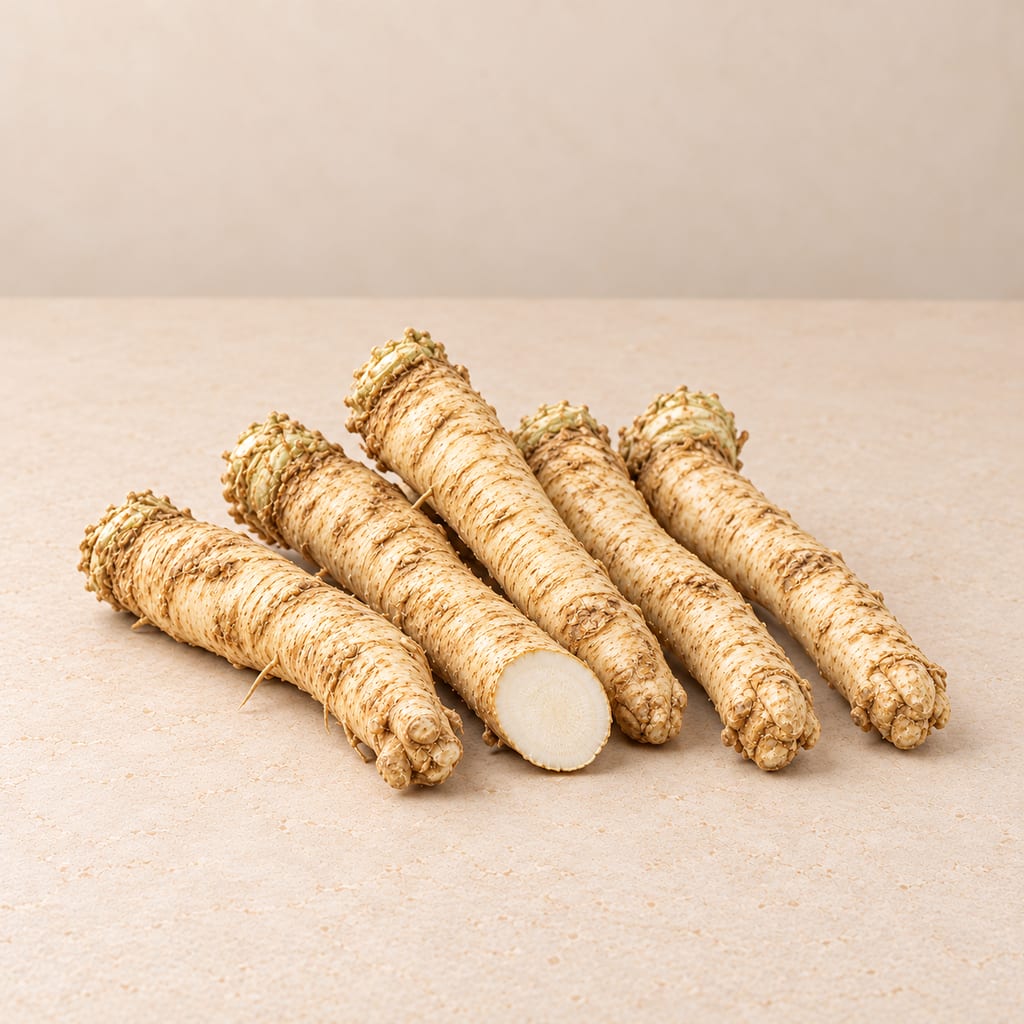
Horseradish root
Horseradish is the long white root of Armoracia rusticana, a perennial of the mustard family. Grated, it releases a sharp, nose-clearing heat that vinegar fixes in the sauce.
 FermenteaWhere food goes to change
Mushrooms
A spring pink-spored mushroom associated with Rosaceae. European food use is documented, alongside a Turkish poisoning report and unresolved species-complex records in Mexico.
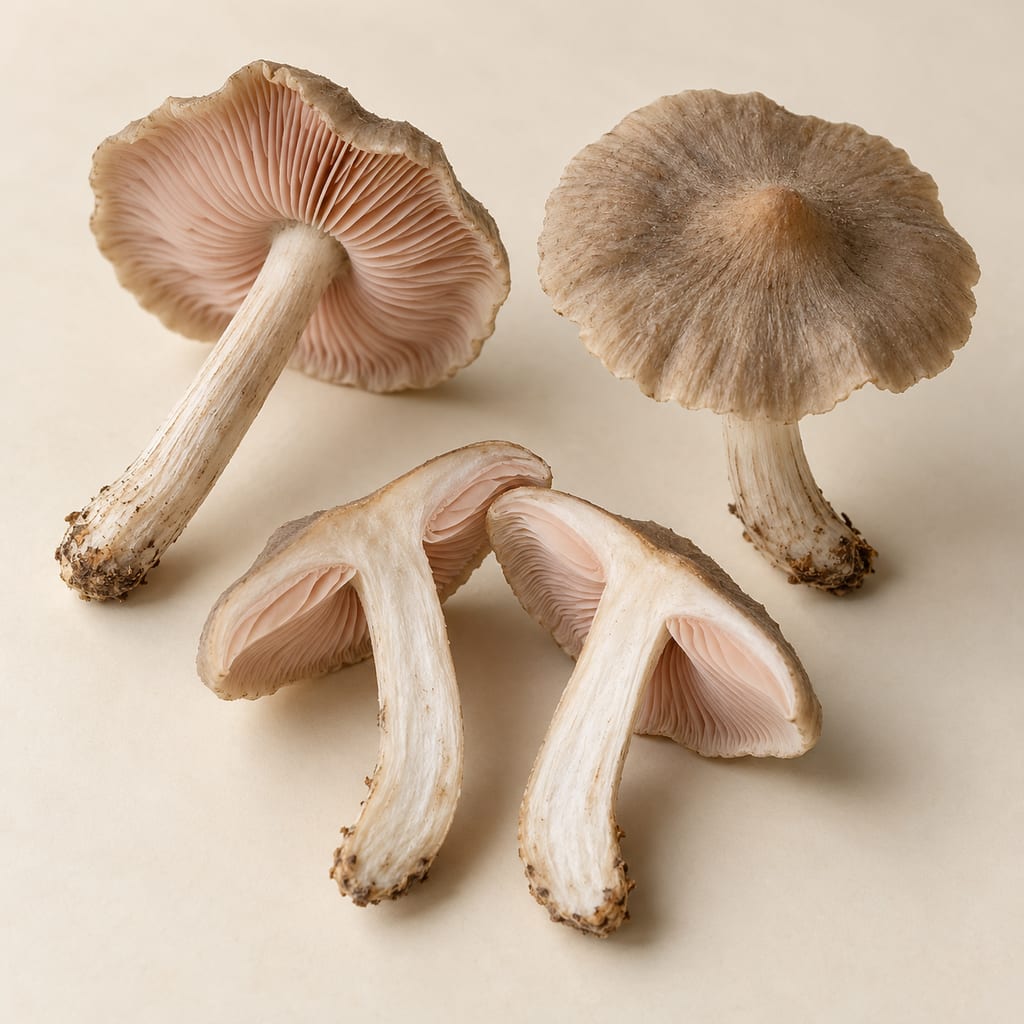
Index Fungorum accepts Entoloma clypeatum (L.) P. Kumm. (1871), based on Agaricus clypeatus L. (1753). It belongs to Entolomataceae. Descriptions report a grey-brown, often umbonate cap, pale gills that become pink, and a pinkish spore deposit. The species is associated with Rosaceae shrubs and trees, including plum and hawthorn. These features describe the taxon; they are not sufficient to identify a wild mushroom, and similar pink-spored Entoloma can be hazardous.
European accounts place fruiting in spring to early summer, often around April–June; a Czech mycology account gives March–June. The calendar varies with region and weather. UNAM records a complex of related species near E. clypeatum across parts of Europe, Asia and North America, and reports Mexican records in Chihuahua, Jalisco, Puebla, Tlaxcala and the State of Mexico. The Mexican account explicitly says this complex is not taxonomically resolved there, so those state records should not be read as confirmed occurrences of E. clypeatum sensu stricto. Market reports from Ozumba and Tlaxcala likewise concern local names and the complex rather than certain species identifications.
Use records are regional rather than universal. A Croatian food-chemistry study included E. clypeatum among ten popular Croatian wild edible mushrooms. An ethnobotanical survey of Ukrainians in the western Maramureș region of Romania discusses the species in the local wild-food repertoire and notes it among mushrooms eaten by Ukrainians; it does not provide a species-specific preparation method. These reports document cultural and research contexts, not a validated way to determine whether a specimen is safe.
A peer-reviewed report describes four people poisoned after eating wild mushrooms collected in Burdur Province, Turkey. The authors identified the specimens as E. clypeatum from morphology and spores. The report is a meaningful safety signal, although the identification method and later recognition of species complexes limit what it proves about all populations currently given this name. It should be presented alongside, not erased by, European edible-use accounts. No visual description, market name or geographic range is a reliable basis for personal identification.
A Croatian food-chemistry study included this species among ten popular wild edible mushrooms; no finer collection locality is given here.
The ethnobotanical study discusses this mushroom in a local wild-food repertoire and reports it eaten by Ukrainians; it does not establish an exact collection site or species-specific preparation.
The paper reports four poisonings from mushrooms collected in this province and identifies specimens as E. clypeatum by morphology and spores. This is a safety-event association, not a range or culinary-use claim.
Horseradish is the long white root of Armoracia rusticana, a perennial of the mustard family. Grated, it releases a sharp, nose-clearing heat that vinegar fixes in the sauce.
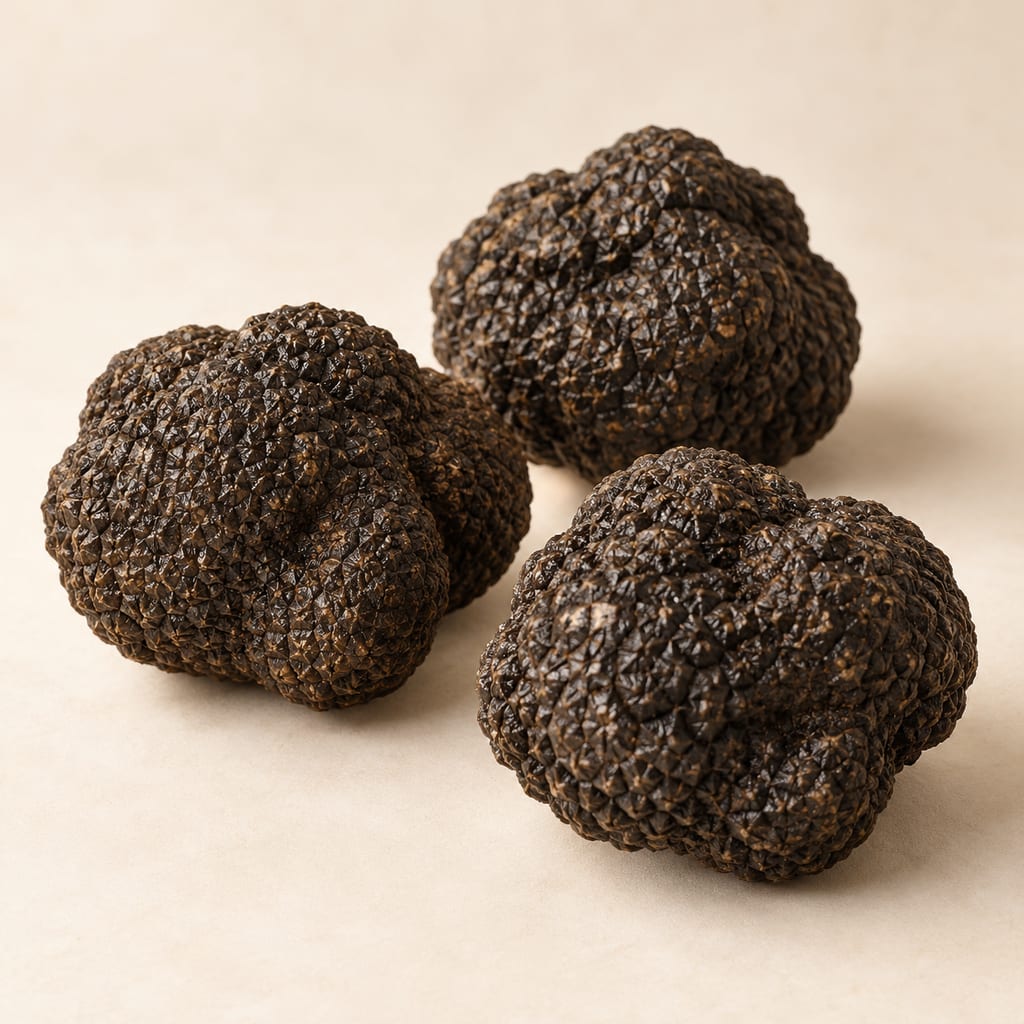
Tuber melanosporum is the Périgord black truffle, a mycorrhizal fungus of southern Europe grown in inoculated oak and hazel orchards and used as a high-value aromatic seasoning.
A cleaned pig caecum forms the broad, closed-end casing used for Slavonski kulen and Baranjski kulen. Its shape, preparation and regional names differ from other pig intestines.
Unpasteurized sheep milk with its natural fat retained, documented as the starting milk for Kashkaval. Seasonal composition affects curd behavior; raw status does not establish microbiological safety.
No community contributions have been published for this entry yet.
Sign in to contribute. Published comments and photos are free to read.
Index FungorumTaxonomy
Entoloma clypeatum (L.) P. Kumm. 1871, record 193495Accepted name and authorship; basionym Agaricus clypeatus and original date.
Cited in: Identity and ecology
Hongos comestibles y tóxicos de México, UNAMIdentity · Habitat · Distribution · Season · Safety
Entoloma clypeatumMexican records are an unresolved complex of species near E. clypeatum; ecology, morphology and broad distribution; Mexican market and state records with complex-level caveat.
Cited in: Identity and ecology; Season and range; Safety and limits
Turkish Journal of BotanySafety · Distribution
Entoloma mushroom poisonings in Mediterranean TurkeyFour poisoning cases from wild mushrooms collected in Burdur Province; specimens identified as E. clypeatum by morphology and spores.
Cited in: Safety and limits
Food ChemistryFood use
Chemical composition and non-volatile components of Croatian wild edible mushroomsStudy includes E. clypeatum among ten Croatian wild edible mushroom species.
Cited in: Documented food use
Acta Societatis Botanicorum PoloniaeFood use · Distribution
Wild food plants and fungi used by Ukrainians in the western part of the Maramureș region in RomaniaDiscusses E. clypeatum in the local wild-food repertoire and reports it eaten by Ukrainians; does not establish a preparation method in the cited passage.
Cited in: Documented food use
Mykologie.netSeason · Habitat
Entoloma clypeatum (Závojenka podtrnka)Secondary mycological account describes spring–early-summer occurrence under Rosaceae and gives March–June.
Cited in: Season and range
Norfolk Fungus Study GroupDistribution · Season
Entoloma clypeatum — Norfolk recordsRegional observational record series; records are not a harvest calendar.