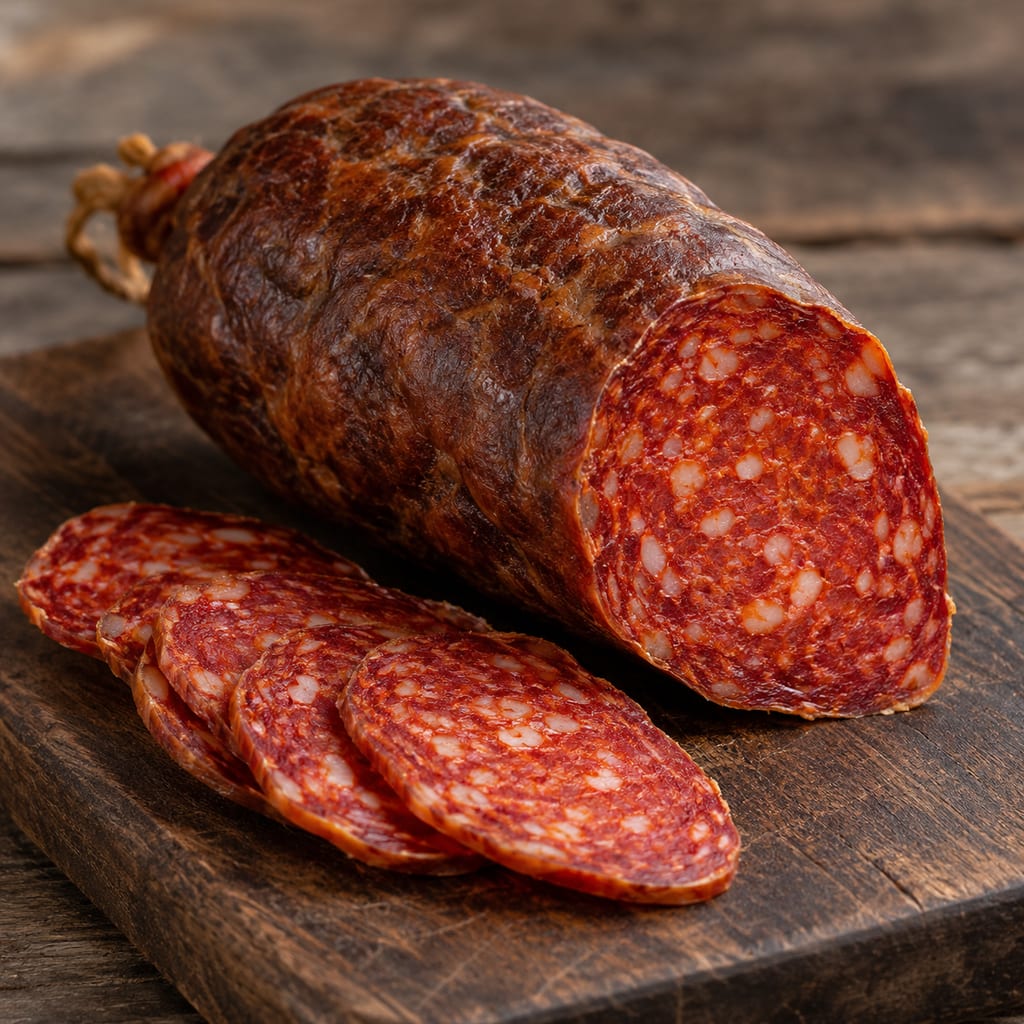
Baranjski kulen
Baranjski kulen is a Croatian protected fermented pork sausage seasoned with sweet and hot paprika, garlic and white pepper, stuffed into a pig’s caecum called katica, cold-smoked and matured.
 FermenteaWhere food goes to change
Substrates
A cleaned pig caecum forms the broad, closed-end casing used for Slavonski kulen and Baranjski kulen. Its shape, preparation and regional names differ from other pig intestines.
A pig caecum is the blind pouch at the beginning of the large intestine, near the junction with the small intestine. As a casing it is a one-ended envelope rather than a long, open tube: the natural pouch gives the sausage a broad body and a closed end. The Croatian product specifications for Slavonski kulen and Baranjski kulen name this exact organ. Baranja’s specification also records the regional term katica for the caecum used in that sausage.
The organ matters because trade names for natural casings do not line up neatly across species and regions. In pig casing trade, a bung can mean the terminal straight part of the large intestine, while the caecum is a separate pouch. Baranjski kulen’s specification explicitly calls its casing the caecum and identifies it with katica. It should not be casually relabelled a pig bung, pig middle, small-intestine round or stomach casing.
This ingredient record is about the prepared pig caecum used as an edible sausage envelope. It is not a page about the caecum of cattle, sheep or goats, nor the broader anatomy entry for blind gut, nor the caecum eaten as offal. The species, segment and intended use are all part of the name. The regional word katica is attached here to Baranja’s use; it is not presented as a universal name for every pig caecum casing.
The best documented food uses of pig caecum are Slavonski kulen, also called Slavonski kulin, and Baranjski kulen. Their protected specifications both describe a large regional dry-fermented sausage made in a pig’s caecum, but each product has its own name, production geography and rules. The shared casing does not make the sausages interchangeable.
The Slavonski kulen specification describes a cleaned and drained caecum filled with selected pork cuts, firm back fat, salt, hot and sweet paprika, and garlic. The filled organ is tied in a characteristic pattern that follows its natural folds. Its finished outline can vary with the size and volume of the caecum. The protected product is fermented, cold-smoked, dried and matured over at least 150 days. The specification also limits its production cycle to the colder part of the year. These are facts about the named protected sausage, not a household schedule for preparing raw casings or validating a new batch.
The Baranjski kulen specification calls the casing the end of the pig’s large intestine, or caecum, locally known as katica. It describes an oval sausage whose shape depends on the casing, which must be filled fully. The filling is pressed pork seasoned with paprika, garlic and pepper; the production steps include casing stuffing, conditioning, fermentation and maturation in Baranja. Those details explain why the casing is central to the identity of the sausage, but they remain attached to that product’s specification.
The European Union registered Baranjski kulen as a protected geographical indication in 2015. Slavonski kulen also has a protected geographical specification. Protection records named products and their defined production areas; it does not mean that every sausage in a pig caecum belongs to either name. The ingredient can appear in other regional products, but this source set only gives firm, detailed evidence for these two Croatian examples.
Unlike a narrow intestinal tube, a caecum already has a broad closed-end form. When stuffed, it becomes the body of the sausage rather than a skin wrapped around a separately shaped log. Product specifications describe its size and volume as variable, so the casing itself helps explain why individual Slavonski kulen can differ in dimensions. Baranjski kulen is described as oval, with its final shape determined by the casing and the filling packed into it.
The casing also has to carry a heavy mass through several stages. Slavonski kulen’s specification notes that filling a large-diameter caecum and handling the resulting weight call for producer skill when tying the natural folds, cold-smoking and drying the product over a long period. The casing is not decoration; it is a structural part of the product and one reason the protected preparation requires specialized handling.
Natural casings bind and protect a sausage filling and allow the product to contract or expand as processing changes it. A broad pouch creates different geometry from a narrow round: the surface area, thickness and centre-to-edge distance are not the same. Fermentation and drying schedules are therefore specific to the named product and casing, and cannot be transferred just because another sausage is also pork-based. This page does not supply a process formula or infer a safe schedule from the casing alone.
A manufactured tube can be consistent in diameter, while a natural caecum comes with its own form. In the protected Slavonski product, the specification ties the casing along its folds and accepts a range of shape and volume. That variation is part of working with an animal organ rather than a uniform industrial film. It is also why a recipe’s ingredient name should retain the organ instead of flattening all natural casings into one generic category.
Natural animal casings have a long history in sausage making, but the sources do not identify when or where people first used a pig caecum for this purpose. Gut is an available container at slaughter, yet that plausibility cannot be turned into an origin story. The records gathered here show documented regional products and modern product specifications rather than a universal invention date for the casing.
Baranja’s product specification gives a more specific historical trail. It points to writings by the Croatian folklorist and author Nikola Tordinac from the 1880s as the first written mention of kulen from Baranja. It then describes organized preserved-meat production around the turn of the twentieth century, including a Pannonski kulin associated with Karanac, and later production centred in Beli Manastir after the Second World War. The specification’s historical account concerns Baranjski kulen and the region’s product tradition. It does not prove that the current formulation, casing handling or protected specification is unchanged from that time.
Slavonski kulen’s official description connects the sausage with local annual pig processing and traditional production in Slavonia. The European dossier explains that a large caecum and a heavy sausage demand the skills needed for tying, smoking, drying and maturation. Its protected product and seasonal cycle are modern official descriptions of a regional tradition; they should not be presented as the moment the casing was invented.
Reading the chronology this way keeps three histories apart: the broad use of animal intestines as containers, the regional histories of named kulen products, and the current regulated definition of each protected name. A date that supports the product’s reputation does not automatically date every ingredient or every step in its manufacture.
A natural casing is not simply an intestine removed from an animal and stuffed. The European casing-industry guide defines the edible casing through its intended role as a food envelope and describes industrial preparation involving cleaning, tissue scraping, defatting, washing and treatment with salt. It follows casing production from the slaughterhouse through cleaning, sorting, grading, curing or salting, packing and dispatch to sausage makers.
The caecum begins as a full organ with contents and attached tissues. The Slavonski kulen specification is precise about the casing arriving as cleaned and drained material. The Baranjski specification identifies the anatomical segment, while the EU hygiene guide describes the managed production system for natural casings more broadly. These sources do not provide one home-cleaning recipe for caecum, and the catalogue does not turn industrial flowcharts into household directions.
General descriptions of casing wall layers vary with which intestine is being discussed and how it is processed. The EU guide describes cleaned pig natural casings in terms of their submucosal layer; an older FAO account treats pig caecum (called a cap in its terminology) separately and describes a different set of retained layers after cleaning. The product specifications identify the caecum and its clean, drained state without settling that technical disagreement. This page therefore does not promise one universal microscopic structure for every prepared caecum casing.
After preparation, natural casings may be preserved and supplied in salted or brined forms, then sorted and packed for the sausage trade. The casing maker and the sausage maker handle different parts of that chain. A recipe that names fresh, salted or dried casing should identify the actual product and stage described; one form cannot be assumed from the word “caecum” alone.
A casing does more than hold mince in shape. Its tissue and permeability affect how a sausage behaves as it shrinks and dries, while the microbes on a natural casing can join the microbial environment of a sausage. Research comparing hog, cow and sheep casings found that casing communities differed between animal sources and that the technologies used to prepare casings strongly affected the microbial ecology measured.
That finding makes casing provenance and preparation relevant to fermented meat, but it has limits. The study covered different casing materials and stages of preparation; it does not establish that a particular pig caecum supplies a desired culture, nor that a caecum acts as a reliable starter. It cannot be used to skip a deliberately managed fermentation process or to infer safety from a casing’s natural origin.
For Slavonski kulen, the casing surrounds meat that undergoes fermentation before cold smoking, drying and maturation. The protected specification names those stages and describes the sensory characteristics of the finished product. The pig caecum is an enabling envelope within that defined system, not the sole cause of fermentation or the whole preservation method. Baranjski kulen likewise has its own regional preparation and maturation requirements.
The practical implication is modest but important: natural casing is biologically active enough to matter, yet not predictable enough to count as a standardized culture. Results depend on the casing’s source and treatment as well as the meat, season, room and process. The sources here do not support a stand-alone fermentation instruction for raw caecum or a claim that a casing will make an unsafe sausage safe.
The source-backed geography for this casing is Croatia, specifically the documented regional production of Slavonski kulen in Slavonia and Baranjski kulen in Baranja. Those names do not claim that the pig caecum itself originated in either region. They record where these particular uses and protected sausage traditions are documented.
Baranja lies in northeastern Croatia, across the Drava–Danube borderland. Its product dossier places Baranjski kulen within a regional tradition shaped by households and later organized producers. The name katica belongs to that local use of the caecum. Slavonski kulen is tied to the Croatian region of Slavonia and has its own protected product definition. The names and recipe specifications preserve local distinctions even though both sausages use the same anatomical casing.
The broader casing trade uses terms such as cap, bung, middle and round differently according to animal and market. The European industry guide provides a nomenclature for international casing production; FAO’s small-scale guide uses “cap” for the pig caecum and “bung” for the pig’s terminal large intestine. A product specification may use more precise anatomical language than a trade label. When a source says pig caecum, a reader should keep that exact segment visible.
This geography is therefore at region precision, not a village-level origin claim for casing. No locality is assigned solely because a product producer or processing plant happens to be there. A regional map point shows where the named food use is documented, not where every caecum casing is raised, cleaned or traded.
Raw intestinal material is perishable and requires controlled hygienic handling. The European casing-industry guide identifies biological hazards, including pathogenic bacteria, in the production of natural casings and treats sanitation, traceability and salting within a food-business hazard-management system. It places responsibility for safe production on operators and covers the commercial chain rather than giving a home preservation plan.
A protected product specification shows how a named sausage is defined; it is not automatically a safe household method for every reader, casing size or room. The minimum time, dimensions and material requirements in a product dossier are tied to that product and its regulated context. They should not be pulled out as a generic caecum-casing recipe or as a substitute for current local food-safety requirements.
The sources do not establish a universal household cleaning procedure, salt concentration, storage duration, fermentation endpoint or test that would validate a caecum casing for an improvised sausage. A food casing’s clean appearance or lack of odor cannot verify that those controls were met. The appropriate use context is a traceable casing prepared for food use and a validated process for the named sausage, not a guessed procedure based on anatomy.
When reading a recipe, first check that it means pig caecum rather than pig stomach, small intestine, terminal bung or another animal’s caecum. Then note whether it specifies the cleaned, drained or preserved form. Finally keep the product, region and processing method together: Slavonski kulen and Baranjski kulen document the casing in their own systems, but do not provide a universal set of limits for every fermented meat.
Documents pig caecum casing in Slavonski kulen; it does not claim the casing originated in Slavonia.
Documents pig caecum casing in Baranjski kulen; it does not claim the casing originated in Baranja.
Baranjski kulen is a Croatian protected fermented pork sausage seasoned with sweet and hot paprika, garlic and white pepper, stuffed into a pig’s caecum called katica, cold-smoked and matured.

Dry salami, sour pork with rice, matured sheep and aged blubber follow different paths from animal to food. Their stories connect microbes with climate, slaughter, migration and the meals people share.
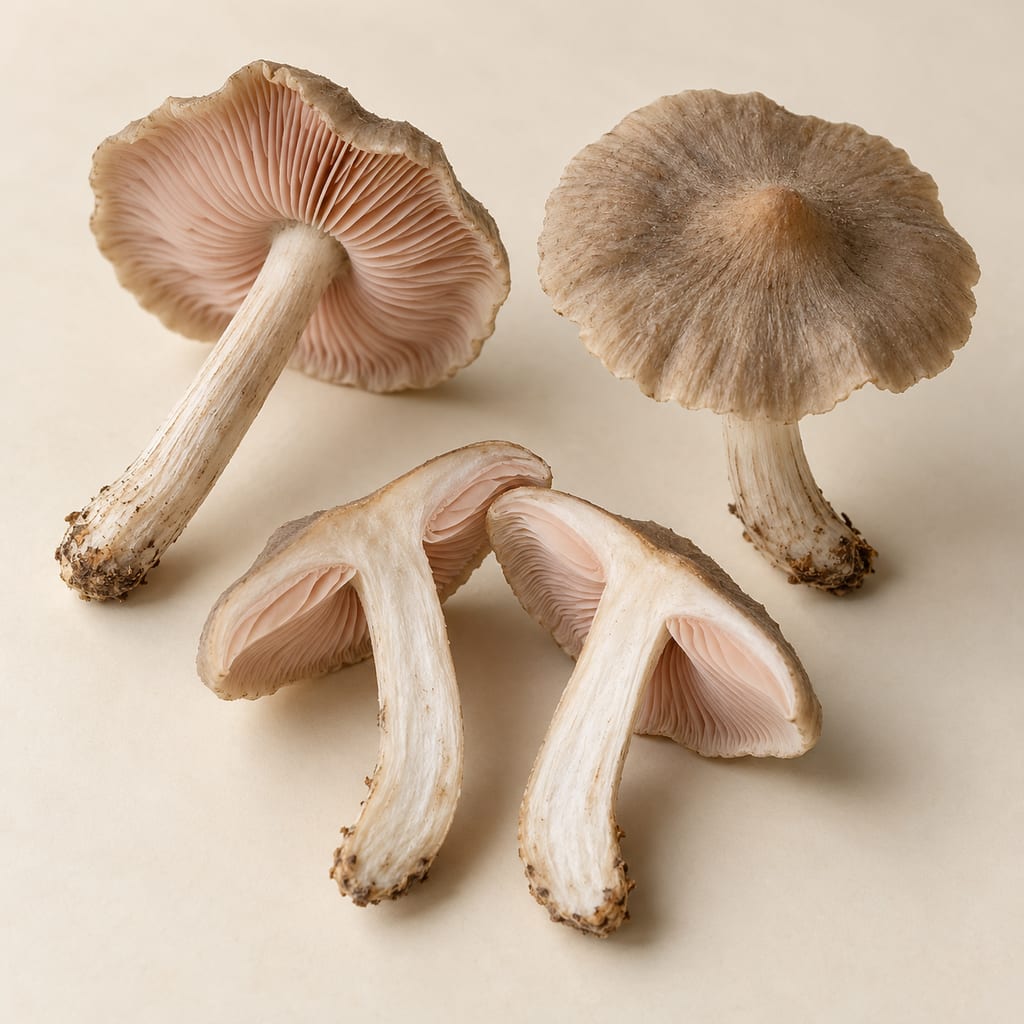
A spring pink-spored mushroom associated with Rosaceae. European food use is documented, alongside a Turkish poisoning report and unresolved species-complex records in Mexico.
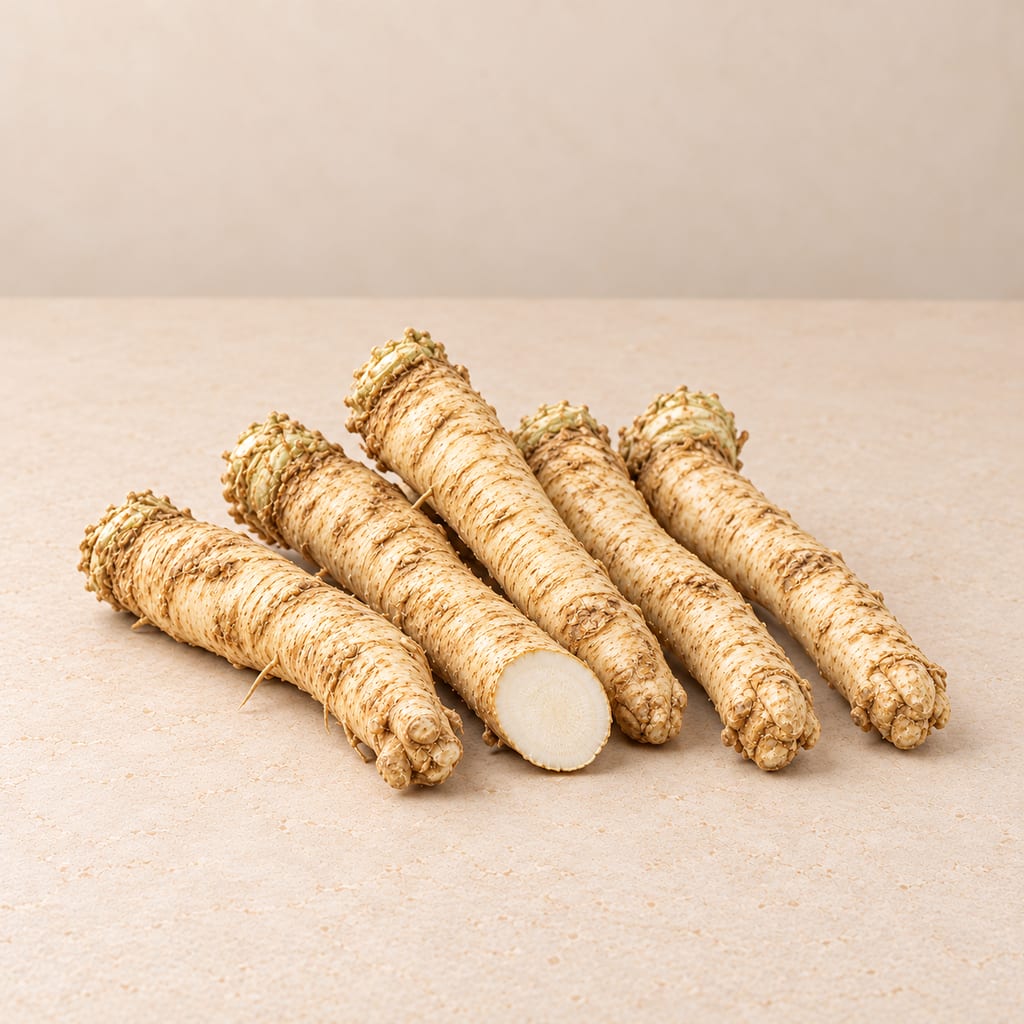
Horseradish is the long white root of Armoracia rusticana, a perennial of the mustard family. Grated, it releases a sharp, nose-clearing heat that vinegar fixes in the sauce.
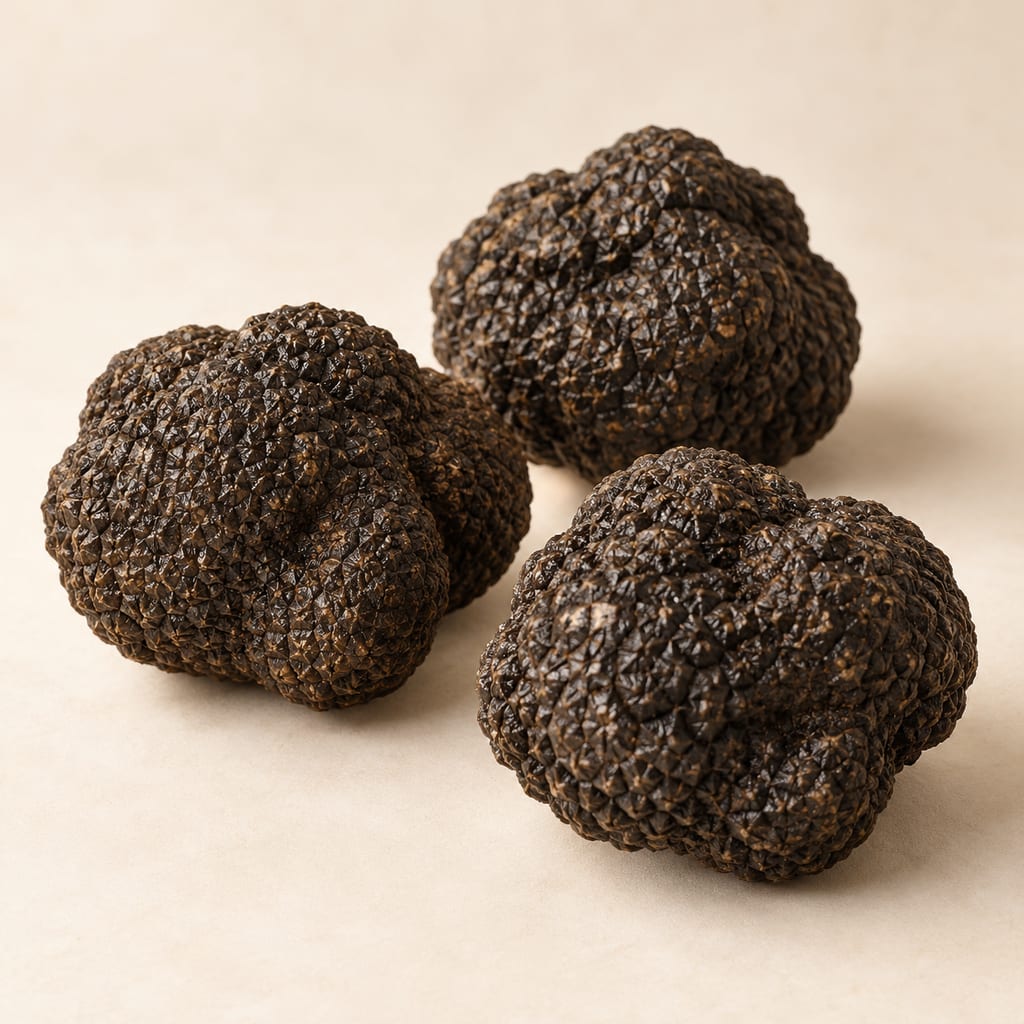
Tuber melanosporum is the Périgord black truffle, a mycorrhizal fungus of southern Europe grown in inoculated oak and hazel orchards and used as a high-value aromatic seasoning.
Unpasteurized sheep milk with its natural fat retained, documented as the starting milk for Kashkaval. Seasonal composition affects curd behavior; raw status does not establish microbiological safety.
No community contributions have been published for this entry yet.
Sign in to contribute. Published comments and photos are free to read.
European Commission, Official Journal of the European Union C 375 (2015/C 375/08)Use · Geography · History
Publication of an application: ‘Slavonski kulen’ / ‘Slavonski kulin’The protected sausage is stuffed in a cleaned and drained pig caecum.
Its dimensions vary with the caecum's size and volume; the specification describes tying the stuffed caecum in a characteristic pattern that follows its folds.
The specified product undergoes fermentation, cold smoking, drying and maturation for at least 150 days, with production in a stated seasonal cycle.
The dossier describes the local history and production region of Slavonski kulen.
Cited in: The pig caecum is a pouch, not a length of casing; Two Croatian sausages use the same organ differently; The pouch sets the shape and the work; Casing history is older than its written record; Cleaning turns an organ into a food envelope; Its living surface is part of the fermentation environment; Regional geography and names belong to the product; Read the casing claim and the safety claim separately
European Commission, Official Journal of the European Union C 139 (2015/C 139/05)Use · Geography · History
Publication of an application: ‘Baranjski kulen’Baranjski kulen is stuffed into the end of a pig's large intestine, identified as the caecum and locally called katica.
The casing determines the oval shape and is described as fully stuffed with the filling.
The product dossier places production in Baranja, records a written mention in works from the 1880s, and discusses organized production around the turn of the twentieth century and after the Second World War.
Cited in: The pig caecum is a pouch, not a length of casing; Two Croatian sausages use the same organ differently; The pouch sets the shape and the work; Casing history is older than its written record; Its living surface is part of the fermentation environment; Regional geography and names belong to the product; Read the casing claim and the safety claim separately
European Natural Sausage Casings Association; European CommissionHandling · Safety · Identity
Community Guide to Good Practice for Hygiene and the Application of the HACCP Principles in the Production of Natural Sausage CasingsThe voluntary guide covers industrial natural-casing production from the slaughterhouse cleaning stage through dispatch to sausage makers.
Natural casings are cleaned, treated by scraping, defatting and washing, then preserved with salt; the guide distinguishes processed edible casings from other treated animal intestines.
It identifies biological, chemical and physical hazards considered in casing production and assigns responsibility for safe production to food business operators.
Pig intestines supply several casing segments; technical trade terminology can distinguish the caecum from the terminal pig bung.
Cited in: The pig caecum is a pouch, not a length of casing; Cleaning turns an organ into a food envelope; Its living surface is part of the fermentation environment; Regional geography and names belong to the product; Read the casing claim and the safety claim separately
Food and Agriculture Organization of the United Nations, Animal Production and Health Paper 52Identity · Handling · Use
Small-scale sausage production, Chapter 3: Sausage casingsNatural casings are prepared from different parts of animal digestive tracts and function as forms and containers that bind and protect sausage filling while regulating contraction and expansion.
The chapter describes pig caecum as a cap and distinguishes it from pig middles and terminal bungs.
Its description of caecum processing differs in retained wall layers from some later general casing descriptions, so this account does not claim one universal tissue-layer profile.
Cited in: The pig caecum is a pouch, not a length of casing; The pouch sets the shape and the work; Casing history is older than its written record; Cleaning turns an organ into a food envelope; Regional geography and names belong to the product
International Journal of Food MicrobiologyUse · Handling
High-throughput assessment of bacterial ecology in hog, cow and ovine casings used in sausages productionThe study found distinct bacterial community structures among hog, cow and ovine casings.
Casing-preparation technology strongly affected the bacterial ecology measured.
The research supports casing-associated microbial ecology as relevant to sausage production but does not establish that a pig caecum is a controlled starter or provide a caecum-specific process validation.
Cited in: Its living surface is part of the fermentation environment
European Commission, Official Journal of the European Union L 246History · Geography
Commission Implementing Regulation (EU) 2015/1579 entering ‘Baranjski kulen’ in the register of protected geographical indicationsConfirms the European Union registration of Baranjski kulen as a protected geographical indication in 2015.
Cited in: Two Croatian sausages use the same organ differently