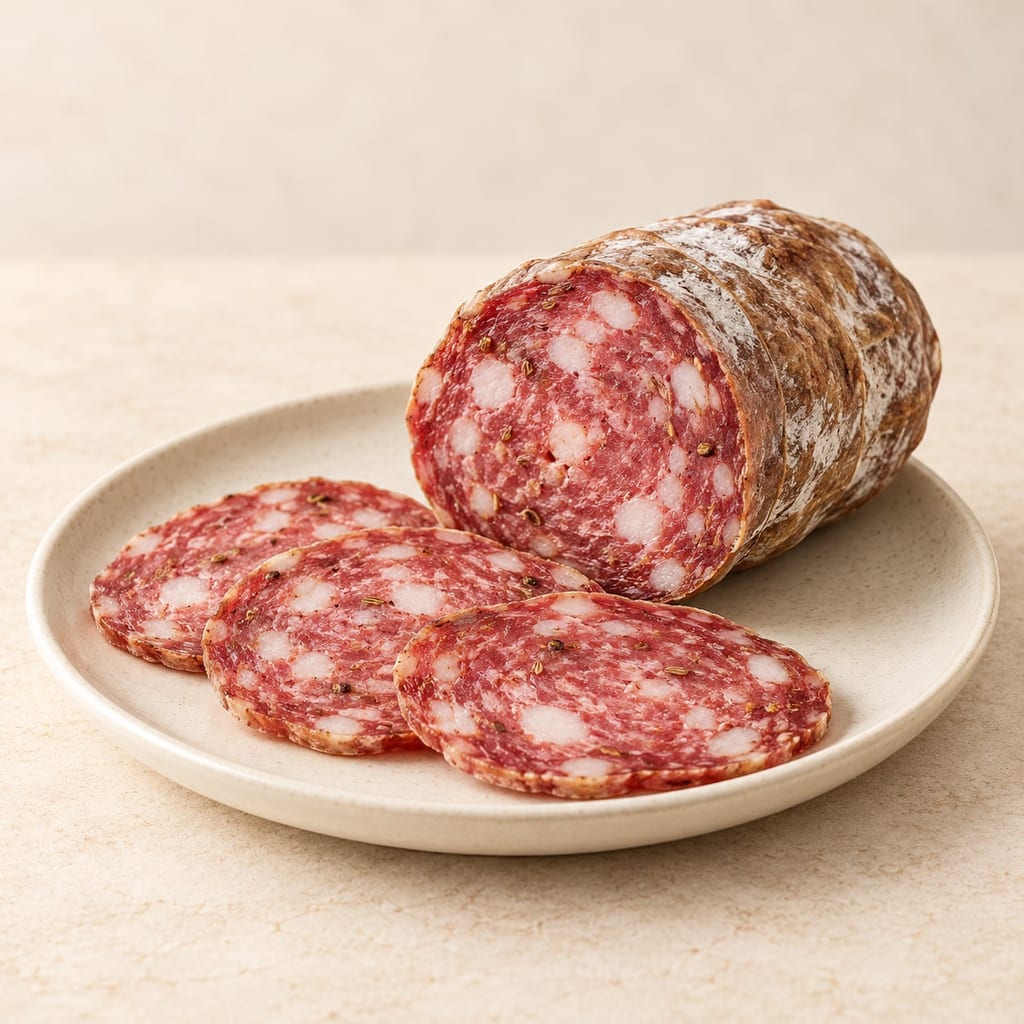
Finocchiona, starter-cultured
A Tuscan-style fennel salami made with pork and back fat. Toasted fennel, fennel pollen and Sambuca flavor this starter-cultured preparation.
 FermenteaWhere food goes to change
Cultures
Flavor of Italy is a freeze-dried meat culture combining lactic acid bacteria with Staphylococcus carnosus to support sausage acidification, colour and aroma.

Flavor of Italy is a selected bacterial culture for fermented meat. It is supplied as a freeze-dried powder and worked into the filling, where its organisms participate in acidification and ripening. Its name suggests a finished flavour, but the packet supplies living microorganisms rather than an Italian seasoning blend. Garlic, wine, pepper and other aromatics still belong to the recipe that uses it.
The specified formulation is SafePro Flora Italia LC US. It contains Lactobacillus sakei, Pediococcus acidilactici and Staphylococcus carnosus. These organisms belong to different functional groups: the first two are lactic acid bacteria, while the third is a coagulase-negative staphylococcus selected for meat processing. Combining them brings more than one kind of microbial activity into the same filling.
Lactobacillus sakei is now classified as Latilactobacillus sakei. The older name remains on this product’s published formulation, and neither name supplies a strain identifier. This is a change in taxonomic naming, not evidence that a different organism has been added to the blend.
The powder itself is described as off-white to brownish. After incorporation it becomes dispersed through meat, fat and seasonings, rather than forming the white bloom associated with a surface mold. A recipe may use both cultures, but the bacterial starter inside the sausage and the mold applied outside it occupy different habitats. Their separate preparation and application are part of the method.
Fermented sausages can acquire microorganisms from meat, seasonings, casings, equipment and the production environment. In established processing rooms, resident communities can contribute to the character of successive batches. Their presence makes fermentation possible without a packet, but the composition and activity of such communities are not the same as a defined commercial ingredient.
Selected starter cultures developed as a way to direct this variable process. Organisms were examined for useful technological properties and supplied as inocula, allowing a producer to introduce an intended population at the beginning. Selection concerns the food as well as the organism: acid production, colour, aroma and the capacity to function in a salted meat environment all matter.
In 1961, R. H. Deibel, G. D. Wilson and C. F. Niven published an account of a lyophilized Pediococcus cerevisiae starter for fermented sausage. Lyophilized means freeze-dried. That historical example shows the connection between microbial selection and a transportable dry preparation. It is part of the history of meat starters, distinct from the later three-species formulation sold as Flavor of Italy.
A commercial name, a manufacturer code and a species name describe different levels of identity. Flavor of Italy is the retail name associated here with Flora Italia LC US. Lactobacillus sakei is one organism in that formulation. A packet containing that species alone would still be a different ingredient from the three-organism blend.
Closely named cultures can also differ between versions or markets. Flora Italia LC without the US suffix has its own specification, while other meat cultures are sold under different product codes. Similar names and overlapping species do not establish identical ratios, strains, carriers or technological performance. The complete product name and the corresponding label are more useful than a shortened description such as “salami bacteria.”
The organisms work within a formulation whose other ingredients remain important. A starter is distinct from nitrite-containing curing salt, ordinary sodium chloride and fermentable sugar. One introduces organisms, another supplies curing agents, another affects salinity and protein behaviour, and another provides carbohydrate. Their contributions interact, but substituting one for another would change the system rather than perform the same job by another route.
Lactic acid bacteria use fermentable carbohydrate and accumulate organic acids, lowering pH. The resulting acidity contributes tang and changes the environment surrounding meat proteins and other microorganisms. A sausage's sourness is consequently produced within the filling over time, rather than necessarily being added as an acidic dressing to the finished slice.
Changing the amount of fermentable sugar changes the substrate available for acid production and can affect final pH. Sugar provides material for metabolism, while the culture supplies organisms capable of using it. Temperature, salt, the meat mixture and competing organisms influence that activity as well. More carbohydrate is therefore one variable in a living system, not a complete description of how a fermentation will proceed.
Acid production and drying also change texture through different routes. Acidity affects protein properties and water binding. Drying removes water through the casing into the surrounding air. These operations can overlap in a ripening sausage, but one is a biochemical change and the other is physical mass transfer. Their different purposes explain the move from a fermentation environment into a cooler drying stage in many recipes.
Lactobacillus sakei is well adapted to meat environments, where fermentable sugars can be limited. Its metabolism includes ways of using available carbohydrate and, under suitable conditions, other substrates. This helps explain why selecting an organism for sausage involves more than asking whether it can produce acid in a rich laboratory broth.
The separately identified strain Chr82 has been compared in defined media containing glucose or ribose at different concentrations. The kind and availability of sugar affected organic-acid accumulation and amino-acid use. The culture's response involved more than a uniform conversion of every added sugar into the same result. Substrate availability altered the pattern of metabolism.
Glucose and ribose are different sugars whose metabolism can involve different pathways. The available carbohydrate therefore influences the organism’s metabolic options. In a developing sausage, the materials around the cells also change as sugar is consumed and moisture is lost. The species' adaptation offers a useful explanation of its place in meat cultures, while the Chr82 experiment concerns that named strain rather than the undisclosed strain in this blend.
Pediococcus acidilactici supplies another lactic acid bacterium in the formulation. Its presence connects the product with the long use of pediococci in fermented meat, while its precise identity distinguishes it from Pediococcus pentosaceus and from historical terminology used in early starter research. These names refer to related organisms, not interchangeable entries on an ingredient list.
Selection can consider several traits at once. Investigators examine growth in the intended environment, acid production and interactions with other organisms. Some Pediococcus isolates have been studied for antibacterial activity, including activity associated with bacteriocins, which are compounds made by bacteria that inhibit susceptible microorganisms. Such a trait belongs to the tested isolate and conditions.
The blend is described as able to help control growth of Listeria monocytogenes. That product-level description is different from identifying a particular antibacterial molecule or demonstrating a particular reduction in an arbitrary sausage. The contribution of the mixed culture needs to be understood within the food in which it is used, alongside the rest of the process.
Staphylococcus carnosus is included for technological functions beyond the principal acidifying role of the lactic acid bacteria. Selected meat-associated staphylococci have been investigated for nitrate reduction, antioxidant enzymes, protein transformations and aroma formation. These activities connect microbial metabolism with the curing and maturation chemistry of the meat.
Examined sausage isolates of Staphylococcus carnosus have shown catalase and superoxide dismutase activity. These enzymes act on reactive oxygen compounds. The same investigation found breakdown of sarcoplasmic proteins, while the tested strains did not hydrolyse pork fat. That combination is instructive: a useful meat organism need not perform every possible ripening reaction, and activity against one protein fraction does not imply equivalent activity against another.
Nitrate reduction also depends on the curing system and the strain. Nitrate must first be converted to nitrite before entering the familiar cured-colour chemistry. The curing ingredients provide the nitrogen compounds; the organism's metabolism can contribute to their transformations. Supplying a bacterium with a potential technological role does not supply the curing ingredient itself.
Meat aroma emerges from several interacting reactions. Protein breakdown releases peptides and amino acids, while further metabolism can turn smaller molecules into volatile compounds. Fat transformations and oxidation contribute another set of compounds. The resulting aroma is a mixture whose components can change at different rates during maturation.
In experimentally prepared dry sausages, changing the initial Staphylococcus carnosus inoculation level and ripening time altered the volatile profile. Higher starting levels were associated with larger amounts of several branched aldehydes, acids and sulfur compounds, while other volatiles followed different relationships. Increasing the organism did not simply increase every aroma component together.
This helps make the phrase Mediterranean flavour more concrete without turning it into a single chemical promise. A starter can influence the formation of aroma precursors and volatiles, while the pork, fat, wine and spices provide the material in which those reactions occur. A pepper-rich sausage and one seasoned with wine and garlic can use the same culture and still have different sensory identities.
Freeze-drying produces a dry culture that can be distributed and stored before use. Keeping microorganisms viable through freezing, dehydration and subsequent rehydration is a different task from growing them in the sausage. For freeze-dried lactic cultures, surrounding materials and storage conditions can affect survival through these stresses.
Cold storage and growth in food answer different biological questions. Below its minimum growth temperature, a strain can remain alive without multiplying. The preparation is kept so that viable organisms remain available for later use; visible inactivity in storage is consequently different from loss of the ability to grow. Once introduced into a suitable food, its environment changes again, bringing water, nutrients and a working temperature together.
The number of organisms initially supplied and the number that survive handling and storage are different measurements. Viability is a measured biological property, while the mass of powder includes the rest of the preparation as well as its cells. The weight on a packet therefore describes the supplied ingredient, not a direct count of organisms. Culture handling connects those two practical concerns: distributing the intended amount and preserving the living material that amount is intended to deliver.
The supplied formulation lists sucrose, culture and manganese sulfate. It is a ground powder that forms a suspension in water. Those ingredient and physical descriptions identify the supplied preparation, while the manufacturer’s production method remains distinct from laboratory freeze-drying experiments involving other cultures and protective materials.
Addition early during grinding, cutting or blending with other dry ingredients distributes this formulation through the filling. The linked finocchiona preparation instead includes a measured rehydration stage before mixing. Those directions belong to their respective products and recipes. In either case, distribution matters because the inoculum needs to reach the filling in which it will work, rather than remain concentrated in a few unmixed pockets.
For this specified freeze-dried formulation, the dated 2021 directions call for dry storage below −17°C, with a shelf life of at least eighteen months under those recommendations. At +5°C the stated maximum is six weeks. These are directions for that freeze-dried preparation, separate from the storage of a finished sausage and from the time a rehydrated culture spends awaiting use.
The dated formulation declares the listed common allergens absent as ingredients, including milk and lactose, soy and gluten-containing cereals. This is a declaration about the listed product formulation. A sausage made with it may contain milk powder, wine or other ingredients with their own dietary implications. The culture's declaration does not describe the complete food.
Fermented-meat controls must also address hazards such as Staphylococcus aureus toxin and pathogenic E. coli or Salmonella. Drying that prevents growth is not necessarily a treatment that destroys organisms or toxins already present. The selected culture works within the sausage’s complete, process-specific control system; it does not supply the curing ingredients or a separate pathogen-reduction treatment.
Flavor of Italy is intended for fast fermented sausages. The selected culture joins the recipe's meat, fat, sugars, salt, curing ingredients and seasonings, helping direct their transformation into a cohesive, aromatic sausage. Its useful identity lies in that defined role: organisms selected for the filling, supplied in a form that can be handled, distributed and brought into activity within a particular process.
The public formulation names species but supplies no strain identifiers, species ratios or commercial launch date. Manufacturing origin and a current lot-specific label have not been established here. No verified photograph of the exposed powder was found. Product descriptions do not supply a complete sausage process or replace application-specific assessment.
Product manufacturing location and the proprietary strains’ isolation places are not established; the trade name does not establish Italian origin.
A Tuscan-style fennel salami made with pork and back fat. Toasted fennel, fennel pollen and Sambuca flavor this starter-cultured preparation.
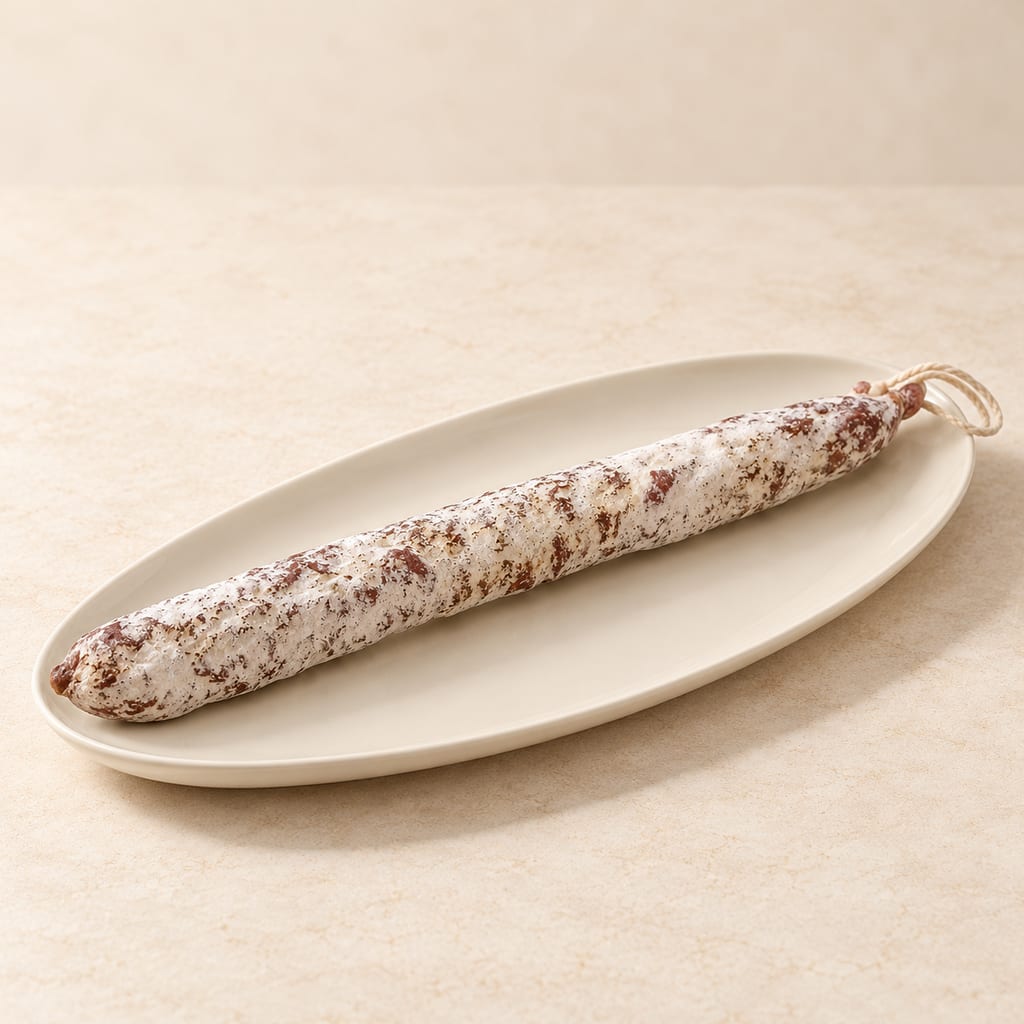
A documentary account of a modern starter-cultured Fuet formula and its place in Catalan sausage culture. The cited raw-pork process lacks matched safety validation, so this page does not present it as a household recipe.
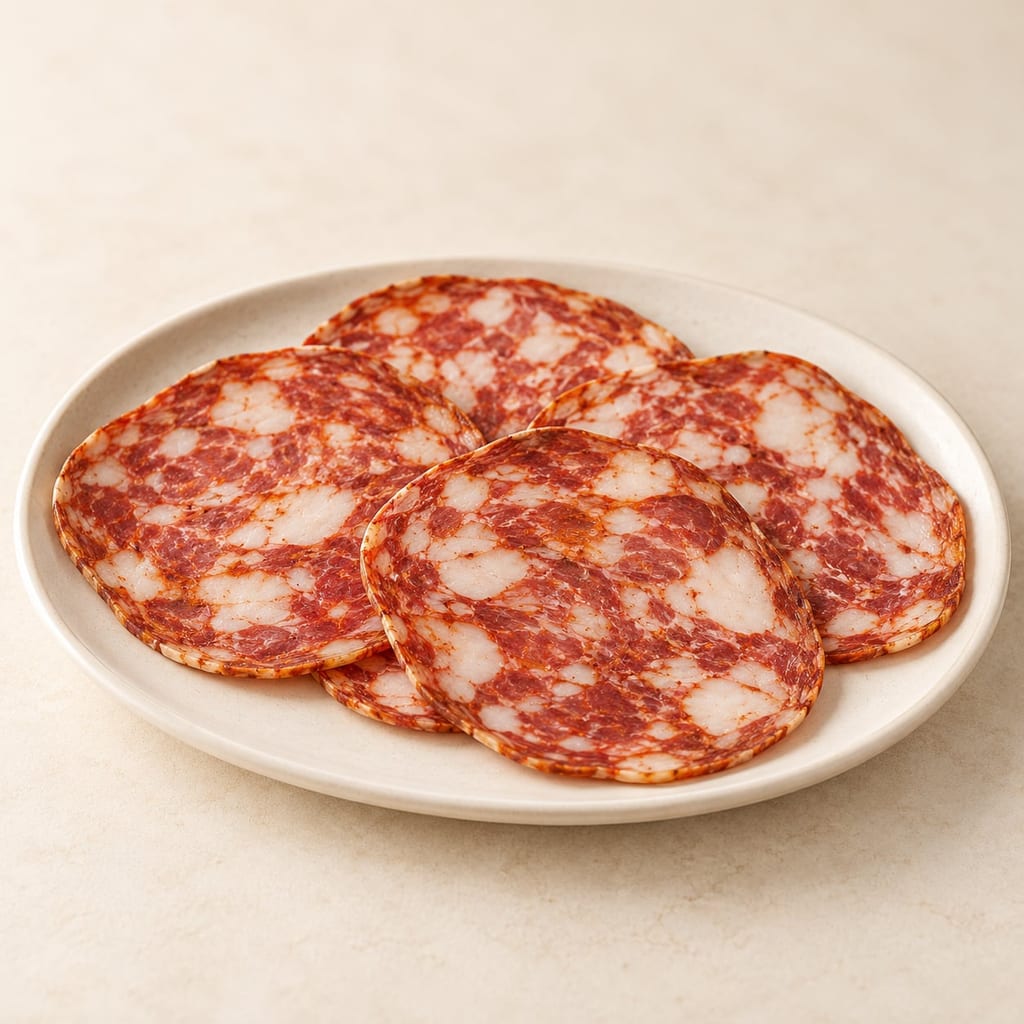
A documentary account of a modern ventricina-style salami source and its Abruzzese context. This page provides no preparation directions or validated home process.
No community contributions have been published for this entry yet.
Sign in to contribute. Published comments and photos are free to read.
Chr. Hansen A/SCulture identity · Science
SafePro Flora Italia LC US Product Information, version5, 06-02-2021Product-specific identity, three listed species, ingredients, physical form, dry addition, storage and allergen declaration; not recipe-process validation.
Cited in: A living ingredient for the sausage filling; Keeping the formulation's identity precise; Sugar, acid and the changing meat environment; Pediococcus and acidifying work; A dry preparation that must remain viable; Storage, dietary declarations and use; Notes
The Sausage MakerContext
Bactoferm – Flavor of ItalyRetailer identifies the product and links the manufacturer’s LC US sheet; broad retail claims do not validate a sausage process.
Cited in: A living ingredient for the sausage filling; Keeping the formulation's identity precise; Notes
Applied MicrobiologyContext
Microbiology of Meat Curing: IV. A Lyophilized Pediococcus cerevisiae Starter Culture for Fermented SausageBibliographic metadata for Deibel, Wilson and Niven (1961); no experimental findings attributed beyond the available record.
Cited in: From resident flora to selected inocula
Journal of Food QualityContext
The Use of Starter Cultures in Traditional Meat ProductsReview of selected cultures, LAB and coagulase-negative staphylococci functions, and dependence on formulation and process.
Cited in: From resident flora to selected inocula
FoodsContext
Metabolism of Lactobacillus sakei Chr82 in the Presence of Different Amounts of Fermentable SugarsBarbieri et al. (2020), Foods 9:720: defined-medium sugar, organic-acid and amino-acid findings for the tested strains, not the exact LC US culture.
Cited in: Lactobacillus sakei and a meat-adapted metabolism
Meat ScienceContext
Technological activities of Staphylococcus carnosus and Staphylococcus simulans strains isolated from fermented sausagesThe abstract reports antioxidant-enzyme activities, differences in sarcoplasmic and myofibrillar protein hydrolysis, and no pork-fat hydrolysis by the tested strains. It establishes no generic numerical growth limits.
Cited in: Staphylococcus carnosus brings complementary functions
Meat ScienceContext
Growth and production of volatiles by Staphylococcus carnosus in dry sausages: Influence of inoculation level and ripening timeThe abstract reports that inoculation and ripening changed individual volatile compounds differently; the studied blend is not identified as Flavor of Italy.
Cited in: Aroma is a changing mixture
FoodsContext
A Comparative Study of Skimmed Milk and Cassava Flour on the Viability of Freeze-Dried Lactic Acid Bacteria as Starter Cultures for Yogurt FermentationIbrahim et al. (2023): the accessible abstract and discussion address viability and protective matrices; they do not disclose the proprietary culture’s manufacture.
Cited in: A dry preparation that must remain viable
Canadian Food Inspection AgencyContext
Preventive control recommendations for manufacturing fermented and dried meat productsFermentation time-temperature-acidification and pathogen reduction are process-specific; not replaced by culture identity.
Cited in: Sugar, acid and the changing meat environment; Storage, dietary declarations and use
List of Prokaryotic names with Standing in Nomenclature / DSMZCulture identity
Species: Latilactobacillus sakeiAccepted name and Lactobacillus sakei basonym; taxonomic rename does not identify a commercial strain.
Cited in: A living ingredient for the sausage filling; Lactobacillus sakei and a meat-adapted metabolism
Chr. Hansen A/SCulture identity
SafePro Flora Italia LC Product Information, material713258, version9, printed06-01-2022Distinct non-US product specification and code; not assumed equivalent to assigned LC US material715383.
Cited in: Keeping the formulation's identity precise
2 Guys & A CoolerCulture identity
How to Make Tuscan Finocchiona SalamiExisting linked preparation includes culture rehydration before mixing; recipe-specific, no dose or safety endpoint transferred.
Cited in: A dry preparation that must remain viable
Journal of Food QualityCulture identity
The Use of Starter Cultures in Traditional Meat ProductsGeneral starter functions, lactic bacteria and coagulase-negative staphylococci; strain-specific bacteriocin examples; food/process dependence.
Cited in: From resident flora to selected inocula; Sugar, acid and the changing meat environment; Pediococcus and acidifying work; Staphylococcus carnosus brings complementary functions; Aroma is a changing mixture
