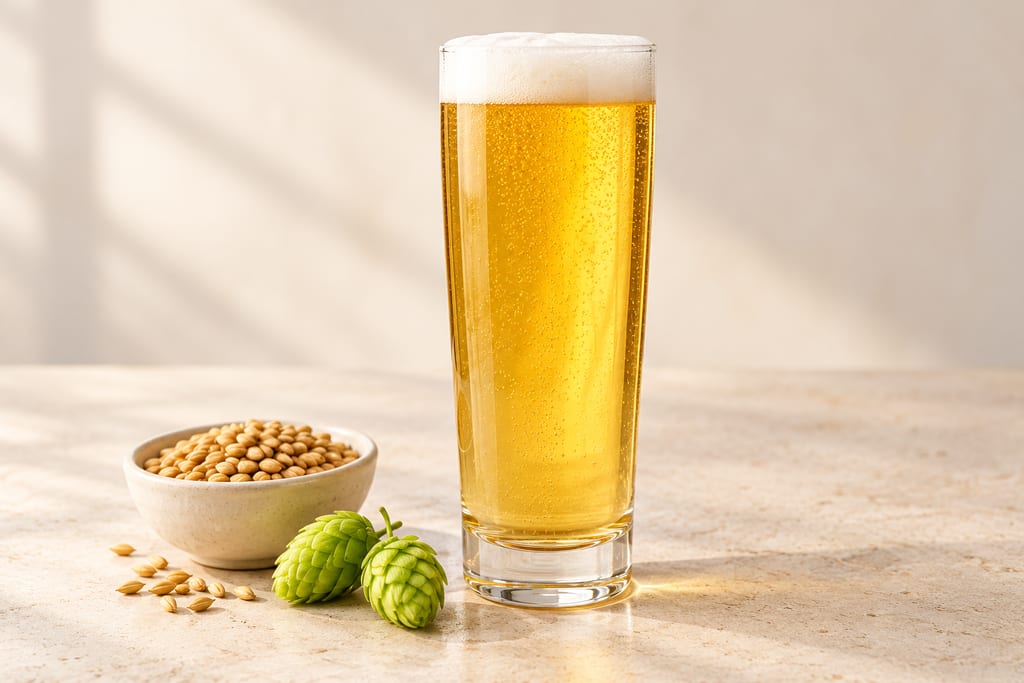
German pils, all-grain
A pale, dry lager with Pilsner malt, Magnum bittering hops and Hallertau Mittelfrüh and Tettnang additions, followed by cold maturation.
 FermenteaWhere food goes to change
Spices and aromatics
A traditional German aroma-hop land variety, associated with the Hallertau and described with herbal, spicy and floral notes. Cultivar identity, crop analysis and the growing place of a particular lot remain separate facts.
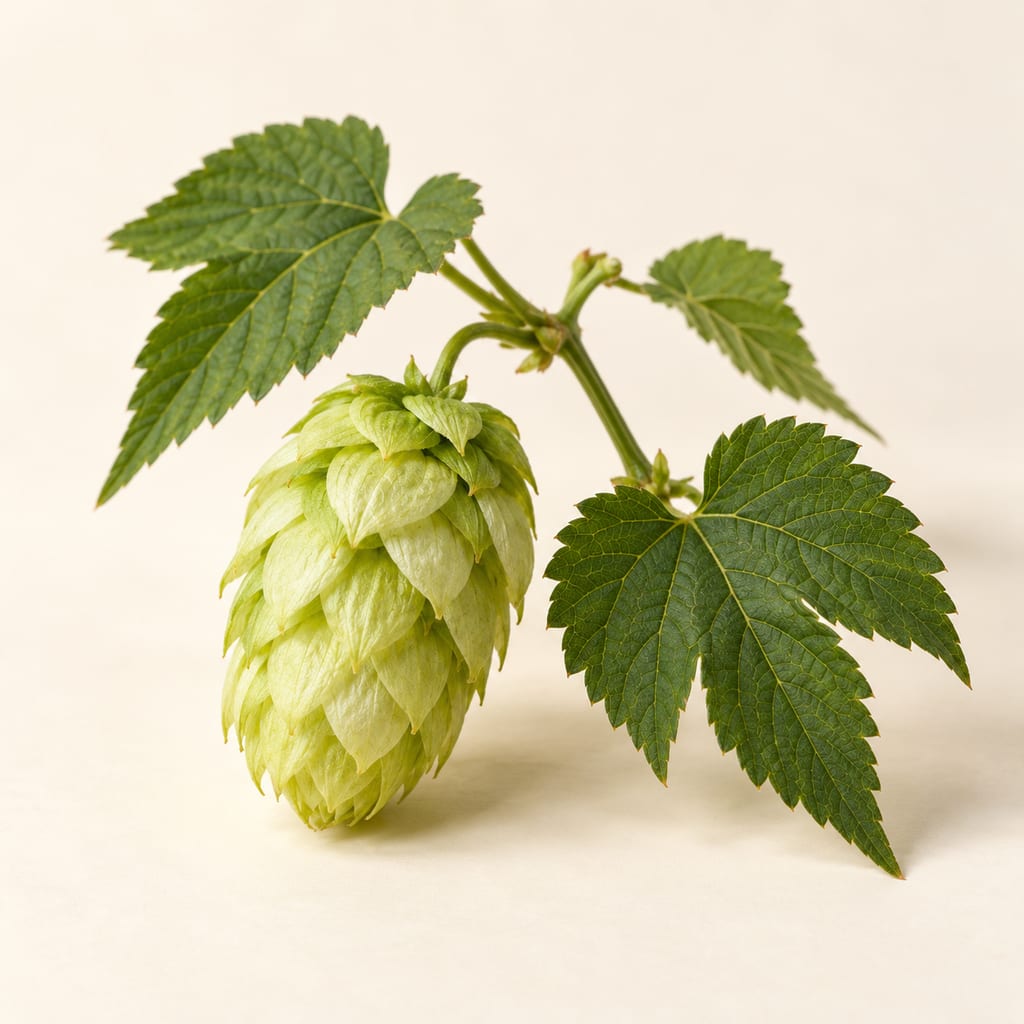
Hallertau Mittelfrüh is a traditional aroma-hop name, also written Hallertauer Mittelfrüh or Hallertauer Mittelfrueh. It identifies a particular cultivated hop rather than every hop grown in the Hallertau. The distinction matters when buying ingredients: a place name used broadly in trade can conceal differences among plants.
The United States Department of Agriculture's accession 56001 records the plant as Humulus lupulus and gives its cultivar as Hallertauer, Hallertauer mittelfrueh. It records no known pedigree, describing an old German landrace as the probable source. Landrace here signals a traditional cultivated population, rather than a modern cross with two documented parents and a named release date.
The accession reached the American collection as rhizomes in spring 1956 from an Oregon farm. That history illustrates the difference between a cultivar's historical association and where a particular plant grows. The same record warns that Hallertauer Gold and Mittelfrüh have sometimes shared a broad Hallertau trade name. Buying by the more specific name helps preserve the distinction, although an actual package still needs its own traceability.
The Hallertau's hop-growing story belongs to Bavaria's agricultural history, but its earliest dates need care. The Society for Hop Research distinguishes a traditional account of a Geisenfeld hop garden in 736 from documentary evidence of cultivation in Bavarian territory beginning in the ninth century. A frequently repeated date is not necessarily a securely documented beginning.
That distinction also prevents an old regional history from becoming an invented cultivar pedigree. Evidence that people grew hops in a district does not show that they cultivated today's Mittelfrüh under its modern identity. Fields, varieties, names and markets change over centuries, even where a crop remains characteristic of a landscape.
The Society's account describes the Hallertau's later rise in importance, particularly in the nineteenth century. This gives the variety's regional association a useful setting: hop gardens became part of a specialised agricultural economy connected with brewing. It leaves the precise beginning of the plant population open. The place and the crop have a long relationship without needing one confidently stated founding year for this particular hop.
Christoph Pinzl's account for the German Hops Museum draws on Friedrich Wagner's 1905 study of Bavarian hop varieties. Wagner collected growers' observations about plants, sites, market reception and performance. The picture is of varieties moving between districts, with reputations and local names changing alongside cultivation.
The museum describes Hallertauer Mittelfrüh as prominent in the Hallertau at that time, while also appearing elsewhere. It reports Grünspalter as a historical name used by Hallertau growers, explaining that Spalter could express a claim to quality rather than actual origin in Spalt. A historical market name therefore needs its setting before it becomes a modern synonym.
This is a useful warning against reading every geographic-looking name literally. The museum's account concerns historical exchange and naming, not a guarantee that different present-day products are identical. Spalt Spalter, Hallertauer Tradition and Mittelfrüh retain their own identities. An old alias can illuminate how growers sold a crop without justifying a substitution in a current brewing formulation.
Mittelfrüh's reputation did not remove the grower's need for a reliable harvest. Alfred Haunold and Gail B. Nickerson's research paper, published in 1987 after a 1986 presentation, describes a decline in German acreage despite demand from brewers. Low yield and susceptibility to Verticillium wilt made the cultivar less attractive to farmers.
Their breeding work sought plants with European aroma characteristics and better agricultural performance. A tetraploid Hallertauer was crossed with selected male hops, and the resulting selections were evaluated for agronomy and quality. The research joined two kinds of value: a hop needed to perform in a field as well as offer material a brewer wanted.
These selections were new breeding material, not renamed Mittelfrüh. That distinction explains why a supplier's proposed alternative can be related in purpose or ancestry without becoming an alias. The paper also records a particular historical situation. It should not be read as a current acreage report or proof that every garden now has the same yield or disease pressure.
A Hallertau grower interview with Adi Schapfl describes an agricultural year built around the hop's vertical growth. Growers prepare support wires, train young shoots by hand and tend the crop through its rapid growth. Machinery changes some tasks, but preparing and guiding the plants remains substantial work.
Harvest brings the bines to equipment that separates the cones. The cones then pass through a hop kiln for drying before being pressed and collected. Specialist processors can turn the dried crop into pellets or extracts. The ingredient in a brewery therefore carries a sequence of field, harvest and postharvest decisions, rather than arriving unchanged from a wild plant.
Schapfl also describes the crop as an income source for farming families and explains the importance of grower organisation and cooperative marketing. This is a grower's account of regional practice and economics. It gives context to the cultivar's association with the Hallertau while leaving the provenance of a separately purchased lot to its actual records. A named district can be a farming community as well as a word on a recipe.
Harvest maturity is a condition to assess, not a date permanently built into a cultivar name. Bavaria's State Research Center for Agriculture made that clear in its 28 August 2026 hop bulletin. Rainfall and soil differences had produced uneven maturity, sometimes even among gardens of the same variety within one farm.
The bulletin estimated the beginning of Hallertauer Mittelfrüh maturity from 29 August for that season. It also discussed the consequences of picking too early or too late, and the need to consider quality requirements as well as yield. These are observations and recommendations for a particular growing season, rather than a calendar to impose on every site.
For the brewer, crop year and lot information connect this agricultural variation with the package. A cultivar name describes the plant, while harvest conditions help shape the material it supplied. The date printed in a regional bulletin cannot reveal when an unidentified recipe's hops were picked. It does explain why two crops carrying the same variety name need not deliver an identical analysis or sensory character.
Hopsteiner describes Hallertauer Mittelfrüh as a German land variety and uses herbal, spicy, grassy, tea-like and slightly citrus-like terms for its aroma. These words give a brewer a sensory direction to consider, rather than a list of separate ingredients present in the cones.
The supplier's profile also supplies compositional ranges, including alpha acids of 3.0–5.5% and total oil of 0.7–1.3 mL per 100 g. Alpha acids and oil describe different parts of hop composition. A higher value in one column does not automatically mean more of every flavour the brewer wants.
Hopsteiner separately lists other cultivars as alternatives for particular brewing uses. That is application advice, not an assertion of botanical identity or an instruction to replace the hop in every recipe. Hallertauer Tradition and Mount Hood, for example, remain different named hops. A brewer comparing them needs to consider the actual use and analysis, rather than expanding Mittelfrüh into a catch-all category for restrained lager aroma.
BarthHaas gives another view of the variety's aroma, using spicy and woody descriptions with floral and fruit associations. Its current profile lists an alpha-acid range of 2.3–6.6% and total oil up to 1.5 mL per 100 g. The company explicitly says its values represent a recent multi-year range and can vary substantially with crop year.
The difference from another supplier's range is not, by itself, an error. Sources may describe different samples, years and analytical procedures. A variety profile helps a brewer understand the kind of material available. A lot analysis is the more relevant evidence for a particular purchase.
BarthHaas also attributes the cultivar's commercial recovery to demand and virus-free rootstock after problems associated with wilt. That account links plant health and market demand, without promising resistance in every environment. A desirable aroma does not remove agricultural vulnerabilities. Keeping the supplier's claims within their scope allows both the appeal of the cultivar and the difficulty of maintaining it to remain visible.
Hops come from the female cones of a perennial climbing plant. John I. Haas's Hops Companion explains the importance of the lupulin glands, which contain resinous material associated with brewing bitterness and aroma. The visible cone is therefore a structure carrying several useful chemical fractions, rather than one uniform flavour substance.
Alpha acids are important precursors of conventional beer bitterness. During kettle boiling they undergo isomerisation, a rearrangement that produces iso-alpha acids with different brewing properties. Aromatic oils form another part of the hop's contribution. The same cone can supply both kinds of material, but they do not behave identically in the kettle.
Whole hops, pellets and extracts give brewers different ways to use that material. Pellets are processed cone material; extracts concentrate selected fractions. The form belongs in a purchase record because it changes what is being weighed and added. A recipe that simply names a hop variety has not thereby specified whole cones, pellets or a particular extract.
Christina Dietz and colleagues' review of hop essential oil explains why smelling a hop and tasting a finished beer are different experiences. Aroma depends on combinations and concentrations of compounds, their perceptual thresholds and the beer around them. One familiar molecule cannot account for an entire variety's character.
Boiling can remove volatile material, while later brewing operations can transform or retain different compounds. Yeast contact and the liquid's composition also affect what reaches the drinker. A raw-hop profile therefore gives information about the starting ingredient without guaranteeing the same set or balance of sensations in a glass.
This helps explain the purpose of a hop schedule. Earlier and later additions expose the material to different amounts of heat and time. They are process choices within a recipe, not simply larger or smaller versions of one aroma addition. For Mittelfrüh, a recognised aroma-hop role does not exclude bitterness from a kettle addition, and neither role fixes the result independently of the other ingredients and brewing conditions.
Bräu Supply's German Pils recipe uses one ounce of Hallertau Mittelfrüh, with a stated alpha-acid value of 4%, at twenty minutes remaining in the boil. Magnum appears earlier and Tettnang later. Mittelfrüh is therefore part of a sequence involving several hops, rather than the sole explanation of the beer's bitterness or aroma.
The 4% value belongs to the formulation. It is not a constant for the cultivar or a verified analysis of the reader's package. The source also leaves crop year, supplier, growing location and product form unreported. A brewer can preserve the published schedule while recognising those limits.
For purchasing and record keeping, retain the full cultivar name together with the supplier's actual package and lot information. The Hallertau association explains part of the hop's story; it does not locate the recipe's bag. That separation keeps a specific brewing ingredient recognisable without giving it a provenance the recipe never supplied.
Check the actual supplier label for ingredients and cross-contact information.
Documented association of the land variety with the Hallertau; not provenance of the Bräu Supply recipe lot.
Recipe supplier, crop year and growing place are unreported.
A pale, dry lager with Pilsner malt, Magnum bittering hops and Hallertau Mittelfrüh and Tettnang additions, followed by cold maturation.
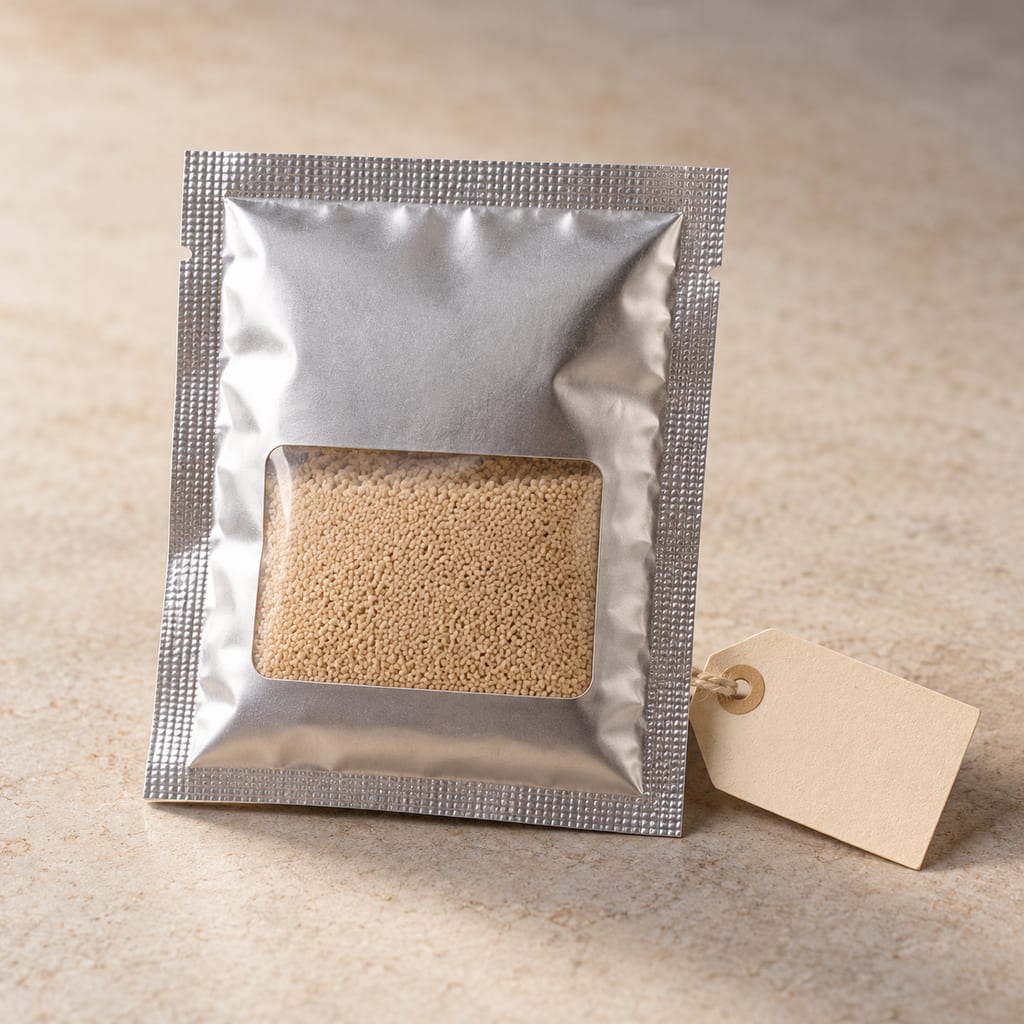
Lager yeast is the bottom-fermenting brewing yeast Saccharomyces pastorianus, a hybrid of S. cerevisiae and S. eubayanus, sold and kept as named strains that are not interchangeable.
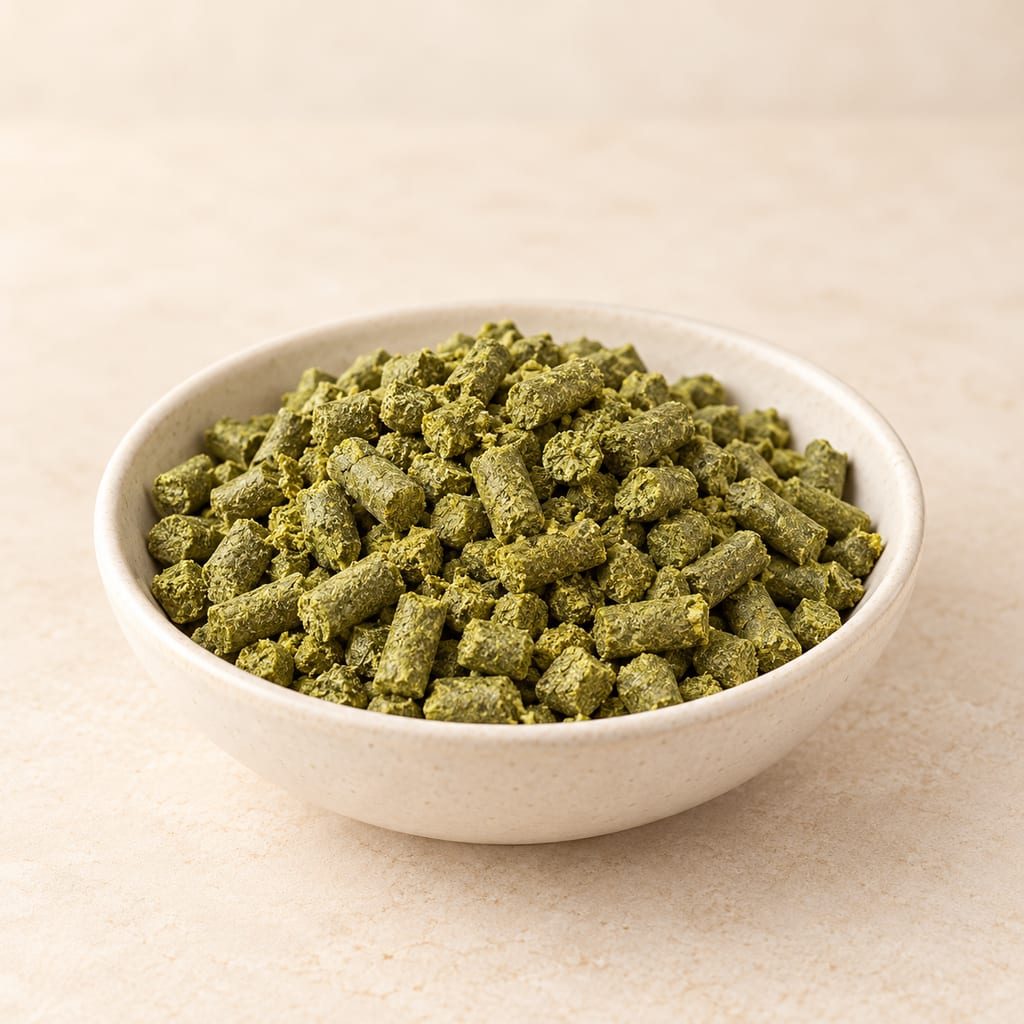
Perle is a German-bred hop cultivar supplied as pellets for beer, with documented spicy aroma and both bittering and aromatic uses. Pellet grade and lot chemistry are unconfirmed.
Saccharomyces pastorianus is the hybrid lager yeast, a cross of the ale yeast S. cerevisiae and the cold-tolerant S. eubayanus, that ferments beer at cool temperatures from the bottom of the tank.
No community contributions have been published for this entry yet.
Sign in to contribute. Published comments and photos are free to read.
Bräu SupplyIngredient identity · Ingredient use · Regional use · Processing
German Pils Recipe, All-GrainThe linked recipe’s exact cultivar name, dose, stated alpha-acid assumption and boil timing as supplied in the verified item snapshot.
Cited in: Mittelfrüh in the German Pils hop schedule
United States Department of Agriculture, Agricultural Research ServiceIngredient identity · Ingredient use · Regional use · Processing
Hallertauer Mittelfrueh (56001)Species-level name, accession 56001, no pedigree known, probable old German landrace, accession maintenance in Oregon, received from Independence Oregon in spring 1956 as rhizomes, historic single-accession chemistry and trade ambiguity.
Cited in: Mittelfrüh names a particular hop
Simon H. Steiner, Hopfen GmbHIngredient identity · Ingredient use · Regional use · Processing
Hallertauer MittelfrühGerman-language land-variety label, grower-facing agronomic descriptors, supplier compositional ranges and explicitly separate alternatives.
Cited in: Herbal and spicy are descriptions, not a fixed flavour formula
BarthHaas GmbHIngredient identity · Ingredient use · Regional use · Processing
Hallertauer MittelfrühCommercial variety account, a different alpha-acid and oil range, current producer terminology and warning that crop year shifts values.
Cited in: A range represents crops, not every bag
USDA-ARS and Oregon State University; paper hosted as a PDF copyIngredient identity · Ingredient use · Regional use · Processing
Development of a Hop with European Aroma CharacteristicsHistorical breeding response to Mittelfrüh’s low yield/disease susceptibility and development of Hallertauer-type aroma selections.
Primary PDF page1 identifies a May 1986 presentation and ASBC 1987 publication. Research report date is presentation, not publication year.
Cited in: Brewer demand and the cost of growing it
Society for Hop ResearchIngredient identity · Ingredient use · Regional use · Processing
GeschichteA critical institutional counterpoint to traditional 736 founding stories.
Cited in: A regional history older than the named cultivar record
Deutsches Hopfenmuseum / German Hops MuseumIngredient identity · Ingredient use · Regional use · Processing
Hirschberger, Hierländer, and Prackenfelser Spät: The Bavarian Hop-Growing Consultant and the Old Hop VarietiesHistorical varietal exchange, old aliases and the evidence base of Wagner’s variety study.
Cited in: Old variety names travelled with the plants
Hopfenland Hallertau Tourismus e.V.Ingredient identity · Ingredient use · Regional use · Processing
Hopfenanbau – eine ErfolgsgeschichteContemporary grower perspective on Hallertau cultivation labor and postharvest stages.
Cited in: The work behind a climbing crop
Bavarian State Research Center for AgricultureIngredient identity · Ingredient use · Regional use · Processing
Aktuelle HopfenbauhinweiseCrop-year and field-specific maturity variability; examples of official seasonal harvest guidance.
Cited in: Maturity follows the garden and the season
Journal of the Institute of BrewingIngredient identity · Ingredient use · Regional use · Processing
The multisensory perception of hop essential oil: a reviewGeneral mechanism and limits of predicting hop aroma from individual compounds; aroma depends on multiple compounds, concentration, thresholds and beer matrix.
Cited in: Brewing changes the aroma carried by the hop
John I. Haas, Inc.Ingredient identity · Ingredient use · Regional use · Processing
Hops Companion: A Brewer’s Guide to Hop Varieties and Hop Products, 4th editionGeneral use of whole cones, pellets and extracts; alpha-acid isomerization and hop chemistry.
Cited in: The cone carries bitter acids and aromatic material