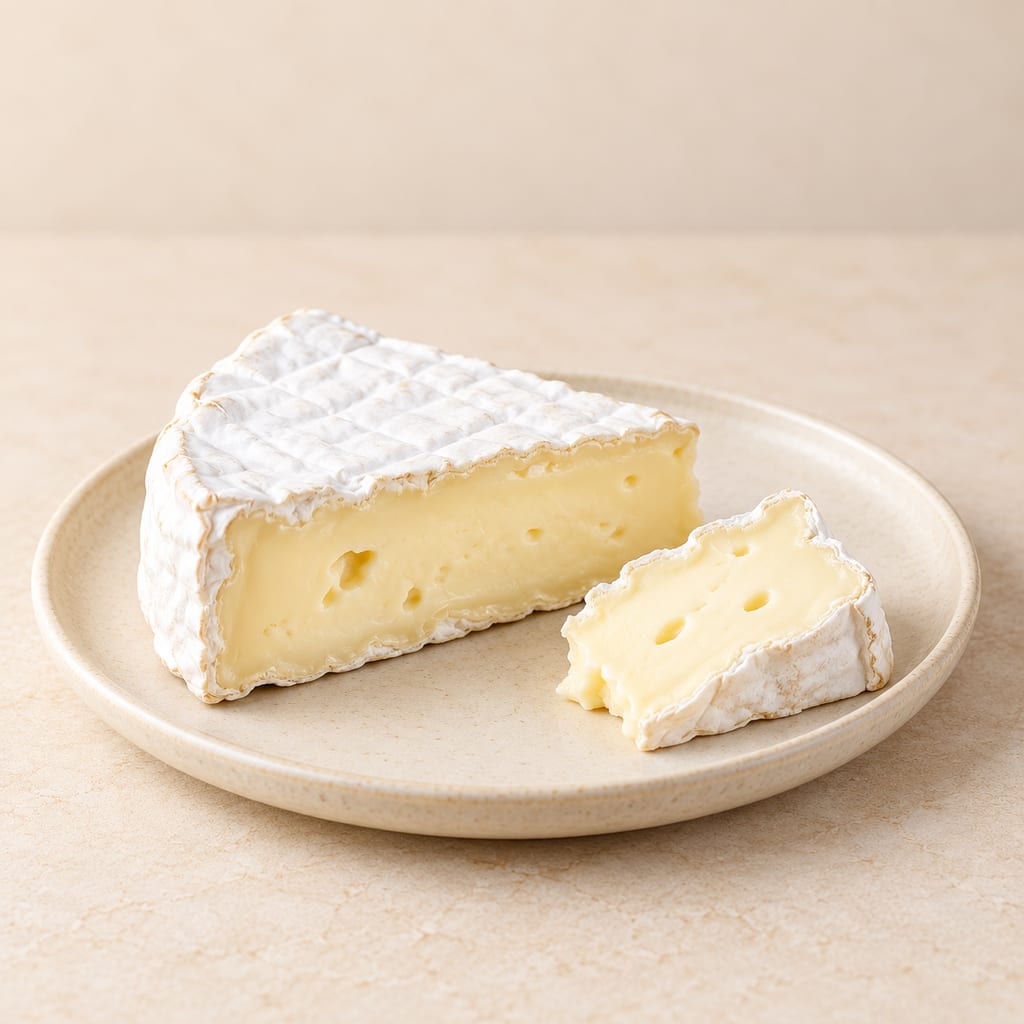
Brie, cream-enriched
A cream-enriched Brie with a white bloomy rind and a softening center, made from pasteurized milk with lactic and surface cultures.
 FermenteaWhere food goes to change
Substrates
A fat-rich liquid separated from milk, used to enrich cheese and sauces, form whipped foams and supply fat for cultured cream and butter.
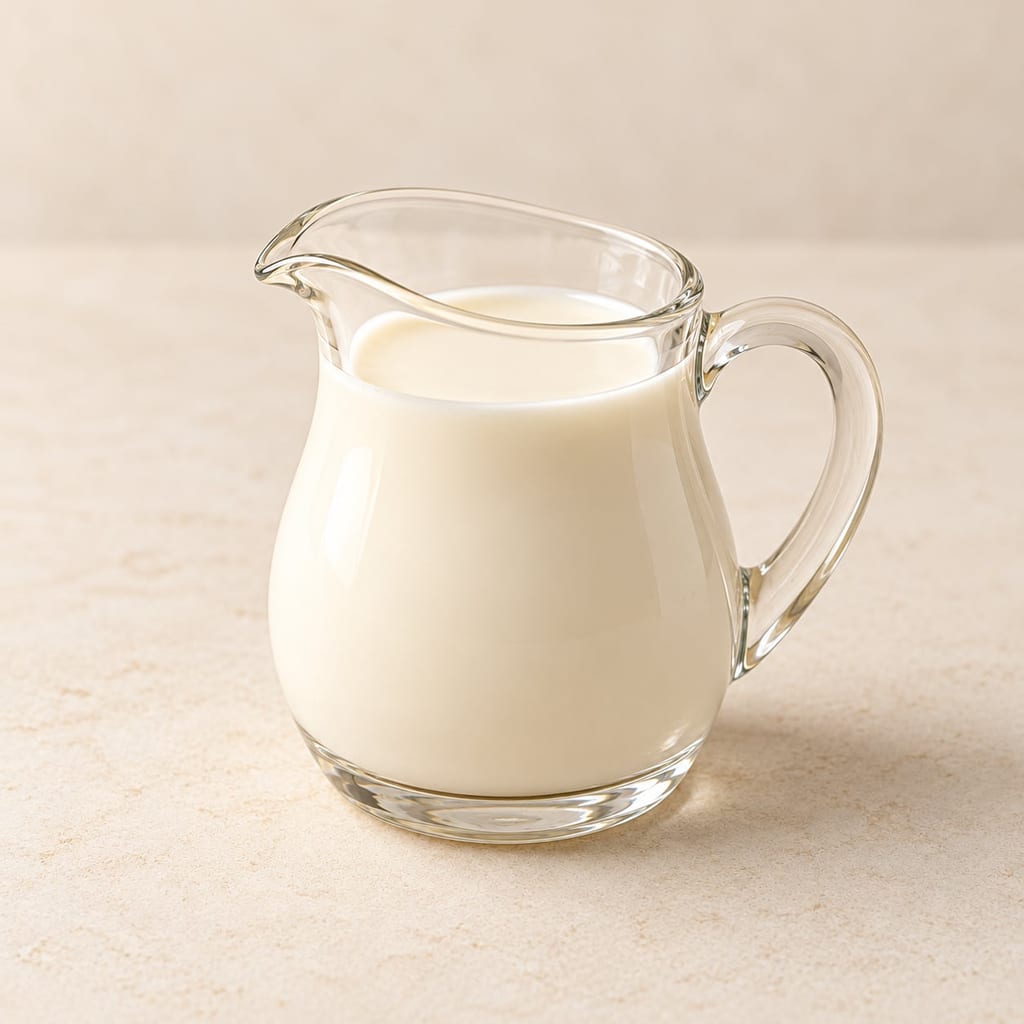
Heavy cream begins with a familiar event: fat collects above the thinner liquid in milk left undisturbed. Skimming that layer gives a cook a richer ingredient without drying or churning it. The cream still pours, carries water and milk proteins, and can be returned to milk to change its richness. Separation turns one food into two useful streams. Cream becomes an ingredient for butter, desserts and enriched cheeses; the remaining skim milk has uses of its own.
The mechanical separator changed the scale and pace of that work. Sweden's Tekniska museet describes the earlier practice of letting cream rise, then the rotating separator patented by Gustaf de Laval and his business partner Oskar Lamm in 1878. Their machine had separate outlets for cream and skimmed milk. They founded AB Separator in 1883, and the museum records its adoption across Swedish farms around the turn of the century. This is a documented Swedish industrial story within the wider history of dairying, rather than a date for the first discovery of cream.
Before controlled dairy processing, cream intended for butter could sour while standing. The University of Guelph's account of butter manufacture describes that nineteenth-century practice, including the uncertainty of uncontrolled microbial growth. Modern cultured butter separates those operations more deliberately: a suitable starter develops acidity and flavour, cooling prepares the fat, and churning changes its physical arrangement. Sweet cream can instead be churned without that culture stage. Cream's history therefore connects the management of milk fat with the management of microbes, even though fresh heavy cream itself has not necessarily been fermented.
Heavy cream is a concentrated milk-fat ingredient. In the United States, the standard of identity requires at least 36 percent milkfat and permits the alternative name heavy whipping cream. The standard allows pasteurization or ultra-pasteurization and permits homogenization. It also permits certain optional ingredients, including stabilizers and emulsifiers. The name consequently describes a fat category, rather than one guaranteed manufacturing sequence or an assurance that the carton contains cream alone. The ingredients and treatment statements complete the description.
Cream names vary between markets. A product sold as whipping cream elsewhere should be compared by its declared fat content, ingredients and intended use rather than translated by name alone. The broader Codex definition describes cream as milk fat dispersed in skimmed milk and obtained by physical separation. It also distinguishes reconstituted and recombined products, prepared whipping cream, fermented cream and acidified cream. These distinctions explain why two white, thick dairy liquids may serve different purposes even when both are casually called cream.
Full-cream milk remains milk with its full-fat character; heavy cream is the separated, much more concentrated fat fraction. Neither should be substituted for the other merely because the words overlap. Likewise, heavy cream is the liquid starting ingredient for whipped cream. Air has already been incorporated into the finished topping, so its apparent volume describes a different structure. Cultured cream has undergone microbial acidification, and butter has undergone a further physical transformation. These are related foods with distinct identities.
A dairy separator accelerates the density-based separation that occurs during standing. Centrifugal processing produces a fat-rich cream stream and a skim-milk stream. Standardization then adjusts composition by blending appropriate streams to reach the intended fat content. This makes cream a controlled formulation ingredient: its richness can be selected rather than left to the thickness of a naturally risen layer. The Canadian Dairy Commission describes separation, standardization and heat treatment as successive parts of cream manufacture.
Pasteurization addresses microbial hazards through controlled heating. Ultra-high-temperature processing applies a different heat treatment, while homogenization is a mechanical operation that changes fat-globule size and distribution. These operations have different purposes. Heating history matters when choosing cream for storage or a cultured product; homogenization matters to physical stability and performance. Neither operation should be inferred from a smooth appearance. A cream that pours uniformly may have acquired that stability through its processing, formulation or both.
Production for whipping also includes attention to cooling and the state of the fat. Tetra Pak's processing account explains that partially crystallized globules are sensitive to rough handling, which can cause clusters before the cream reaches the kitchen. Manufacturers balance stability in the package with the capacity to develop structure during whipping. Unwanted clustering can create a plug of cream or poor whipping performance. The desired product is therefore more specific than a liquid containing a large amount of fat: its prior handling affects what the cook can make from it.
In liquid cream, fat is dispersed as globules through an aqueous phase. Each globule has an interface containing membrane material, including proteins and phospholipids. That interface helps keep separate globules from joining into one mass. The surrounding liquid also carries milk constituents, including proteins and lactose. Cream is consequently different from melted butterfat or oil. Its water and interfacial material participate in the texture and behaviour of the ingredient alongside its fat.
Homogenization divides fat into smaller droplets and creates additional surface area. Proteins can become associated with the new interfaces, changing how droplets interact with the surrounding liquid and with one another. Research examining dairy-lipid organization shows that commercial creams can contain differently processed droplets and that, in cultured cream, small protein-covered droplets can connect with an acid-formed protein network. A smooth spoonful can therefore contain a structure built jointly from fat droplets and proteins, rather than fat simply floating in an otherwise passive liquid.
The intact globule membrane also helps protect fat from lipase, an enzyme that can break down fat and contribute rancid flavours. Rough treatment can disturb that protection. This gives practical meaning to gentle handling and appropriate processing: cream's quality depends partly on preserving or deliberately rebuilding the surfaces around its fat. Churning and whipping intentionally disturb those surfaces for particular results; accidental damage during storage or transport is a different event. The same milk fat can behave differently according to its physical organization.
Whipping incorporates air and builds a supporting structure around bubbles. Tetra Pak describes fat globules collecting at bubble walls, with some released liquid fat helping globules adhere. The balance between liquid and crystallized fat matters to the resulting foam. Cooling the cream prepares that balance; indiscriminate warming while whipping can weaken the result. Increasing volume comes from incorporated air, so a larger bowlful does not indicate that more cream or fat has been created.
Churning carries the transformation further. Guelph's dairy-science account describes butter as a water-in-fat emulsion, whereas cream begins with fat dispersed in an aqueous phase. The continuous phase has changed. Butter grains and the liquid separated during churning are recognizable evidence of this rearrangement. Continuing to beat cream past the desired foam can move toward that butter-making process. A grainy mixture is therefore not simply a stiffer version of a successful whipped topping.
Culturing takes another route. Suitable microorganisms acidify the cream, reducing its pH; proteins participate in the developing structure, sometimes producing a thick or coagulated product. Direct acidification can also lower pH, but it does not establish microbial fermentation. Codex treats fermented and acidified creams separately for precisely that reason. A cream that thickens through deliberate fermentation, one thickened by beating, and one formulated with a stabilizer may look superficially alike while having different flavours, structures and uses.
The linked cream-enriched Brie method uses heavy cream as part of the milk mixture. Jim Wallace's formulation replaces part of the milk volume with cream, then warms milk and cream together before adding the lactic and surface cultures. This puts the extra fat into the cheesemaking mixture before the curd forms. It is a change to the composition of the cheese's starting material, rather than a cream topping applied after ripening.
Lactic cultures convert lactose to lactic acid. Rennet acts on milk proteins to enable the curd network to form; the fat is held within that developing structure. Cream contributes richness, while the cultures, coagulant and drainage determine other parts of the transformation. Adding more cream does not replace the work of acidification or coagulation. It also changes the balance of fat to the protein framework, which is why an enriched formulation should be followed as a formulation rather than adjusted solely by the desired taste of the starting milk.
In this method the curd is transferred to forms and allowed to release whey before salting and surface ripening. The source names Penicillium candidum and Geotrichum candidum among the added cultures. Those organisms belong to the developing rind and ripening process; they are not evidence that fresh heavy cream comes with a dependable cheese-making community. The source's exclusion of ultra-pasteurized milk applies explicitly to its milk ingredient. Its heavy-cream line does not specify a cream heat treatment, and that distinction should be preserved when sourcing the ingredients.
Beyond cheese, cream supplies richness and body to soups, sauces, fillings and frozen desserts. It brings both milk fat and the water-containing dairy phase into a dish. This can be useful when a cook wants the smoothness of cream distributed through a sauce rather than a separate slick of added oil. Its proteins and dispersed droplets contribute to that behaviour, while cooking, acidity and the rest of the formulation determine the finished consistency.
In ice cream, dairy fat contributes to texture and helps support the air-cell structure developed during freezing. Tetra Pak's ice-cream account describes ageing of the mix as a period when fat crystallization and changes at the droplet interface prepare it for subsequent partial aggregation. Cream's role extends beyond adding a flavour associated with dairy: its fat must arrive in a form that can participate in the frozen product's structure. A recipe balances that contribution with water, sugars and non-fat milk solids.
Sweet and savoury uses draw on the same ingredient in different ways. A whipped filling emphasizes aeration; a cultured cream emphasizes acidity and microbial flavour development; an enriched cheese carries the fat into a drained protein network. Choosing cream by the intended transformation is more informative than choosing the thickest-looking product. A package intended for whipping, a sweetened cream, and a cultured cream can each be useful, but their existing ingredients and processing should agree with the recipe.
Read the fat declaration, heat-treatment description and ingredient list together. For a recipe that asks for heavy cream, plain liquid cream with the specified fat category is the clearest starting point. Stabilizers, sweeteners and flavourings may be appropriate in some products, but should be deliberate choices. The linked Brie formulation gives no particular brand, cream source, homogenization state or fat percentage, so those details cannot be recovered from its ingredient name alone.
Keep cream according to its package instructions and maintain refrigeration where required. Heat treatment does not make a repeatedly opened container immune to contamination or spoilage. Use clean utensils and close the package after use. The Canadian Dairy Commission notes that freezing can destabilize cream's emulsion, leaving separated fat after thawing and reducing its suitability for whipping. Preserving the cold chain supports both microbiological quality and the physical performance expected of the ingredient; a universal shelf life would ignore important differences between packages and treatments.
Heavy cream contains milk proteins and remains a milk-allergen ingredient. Pasteurization does not remove the proteins responsible for milk allergy. Fat richness also does not establish that a product is lactose-free: milk's aqueous phase remains present, and any lactose-free claim belongs to the specific product. Controlled culturing is a recipe process, while unexpected sourness in a stored carton is a spoilage concern. Fresh heavy cream, its cultured descendants and the foods made with it should each be handled according to their own preparation and storage requirements.
milk
Linked Brie method specifies heavy cream without supplier, farm, production place or species detail for that cream. Swedish separator history and U.S. identity standard are contextual evidence, not sourcing geography.
A cream-enriched Brie with a white bloomy rind and a softening center, made from pasteurized milk with lactic and surface cultures.
No community contributions have been published for this entry yet.
Sign in to contribute. Published comments and photos are free to read.
Tekniska museetIngredient context
Gustaf de Laval – The milk-cream separatorHistory of cream separation: standing and skimming, separate cream and skim-milk streams, the de Laval–Lamm patent of 1878, AB Separator in 1883 and Swedish farm adoption.
Cited in: From a rising layer to a separate ingredient
University of Guelph Dairy Science and Technology eBookIngredient context
Butter ManufactureButtermaking history and the physical changes from cream to butter: culture, fat crystallization, aggregation into grains and separation of buttermilk.
Cited in: From a rising layer to a separate ingredient; Three ways cream becomes thicker
Electronic Code of Federal RegulationsIngredient context
21 CFR §131.150 Heavy creamU.S. heavy-cream identity: at least 36% milkfat, pasteurized or ultra-pasteurized treatment, optional homogenization and permitted ingredients; heavy whipping cream is an alternative name. This is a U.S. standard.
Cited in: What the word heavy identifies; Buying, keeping and serving
Codex Alimentarius / FAOIngredient context
Codex Standard for Cream and Prepared CreamsCream definitions distinguish physical separation, reconstituted and recombined products, whipping without phase inversion, fermentation and direct acidification.
Cited in: What the word heavy identifies; Three ways cream becomes thicker; Richness in the kitchen
Canadian Dairy CommissionIngredient context
CreamSeparation, fat standardization, heat treatment, homogenization, cream uses and storage. The profile describes refrigeration and the separation that can follow freezing.
Cited in: From a rising layer to a separate ingredient; What the word heavy identifies; Separating and preparing the fat stream; An emulsion with a working surface; Richness in the kitchen; Buying, keeping and serving
Tetra Pak Dairy Processing HandbookIngredient context
Pasteurized and ESL Dairy Products: Production of creamCream production and whipping: fat crystallization, droplet clusters, partial aggregation around air and the effects of cooling and mechanical treatment.
Cited in: Separating and preparing the fat stream; Three ways cream becomes thicker
Christelle Lopez et al.; Dairy Science & TechnologyIngredient context
Organization of lipids in milks, infant milk formulas and various dairy products: role of technological processes and potential impactsMilk-fat emulsion structure, native and processed droplets, microscopy of protein-covered droplets within cultured-cream acid protein networks, and homogenization functionality.
Cited in: An emulsion with a working surface; Three ways cream becomes thicker
FAOIngredient context
Small-Scale Dairy Farming Manual: Milk Composition, Part 1Milk constituents, fat-globule membranes, lipase, casein and whey proteins, illustrated through cow milk.
Cited in: An emulsion with a working surface; Cream in a ripening cheese
New England Cheesemaking Supply Company; Jim WallaceIngredient context
Brie Cheese Making RecipeBrie formulation using cream to replace part of the milk, followed by warming, lactic and surface cultures, rennet, drainage and rind development.
Cited in: Cream in a ripening cheese; Buying, keeping and serving
Tetra Pak Dairy Processing HandbookIngredient context
Ice CreamCream as a source of milkfat in ice cream; ageing, fat crystals, interfaces and partial fat agglomeration help support air cells within the full formulation.
Cited in: Richness in the kitchen
U.S. Food and Drug AdministrationIngredient context
Raw Milk Questions & AnswersPasteurization, refrigeration and remaining spoilage organisms; milk proteins and lactose remain relevant to dairy dietary suitability.
Cited in: Separating and preparing the fat stream; Buying, keeping and serving