Milk, curd and the world's dairy stores
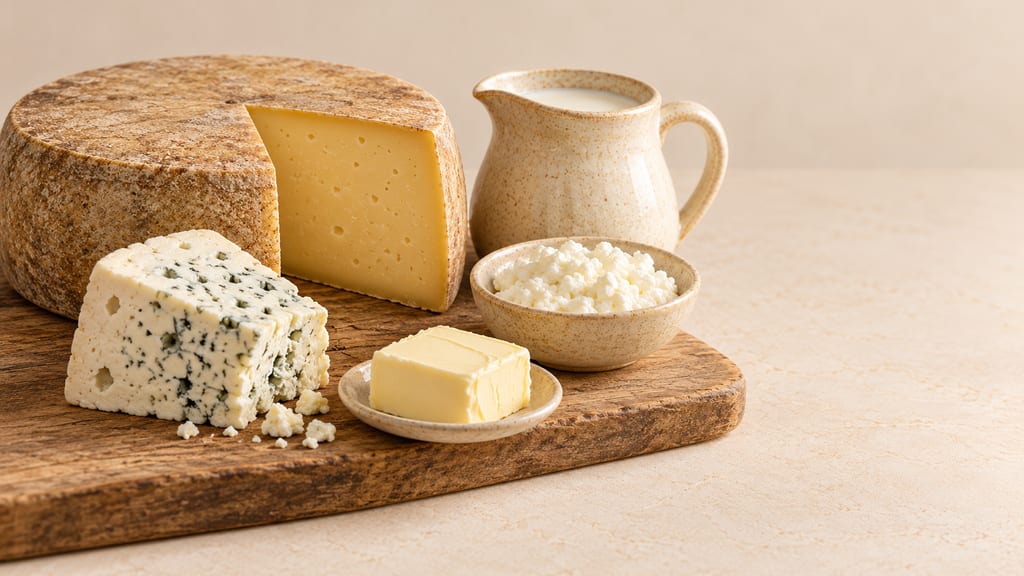
Follow milk into cheese, cultured drinks, butter, dried curds and sweets: a journey through the animals, seasons and household decisions behind the world's dairy foods.
 FermenteaWhere food goes to change
Coagulants
Papaya latex from unripe Carica papaya fruit supplies proteases used to set Enrekang Dangke. Fresh latex, dried latex and standardized papain are distinct preparations with different evidence and handling needs.
Papaya latex is the milky plant secretion that exudes when tissues of Carica papaya L. are injured. The food-enzyme assessment describes latex in secretory laticifers across the plant, with its highest concentration in the peel of unripe fruit; production declines as fruit ripens. An incision can cause the latex to flow. This botanical secretion is the raw material, not a ready-made standardized enzyme.
Papain is one cysteine protease in papaya latex. The EFSA assessment describes commercial food-enzyme preparations that may contain papain and other proteolytic enzymes, including chymopapain, caricain and glycyl endopeptidase. A preparation made from fresh latex, dried crude latex, a purified enzyme, or a standardized commercial concentrate should not be treated as the same ingredient. Processing changes composition, strength and the material that accompanies the enzyme.
The item title retains both common search terms because papain is central to the coagulant story, but the fruit itself is a separate ingredient. The latex is also not interchangeable with every product sold as papain. The record therefore has no bare “papaya” alias: that name refers first to the fruit, which has its own catalogue record.
Dangke is described in the food-science literature as a traditional milk curd of Enrekang, in South Sulawesi, Indonesia. The studies associate papaya latex with the setting of this product. A 2024 article describes milk from cow, buffalo, goat or sheep in its background, while its own experiment uses fresh cow's milk. Its introduction describes Dangke as a side dish made by local farmers, with surplus product sold in traditional markets and beyond Enrekang. That is evidence for a specific regional food practice, not for a universal Indonesian cheese method.
The recorded household process involves heating milk, adding papaya latex or a prepared papain material, separating curd from whey and compacting the curd in a coconut-shell mould. In the 2024 paper the experimental curd was pressed in a coconut shell while whey drained. This explains the relationship between the enzyme and the finished product; it is not a validated household recipe. The study does not make each listed milk species equally supported by its own experiment.
No inspected source supplies a dated origin record for the practice. The designation “traditional” is a source description of Dangke, not a basis for assigning a century, inventor or exact first village. Enrekang is recorded as a documented-use locality and South Sulawesi as the associated region; neither is presented as the botanical origin of papaya.
Papain is a protease: it cuts peptide bonds in proteins. In milk, that activity can destabilize casein structures and contribute to curd formation. The 2020 comparative study examines papain alongside cardoon and fig latex, and reports the difficulty of matching plant coagulants to milk and cheese styles. A plant protease may continue to hydrolyse proteins after initial setting. Broad proteolysis can produce a weak curd or undesirable bitterness when activity, dose, milk composition and process are poorly matched.
This behaviour differs from simply adding acid until milk separates. Enzymatic cleavage, acidification, heating and the minerals and proteins in milk each affect the resulting gel. The Dangke papers describe heat together with the papaya material, so their outcome cannot be attributed to latex alone. Nor can the enzyme's ability to clot one regional fresh curd be taken as proof that it works for every aged, pressed or high-moisture cheese.
A curd that appears to set is a texture observation. It does not demonstrate that a product has reached a safe pH, water activity, microbial reduction or shelf life. Enzyme action is a cheesemaking function; antimicrobial findings from a laboratory assay do not turn the enzyme into a preservation control.
Fresh latex is collected by tapping or making cuts in unripe fruit. The 2024 Dangke research collected latex from ten fresh fruits on the tree, dried it separately in an oven and refrigerated the resulting material before use. The 2014 study used a different laboratory preparation: it vacuum-dried fresh latex at 50–55°C for 22 hours. These are descriptions of research preparations, not a common home standard. Even the two papers' drying conditions differ, and neither supplies a household specification for enzyme activity, microbial quality or storage.
Commercial food-enzyme production is a separate controlled process. The EFSA assessment describes food papain produced from latex obtained from unripe fruit, followed by processing steps that include clarification, filtration, purification, concentration and drying. Manufacturers test the resulting material against specifications. These controls help define the evaluated enzyme preparation; they are not reproduced by collecting latex from an unknown fruit or drying it in a kitchen.
A weight percentage from one experiment is not a transferable dose. A raw-latex mass, a dried-latex mass and a commercial enzyme dose with stated activity have different meanings. The inspected studies do not provide a universal conversion between them. A source that does not specify enzyme activity, milk and heat process, sanitation and finished-product controls cannot support a consistent home method.
The 2024 paper measured physicochemical properties of Dangke made with papaya-derived coagulant and different heating treatments. It identifies Enrekang as the traditional product's area and reports the use of a coconut-shell mould. Its report is internally difficult to translate into a process: the abstract names a preferred treatment at 75°C and a coagulant level of 0.5%, while the methods describe treatment units heated to 50°C before adding papain, followed by listed treatment temperatures from 80°C through 100°C. The abstract and methods therefore do not describe one consistent temperature schedule. Its numerical treatment is not copied here as instructions or a recommendation.
The 2014 study tested dried papaya latex and papain against Staphylococcus aureus in broth and Dangke. It reported an approximately one-log reduction in broth under one stated experimental concentration and observed that dried latex or papain maintained the measured S. aureus count in Dangke over 24 hours at room temperature. Those findings describe a limited laboratory experiment on one organism and short observation period. They do not establish control of other pathogens, a safe room-temperature storage life, or a validated preservation process.
These studies answer different questions. One compares processing conditions and product measurements; the other tests a bacterial response to selected materials. Neither resolves how activity varies among latex batches, how a standardized food-grade enzyme should be dosed for every milk, or which finished-product safety limits apply. The evidence supports describing a culinary coagulant use and its research context, not converting study treatments into a general-purpose formula.
The 2014 paper describes Dangke as commonly held at 27–30°C before consumption in the setting it studied. That is a report of observed practice, not advice that an unrefrigerated product is safe. The study's 24-hour observation of one bacterial species cannot validate the practice for other organisms, kitchens, milk supplies, latex batches or storage periods. This account preserves the distinction between describing a tradition and endorsing a storage condition.
Milk type is another boundary on what the papers establish. The 2024 article discusses several animal milks as Dangke possibilities, but its experiment sampled fresh cow milk from farms in Enrekang. Its measured results therefore do not establish equal coagulation or safety behavior for buffalo, goat and sheep milk. Likewise, the use of papaya-derived protease in a fresh curd does not show that a ripened cheese will retain its intended structure or flavour.
Papain is an allergen. The EFSA assessment of a food enzyme derived from unripe papaya latex notes that papain and chymopapain are known food allergens and concludes that allergic reactions upon dietary exposure cannot be excluded. It also discusses sequence matches with food and respiratory allergens and potential concern for some people with allergies to papaya and other foods. The assessment concerns a specified enzyme and its evaluated manufacturing uses; it is not a claim that every exposure has the same risk or that an enzyme is universally authorised.
Papain is an active protease and can irritate or sensitise people who handle enzyme-containing dust or aerosols. Avoid dry-powder exposure and follow the supplier's food-grade handling information. People with papaya or relevant food allergies should not assume that a latex-derived enzyme is harmless because it is plant-derived. A product may also contain carriers or other ingredients that its enzyme assessment did not evaluate.
The 2014 experiment's short-term bacterial measurements are not food-safety limits. They do not support holding Dangke at room temperature or inferring safety from reduced counts. No pH, time, temperature, water-activity or storage endpoint in the evidence examined here establishes a safe general home process. Use a published, validated process appropriate to the specific milk, enzyme product and cheese; where that process is unavailable, the missing control is unresolved.
The documented Dangke tradition shows that papaya latex can serve in a cooked regional milk-curd process. The research also shows that dried material and standardized papain have been tested. It does not provide a single reproducible preparation for a reader at home: the studies use different raw materials and laboratory treatments, and the 2024 paper contains conflicting treatment temperatures between its abstract and methods.
For those reasons this ingredient account does not give a fresh-fruit tapping guide, a drying procedure, an enzyme dose or a storage schedule. A safe and repeatable method would need a named food-grade preparation with activity information, a validated milk and heat process, hygienic handling and finished-product controls. Those details are not settled by the evidence assembled here. The source-backed use is Dangke; wider use in unrelated cheese styles remains product-specific and should not be inferred from the word “papain.”
The evidence also does not justify a small-scale extraction workflow. Latex yield and enzyme composition depend on the source fruit and handling, and the laboratory drying studies did not establish sanitation, activity after storage or an acceptable finished-food limit. Collecting a milky exudate and seeing milk thicken would not verify the enzyme's identity, strength, microbial quality or the safety of the resulting curd.
For a reader interested in Dangke, the useful distinction is between the recorded food tradition and a validated process. The tradition identifies where this coagulant is used and what product it helps make. A process recommendation would need a food-grade ingredient specification, an internally consistent method, and product-specific safety controls. Those gaps remain open in the inspected papers, so the account treats the home method as unsupported rather than filling it with assumed temperatures, percentages or storage advice.
The EFSA dossier describes a defined enzyme product made from latex harvested from unripe, non-genetically modified papaya fruit. It outlines a controlled sequence of downstream processing, including clarification, centrifugation and filtration, purification, concentration and drying. The product is tested against specifications and produced with food-hygiene and quality systems. The exact details belong to the evaluated manufacturer and preparation; they do not establish that all food papain products share one composition or activity.
An assessment of one commercial enzyme under stated manufacturing uses cannot be carried over to raw latex collected at home, an unlabelled dried preparation or another supplier's enzyme. The assessment's conclusion is bounded by its exposure estimate, product characterization, quality controls and intended uses. It expressly says allergic reactions cannot be excluded. Readers should check the current local rules and product label for the particular food enzyme rather than infer blanket approval from a published assessment.
Standardization matters because the papain enzyme is only one activity among proteases that may accompany it, and the material's action depends on more than its mass. A label that reports enzyme activity is more informative for repeatable processing than a household weight of an unidentified latex or powder, but this page does not set a dose. A dose still has to be paired with the specific milk, heat, acid conditions and the intended curd.
A 2024 Dangke study identifies Enrekang as the traditional product's area and documents papaya latex use; this does not claim that papaya or latex originated here.
The Dangke study places the named dairy tradition in South Sulawesi; no broader Indonesian papaya-latex cheesemaking tradition is inferred.
Follow milk into cheese, cultured drinks, butter, dried curds and sweets: a journey through the animals, seasons and household decisions behind the world's dairy foods.
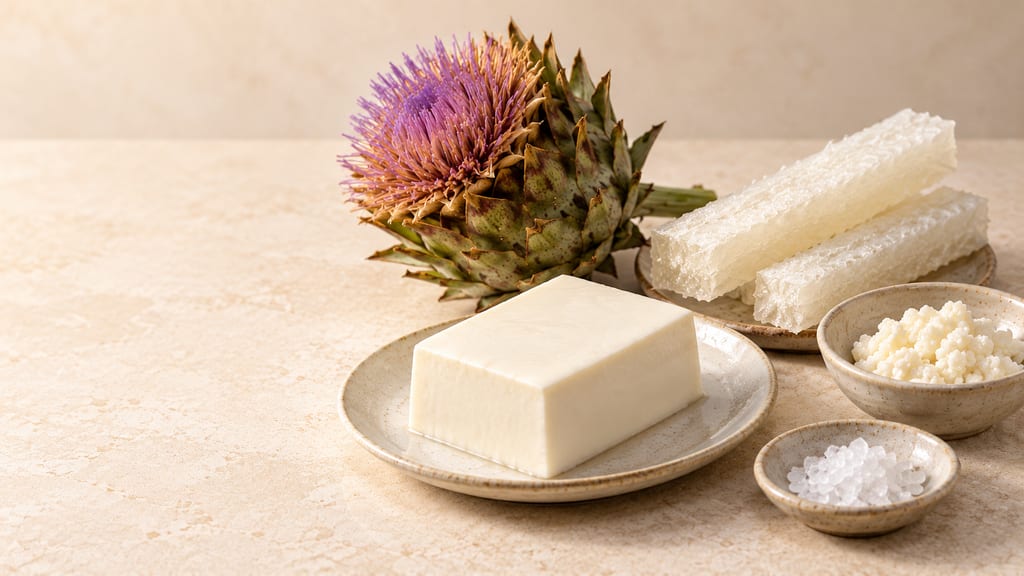
Cheese, tofu, agar, nixtamal and cured ham all begin with a liquid or soft food made to set, sour or keep. Rennet is one branch of that history, beside plant enzymes, acids, minerals, alkalis, gels, finings and curing salts.
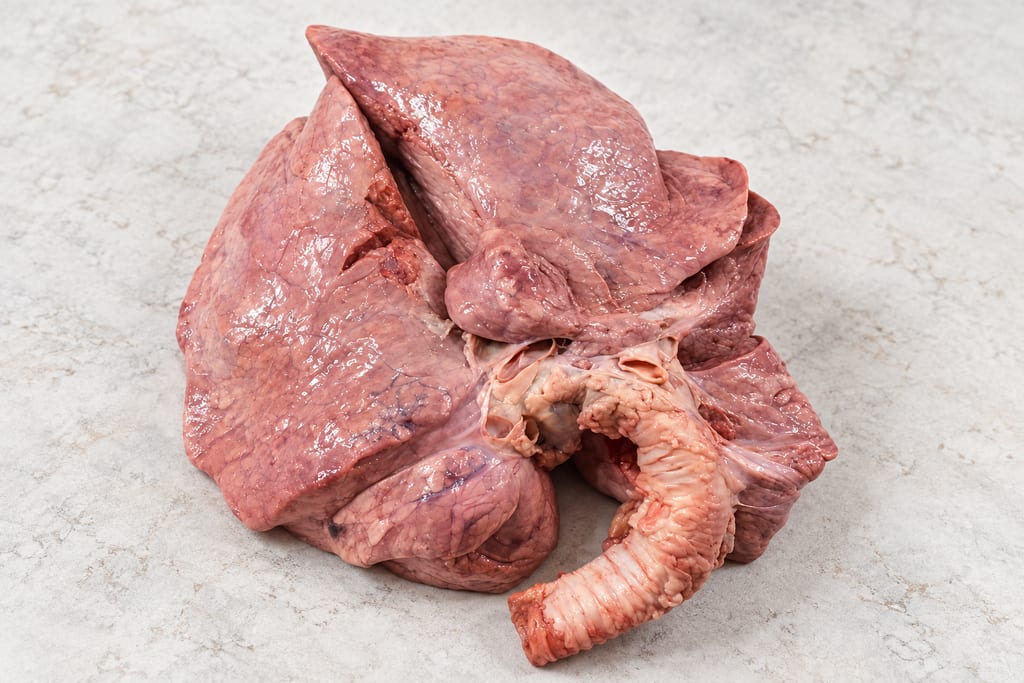
Beef lung is cattle offal used in regional Indonesian dishes and studied as a substrate for a modern fermented-sauce proof of concept. Culinary, regulatory and experimental uses vary; the sources support no universal process.
No community contributions have been published for this entry yet.
Sign in to contribute. Published comments and photos are free to read.
EFSA Journal, via PubMed CentralIdentity · Production · Safety
Safety evaluation of the food enzyme papain from the latex of Carica papaya L.Cited in: Latex, papain and the names between them; Fresh latex, dried latex and manufactured papain; Allergy, handling and food-safety limits; Home preparation and practical scope; Commercial enzyme material is a different product
Indian Journal of Agricultural ResearchUses · Geography · Method · Uncertainty
Physicochemical Properties of Dangke-cheese by Different Temperature Processing and Papaya-latex as CoagulantCited in: A regional dairy use in Enrekang; How the enzyme changes milk; Fresh latex, dried latex and manufactured papain; What the Dangke studies do and do not show; Home preparation and practical scope
Jurnal Teknologi dan Industri PanganProduction · Use · Safety · Uncertainty
Antibacterial Activity of Dried Papaya Latex toward Staphylococcus aureus in DangkeCited in: A regional dairy use in Enrekang; Fresh latex, dried latex and manufactured papain; What the Dangke studies do and do not show; Allergy, handling and food-safety limits; Home preparation and practical scope
Peer-reviewed primary food-science study, via PubMed CentralFunction · Use · Uncertainty
Comparing cardoon, fig latex and papain for milk coagulationCited in: How the enzyme changes milk