
Skyr
Skyr is Iceland’s thick, tart fresh cheese. This home method cultures skim milk with fresh skyr and rennet, then drains the curd under refrigeration.
 FermenteaWhere food goes to change
Substrates
Milk with most of its fat separated into cream, retaining lactose and proteins used in cultured curds, starter media and other dairy foods.
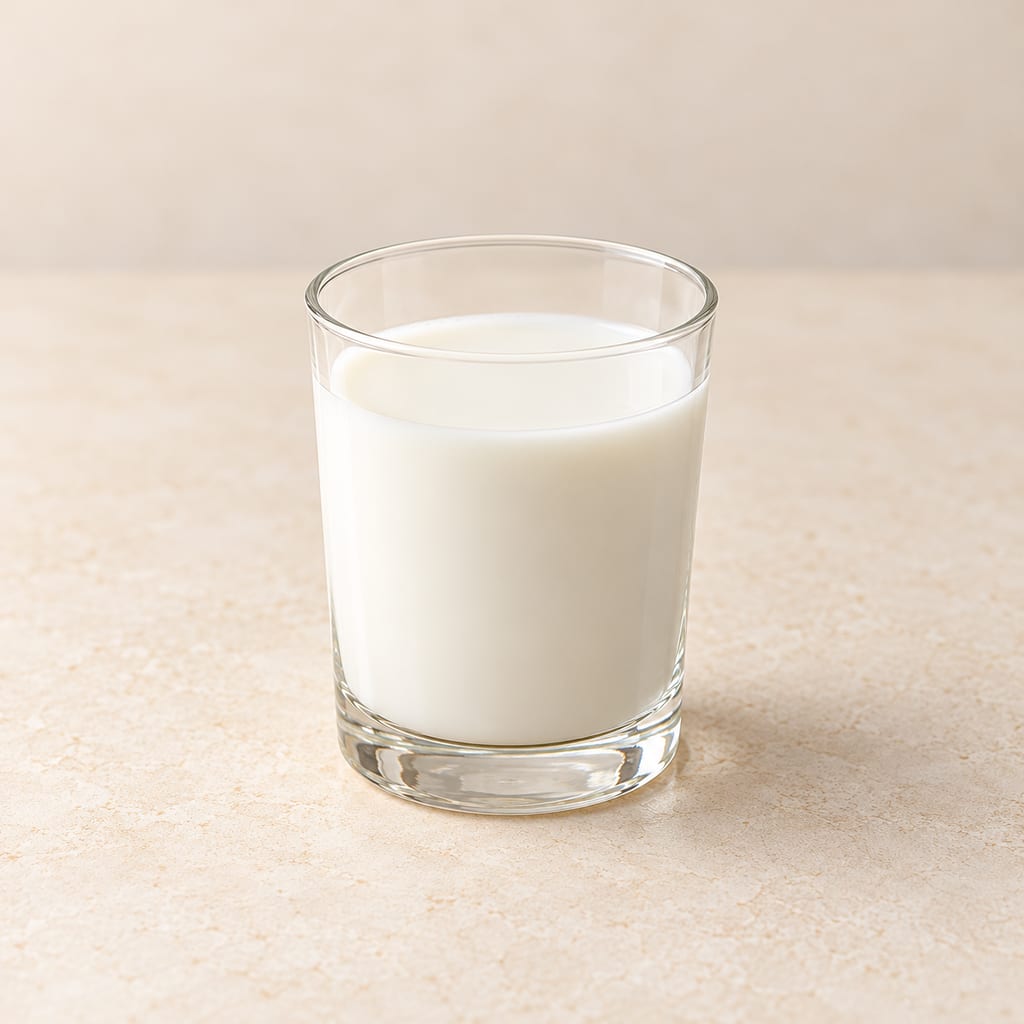
Skim milk is the liquid left when most of milk's fat has been separated into cream. Its apparently modest place beside richer dairy foods hides a useful distinction: removing cream leaves a liquid that still contains milk proteins, lactose and minerals. It can support a starter culture and form a curd. The cream and the skim milk are two useful streams from one supply, each suited to different foods. Skim milk is therefore more than a thinner drink; it is a starting material for cultured and concentrated dairy products.
In household dairying, this separation once began with standing milk and a spoon. A cream-rich layer rose to the surface and could be skimmed away for butter making. The liquid beneath it remained available for other work. The amount of cream recovered depended on the arrangement and handling of the milk, rather than a standardized retail specification. Skimmed milk obtained in this way belongs to the same household economy as the cream, butter and curds made alongside it.
A Canadian farm manual published in 1907 compared shallow pans, deep setting and the hand separator as ways of recovering cream. George H. Barr considered both the recovery of butterfat and the condition of the milk left behind. A separator could recover cream promptly, while the skim milk could be used on the farm. His account places the two fractions in a working dairy rather than treating one as the finished food and the other as a waste product. Labour, equipment and the destination of each fraction shaped the choice of method.
Centrifugal separation made the division faster and more regular. Rotating equipment sends the denser skim milk and the lighter, fat-rich cream into separate streams. Subsequent standardization can combine dairy streams to obtain a chosen composition. Separation, standardization and homogenization describe different operations: the first divides milk into fractions, the second adjusts their proportions, and the third changes the size and surface of fat droplets. A skim-milk label describes the fat-reduced ingredient, without specifying every other treatment it has received.
The economics of separation changed with transport and markets. In New Zealand, farmers supplying cream to factories had much less liquid to transport than farmers carrying the whole milk supply. Skim milk remained on the farm and was often fed to pigs. By 1918, cream supply had become widespread among the country's dairy farms. Later, improved collection and the growth of processing uses changed the value and destination of the remaining milk. Protein became a commercially useful component in its own right, rather than something considered only after the butterfat had been sold.
That history helps explain why skim milk appears in both everyday drinking and specialist dairy manufacture. Removing fat does not mean diluting milk with water. Nor does it remove the ingredients needed for many cultured foods. When buying it for a recipe, distinguish plain liquid skim milk from a flavoured drink, a concentrated dairy ingredient or a powder. The fat description alone does not identify an added starter, a rennet enzyme or a lactose-reduction treatment. Those are separate features that need their own description.
Liquid skim milk and skim milk powder also require different preparation. Powder is made by removing water from pasteurized skim milk. Reconstitution adds water back to the powder; recombination adds both water and fat to produce a different dairy mixture. These operations are useful in manufacturing, but the dry powder and the liquid are not interchangeable measures in a recipe. Adding powder to an existing quantity of milk increases its milk solids, while making up powder with water produces a liquid ingredient. The two choices change the starting mixture in different ways.
Spray drying is a common route to powder. Instant varieties have been agglomerated into larger particles that disperse more readily in water. Processing heat also changes the behaviour of the proteins, so manufacturers distinguish powders by their heat treatment and functional properties. A powder intended for a bakery formulation is not selected solely because its package says skim milk. For a liquid-milk recipe, follow the specified ingredient and preparation rather than assuming that any dry dairy powder will behave in the same way.
Skim milk supplies both a food source for appropriate dairy cultures and the proteins from which a curd can develop. Lactic acid bacteria metabolize lactose and produce lactic acid. As acidity rises, casein proteins lose the conditions that kept them dispersed and begin forming a connected gel. The sour flavour and the thickening arise together during acidification, but they describe different results: one is a change in taste, the other a change in the organization of milk proteins and water.
The protein network holds liquid within its structure. Some milk components remain dissolved in that liquid rather than becoming part of the curd itself. When a fermented gel is strained, whey carries away water and soluble components, leaving a more concentrated curd. This explains how a milk with little fat can become a substantial spoonable food. Its body comes from protein concentration and the water held in the gel, rather than requiring the starting liquid to contain a large proportion of cream.
Rennet provides another way of changing the behaviour of casein. Its enzyme action differs from the effect of acid, even when a dairy process uses both. A culture acidifies the milk; rennet assists coagulation through its action on the protein system. Draining then separates liquid from the resulting curd. These stages have distinct jobs. Using skim milk does not itself identify whether a finished food was acid-set, rennet-assisted, strained, or made with some combination of those operations.
Heating before fermentation can contribute to texture as well as performing its specified processing role. Whey proteins are normally soluble, but sufficiently strong heating unfolds them and allows associations with casein. In cultured-milk manufacture, these associations can make the gel hold water more firmly and reduce whey separation. This is one reason two milks with a similar fat description can produce different textures after different processing histories. The recipe's heating stage and its later incubation stage should be understood as separate parts of the transformation.
A recipe for skyr from Hjemmeriet begins with skim milk and uses fresh skyr together with rennet. The fresh skyr provides the culture inoculum, while the milk supplies the material that becomes the new batch. The process heats and cools the milk, cultures it and drains the resulting curd. Each stage contributes to the final food: the milk is prepared, the starter develops acidity, the protein structure forms, and removal of whey concentrates it. The recipe's particular measurements and conditions belong to its own method.
Skim milk also has a role behind the scenes in starter manufacture. Dairy teaching describes it as a medium in which cultures can be propagated before they are added to the final product. A prepared culture medium is heated, cooled, inoculated, incubated and cooled again for its intended use. The milk provides an environment containing lactose and other nutrients; the starter supplies the microorganisms. Plain skim milk is consequently a substrate, not a starter culture simply because it can be used to grow one.
Adding skim milk powder can increase the protein and other non-fat solids in a cultured dairy mixture. More solids can alter viscosity and the strength of the resulting gel. This is different from adding cream, which changes the fat-rich part of the mixture, and different again from straining a finished gel to remove whey. These routes can all affect body, but they do so through different changes in composition or structure. Their results depend on the whole formulation and process rather than the ingredient name alone.
Skim milk remains a milk ingredient and contains milk proteins. Separating cream does not remove the milk-allergen identity of the remaining liquid. Milk allergy concerns an immune reaction to proteins; lactose intolerance concerns difficulty digesting milk sugar. Skim milk can still contain lactose, so a low-fat description does not mean lactose-free. A product specially treated to reduce lactose should be identified through its own label rather than inferred from its appearance or fat description.
For liquid milk, select the heat treatment and storage format required by the recipe, and follow the product's refrigeration and opening instructions. Pasteurization and subsequent handling are separate matters: heat treatment acts on microorganisms in the milk, while later contamination can occur during filling, storage or use. A container opened for a dairy batch should be handled as the liquid product it is. Removing fat does not create the dry storage conditions that preserve a milk powder.
Dry skim milk powder needs protection from moisture. Its low water content is central to the usefulness of the dry form, and contact with water during storage changes that condition. Keep it in the manufacturer's recommended cool, dry conditions, with its package protected and its date instructions observed. Caking and poor powder flow can develop when moisture and storage conditions change. A powder is selected and stored as a dry ingredient until it is deliberately mixed into a liquid formulation.
Reconstituting powder restores a liquid environment; it does not carry the dry product's storage conditions into the prepared milk. Follow the powder manufacturer's directions for preparation and subsequent storage, as well as the requirements of the recipe using it. This distinction matters when powder is kept in a cupboard but the cultured food will be made from a prepared liquid. There is no single shelf life that can be assigned to every liquid, powder, opened package and fermented product under the name skim milk.
Skim milk's place in Icelandic skyr connects the ingredient to a wider dairy economy. Cream could be reserved for butter while the remaining milk became a cultured curd. The products used different parts of the same milk supply, allowing richness to be added at the table rather than necessarily remaining in the milk throughout production. Studies of Icelandic food history describe skyr eaten with milk or cream and, in some settings, berries. The comparatively lean curd and its richer accompaniment therefore belong to a meal as well as to a manufacturing process.
That relationship also prevents a misleading reading of the finished bowl. Cream served with skyr does not establish that the original curd was made from cream-rich milk. Likewise, a smooth strained product does not reveal its starting fat content by appearance alone. In the linked skyr preparation, the named skim milk is the batch ingredient, fresh skyr is the inoculum and rennet has its own role. The optional foods eaten alongside a finished portion are a separate culinary choice.
The non-fat milk components have uses beyond cultured curds. In powder form, they contribute dairy flavour and functional solids to breads, cakes, dry mixes, sauces and desserts. Milk proteins can help bind water and stabilize interfaces in a formulated food. Lactose and amino compounds contribute to browning reactions during heating. These effects explain why a manufacturer may value the skim fraction even when a recipe obtains its fat from another ingredient. Its contribution extends beyond supplying a white liquid or replacing the volume of whole milk.
Liquid, dried, reconstituted and cultured skim-milk foods thus belong to related but distinct stages of dairy work. Separation creates the ingredient; drying changes its storage and transport form; reconstitution restores liquid; fermentation changes acidity and protein structure; and drainage concentrates a curd. Reading those stages separately makes the ingredient easier to choose and the recipe easier to understand. Skim milk's usefulness comes from the components retained after cream is removed and from the different ways those components can be organized into food.
milk
1907 farm dairy publication; not first origin or current milk manufacturing place.
Documented cream separation, farm use of skim milk and changing processing economy.
Skim milk used for skyr while cream was available for butter; not a claim that all skim milk originates in Iceland.
The linked skyr recipe does not identify the producer or manufacturing location of its skim milk.
Skyr is Iceland’s thick, tart fresh cheese. This home method cultures skim milk with fresh skyr and rennet, then drains the curd under refrigeration.

A living dairy inoculum that starts controlled cream fermentation, developing acidity and aroma before sour cream or cultured butter is finished.
The fat-rich fraction of milk, used as a pouring ingredient, a whipped foam, a cultured dairy substrate or the starting material for butter.
Heat-treated dairy cream whose fat globules have not been mechanically homogenized, retaining a form used for churning cultured and sweet-cream butter.
No community contributions have been published for this entry yet.
Sign in to contribute. Published comments and photos are free to read.
Tetra PakResearch
Centrifugal separators and milk standardizationGravity creaming and centrifugal separation divide milk by fat distribution and density. Dissolved lactose remains in the skim fraction; standardization adjusts the final milk-fat content.
Cited in: The milk left after the cream
Canada Department of AgricultureResearch
Buttermaking on the FarmA May 1907 dairy manual compares shallow pans, deep setting and hand separators, discussing cream recovery and skim milk’s condition and use on farms.
Cited in: The milk left after the cream
Te Ara — The Encyclopedia of New ZealandResearch
Dairying and dairy products: Separators and milking machinesNew Zealand dairy history connects farm cream supply and transport with skim milk fed to pigs and later recognition of its protein value. Farm cream supply was widespread by 1918.
Cited in: The milk left after the cream
Canadian Dairy CommissionResearch
Skim Milk PowderLiquid skim milk and skim milk powder are different physical forms. Reconstitution adds water to powder; recombination also involves milk-fat components. Agglomeration produces instant powder particles for easier wetting.
Cited in: Liquid milk, powder and reconstitution; A medium for cultures and a source of milk solids; Milk allergens and two storage forms; Beyond the cultured curd
AgroscopeResearch
Concentrates and Dried Products with Milk ComponentsDrying removes water from milk. Spray and drum processes apply different heat stresses; protein functionality, lactose, moisture and particle behaviour influence powder handling and Maillard browning.
Cited in: Liquid milk, powder and reconstitution; A medium for cultures and a source of milk solids; Milk allergens and two storage forms; Beyond the cultured curd
American Dairy Products InstituteResearch
Skim Milk Powder Standard v3.0The ADPI Skim Milk Powder Standard effective 7 July 2023 describes powder identity, applications and dry storage and date rotation. It is an industry standard, rather than a specification identifying a particular supplier’s lot.
Cited in: Liquid milk, powder and reconstitution; Milk allergens and two storage forms; Beyond the cultured curd
Microbiology SpectrumResearch
The Basics of CheesemakingMilk contains lactose and proteins. Cultures produce acid from lactose; acid and rennet affect coagulation, after which curd and whey can be separated.
Cited in: Acid, rennet and the protein network; Beyond the cultured curd
University of Wisconsin–Madison Center for Dairy ResearchResearch
Yogurt Monograph Series: ProductionAcidification forms a milk-protein gel. Heating before fermentation changes whey-protein interactions, while straining removes whey and concentrates the retained gel.
Cited in: Acid, rennet and the protein network; Heating, culturing and draining
Tetra PakResearch
Cultures and starter manufactureSkim milk can serve as a propagation medium, supplying lactose and milk nitrogen. Starter manufacture includes preparation, heating, cooling, inoculation, incubation and final cooling; the medium is distinct from the inoculum.
Cited in: A medium for cultures and a source of milk solids
HjemmerietResearch
SkyrThe linked skyr method uses skim milk with fresh skyr inoculum and rennet, followed by heating, cooling, culturing and draining stages.
Cited in: Heating, culturing and draining; Skim milk in Icelandic dairy meals
Journal of American FolkloreResearch
Stirring Up Skyr: From Live Cultures to Cultural HeritageIcelandic skyr traditions connect skim milk use with butter making and include serving skyr with milk or cream and berries.
Cited in: Skim milk in Icelandic dairy meals
U.S. Food and Drug AdministrationResearch
Food Allergies: What You Need to KnowMilk proteins retain their allergen relevance in skim milk; reducing fat does not remove the milk ingredient.
Cited in: Milk allergens and two storage forms
National Institute of Diabetes and Digestive and Kidney DiseasesResearch
Definition & Facts for Lactose IntoleranceLactose digestion and immune-mediated milk allergy are different. Removing milk fat does not establish lactose-free status.
Cited in: Milk allergens and two storage forms
BC Centre for Disease ControlResearch
Dairy SafetyPasteurization and later contamination are separate parts of dairy handling. Liquid milk requires storage and handling appropriate to the product.
Cited in: Milk allergens and two storage forms