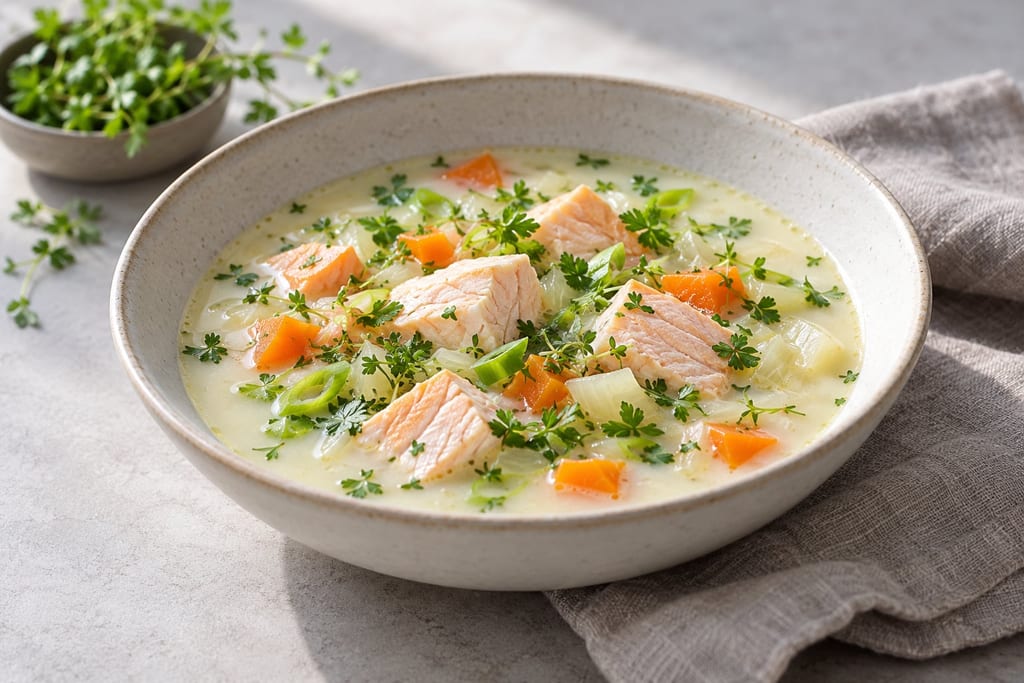
Fish and onion soup (modern reconstruction)
Trout or salmon poached at the end of a simmered broth of onion and root vegetables, a present-day reconstruction of coastal cooking built on excavated fish bones and a boiling pot.
 FermenteaWhere food goes to change
Trout names several salmonid food fish, not one globally uniform ingredient. Inuit accounts from Nunavut and Norway’s Valdres rakfisk document distinct fermented preparations; neither establishes a universal process or safe limits.
Trout is a familiar market and food name, but a source that says only “trout” does not identify a species, population, habitat or production system. Rainbow trout is one well-described species, Oncorhynchus mykiss. It has both freshwater-resident populations and anadromous steelhead life histories. Those names can therefore refer to different stages and settings within the same species. A page about trout should preserve the specificity each source provides instead of turning every record into rainbow trout or assuming every trout shares the same culinary or biological traits.
The atlas row that prompted this entry names fermented Arctic char and trout in Inuit communities in Nunavut, but assigns no universal local name or species-level identification. That broad phrasing is a limit of the evidence, not permission to choose a fish species. Arctic char, Salvelinus alpinus, is named separately in the research literature alongside trout; it is not interchangeable with rainbow trout, even where sources group them as comparable cold-water foods.
FAO identifies rainbow trout as Oncorhynchus mykiss and describes its native range in Pacific-draining waters of North America, from Alaska to Mexico. The species was introduced to waters on other continents beginning in the late nineteenth century for fishing and aquaculture. Farmed stocks and regional strains now shape much of the trout sold in markets, so “trout” on a menu or package may be a farmed rainbow trout, a wild-caught fish, or another species. The label alone does not establish its origin.
Steelhead is the sea-going, anadromous life history of rainbow trout: those fish grow in the ocean and return to rivers to spawn. Many other rainbow trout remain in streams or lakes. This ecological variation affects where the fish is harvested and how it is raised, but does not by itself establish a fermentation tradition. Nor should the description of rainbow trout stand in for the unnamed trout in Nunavut research or the trout specified for Valdres rakfisk.
A 2022 open-access perspective by researchers and collaborators with ties to Nunavut and Inuit-led research describes fermented trout and Arctic char among homemade animal-source foods prepared by Inuit communities in Nunavut, Canada. The authors explain that published cultural, nutritional and microbiological accounts remain limited. This entry therefore treats the finding as evidence that Inuit fermented trout exists in a specific northern context; it does not supply a common Inuit name or claim one process shared across communities.
Microbial characterization of the study’s trout and Arctic char samples found enrichment in Pseudomonas and Photobacterium compared with the mammal ferments examined. That finding describes those samples and methods; it is not a diagnostic test for all trout fermentations, a recommended culture, or evidence that a food is safe. The same article calls for more research and careful collaboration that acknowledges Inuit knowledge, food sovereignty and the social and geographic settings in which foods are made.
In Norway, Valdres presents rakfisk fra Valdres as a semi-fermented trout with a documented regional identity. Visit Valdres says the area is a primary production centre, and traces rakfisk production there to the 1600s. It also describes rakfisk, more broadly, as a preservation method from the inner mountain valleys of southern Norway. The source’s historical statement belongs to this regional product and tradition; it does not date trout eating or fermenting across the world.
The Valdres account identifies its product’s trout as fish spawned and farmed in the lakes and rivers of the region, processed by local producers and protected by a Norwegian geographical indication. It distinguishes mild, matured and well-matured versions. The named regional product should not be collapsed into Inuit fermented trout merely because both involve trout and maturation: their places, knowledge systems, terms, foodways and documentation are different.
Rakfisk has a specific place at the Valdres table. The regional account lists potato lefse, flatbread or boiled potatoes, red onion, sour cream and butter as common accompaniments, and says it may also be served as sushi. This describes ways the prepared product is eaten, not instructions for making it. The fish’s firm, buttery texture and characteristic aroma are part of the source’s description of rakfisk, not universal traits of raw trout or every fermented fish.
Fresh trout is also sold and eaten in many settings, but recipes often omit species or capture context. Farmed rainbow trout, local river trout and fish prepared as rakfisk are not automatically equivalent products. A source-backed ingredient record should preserve named species, regions and forms when available, and leave them unspecified when a source does not. It should also separate culinary accompaniments from the fish itself so that a serving tradition is not mistaken for a preservation method.
FAO describes rainbow trout as adaptable to several habitats and says its aquaculture expanded in the twentieth century, alongside the development of manufactured feed and local cultured strains. The species is now farmed in parts of Europe, North and South America, Asia and elsewhere. This widespread production changes how trout reaches kitchens: a market fish may be raised in a managed system, while other trout are harvested from freshwater or coastal environments. Source-specific country and species information matters more than the generic product name.
Valdres’s account is explicit about farmed fish from the region’s lakes and rivers for its protected rakfisk. The Nunavut perspective, by contrast, documents Inuit fermented animal foods and presents no detailed source-level species or supply chain for each trout sample. Keeping these descriptions separate prevents aquaculture facts from being transferred to a traditional preparation without evidence and avoids using a Norwegian commercial specification to explain a northern Indigenous practice.
The Nunavut study used DNA-based microbial characterization to compare animal-source ferments. It found differences between the fish samples and mammal meats, as well as variation among substrates. Such work can help researchers describe microbial communities and ask new questions about food and human microbiomes. It cannot, on its own, verify the viability of detected organisms, describe every preparation in a region, or convert a reported microbial pattern into a safety control.
The article explicitly notes the limited research base and emphasizes that foods are made in natural environments with substantial variation. Its findings should be read alongside, not in place of, community knowledge and food-specific research. A list of bacterial genera is not a starter culture recommendation. It does not establish that a home ferment should contain or exclude any organism, and it cannot replace validated process guidance.
Freshwater fish, including trout, may carry larvae of freshwater tapeworms in the genus Diphyllobothrium, according to the BC Centre for Disease Control. The public-health sheet explains that live parasites can cause human illness and that parasites can be difficult to detect within thick fillets. It discusses parasite controls for fish, but it does not evaluate any particular trout ferment or establish that fermentation removes parasite hazards.
A historical account, a regional product description or an attractive aroma cannot be used as proof of safety. The sources reviewed here do not establish a universal safe salt level, pH, temperature, fermentation duration or storage life for trout. Valdres’s product description is not a home process standard, and microbiome results from Nunavut are not safety tests. Readers need current, authoritative guidance specific to the fish, handling method and preserved product; no smell, taste, bubbling or home measurement should be treated as evidence that a ferment is safe.
The item has two well-supported regional associations: Inuit communities in Nunavut for documented fermented trout and Arctic char, and Valdres in Norway for rakfisk made from regional trout. Each link describes a distinct food context. The research perspective does not provide one locality for all Inuit preparations; the geographic record therefore stays at the territory-level region reported by the source. Valdres is likewise recorded as a region rather than assigned an unsupported town of origin.
Neither association is presented as the birthplace of trout as an ingredient. The evidence instead shows how a broad fish name enters different local foodways, from regional maturation in Norway to a northern Inuit research context. A single ingredient page can introduce those records while retaining their differences and uncertainty. It cannot replace community-led documentation or fill gaps in local names and species information by inference.
The source record uses the plain English word “trout” without a species identification or a universal local name. This is common in regional food writing: everyday ingredient names may be useful to readers but less precise than a scientific name or a community-specific term. This page keeps the atlas wording and uses rainbow trout only when a source explicitly identifies Oncorhynchus mykiss. It does not turn the Nunavut account into rainbow trout or assign an Inuit term that the evidence does not give.
Rakfisk is more specific than the word trout. It names a Norwegian regional food, and the Valdres label describes a protected product with local fish and producer criteria. The name therefore carries geography and food history that a generic trout label does not. Conversely, the word “fermented” in a research article does not make every fermented trout the same food as rakfisk. Ingredient, local product name and preservation practice are related details, but each answers a different question.
The word “fermented” covers a broad topic in the sources, and it does not by itself describe the conditions, intended endpoint or controls of a particular preparation. The Nunavut research perspective groups homemade fermented animal-source foods while explaining that cultural descriptions and microbiological work remain limited. It also warns that the preparations vary. A reader should not infer from the category alone whether fish was salted, kept at a specified temperature, or matured for a specific length of time.
Valdres describes rakfisk as semi-fermented and gives regional product categories of mild, matured and well-matured. Those labels refer to the local product’s stages and consumer preference; the tourism account is not a home manufacturing protocol. The atlas likewise records fermented Inuit trout without a recipe. Since no one inspected source here establishes universal trout controls, this ingredient page records the documented foods and the evidence limits rather than filling a recipe-shaped gap with guessed figures.
FAO describes rainbow trout as an elongated salmonid, with a pink band along the side and dark spots, but notes that coloration changes with habitat, size and reproductive condition. Resident stream fish tend to look darker, while lake residents are described as brighter and more silvery. These traits help explain why the market appearance of a rainbow trout can vary; they are not sufficient evidence that an unlabeled fish is this species or that it came from a particular watershed.
This matters when a food record moves between science, fishing and cooking sources. A study may use a named species or describe a sample simply as trout, while a market listing may give only a common name. The correct interpretation follows the narrowest evidence: use the documented name, keep source-specific species facts attached to that species, and leave unknown identity open. This is especially important when comparing ingredients from distant places or relating a regional fermentation to a commercial farmed product.
A 2022 collaborative research perspective reports Inuit communities in Nunavut prepare fermented trout and Arctic char; it does not supply a universal name, species identification or one shared method.
The regional tourism organization describes rakfisk from trout farmed in Valdres waters and a documented regional production history. This is a specific Norwegian product, not an Inuit preparation.
Trout or salmon poached at the end of a simmered broth of onion and root vegetables, a present-day reconstruction of coastal cooking built on excavated fish bones and a boiling pot.
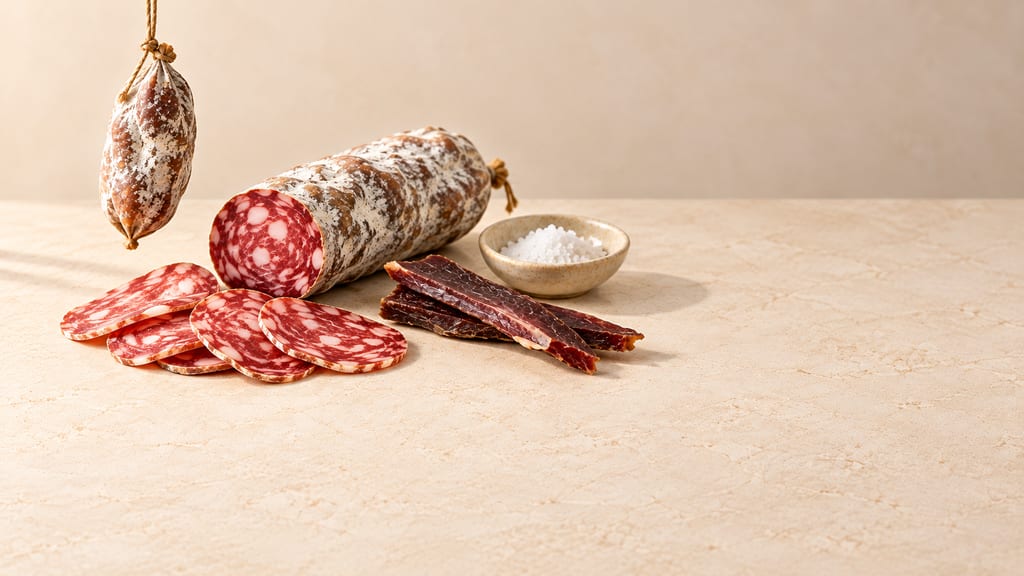
Dry salami, sour pork with rice, matured sheep and aged blubber follow different paths from animal to food. Their stories connect microbes with climate, slaughter, migration and the meals people share.
No community contributions have been published for this entry yet.
Sign in to contribute. Published comments and photos are free to read.
Microbiome Research ReportsHistory · Method · Geography · Microbiology
Better understanding of food and human microbiomes through collaborative research on Inuit fermented foodsA Government of Nunavut-commissioned review and preliminary research describes homemade animal-source ferments prepared by Inuit in Nunavut, including trout and Arctic char.
The authors state that trout and Arctic char fermentations in their samples were enriched in Pseudomonas and Photobacterium relative to mammal ferments; this is a bounded study result, not a universal signature or safety finding.
The authors stress limited research, variable preparations, Inuit knowledge, food sovereignty and culturally grounded collaboration.
Cited in: A name for several food fish; Inuit fermented trout in Nunavut; Rakfisk and a distinct Norwegian tradition; Harvest, farming and changing supply; What microbiology can and cannot tell us; Safety and limits of historical descriptions; Geography and evidence boundaries; Reading names across sources; Maturation does not define a single process
Visit Valdres and Valdres Natur- og KulturparkHistory · Geography · Method · Use
Rakfisk fra ValdresDescribes rakfisk fra Valdres as semi-fermented trout and reports a production history dating to the 1600s in Valdres.
Describes local production from trout farmed in Valdres lakes and rivers, regional protected geographical indication and mild, matured and well-matured product categories.
Records serving with lefse, flatbread or potatoes, red onion, sour cream and butter, and sometimes as sushi.
Cited in: Rakfisk and a distinct Norwegian tradition; Serving and ingredient roles; Harvest, farming and changing supply; Safety and limits of historical descriptions; Geography and evidence boundaries; Reading names across sources; Maturation does not define a single process
Food and Agriculture Organization of the United NationsIdentity · Biology · Production · Geography
Oncorhynchus mykissIdentifies rainbow trout as Oncorhynchus mykiss and describes its native Pacific-drainage North American range from Alaska to Mexico.
Describes steelhead as the anadromous life-history form of rainbow trout, with other populations resident in freshwater.
Reports global introductions and the growth of aquaculture; these details apply to rainbow trout, not all fish called trout.
Cited in: A name for several food fish; Rainbow trout and its range; Serving and ingredient roles; Harvest, farming and changing supply; Appearance is not a complete identity
Committee on the Status of Endangered Wildlife in Canada; Government of CanadaIdentity · Biology · Geography
Rainbow Trout (Oncorhynchus mykiss): COSEWIC assessment and status report 2014Provides species-specific taxonomy, physical description, range, life history and population context for rainbow trout in Canada.
Warns that third-party material, including some pictures, may have separate copyright restrictions; this page is used for text evidence only.
Cited in: A name for several food fish; Rainbow trout and its range; Reading names across sources; Appearance is not a complete identity
BC Centre for Disease ControlSafety
Illness-Causing Fish Parasites (Worms)States that freshwater trout and other fish that spend part of their life in freshwater may carry Diphyllobothrium tapeworm larvae.
Explains that parasitic worms can pose a health concern when live worms are ingested and that not all worms can be detected in thick fillets.
Its control information is directed to specific parasite hazards and fish products; it does not validate trout fermentation.
Cited in: Safety and limits of historical descriptions