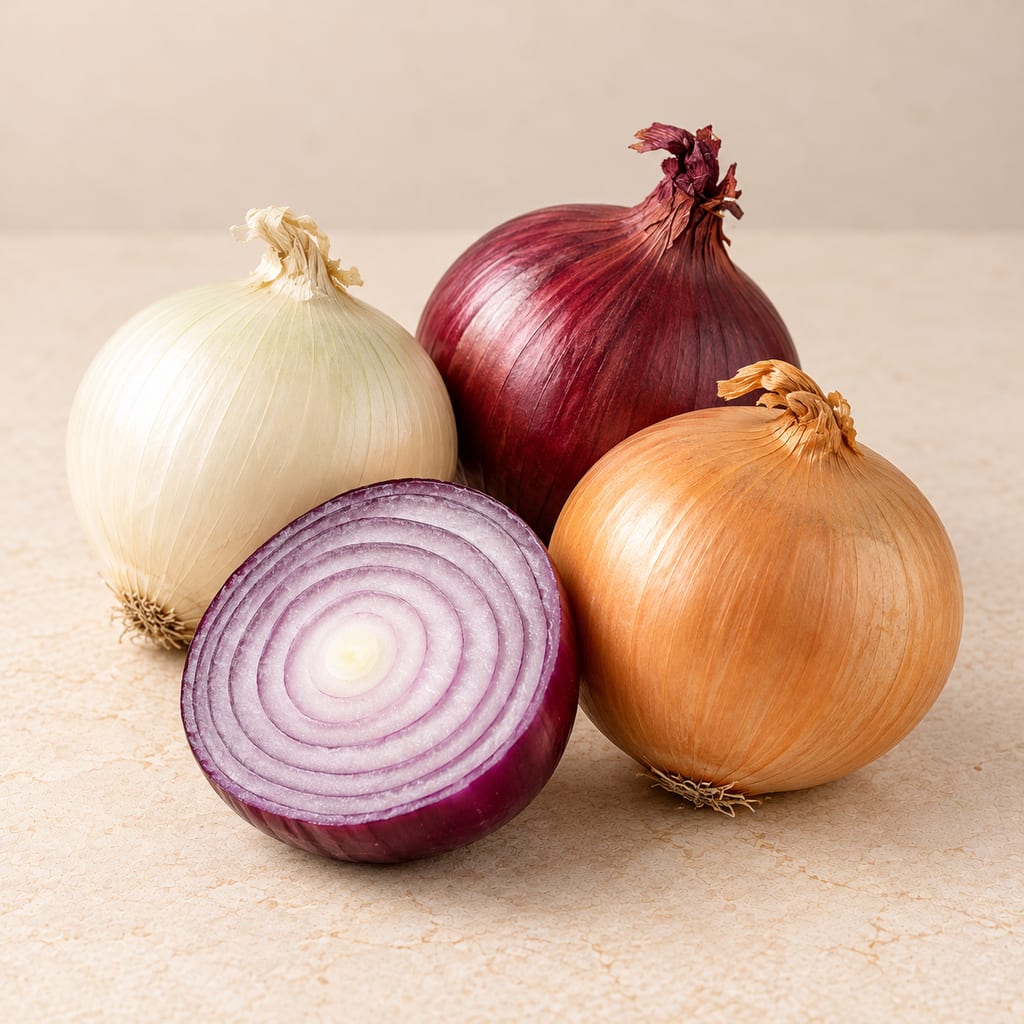
Onion
The onion is the bulb of Allium cepa, built from swollen leaf bases, and is eaten raw, cooked, pickled and as a seasoning in ferments. It is known only from cultivation and probably began in Central Asia.
 FermenteaWhere food goes to change
Modern adaptation
Fiskesuppe · Fiskesuppe · Fisksoppa · Fisksúpa · Viking-inspired fish soup
Trout or salmon poached at the end of a simmered broth of onion and root vegetables, a present-day reconstruction of coastal cooking built on excavated fish bones and a boiling pot.
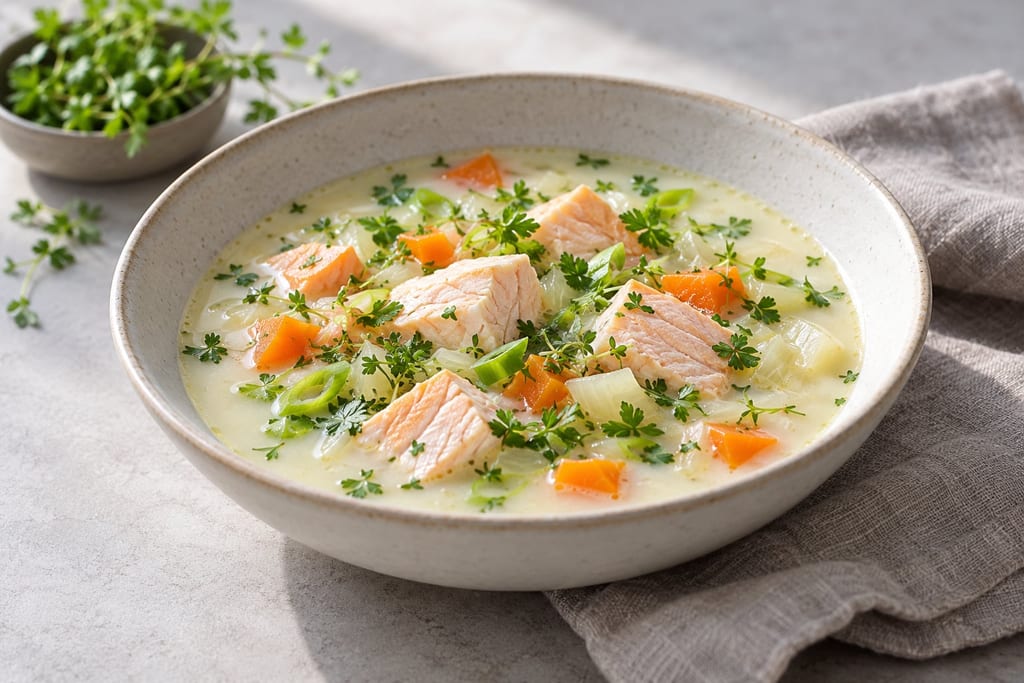
Fish and onion soup is a hot dish made by gently cooking fish in a seasoned liquid with vegetables.
The reconstruction presented here uses trout, salmon or cod, with onion and turnip forming the vegetable base.
It is deliberately straightforward: butter softens the onion, water or stock cooks the vegetables, and fish is added near the end so that its delicate flesh does not disintegrate.
The result differs from modern fish chowder, heavily spiced seafood soup or the creamy salmon soups commonly associated with present-day Nordic food.
Some of those dishes share ingredients and cooking principles, but they are not interchangeable historical traditions.
Fish soup makes a useful Viking Age reconstruction because fishing was a major activity, fish remains survive in archaeological deposits, and boiling vessels were available.
Nevertheless, an archaeologist finding cod bones and an iron pot cannot establish that the fish was cooked in onion soup.
The particular dish remains a modern interpretation of historically possible ingredients and techniques.
Important candidate fish include Atlantic salmon, Salmo salar; brown trout, Salmo trutta; and Atlantic cod, Gadus morhua.
These species have different habitats, flesh compositions and culinary properties.
A soup made from cod will not taste or behave exactly like one made from salmon.
Danish — Fiskesuppe
Norwegian — Fiskesuppe
Swedish — Fisksoppa
Icelandic — Fisksúpa
Old Norse — Súpa — soup
Scandinavian populations exploited rivers, lakes, coastlines and the open sea for food.
Fishing techniques included nets, hooks and other equipment suited to particular environments.
Archaeological assemblages reveal which fish species were used at different settlements.
Ribe, in southwest Denmark, is especially informative because it developed near the Wadden Sea.
Fish bones excavated in the area include plaice, flounder, dab, cod, salmon, trout and thin-lipped grey mullet.
These species point towards multiple fishing habitats.
Flatfish are associated with marine and coastal environments. Salmon may move between the sea and freshwater rivers. Cod is principally a marine fish.
The wider range of species demonstrates that Viking Age fish consumption cannot be represented by cod alone.
At Hedeby, another important trading centre, evidence encompasses many fish species.
Coastal access shaped food supplies, but exchange could bring fish beyond the place where it was caught.
Dried fish was particularly suitable for transport. Fresh fish required much more rapid preparation or consumption.
Fish bones can survive as vertebrae, cranial fragments and other skeletal material.
Their size and shape may allow identification to species or broader taxonomic groups.
The distribution of bones within a settlement may indicate where fish were prepared or discarded.
However, the absence of certain bones is not necessarily evidence that a fish was never eaten.
Cleaning, waste disposal, preservation conditions and archaeological recovery techniques affect what survives.
Small bones may be overlooked if deposits are not carefully sieved.
Fish could be eaten fresh, dried, salted or otherwise processed.
The pattern of surviving skeletal elements can sometimes help distinguish processing or trade, but an individual bone rarely proves a complete culinary method.
The source evidence supports fish as food much more securely than it supports any one soup recipe.
Fish availability varies across the year.
Migratory species may be particularly abundant during certain movements or spawning seasons.
Weather and sea conditions also affect fishing.
A community with access to a river might obtain different species from a household near the open sea.
The ability to dry or salt fish can therefore transform a seasonal catch into a more dependable resource.
However, a soup made from freshly caught fish and one made from rehydrated dried fish represent different preparations.
The present reconstruction is designed for fresh refrigerated fish.
Stockfish is covered separately because its preservation process, rehydration and trade history deserve independent treatment.
Fish muscle differs from the muscle of many land animals.
Its connective tissue structure is often comparatively delicate, and the flesh can separate into flakes relatively easily after cooking.
Heating causes muscle proteins to denature and contract.
As the internal structure changes, the flesh loses its translucent raw appearance and becomes more opaque.
Continued heating can cause moisture loss.
Salmon contains relatively substantial fat, which influences texture and flavour.
Cod generally has leaner flesh that separates into recognisable flakes.
Trout sits within a different flavour and fat profile again.
These differences affect how each fish behaves in a simmering soup.
Vegetables such as turnips and carrots need time for heat to penetrate and soften their cell structures.
Small fish pieces cook much more quickly.
If the fish is boiled for the entire duration of vegetable cooking, its flesh may break into small fragments.
This can produce a cloudy, grainy broth.
Adding fish near the end preserves larger pieces and makes it easier to control the final texture.
A rolling boil moves the fish vigorously through the liquid.
This mechanical movement can break up delicate flesh.
Gentle simmering provides heat while reducing that disturbance.
The aim is to cook the fish thoroughly without unnecessarily destroying its structure.
The soup is not fermented. Its flavour develops through extraction, cooking and the combination of fish fat, vegetable compounds and seasoning.
The museum's recipe is based on a modern cooking reconstruction, with historical support from fish finds in the Ribe area.
1. Prepare the fish.
Check carefully for bones and cut into manageable pieces.
Keep refrigerated until needed.
2. Soften the vegetables.
Melt the butter in a pot.
Add carrots and onions and cook for approximately 5 minutes.
3. Add water.
Pour in 1.5 litres water and bring towards boiling.
Reduce to a simmer.
4. Cook the vegetables.
Continue until they are nearly tender.
The museum does not specify an exact duration for this stage.
5. Add herbs and cream.
Stir in the chopped chervil, cress and cream.
6. Add the fish.
Place the prepared fish pieces into the soup.
Simmer gently until thoroughly cooked.
7. Finish.
Season with salt and scatter chopped spring-onion greens over each serving.
The museum does not provide an exact cooking time or temperature for the fish.
These should not be invented.
Buy 650 g of boneless trout, salmon or cod fillet from the fish counter or the chilled aisle. Frozen fillets work if you thaw them in the fridge first.
Onions, a turnip, butter and single cream are standard supermarket lines. Use plain water or an unsalted fish stock, since many stock cubes carry a lot of salt.
Pick the fish to match the setting you have in mind. Cod suits a North Atlantic coast, and trout suits an inland household with fresh water nearby.
Leave out the cream for a lighter broth. The Ribe recipe that this soup follows treats cream as optional.
The supplied research proposes a simpler version, reducing the number of ingredients and making cream optional.
1. Melt the butter and soften the onion without scorching.
2. Add turnip and water or stock.
3. Simmer until the turnip is tender, approximately 15–25 minutes depending on its size.
4. Add the fish and simmer gently until cooked through.
5. Finish with herbs, salt and optional cream.
This recipe is a modern adaptation, not the original Ribe formulation.
Its smaller amount of onion, use of turnip and optional cream produce a different flavour balance.
Both versions belong on one page because they demonstrate the same underlying preparation.
Dairy products were important in Viking Age farming.
Butter, sour milk and cheese were available in relevant regions.
However, the availability of dairy does not establish that cream was routinely added to every fish soup.
Cream in the Ribe recipe can be understood as a modern culinary choice.
It enriches the broth and provides a rounded mouthfeel.
A clear fish soup without cream is equally reasonable as a reconstruction, provided it is not falsely described as a precisely documented ancient dish.
When using cream, avoid prolonged aggressive boiling because the dairy may separate or develop an undesirable texture.
Southern Denmark, western Norway, northern Scandinavia and Iceland had different fishing environments.
The Wadden Sea provided coastal and estuarine species.
Norwegian fisheries exploited cod and other northern fish resources.
Rivers supported salmon and trout in suitable regions.
Herring could be important in other coastal areas.
A household using freshwater trout might make a soup with a different flavour from one using cod caught offshore.
Preservation also affected geography.
Fish dried in one region could be carried to another, making it possible to consume species outside their immediate fresh-fishing area.
This should not be exaggerated into a claim that every Viking household had access to all Scandinavian fish.
The extent of exchange varied by settlement, period and economic circumstances.
A hot bowl of fish soup is naturally suited to bread.
Barley flatbread absorbs broth and provides additional starch.
The vegetables contribute texture while the fish supplies protein and, depending on the species, fat.
A clear broth gives a relatively light meal.
Cream produces a richer dish.
Herbs can change aroma considerably, especially when introduced at the end.
There is no archaeological evidence for a universal Viking garnish or standard serving vessel specifically associated with this soup.
Museum reconstructions may use pottery or wooden utensils to evoke historical cooking, but present-day tableware has no bearing on the dish's underlying technique.
The soup may have been boiled too vigorously or stirred too aggressively after the fish was added.
The pieces may need further heating. Their size affects cooking time.
Use an appropriate temperature check rather than relying entirely on visual appearance.
Some cloudiness can result from proteins entering the liquid.
It is not automatically a sign of spoilage.
Excessive boiling, acidity or other conditions may destabilise the cream.
Add dairy near the end and heat gently.
Purchased stock may already contain salt.
The simpler version specifies unsalted stock to make seasoning easier to control.
Fish is highly perishable.
Buy it from a reliable supplier and keep it chilled until preparation.
Remove bones carefully, particularly when serving children.
For an appropriately thorough cooking check, the UK Food Standards Agency gives a centre temperature of 70°C for two minutes, or an equivalent combination.
In practice, delicate fish can overcook, so appropriate validated time-temperature combinations and supplier guidance should be followed.
Do not use raw or poorly handled fish that has developed suspicious odours.
Cooked soup should be cooled promptly, refrigerated within two hours and eaten within 48 hours or frozen.
The presence of cream increases the importance of correct refrigeration, although fish soup without cream is also perishable.
Fish is a recognised food allergen, and cream introduces milk as an additional allergen.
The archaeological evidence for fish consumption is strong.
The exact soup formulations are not.
We cannot establish whether an inhabitant of ninth-century Ribe combined five onions, five carrots and 750 g trout in a single pot.
Nor can we demonstrate that fish soup was a standard meal in every season.
What can be reconstructed responsibly is the cooking logic: fish harvested from available waters, vegetables prepared in a boiling vessel and delicate flesh added after slower-cooking ingredients.
This is a practical representation of the food resources and technology of the period, rather than an attempt to manufacture false recipe certainty.
The archaeological backbone of this page is a bone assemblage rather than a recipe, and it is unusually informative about habitat. The species excavated in the Ribe area, plaice, flounder, dab, cod, salmon, trout and thin-lipped grey mullet, span flatfish from marine and coastal waters, a cod that is principally marine and salmon that move between sea and river, so a settlement near the Wadden Sea was drawing on several environments at once; Hedeby's evidence likewise encompasses many species, which is why Viking Age fish consumption cannot be reduced to cod. Reading such material takes care in both directions. Vertebrae and cranial fragments may be identified to species or to broader groups, and the distribution of bones within a settlement can indicate where fish were prepared or discarded, but absence proves little, because cleaning, waste disposal, preservation conditions and recovery technique all shape what survives and small bones are easily missed when deposits are not sieved. Season shaped supply as much as geography: migratory species were abundant at particular times, weather and sea conditions governed fishing, and the ability to dry or salt a catch turned a seasonal glut into a dependable resource that could travel, which is why dried fish was suited to transport while fresh fish had to be eaten quickly. This reconstruction belongs on the fresh side of that divide, and its cooking logic, slower ingredients first and delicate flesh last, is what can responsibly be recovered from the period.
Scaling: source batch only
Fish spoils quickly, so it needs a reliable supplier and chilled storage until preparation, and raw fish that has developed suspicious odours must not be used.
Hazard sourceThe fish is cut into pieces and served in liquid where bones are hard to see, which matters particularly when serving children.
Hazard sourceThe fish is added near the end with no stated cooking time, and translucent flesh means it needs further heating; piece size changes how long that takes, so appearance alone is a weak check.
Hazard sourceCream makes correct refrigeration more important, though a fish soup without cream is perishable too, and the dish also carries fish and milk as recognised allergens.
Hazard sourceBuy fish from a reliable supplier, keep it chilled until preparation and remove bones carefully
Control sourceCook the fish thoroughly using an appropriate centre check rather than relying on colour
Control sourceCool the cooked soup promptly and refrigerate it
Control sourceThe museum gives no cooking time and no temperature for the fish stage, and neither should be invented to fill the gap.
Five onions, five carrots and 750 g of trout are one modern reconstruction's quantities; nothing establishes that an inhabitant of ninth-century Ribe combined them in a pot.
Cream is a modern culinary choice in this soup, not a documented Viking Age addition, and a clear broth is an equally defensible reconstruction.
A cloudy broth is not by itself a sign of spoilage, but raw fish with a suspicious odour must not be used at all.
This soup is designed for fresh refrigerated fish: a soup made from rehydrated dried fish is a different preparation with its own requirements.
Fish is a recognised allergen, and the cream introduces milk as a second one.
The locality is claimed for the fish, not the soup: bones excavated in the Ribe area include plaice, flounder, dab, cod, salmon, trout and thin-lipped grey mullet, which point to marine, coastal and freshwater habitats together. The museum at Ribe also publishes the reconstruction carried here, which is a present-day interpretation rather than an excavated recipe.
A second trading centre whose evidence encompasses many fish species, showing that Viking Age fish consumption cannot be represented by cod alone. Coastal access shaped supplies, but exchange could bring fish beyond where it was caught.
A country-level association for the fishing and cooking technology behind the dish: nets, hooks and other equipment suited to particular waters, and the boiling vessels in which such a soup could be made.
The onion is the bulb of Allium cepa, built from swollen leaf bases, and is eaten raw, cooked, pickled and as a seasoning in ferments. It is known only from cultivation and probably began in Central Asia.
Trout names several salmonid food fish, not one globally uniform ingredient. Inuit accounts from Nunavut and Norway’s Valdres rakfisk document distinct fermented preparations; neither establishes a universal process or safe limits.
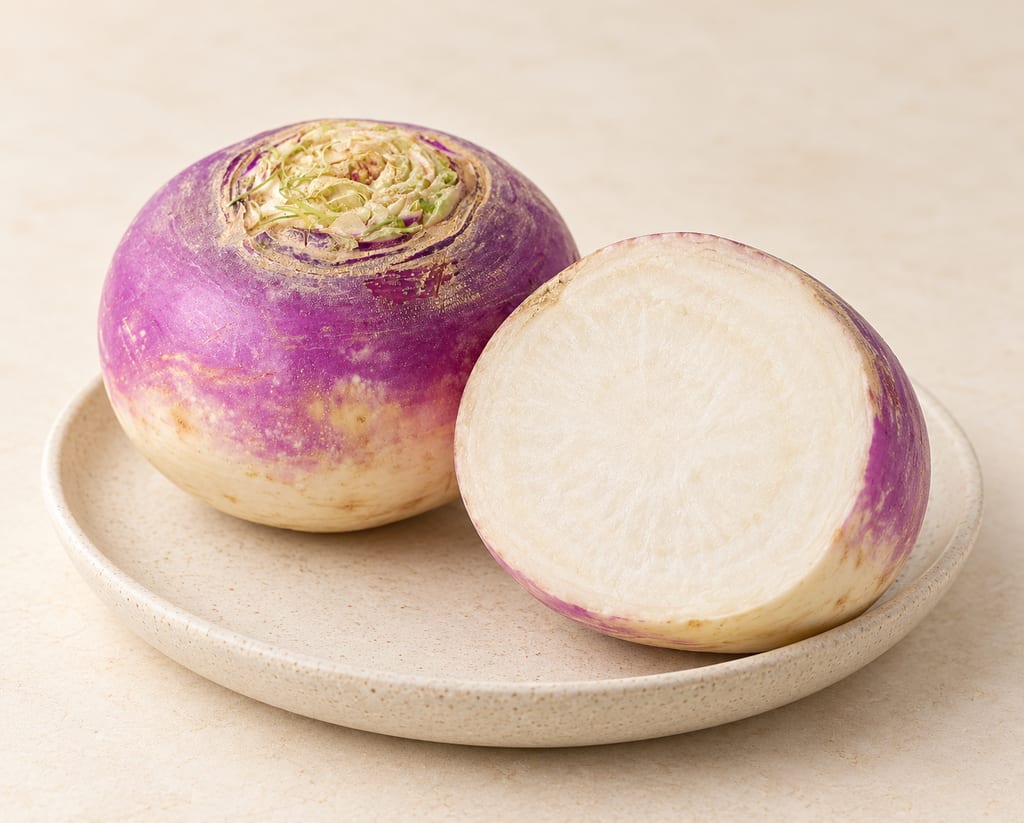
The turnip, a brassica crop whose roots and leaves are eaten. The source record names the species Brassica rapa, but its wild and naturalised forms are not assessed here.
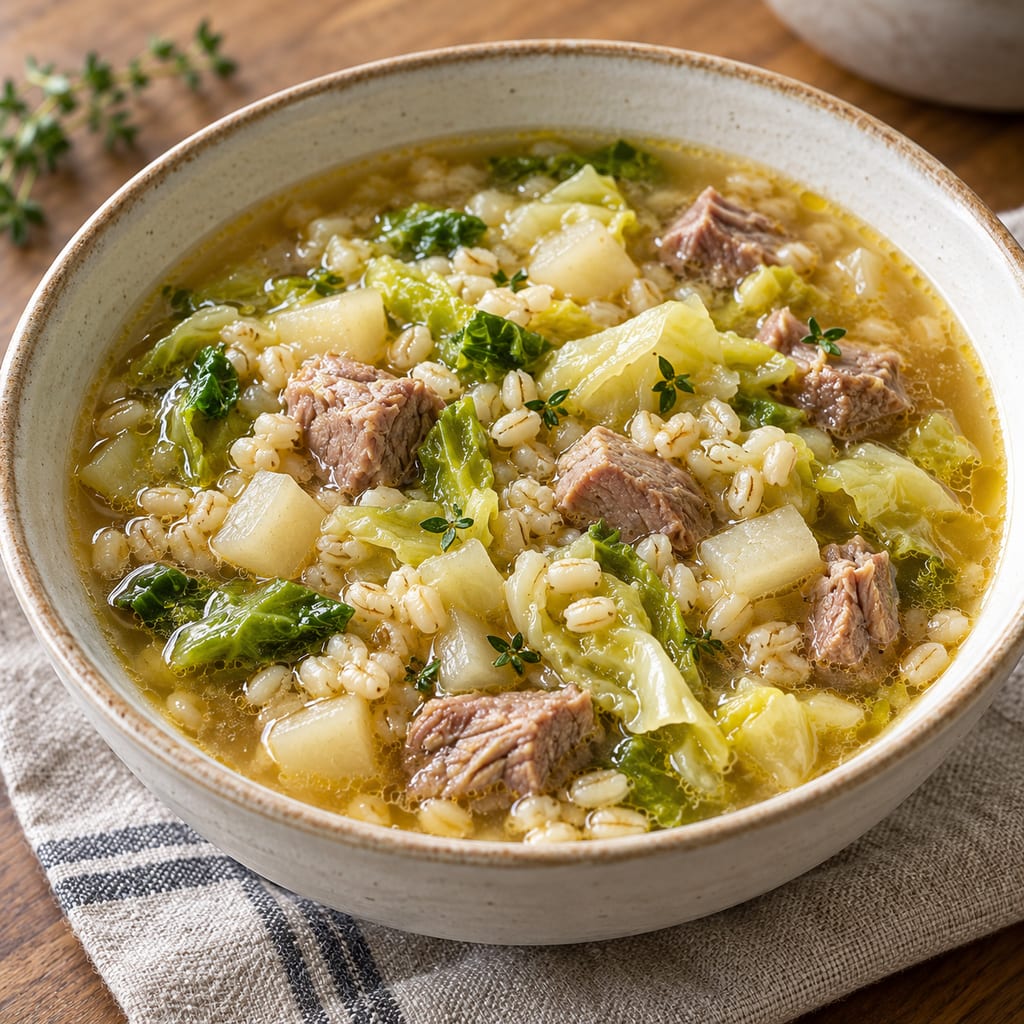
Lamb shoulder simmered with pearl barley, turnip and leafy cabbage in one pot, a present-day reconstruction built from the animals, grains and vegetables of northern European farming.
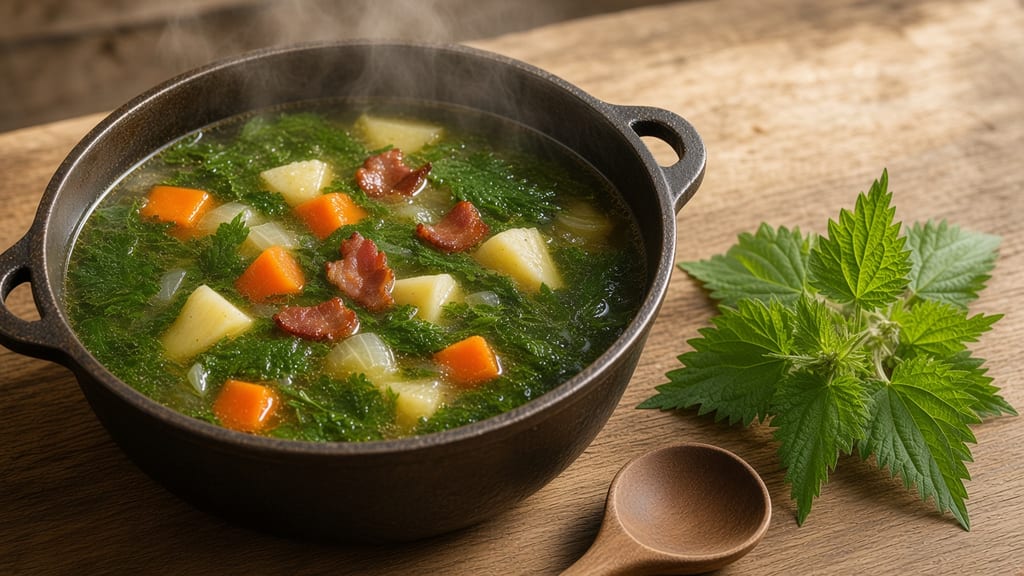
Young stinging nettle shoots cooked with bacon, onion, garlic and three roots into a thick spring soup, from a Danish Viking museum's recipe, with a meat-broth variation and ember-baked turnips.
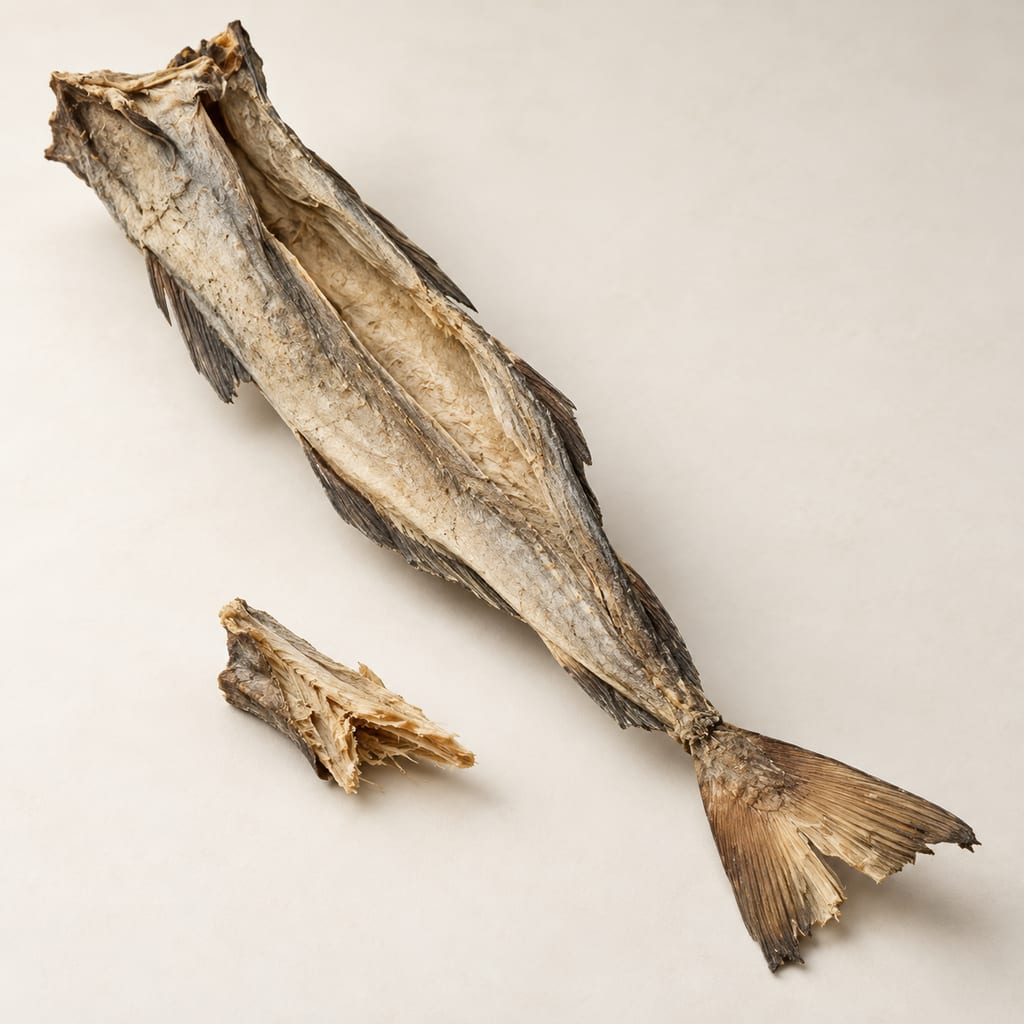
Cod hung on open racks in cold northern air until most of its water has gone, leaving a hard, light, unsalted fish that keeps and travels and must be soaked for days before cooking.
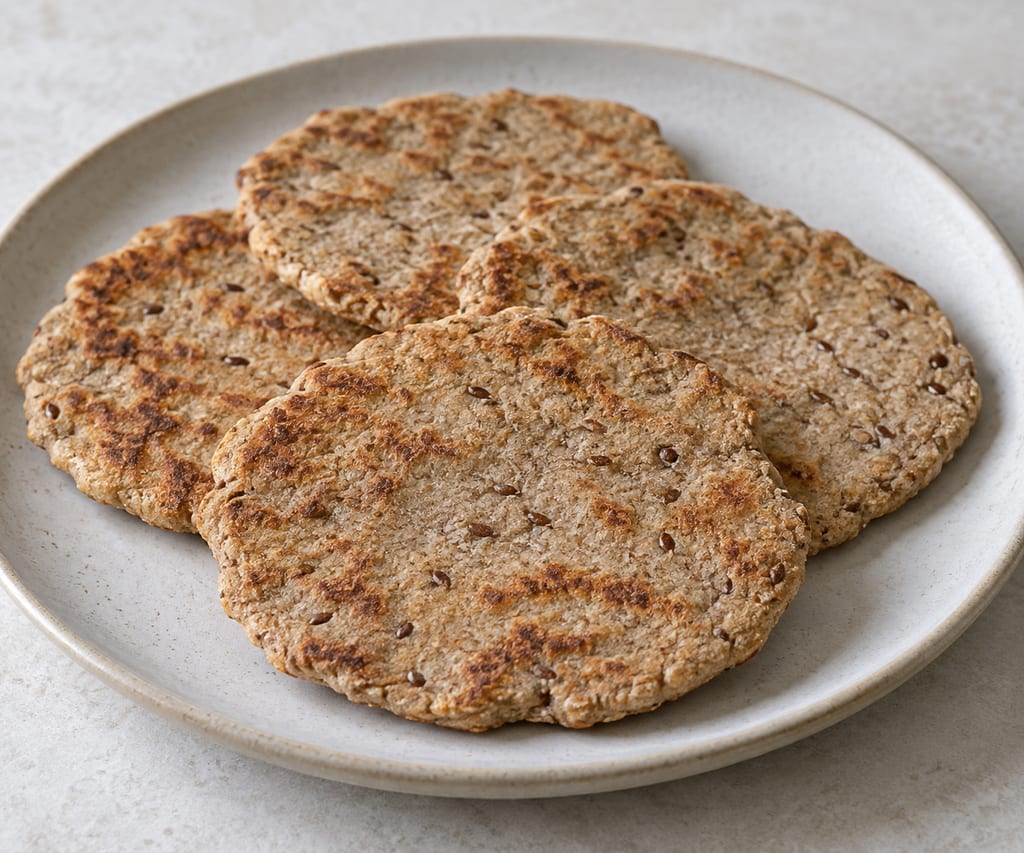
A small, dense cake of ground barley mixed with liquid and cooked against a hot surface, the form a low-gluten northern cereal takes when a household turns stored grain into bread.
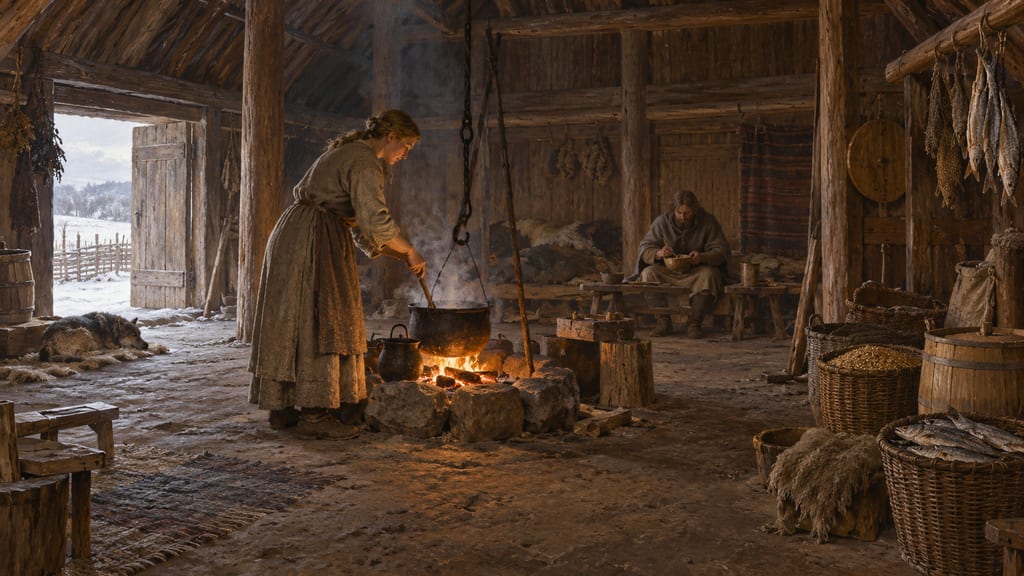
How ordinary Viking-Age households grew, dried, smoked, salted and cooked their food through the northern year, and how to cook their dishes today with supermarket ingredients.

Crushed or milled barley cooked in water until the starch softens and the mixture thickens, the plainest way a northern household turned stored grain into a meal, here with apple and hazelnut.
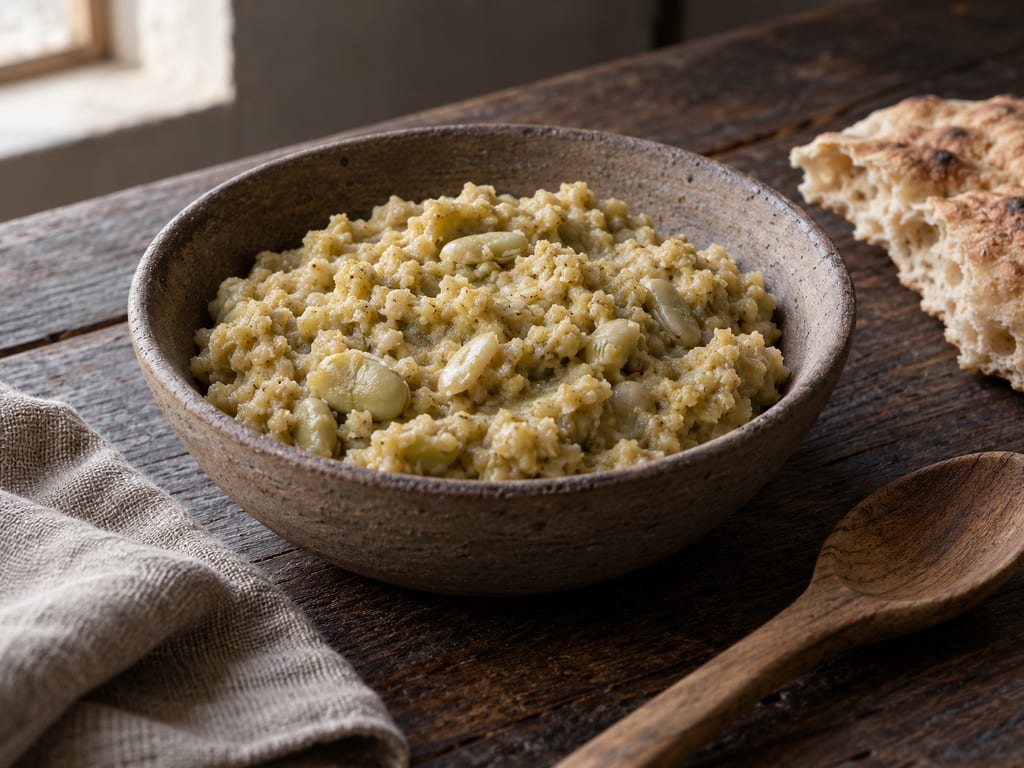
Cooked broad beans crushed to a thick paste with garlic and salt, a museum preparation built on the one European pulse that was already old when the Viking Age began.
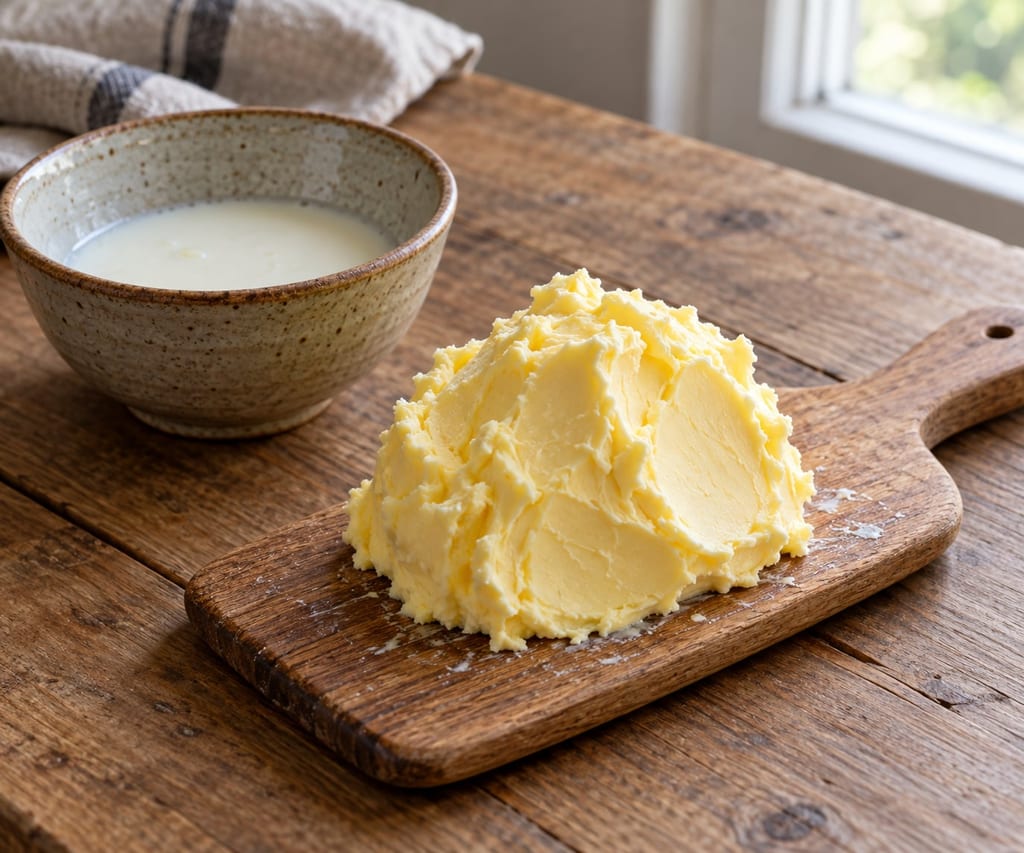
Cream agitated until its fat globules join into a solid mass and release buttermilk, the dairy fat a northern household could concentrate, salt and keep when milk itself would not last.
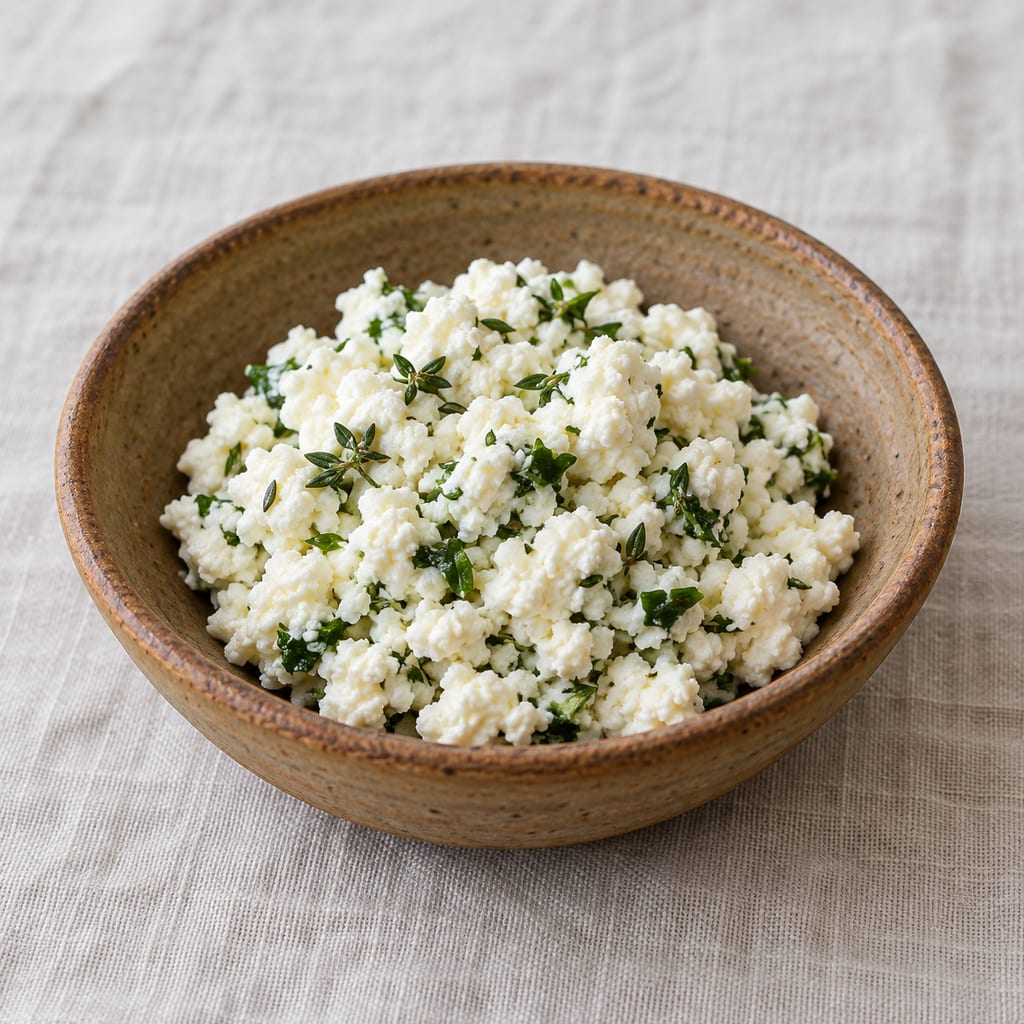
Soft fresh curd made by draining whey from milk already thickened by bacterial acidification, the simplest point in a northern dairy tradition that also produced skyr, ymer and whey itself.
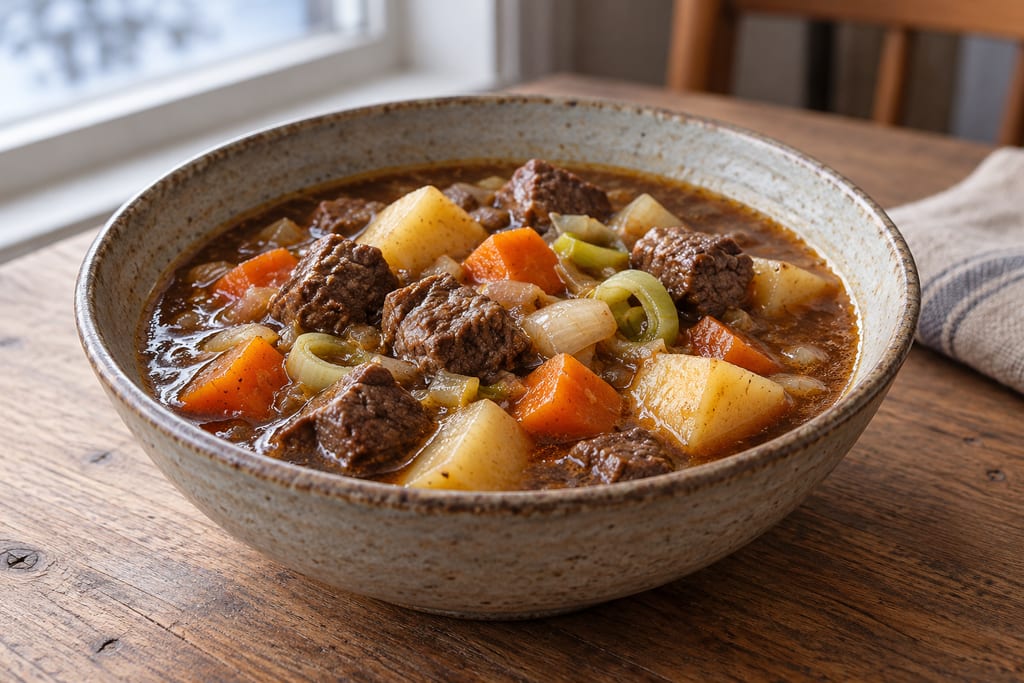
Ann-Kristine Bongo's four-serving bidus from Sami Siida in Alta is a contemporary, festive reindeer stew simmered with onion, carrots and potatoes.

A four-serving cep ohaw recipe from the former Ainu Museum café in Shiraoi, documented in 2015.
No community contributions have been published for this entry yet.
Sign in to contribute. Published comments and photos are free to read.
Ribe VikingeCenterMethod · History
Ribe VikingeCenter — FiskesuppeThe museum's soup for four people: 750 g trout or salmon in bite-sized pieces, 5 finely diced carrots, 5 finely chopped medium onions, butter in an unspecified quantity, 1.5 litres water, chopped chervil, chopped cress, 200 ml cream, salt and finely chopped spring-onion greens.
The sequence: soften carrots and onions in butter for approximately 5 minutes, add the water and bring towards boiling, reduce to a simmer until the vegetables are nearly tender, stir in the chervil, cress and cream, then add the fish and simmer gently until thoroughly cooked, finishing with salt and the spring-onion greens.
The museum specifies no exact duration for the vegetable stage and no cooking time or temperature for the fish.
Fish bones excavated in the Ribe area include plaice, flounder, dab, cod, salmon, trout and thin-lipped grey mullet, pointing to several fishing habitats.
Cited in: What is Viking-inspired fish soup?; Names and principal fish; Fish in Viking Age settlements; What happens when fish cooks?; Why the fish is added last; Why gentle simmering matters; Ribe VikingeCenter fish soup; Method; Cooking it from a supermarket; Alternative fish and onion soup; Preparation; Regional differences; How fish soup is eaten; Fish breaks into small pieces; Broth becomes cloudy; Cream separates; Soup tastes excessively salty; What remains unknown
National Museum of DenmarkHistory
National Museum of Denmark — Meat and fishFishing, species and preservation: rivers, lakes, coastlines and the open sea exploited for food, with nets, hooks and other equipment suited to particular environments, and evidence at Hedeby encompassing many fish species.
Dried fish was particularly suitable for transport while fresh fish needed much faster preparation or consumption, and exchange could carry fish beyond where it was caught.
How fish remains are read: vertebrae and cranial fragments identified to species or broader groups, with cleaning, waste disposal, preservation conditions and recovery technique all affecting what survives, so absence is not proof a fish was never eaten.
Cited in: Names and principal fish; Fish in Viking Age settlements; How archaeological fish remains are interpreted; The importance of seasonality; Why cream is a historical uncertainty; Regional differences; What remains unknown
Viking Ship Museum, RoskildeHistory · Method
Viking Ship Museum — Food in Viking TimesHistorical fishing and cooking technique, including the boiling vessels in which a soup of this kind could be made, and the dairy products available in relevant regions.
Cited in: Why cream is a historical uncertainty; How fish soup is eaten
Food Standards AgencySafety
Food Standards Agency — Cooking your foodA conservative cooking check of 70°C at the centre for two minutes, or an equivalent time-temperature combination.
Cool cooked food promptly, refrigerate within two hours and eat within 48 hours or freeze.
Cited in: Fish remains translucent or undercooked; Safety