
Viking intake
How Viking households fed themselves through winter
How ordinary Viking-Age households grew, dried, smoked, salted and cooked their food through the northern year, and how to cook their dishes today with supermarket ingredients.
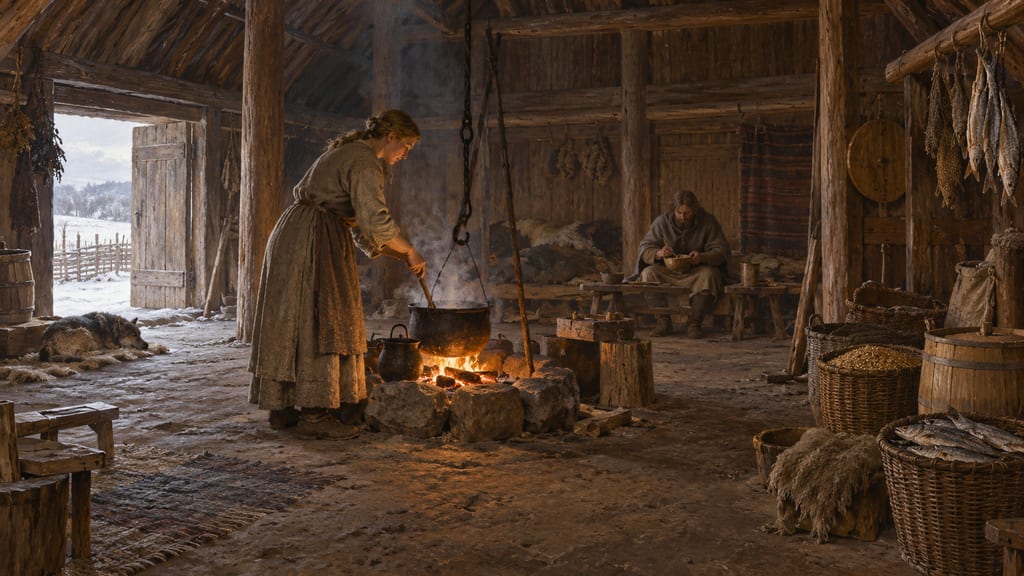
An interpretive reconstruction of a household cooking by the hearth in winter.
A table that told you who you were
Around the 10th century, a poet set down a journey. The god Heimdal, travelling under the name Rig, walks into three houses in turn and eats in each. In the thrall's house, Edda brings food rich in chaff to the table, and a bowl of soup. In the chieftain's house, the mother spreads a patterned cloth of bleached linen, sets out loaves of white, pure wheat, fills silver bowls and brings in pork and roast fowl. There is wine in the jug and the company drinks until the sun goes into the hill.
The farmer's visit, which would have shown the middle of Viking society, is lost from the poem. The Viking Ship Museum in Roskilde, which quotes these lines in its teaching sheet on Viking food, draws the obvious lesson: there were great differences between thrall, farmer and chieftain. Food marked rank, and the bread on your table said as much about you as your clothes.
Most people in the Viking Age ate at the thrall's end of that scale or close to it. Their food came from their own animals, fields and gardens, from berries and plants gathered in the wild, and from whatever they could hunt or catch. This feature follows that ordinary household through a year of feeding itself, from the summer harvest to the long northern winter, and then brings its dishes into a modern kitchen.
What grew, grazed and swam
The museum's list of what was known in Viking times reads like the stock of a careful smallholding. From livestock came cattle, pigs, sheep, horses and goats, along with hens and geese and their eggs. Grain meant especially barley, rye and oats, though bread wheat was known too. The garden gave peas, beans, cabbage, onions, garlic and leeks, and supplied cress, cumin and mustard for flavour.
The wild filled in the rest. Thyme, bog myrtle, milfoil, angelica and juniper came from nature, and angelica was eaten root, stem and leaf. Raspberries, strawberries, bilberries and blackberries grew wild. Fruit meant apples, rosehips, sloes, plums, cherries and elderberries. Honey was the only sweetener, used both in food and in mead.
Hunting mattered differently in different places. In southern Scandinavia deer, hare and wild boar were probably luxury foods. Further north, seals, whales, wild fowl and reindeer made up a large part of what people ate. On the coasts, fish filled the gaps: herring, garfish, salmon, cod and flatfish, as well as mussels and oysters, and in some places fish may already have been traded.
Dairy ran through all of it. The museum lists milk, butter, various cheeses and whey. Whey in particular turns up again and again, as a drink, as the liquid for bread dough and as the by-product of every cheese.
The everyday menu
For a large part of the population, the museum suggests, everyday food was porridge of barley or oats, sourdough rye bread with butter, cheese and possibly sausage. Hot meals were mostly soups and stews of meat, fish and vegetables. People drank milk, berry juice, whey or herbal infusions alongside.
Special occasions, and the houses of the wealthy, looked different. There might be spit-roasted meat, possibly game, and fish. Wheat bread was baked. Beer was brewed from barley and flavoured with hops and bog myrtle. Mead was made by fermenting honey, and a chieftain might drink wine imported from the Frankish Empire.
Seen together, the two menus show how a household's wealth was measured in grain and drink. Barley porridge and rye bread were the floor. White wheat, roast meat, beer and wine were the ceiling. Everything in between was a matter of how good the harvest had been and how many animals came through the winter.
Tools of the hearth
Finds of kitchen equipment fill in how this food was made. Viking households had roasting spits and boiling vessels of wood, leather and clay. They had pans of soapstone and of iron plate, kneading troughs and kneading boards, sieves, grain querns, butter churns, ladles, bowls, small axes and knives.
Food was roasted or boiled over an open fire or cooked in an oven. A wooden bucket or a leather bag could not go on the flames, so cooks heated stones in the fire and dropped them into the water or soup. These potboilers let a household boil in almost any vessel that held liquid.
Flour was ground on a rotary quern. Cheese had its own kit: a special board on which the curd was kneaded and, for softer cheeses, a closely woven cloth to strain off the whey. Iron cauldrons hung from a tripod over the fire. Around the central hearth of the longhouse, these few tools did the work of a whole modern kitchen.
Racing the winter
Without refrigeration, the year turned on preservation. Much of the summer harvest from field and garden was put away for the winter, together with meat. In summer and autumn, grain, vegetables, fruit and berries were dried. When the sun shone, it did the work. When it did not, the heat of the hearths inside the houses dried the food instead. Special buildings for drying and storing food are known as early as the Iron Age.
Later in autumn came slaughter. The meat was dried, smoked, salted or treated with some combination of the three. Salting was the hardest. There were no natural salt deposits in Viking lands, so salt had to be made by boiling down seawater or bought in, possibly from the Baltic countries. That made salt meat a costly, slow way to keep food.
Dried fish was the great winter staple of the coasts. The museum points to Njal's saga, which mentions large quantities of dried fish laid in as winter provisions. Before it could be eaten, either it was beaten until small flakes came away that could be chewed, or it was soaked in water to soften it and then boiled until tender.
Put together, these methods describe a household racing the weather. Drying needed sun or fire. Smoking needed fuel. Salting needed money or labour. Every family chose its own mix, and what they chose shaped what they ate from midwinter to spring.
The first green of spring
After months of dried grain, smoked meat and hard fish, the first green shoots of spring meant fresh food again. Stinging nettle is one of the earliest. It is a perennial that grows upright to 2 m, with soft, serrated leaves in opposite pairs and tiny greenish-white flowers near the top. Its leaves, stems, shoots, flowers and seeds are all edible, and it goes into tea, beer and soup.
Two Danish museums offer nettle soups for modern cooks. Ribe VikingeCenter in southwest Jutland starts with a handful of bacon, one or two onions and one or two garlic cloves sweated in the pot. Then come a parsnip, a carrot and half a celeriac, a handful of wild garlic, four sprigs of thyme and a litre of nettle shoots. The pot sweats under a lid for about 10 minutes, then simmers in 1.5 litres of water or stock for about 45 minutes.
The Viking Ship Museum's version leans on meat. Half a kilo of pork, beef, lamb or mutton, chicken or fish goes into 1 to 1½ litres of cold water and simmers for about an hour. Three parsnips, two large onions and about three cups of chopped nettle tops join it halfway through. When the meat is tender it is lifted out, cubed and returned.
Neither soup is an excavated recipe. Both are museum reconstructions, built from the plants and tools the finds support and written for a modern cook. That is true of every recipe in this story, and it is the honest way to cook Viking food today.
Bread, porridge and the grain economy
Grain fed the Viking world. The museum's barley porridge is the simplest dish here and probably the most typical. Three to four hundred millilitres of coarse barley flour are scattered into a litre of boiling water with constant stirring, brought back to the boil and simmered for five minutes. Two apples, and hazelnuts if you like, go in two minutes before the end. Then the pot comes off the fire and sits near the heat for half an hour to an hour while the grain swells. A knob of butter or a little honey goes on top, with a scatter of dried berries.
Bread was the other half of the grain story. The museum's flatbread is coarse wheat flour kneaded with whey, water, milk or buttermilk into a dough that holds together without being wet. It is rolled into balls the size of a golf ball, pressed flat and baked on a pan over the fire or on a preheated flat stone. The breads are turned often and are done when they sound hollow when tapped with a fingernail. Honey, salt, dried fruit or nuts can be worked into the dough.
That flat stone is worth noticing. A bakestone, a pan of iron plate, a quern to grind the flour and a trough to knead it: the equipment for bread is a large part of the equipment the finds describe. Rye sourdough bread with butter was the everyday loaf for many households, and white wheat was for the chieftain's table.
Beans, cabbage and the pot of the day
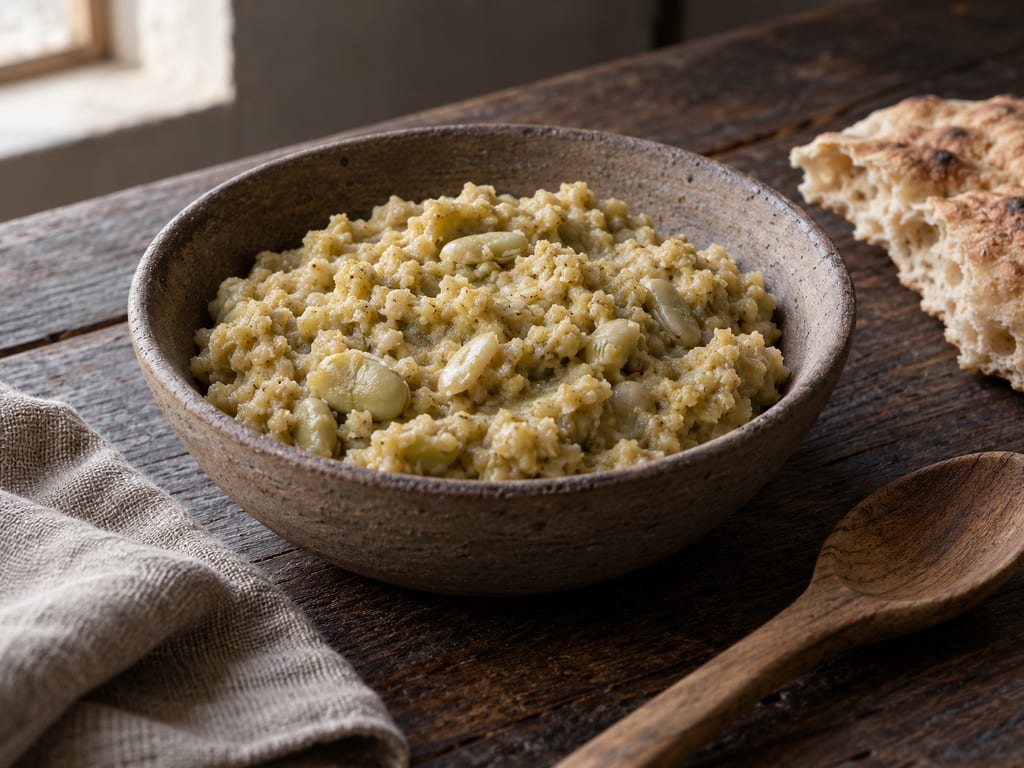
Peas and beans grew in Viking gardens, and they kept well once dried. The museum's bean stew uses 400 ml of horse beans, a kind of broad bean. The museum warns that they must not be eaten raw. The beans soak overnight in three times their volume of water. The soaking water is poured away and the beans cook for 1 to 1½ hours in plenty of fresh water until tender.
Meanwhile three large onions and three large cooking apples are sliced, cubed and fried in butter. A teaspoon of dried thyme, half a teaspoon of crushed mustard seed, one or two garlic cloves and a quarter litre of soured cream follow. The whole thing simmers for about ten minutes with the beans and gets a scatter of parsley on top.
Stews like this, and pottages of lamb, barley and cabbage or fish and onion, were the hot meal of the ordinary day. They used one pot, whatever the garden had, a little meat or fish when there was some, and the grain and pulses from the store.
Milk into food that keeps
Fresh milk does not last, but butter, cheese and whey do, and dairy work runs through Viking food. The museum's butter is made by whipping cream until stiff and then carrying on until it splits into butter and buttermilk. The butter is pressed in a cup with a spoon to drive out the buttermilk, and it can be kneaded with salt to make it keep. A whisk can be made by lashing together seven or eight willow twigs with the bark stripped off.
The buttermilk does not go to waste. Heated to about 40°C, rather more than hand-hot, it separates into white clumps of cheese and a greenish-yellow whey. It must not be stirred while it warms; a ladle drawn once or twice through it spreads the heat. The curd is strained through a loosely woven cloth and can be flavoured with thyme, garlic or mint, or mixed with a little cream, apple and nuts.
The whey that drains away is the same liquid the museum lists as a drink and as a liquid for bread. A single pot of cream thus yields butter for the winter, a soft cheese for the week and whey for the table. Fermented milk foods such as skyr belong to the same economy of turning a perishable liquid into something that lasts.
Fruit dried for the dark months
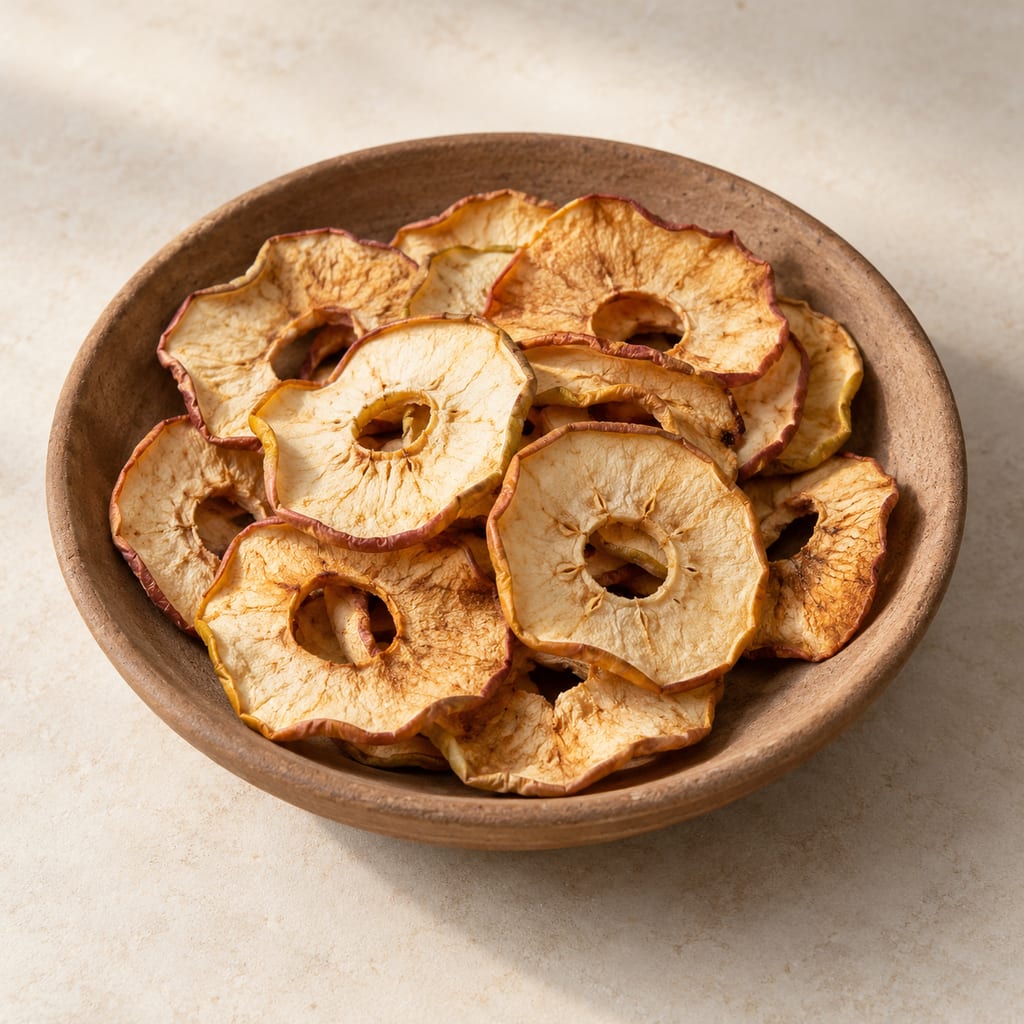
Fruit and berries were dried in summer and autumn like grain. The museum's dried apple snacks show how simple it can be. The stalk and the remains of the flower are removed and the core cut out of the whole apple. The apple is sliced into thin rings.
The rings can go on a wire rack in an oven at no more than 50°C for about six hours. They can also be threaded on string and hung in a warm room, above a wood-burning stove for example, for about 24 hours. Large, firm, slightly sour apples dry best.
Hung in strings above a hearth, rings like these would have turned smoke and spare heat into winter food. Scattered on porridge or worked into flatbread, they brought a little sweetness to the end of the year, when honey was the only other sugar.
Cooking on a real fire
The museums write for cooks who want to try open-fire cooking, and their advice is practical. Build the fire for the food. Boiling needs a blazing fire, while roasting and grilling need good embers. With a large fireplace, keep a boiling fire at one end and rake embers along to a roasting fire at the other.
Hang an iron pot from a tripod of three thick branches lashed together, using hooks and a small chain or rope. The pot must be iron, steel or aluminium, with no Bakelite or plastic handles. It can also sit directly on the fire or on three stones of roughly equal size, so that it is steady and air reaches the flames. Spits should be cut from completely fresh wood such as hazel, and thick enough to bear the meat.
If you cook with potboilers, never use flint, which shatters when heated. And one firm rule from the Viking Ship Museum: never keep campfire food until the next day, not even in a refrigerator, because soil bacteria can grow and cause stomach infections.
Ribe VikingeCenter adds a dish for the embers themselves. Four medium turnips are buried in the glowing embers and left for 45 to 90 minutes, depending on their size and the heat. It is the easiest Viking side dish there is and the one that best explains why a good bed of embers mattered.
Many kitchens, not one Viking diet
Researchers use AD 750 to 1100 as a broad frame for the Viking Age. Within it, a fishing hamlet, an inland farm and a trading town each ate from different supplies.
Isotope work at Birka found that burial groups there ate differently from one another. Wealth, work and status shaped the bowl as much as geography did.
Plant and animal remains name ingredients but leave out quantities. A dairy protein in tooth calculus shows that someone drank or ate milk, but it cannot name a cheese. A pot shows that someone cooked, not what went into it.
Kaupang in southern Norway drew on fields and woodland. Dublin and York ate from their own hinterlands, so Anglo-Scandinavian food in York was mostly local food. In Iceland, barley and arable weeds at Reykholt date from the tenth to the twelfth centuries, so at least some grain grew on the island.
Wild birds and their eggs added to farm supplies in some regions. Chickens have a different archaeological history in Iceland from the mainland, so a hen's egg on an Icelandic table needs its own evidence.
Hay was the first preserve
An Icelandic farm decided its winter menu in the hayfield. The hay it cut and dried set the number of animals it could keep alive until spring, and those animals gave the next year's milk.
In autumn the household weighed each animal's value for breeding, milk, wool and work against the fodder in store. Slaughter turned a mouth to feed into meat, and that meat then needed salt, smoke or drying.
Davide Zori describes this as an allocation problem. It does not prove a single great autumn kill on every farm. Jesse Byock links Icelandic dairying to winter fodder in the same way: the ewe in the byre carried summer grass into the next spring.
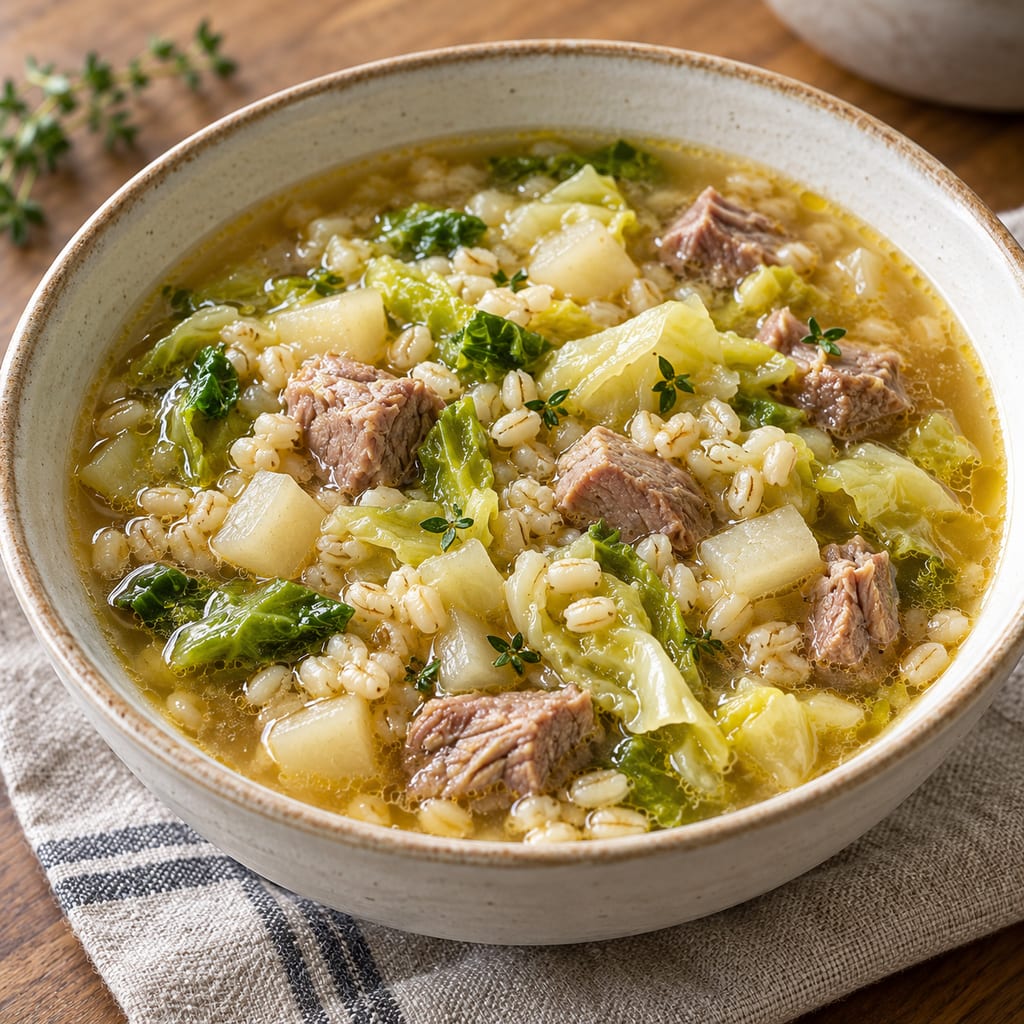
Danish arable farms worked under different limits from the pastoral farms of the North Atlantic. Lamb from the same flocks goes into our lamb, barley and cabbage pottage.
Grain kept whole and ground each day
A household could keep grain unground and mill only what the day's cooking needed. A rotary quern crushed it between two stones. The cook then mixed the meal into porridge, flatbread or a thickener for the pot.
The store needed protection from damp and from mice. Nothing obliged a household to turn its barley into bread or beer at harvest.
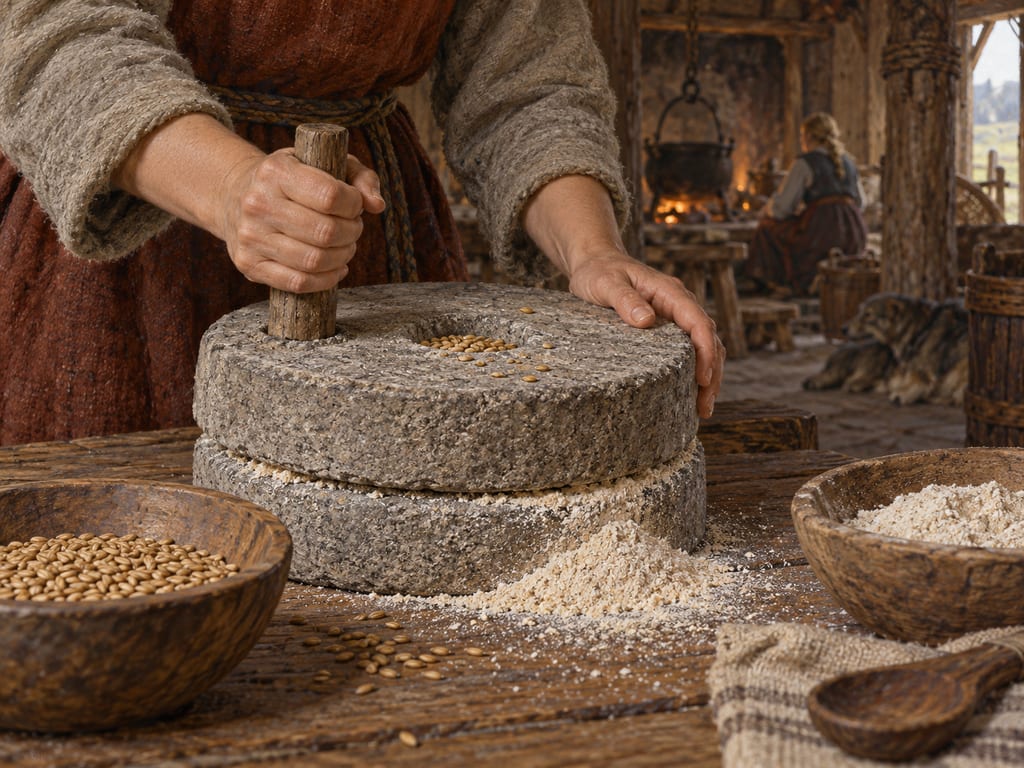
Irene Baug's study of querns, bakestones and soapstone vessels shows how regional this equipment was. The grooved commercial bakestones that most people picture became established around the start of the Middle Ages. Earlier cooks used iron pans and local stone forms.
Charred loaves from Birka contained barley, oats, wheat, peas and flaxseed in different mixtures, and Ann-Marie Hansson interpreted most of them as unleavened. They were grave goods, chosen for burial. Our Birka flatbread follows those finds with modern flour, and rye belongs in the Danish half of the story.
Cod that travelled south
Cod bones from Haithabu, the Viking town known in Danish as Hedeby, carry a genetic signature of the North East Arctic population off northern Norway. Star and colleagues argue that the fish arrived dried, as stockfish,.
The DNA cannot tell us how large the trade was, or whether the fish fed travellers or reached a market.
Norway's heritage inventory describes the modern craft. Producers hang gutted fish on wooden racks in moving air and dry it without salt. Stockfish is a different product from salt cod. Nofima's research shows that a hard early frost can damage the fish, so this process is not a form of freeze-drying.
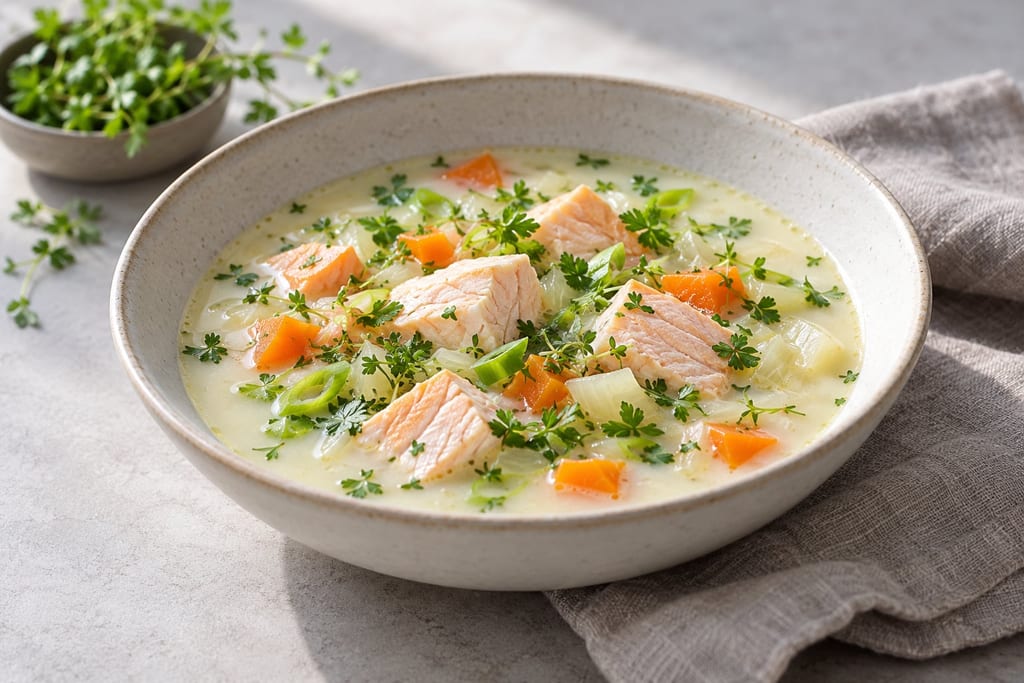
Our stockfish page covers the preparation. Its cooking section explains how to soak a bought piece for a pan of onions and butter. Fresh salmon and trout replace dried cod in the fish and onion soup.
Salt from ash and from the sea
Salt preserved food, but each coast had a different supply. A household's access depended on the shoreline, the saltiness of the water, the fuel to boil it and the goods it could trade.
Per Norseng separates two Norwegian methods. Burning seaweed gave a salty ash, and archaeology shows that practice before the Viking Age. Boiling seawater gave evaporated salt, which Norwegian records describe in detail only in the later Middle Ages.
Newer work rejects the old claim that northern salt was too scarce to matter. Practice varied by region, and the evidence for salting grows stronger after 1100.
Smoke under the roof
The central hearth of a longhouse gave heat, light and smoke. In the Danish model, smoke left through an opening in the roof, so meat or fish hung over the work area would have dried in it.
A few sites had separate buildings for this. The published plan of Granastaðir in northern Iceland includes a structure that Hogg interprets as a smokehouse.
Smoke worked alongside drying and salt. A lightly smoked joint would not keep through a winter by smoke alone, and the archaeology gives us no smoking times.
A cask of sour whey in the floor
Milk became several stores. Churning turned cream into butter, and curdling split milk into curd and whey. Salt helped butter and cheese last beyond the milking season.
Whey then became a preserving liquid. The hall at Hofstaðir in Iceland, used from the tenth century until about 1030, had a cask set into its pantry floor. The excavators interpret it as a store for food kept in whey.
At Hrísbrú, from the same period, a flat-bottomed pit about a metre across held packed stones that probably supported a barrel, with chopped bone close by. Milek and colleagues read the room as a place for preparing and storing food. Neither site tells us how sour the whey was or how long food stayed in it, so we do not publish a recipe for it.
Our butter page follows the Dublin churn dash with supermarket double cream. The cheese and curds page includes a small herb curd made from plain yoghurt.
Spices, fruit and imports
The plant evidence describes a varied table. Southern Scandinavian sites from 775 to 1050 produced peas, broad beans, alliums, cabbage, fruit and aromatic plants. Coriander turned up at Fyrkat. Hedeby yielded grapes and peaches, probably imported.
The waterlogged deposits at Coppergate in York preserved dill, coriander, celery, poppy seed and summer savory, along with plum and sloe stones. Each find shows that a plant reached a site. None gives us a seasoning blend.
Seeds survive better than leaves and roots, so cabbage, turnip and wild greens appear less often in the record than people probably ate them. Garlic and thyme in our reconstructions are modern choices for flavour, and the recipes say so.
The kit in the Oseberg ship
The Oseberg burial in Norway held a working kitchen. It included cooking vessels, whisks, ladles, a milk strainer, wooden containers, a decorated bucket and tools for processing grain.
These objects come from a very rich burial. They show skilled craft and ownership, and an ordinary farmhouse would have had fewer and plainer pieces.
Soapstone pots, iron pans and ceramics all survive from the period. A reconstruction should pick one region and date before it combines equipment from them.
Cooking in the ground
Ribe VikingeCenter demonstrates an earth oven. A fire heats stones in a pit, then the cooks lay in wrapped meat with insulating greenery and cover it with turf. The stored heat finishes the cooking.
Ribe presents this as a modern demonstration, and its dimensions and timings are its own. Pit cooking prepared a meal and did nothing to preserve it.
Beer, mead and water
Beer belongs beside bread and porridge in the story of grain. Malting lets grain sprout and then stops it, and mashing turns the starch into sugars that yeast can ferment.
At Uppåkra in southern Sweden, archaeologists found carbonised sprouted grain beside an oven and interpreted it as malting. The material dates from about AD 400 to 600, centuries before the Vikings.
Geir Grønnesby has studied heat-cracked stones on Norwegian farms as possible brewing tools, since hot rocks can heat a mash. Burnt stones came from many other jobs as well.
Mead needed honey, and wine arrived by trade. People also drank water. The common claim that everyone drank beer because water was unsafe has no support in the sources.
Lars Marius Garshol's research into farmhouse brewing documents recent traditions such as kveik ale and Finnish sahti. They can suggest questions for an experiment, but they are not unchanged Viking beers. Our barley ale page stays a draft until it has a dated, sourced method.
Dishes that are not Viking
Some Nordic dishes get called Viking without evidence. Ribe notes that the earliest printed recipe it knows for æbleflæsk, Danish pork with apples, dates from 1616. Nobody knows whether Vikings cooked that combination.
Nordiska museet traces the trade in surströmming, Swedish fermented herring, back to at least the sixteenth century. Earlier fish fermentation is a separate question.
The Libellus de arte coquinaria, probably compiled in the early thirteenth century, records cooking after the Viking Age. Ribe describes its own recipes as adapted to modern taste. Ashby and Evans Tang warn that a working demonstration shows what people could have done, not what a particular household did. Every measured recipe on this site is a modern reconstruction for that reason.
In your kitchen today
Every dish in this story can be cooked with ingredients from an ordinary supermarket or an online grocer. Nothing needs a fire pit. The museums write their recipes for both a campfire and a home stove, and the Viking Ship Museum says its dishes can be made in a modern kitchen.
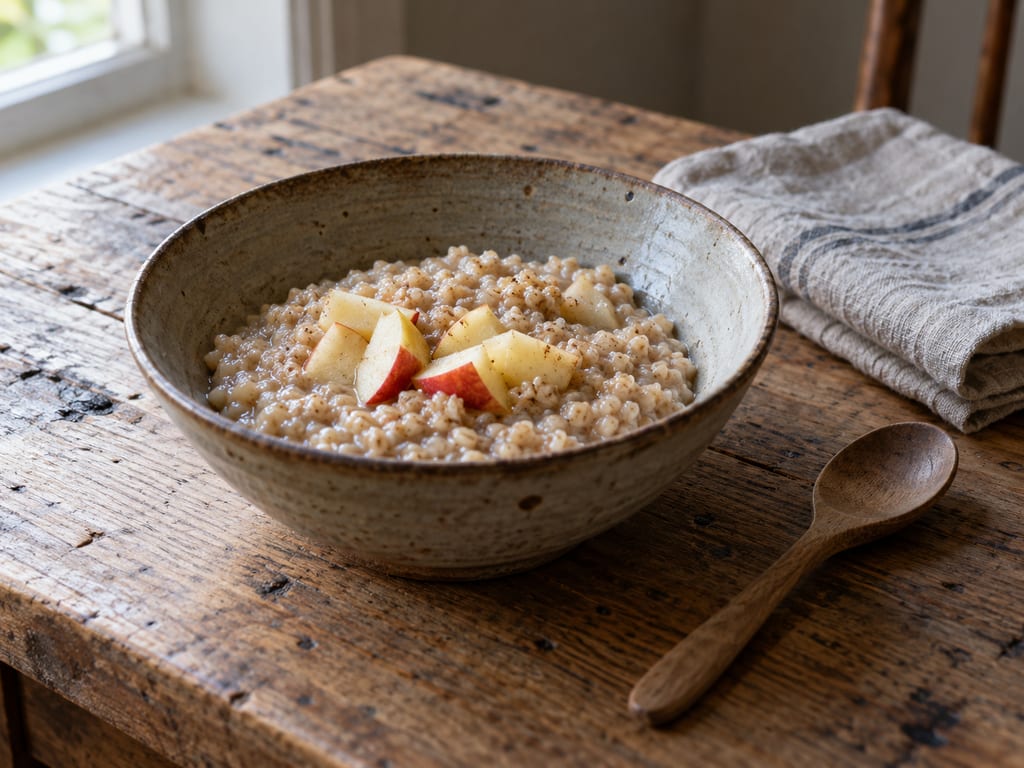
Start with barley porridge. You need coarse barley flour, water, two apples, a little salt and, if you like, hazelnuts. Bring a litre of water to the boil, scatter in 300 to 400 ml of the flour while stirring, simmer for five minutes and add the chopped apples two minutes before the end. Take the pan off the heat and leave it covered for half an hour to an hour. Serve with butter or honey and dried berries. It makes enough for about four.
Make your own butter from supermarket cream. The Viking Ship Museum suggests leaving shop cream at room temperature for about 12 hours so that it whips more easily, then whipping past stiff peaks until it splits. Press out the buttermilk, knead in salt if you want it to keep, and save the buttermilk.
Turn that buttermilk into cheese the same afternoon. Warm it gently to about 40°C without stirring, drawing a ladle through once or twice. When it separates into white curds and greenish-yellow whey, strain it through a loosely woven cloth. Season the curd with thyme, garlic or mint, or fold in a little cream, chopped apple and nuts.
For bread, mix coarse wheat flour with water, milk, buttermilk or the whey from your cheese into a dough that holds together but is not wet. Roll golf-ball pieces, press them flat and cook them in a dry heavy frying pan, turning often, until they sound hollow when tapped. Honey, salt, dried fruit or nuts can go into the dough.
The bean stew needs dried broad beans, also sold as fava beans, which are the horse beans of the museum recipe. Soak 400 ml overnight in three times their volume of water, drain, then boil in fresh water for 1 to 1½ hours until tender. Never eat them raw. Fry three sliced onions and three cubed cooking apples in butter, add a teaspoon of dried thyme, half a teaspoon of crushed mustard seed, one or two garlic cloves and a quarter litre of soured cream, simmer for about ten minutes with the beans and finish with chopped parsley.
Nettle soup is a spring job. Ribe VikingeCenter's version uses bacon, onions, garlic, a parsnip, a carrot, half a celeriac, thyme, salt and water or stock, all of which a supermarket sells, plus a litre of young nettle shoots that you pick yourself. Ribe says the wild garlic can be left out or replaced with dried, and that butter or oil can stand in for the bacon for a vegetarian pot. Wear gloves to pick and handle the nettles, as the Woodland Trust and the RHS both advise, take only the young tops, and never pick from ground that may have been sprayed.
Dried apple rings finish the menu. Core firm, slightly sour apples, cut them into thin rings and dry them on a rack in the oven at no more than 50°C for about six hours. If you have a wood-burning stove, string them up above it for about 24 hours instead.
Keeping it safe at home
Cooking at home brings modern food-safety rules with it. The UK Food Standards Agency says food should be cooked until it is steaming hot all the way through, and gives 70°C for two minutes as the core temperature to aim for. Leftovers should go into the fridge within two hours of cooking and be eaten within 48 hours.
Campfire food is different. The Viking Ship Museum's rule is to eat it the same day and never keep it until the next, even in a refrigerator. Beans need their full soak and boil before they are eaten, and never raw.
When picking wild greens, be certain of what you have. The Woodland Trust warns that wild garlic can be confused with lily-of-the-valley, which is poisonous. Wild garlic leaves grow from the base of the plant and smell strongly of garlic, while lily-of-the-valley carries two or three leaves on its stem. If in doubt, leave it out; Ribe's soup works without it.
Where to taste it
The two museums behind these recipes sit on opposite sides of Denmark. The Viking Ship Museum is in Roskilde on Zealand and publishes its food sheet under the heading The Sea Stallion from Glendalough. Ribe VikingeCenter is in southwest Jutland and publishes its green dishes, the nettle soup and ember-baked roots among them, for visitors and home cooks alike.
Their recipes are the clearest route from the finds to the plate. They do not claim to be Viking recipes. They are careful modern answers to the question the Roskilde museum asks at the top of its sheet: what did the Vikings eat, and how did they prepare it?
Related
Discussed in this article

Barley and oat porridge (Viking Age)
Crushed or milled barley cooked in water until the starch softens and the mixture thickens, the plainest way a northern household turned stored grain into a meal, here with apple and hazelnut.
Broad-bean mash (modern reconstruction)
Cooked broad beans crushed to a thick paste with garlic and salt, a museum preparation built on the one European pulse that was already old when the Viking Age began.
Dried fruit and berries (Viking Age, reconstructed)
Apple slices dried until most of their water has gone, shrinking and concentrating into leathery or crisp rings, with the modern controls that a plausible old technique turns out to need.
Fish and onion soup (modern reconstruction)
Trout or salmon poached at the end of a simmered broth of onion and root vegetables, a present-day reconstruction of coastal cooking built on excavated fish bones and a boiling pot.
Lamb, barley and cabbage pottage (modern reconstruction)
Lamb shoulder simmered with pearl barley, turnip and leafy cabbage in one pot, a present-day reconstruction built from the animals, grains and vegetables of northern European farming.
Oats
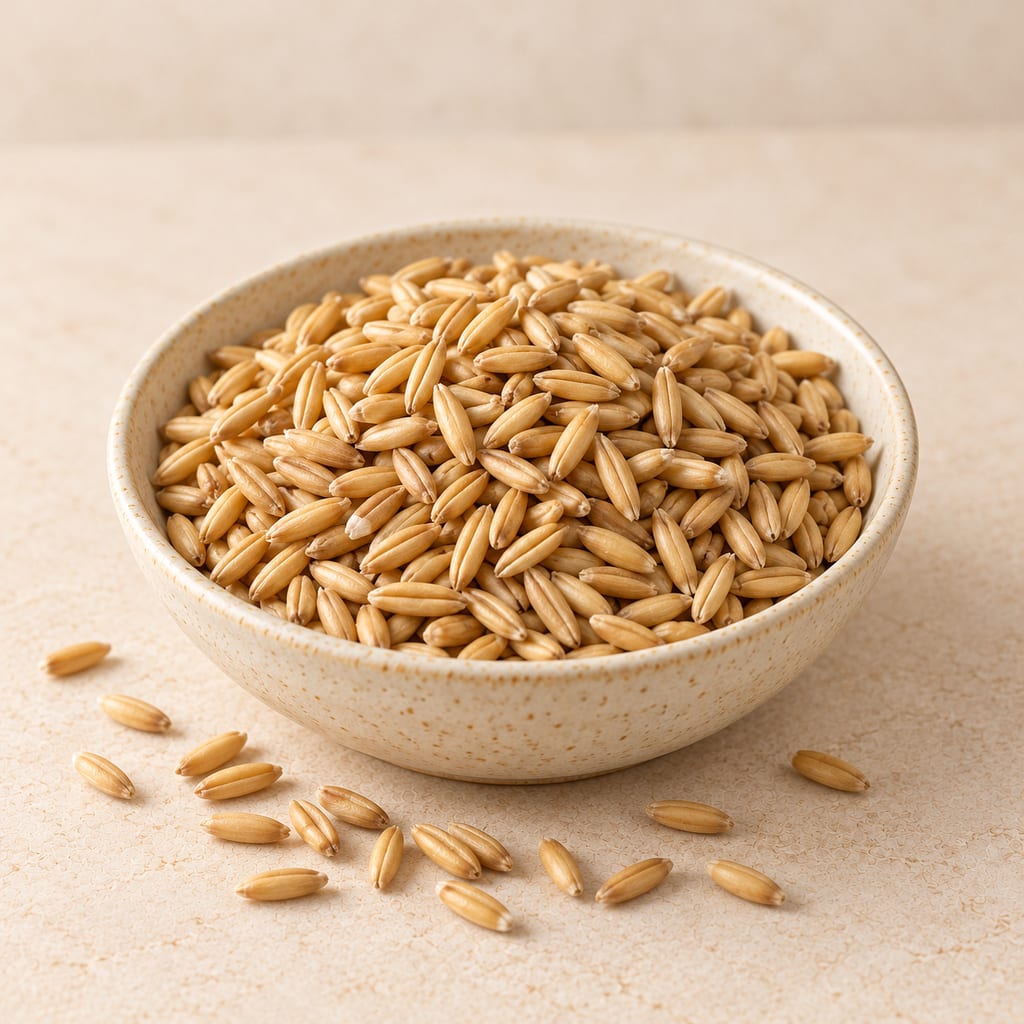
A cereal grain sold as groats, cut pieces, flakes, flour and malt. Oats shape porridge, bread and brewing differently as processing changes hydration, texture, starch, beta-glucan, protein and oil.
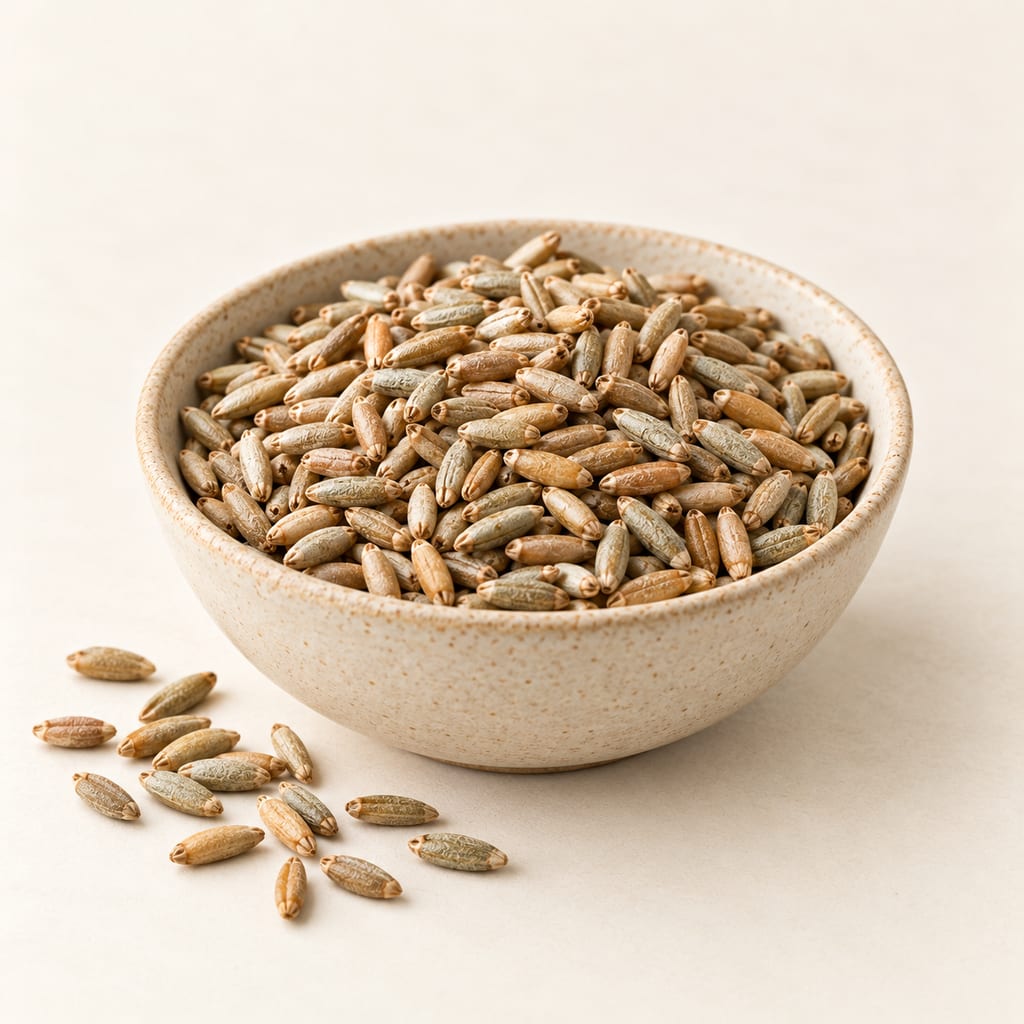
Rye
The grain of Secale cereale is milled whole or refined for breads whose crumb, flavour and fermentation differ from wheat loaves.
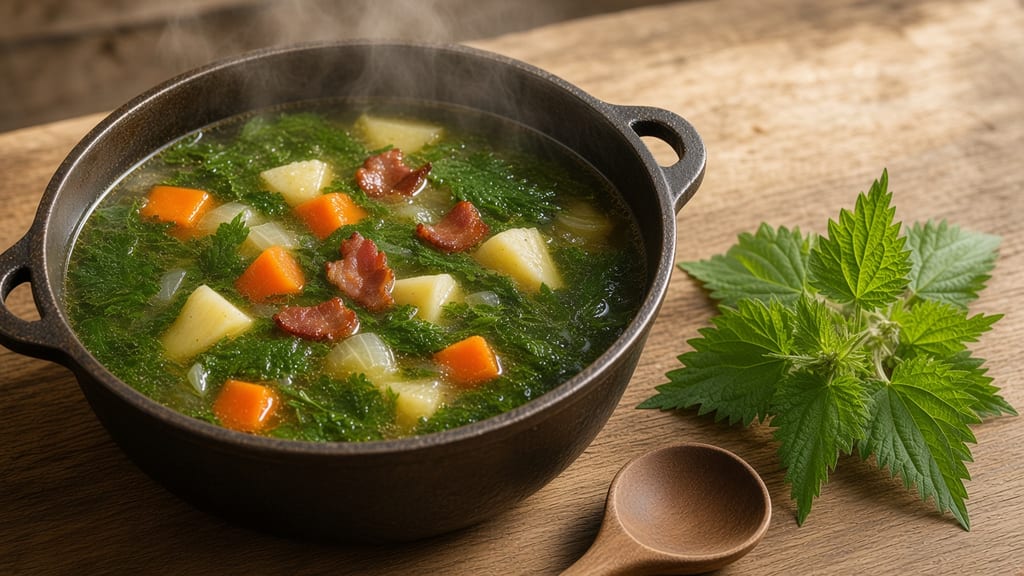
Spring nettle pottage (modern reconstruction)
Young stinging nettle shoots cooked with bacon, onion, garlic and three roots into a thick spring soup, from a Danish Viking museum's recipe, with a meat-broth variation and ember-baked turnips.
Community
No community contributions have been published for this entry yet.
Share what you made
Sign in to contribute. Published comments and photos are free to read.
Sources
Viking Ship Museum, Roskilde
Food in Viking timesCited in: A table that told you who you were; What grew, grazed and swam; The everyday menu; Tools of the hearth; Racing the winter; The first green of spring; Bread, porridge and the grain economy; Beans, cabbage and the pot of the day; Milk into food that keeps; Fruit dried for the dark months; Cooking on a real fire; In your kitchen today; Keeping it safe at home; Where to taste it
Ribe VikingeCenter
BrændenældesuppeCited in: The first green of spring; In your kitchen today; Where to taste it
Woodland Trust
Seven edible weeds: foraging in your gardenCited in: The first green of spring; In your kitchen today
Davide Zori, Oxford Handbook (Oxford University Press)
The Norse in IcelandCited in: Hay was the first preserve
Irene Baug
Stones for bread: regional differences and changes in Scandinavian food traditions, c. AD 800-1500Cited in: Grain kept whole and ground each day; The kit in the Oseberg ship
Star et al., PNAS 2017
Ancient DNA reveals the Arctic origin of Viking Age cod from Haithabu, GermanyCited in: Cod that travelled south
Norwegian inventory of intangible cultural heritage
The cultural and culinary traditions of stockfishCited in: Cod that travelled south
Per G. Norseng
The use and production of salt in eastern Norway to ca. AD 1600Cited in: Salt from ash and from the sea
Cardiff University ORCA
Humans and animals in the Norse North Atlantic (PhD thesis, fig. 3.4, p. 104)Cited in: Smoke under the roof
Hofstaðir archaeological project
Hofstaðir cultural heritageCited in: A cask of sour whey in the floor
Milek et al., Brepols
Spatial analysis of the Hrísbrú longhouseCited in: A cask of sour whey in the floor
Lars Marius Garshol, Brewers Publications
Historical brewing techniques: the lost art of farmhouse brewingCited in: Beer, mead and water
Antiquity, Cambridge University Press
Diet and status in Birka: stable isotopes and grave goods comparedCited in: Many kitchens, not one Viking diet
White Rose eprints
Texts, memory and the Viking Age (Ashby and Evans Tang)Cited in: Dishes that are not Viking
York Archaeological Trust
Coppergate plant remains, Yorkshire Archaeology Today 1Cited in: Spices, fruit and imports
Ann-Marie Hansson, Stockholm University
Bread in Birka and on BjörköCited in: Grain kept whole and ground each day
Danish Journal of Archaeology
Viking Age garden plants from southern ScandinaviaCited in: Spices, fruit and imports
National Museum of Ireland
Viking collectionsCited in: Many kitchens, not one Viking diet; A cask of sour whey in the floor
PMC, National Library of Medicine
Icelandic food evidence and chronologyCited in: Many kitchens, not one Viking diet
White Rose eprints
Archaeological food evidence at KaupangCited in: Many kitchens, not one Viking diet
Gaps
- The museum recipes are modern reconstructions; no source here gives a recipe recorded in the Viking Age.
- The farmer's household in Rígsþula is lost, so the poem gives no picture of middle-ranking meals.
- Quantities and proportions of drying, smoking and salting in a single household are not established by these sources.
- Where Viking-Age salt was produced or bought, beyond seawater evaporation and possible Baltic imports, is not settled here.
- Many linked items, including fermented fish, kveik ale and imported fruit, are not discussed here and need their own sourced coverage.
Updated 2026-10-31