
Home equipment crafts
Cheese in the brewhouse: a brewing kettle as water jacket, hot-water tank and whey cooker
A home brewing kettle can hold a cheese pot in hot water, supply wash water and reheat whey. This is what two brewer manuals allow, and which cheeses show each job.
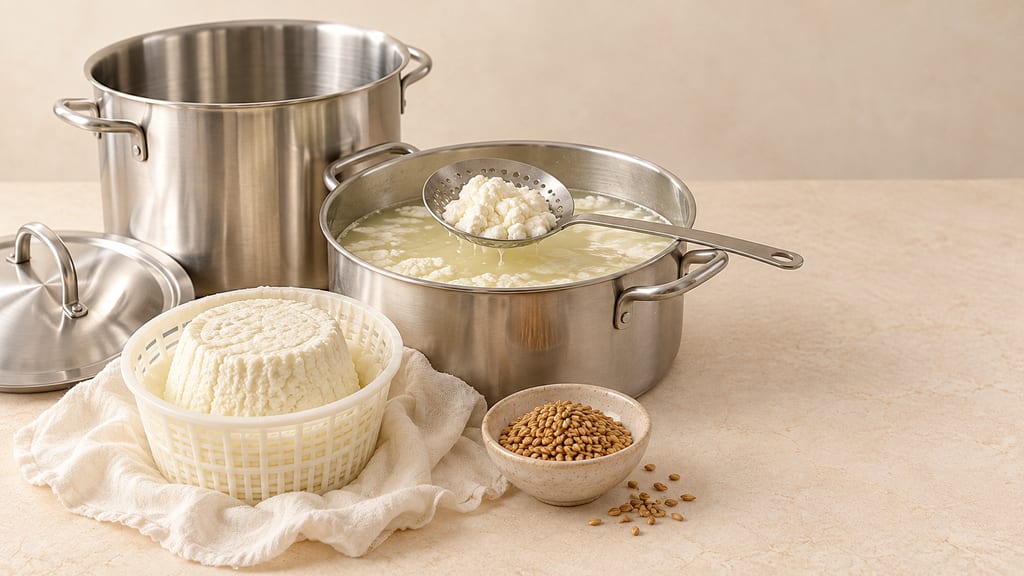
Fresh curd in whey and a brewing kettle: the same pot can make beer or cheese.
Tony Hamblyn's brewery double boiler
Tony Hamblyn flies Boeing 787s for Air New Zealand and makes cheese at home in New Zealand. In 2017 New England Cheesemaking Supply interviewed him for its series on home cheesemakers. He had recently built a brewery from 70-litre (18½ US gallon) pots and wanted it to earn its keep. He lifted the false bottom out of the mash tun, the centre pot, and lowered a 50-litre (13 gallon) pot into it with its handles resting on the rim. Water filled the space between the two vessels and turned the pair into a double boiler.
The water did not sit still. He heated it in the pot to the left of his control box, let it run by gravity into the space around the cheese pot and pumped it back, setting the flow with a ball valve on the return. PID controllers, which adjust heating continuously from a sensor reading, held the water at the temperature he chose. He usually worked with 25 to 30 litres of farm milk and pasteurised it first, to remove the variation in farm flora, although he had once made a brick cheese from raw milk. The weak point was speed: bringing the milk to 72 °C took more than an hour, so he planned to start heating the water before collecting the milk.
An update written after three years with the brewery shows the system settled into separate roles. One tank held only hot water, the tanks on a low table were for cheese and a third brewed 40-litre beer batches, with one box on the wall controlling temperature throughout. The same system cooked beef briskets sous vide for 48 hours at 64 °C before a quick finish on a hot barbecue, and his photographs of the period show a cheese press and an adapted maturation refrigerator. He could pasteurise, cool to any ripening temperature and hold it there for a long time, and his cheeses included Brie, feta, Havarti, mozzarella, burrata, halloumi, paneer, ricotta and cheddar, ripened in a shop display fridge set to 12 °C and 90% humidity.
These accounts are the strongest published case for using brewing hardware as a cheese vat, and they describe one experienced maker's custom build. They give no milk temperature curves, water volumes, support loads or cleaning routine, and nothing in them shows that a commercial all-in-one brewer will accept a second pot.
What water around the pot changes
A cheese vat must heat milk evenly yet keep it perfectly still during the rennet set. On a burner, even heating comes from stirring, which the set forbids. In a jacketed vat the moving part is the water outside: Hamblyn's pump kept the water circulating while the milk stood untouched. A brewer's pump used this way should move only bath water and return it into the gap around the pot, never into the milk. If the machine's fixed recirculation geometry cannot route the return safely around an insert, the routing should not be forced, and no pot should be allowed to block an inlet, a return or the sensor. An improvised seal, or a lid locked down so that it builds pressure, has no place in the arrangement.
The jacket also caps the temperature of the surface the milk touches. Heat reaches the milk through the inner pot's wall, which cannot be hotter than the water around it, and at ordinary pressure that water cannot pass its boiling point. A heating element under milk has no such ceiling while it is on.
The cost is lag. Heat flows from water to milk in proportion to the temperature difference between them, so the milk warms quickly at first and ever more slowly as it nears the bath temperature. A large bath stores a lot of heat and cannot shed it quickly: if the bath overshoots, the milk follows. A bath is not a thermostat for the milk. It holds the milk near its own temperature only after the milk has caught up.
The display adds a further trap. KegLand's manual for the 35-litre BrewZilla Gen 4 explains that its controller reads the liquid near the elements at the bottom of the boiler, that this is not the core temperature of the mash, and that a second calibrated thermometer shows the real figure. With a nested pot the sensor sits in the bath and never touches the milk. The temperature that matters comes from a probe in the centre of the milk; an infrared gun, which Hamblyn mentions buying, reads only the surface.
The support decides whether a run can be repeated. Hamblyn's pot hung from its handles, so its height stayed fixed as whey was ladled out, while a floating bowl rises as it empties and can tilt when stirred. He also took out the false bottom rather than standing the pot on it, and KegLand's manual shows why that matters: the BrewZilla's perforated false bottom exists to stop the pump drawing in solids such as hop pellets, and is not designed to hold even the weight of a grain bill. A rack or rim bridge that holds the pot at a known height, leaves water paths under and around it and keeps its rim above the water line is a sensible design, though no brewer maker offers one.
Milk on a hot base, and the three stirring regimes
Heating milk in the kettle itself, without a second pot, needs more care. Jim Wallace, writing recipes for New England Cheesemaking Supply, calls a pot standing in a sink of warm water the steadiest way to warm Cheddar milk, and for Cheddar and paneer alike says that on a stove the milk must be heated slowly and stirred well.
The reason is the hot surface: milk touching a heated base is hotter than the milk a probe reads a few centimetres away. In dairy plant equipment, the deposit that dominates between about 70 and 90 °C comes from heat-sensitive whey protein, chiefly β-lactoglobulin, and is roughly 60% protein and 40% minerals. Deposits slow heat transfer, so a fouled base has to run hotter to deliver the same heat. The Grainfather G30 manual describes the brewing version: proteins can collect on the base at the start of the boil, and the brewer should scrape the element lightly with a paddle so the boil-dry protection does not cut out. KegLand places the BrewZilla's probe near its elements to stop them overheating and scorching wort.
Turning the power down helps without solving the problem. Grainfather's support page describes a manual mode on the G30 controller that sets heat output as a percentage, giving 65% as 1,040 W of a 1,600 W element. KegLand suggests 30 to 40% heating power during the mash when PID control is off, to stop overshooting, and says the right figure depends on the grain bill, insulation and heat loss. A percentage lowers the average heat input; it does not say how hot the base gets, and a reduced average can still be delivered as cycles of full element output. Four hundred watts on a small exposed element behaves differently from the same power spread across a broad base, and two litres behave differently from twenty, so no wattage can be called safe for milk across kettles with different bases, volumes and controllers. A trial has to show a stable milk temperature, a clean base and an acceptable curd yield.
The cheese also asks for three kinds of handling. Before the rennet, gentle, thorough stirring carries heat away from the base. Then the milk must rest. Rennet's enzyme, chymosin, cuts κ-casein on the casein micelles, the protein particles suspended in milk, and the micelles knit into a paracasein network that traps fat globules and some whey; work on Parmigiano Reggiano milk found that weak, friable curds hold fat poorly and raise cheesemaking losses. Wallace's Cheddar asks for 45 quiet minutes without heating, and his halloumi and feta accept a drop of a few degrees during the set. For a direct-heated kettle that means switching the element off, because still milk over a live element is the worst case for scorching. After cutting, stirring returns in a gentler form. Wallace's Cheddar curds rest about five minutes, are stirred slowly for 10 to 15, then warmed by 2 to 3 °C every five minutes to 39 °C and stirred 30 to 60 minutes more until firm. That is work for a spoon or a hand; a recirculation pump built to push wort through a screen is not a curd stirrer.
What the Grainfather and BrewZilla manuals establish
Grainfather's G30 manual opens its safety notes by saying the machine was developed for small-batch beer brewing and asking owners to use it only for that purpose. It lists a 30-litre (7.9 US gallon) capacity, grade 304 stainless steel, a 6 W magnetic drive pump and two power ratings: 2,000 W for the 220–240 V version and 1,600 W for the 110–120 V version. The 1,600 W on Grainfather's support page is therefore one version's rating, not every G30's. The boiler, lid and pipes can reach 100 °C, and a boil-dry cut-out switches off the element if the water level falls too low. Its controls give manual percentage heat output, a pump switched independently of the heater, and programmable mash steps; the manual's guide table runs from a beta-glucan rest at about 45–50 °C and a protein rest at about 50–55 °C to saccharification at about 65–72 °C and a mash-out at about 75 °C.
KegLand rates its 35-litre BrewZilla Gen 4 at 2,400 W, for batches of about 25 litres. The product page lists low-watt-density elements, a full-width concave base, a lower-profile false bottom, an optional heat-exchange dish that forces wort around the elements and over the probe during recirculation, and an optional Bluetooth thermometer for controlling temperature from the grain bed. The manual forbids switching on with less than 4 litres of liquid in the boiler, and its default PID settings are tuned for a batch that fills a 23-litre fermenter.
Neither document mentions milk, so every dairy use is an owner's adaptation outside the stated purpose, and the manuals' warnings mark its limits. The minimum fill and the boil-dry cut-out depend on the water covering the element, so a pot that displaces water, or a bath that evaporates during a long hot hold, can bring them into play. The heat-exchange dish and probe position assume liquid moving past the sensor, and an insert must not block the overflow, probe, pump inlet or element. Neither maker gives instructions for any of this. The 4-litre floor belongs to the original 35-litre Gen 4; it is not a universal minimum for other kettles or later models, and the insert's displacement, the water needed under it, the upper safe level and any final reduced volume all have to be checked against the actual machine.
Six ways to put a brewer to work
The brewer's usefulness comes from a controllable heat source paired with the right food container, not from pouring milk into the brewing vessel. Six arrangements follow from that, and only one of them has been shown working by a home cheesemaker.
The first is direct food in the kettle at reduced heater power, with hand stirring. It suits preheating milk, some liquid infusions and the early stage of a reduction. The bottom has to be stirred while milk heats, there has to be headspace, temperatures are confirmed in the food, and the stirring changes once curd forms. Nobody has published a trial of this on a commercial brewer, and each model would need testing.
The second is a solid inner pot suspended in an outer kettle of water. It opens the way to rennet cheeses, paneer, cream cultures and hot-whey work. It needs a stable rim support or a suitable rack, water circulating round the sides and underneath, and an independent food probe. Hamblyn's brewery works this way.
The third is several heat-safe jars in the bath, for small trials of cultures, yogurt or amazake, or for comparing milks and flavours. It needs a rack, headspace and enough circulation, containers and lids suited to the heat, and no tight pressure seal on a fermenting culture. No one has yet tested a layout in a brewer; One bath, many small jars covers the method.
The fourth is a wide shallow pan held in the controlled bath, for soy-milk skin and other surface films: an exposed surface, a shallow depth, repeated lifting of the skin and no lid over the surface. Yuba makers have long lifted films this way, but nobody has tried it over a brewer bath; the soy article covers it.
The fifth is the brewer as a hot-water service only, for washed-curd cheese, for keeping a separate vat warm and for cleaning water. Food utensils and hoses stay separate, water must not splash into milk, and heat lost between vessels has to be allowed for. Hamblyn's later layout had a tank of this kind, and Wallace's Gouda depends on such a hot-water wash.
The sixth uses the brewer for bulk work and another appliance for finishing, for brunost, rice syrup, maple syrup and malt extracts. The batch moves before its volume falls below the appliance minimum or before it is too viscous to heat sensibly. The split suits the process, but no one has tested it as a recipe for any particular appliance.
Halloumi: a cool set and a near-boiling finish
Halloumi shows why a brewer tempts cheesemakers: one batch needs a low, steady set and then a cook close to boiling. Cypriot halloumi is a semi-hard cheese without a rind, traditionally made from mixed sheep's and goat's milk, although large dairies now use almost entirely cow's milk. Dairy scientists at the Agricultural University of Athens single out its characteristic step: blocks of curd are heated at 90–95 °C for at least 30 minutes in whey whose proteins have already been removed. Traditionally the cooked cheese is dry-salted, sprinkled with crushed dried mint and kept in salted whey; industrial makers press the curd, cut it into blocks and cook them in whey at 90–92 °C for 30 minutes. A study of Cypriot milk and retail halloumi notes that fresh halloumi there is made without added starter cultures.
That cook explains the cheese's best-known habit. A 2025 study of halloumi-type cheese made from cow's milk found that it resisted melting during frying when its pH stayed above about 6.4, close to that of milk. As the pH fell toward 5.3, the calcium phosphate holding the casein network together dissolved, and the cheese flowed and released oil when heated. Little acid and a long cook in near-boiling whey give a cheese that keeps its shape on a grill.
Jim Wallace's halloumi, made with cow's milk for a one-gallon trial batch, turns this into a home sequence. The milk is warmed to 30–31 °C; a culture is optional. About ¼ teaspoon of single-strength liquid rennet diluted in ¼ cup of water sets it in 30 to 40 minutes. The curd is cut, warmed slowly to 38–40 °C over 20 to 30 minutes and held, stirred every few minutes, for 20 to 30 more, then packed into forms and turned every 15 to 20 minutes. Meanwhile the whey is heated, an anari-style ricotta is skimmed from it, and it is held at 88–91 °C. The formed cheeses, rounds 1.5 to 2 inches thick, go in whole on a ladle or in a basket so they do not stick to the bottom, and cook for 30 to 40 minutes until they float. They are dipped briefly in cold water, flattened, salted at about 3% with a little mint and folded into a half-moon. He notes that traditional salting runs to 5% and more, and that his lighter-salted cheese must be refrigerated.
The two halves ask different things of the equipment. The set and the gentle cook are what a nested vat does well. The whey cook is where the jacket meets its ceiling: to hold whey at 88–91 °C the bath must sit close to boiling, and the nearer the whey gets to the bath temperature, the slower it climbs. Nobody has published how long a nested brewer pot takes to get there. Wallace heats his whey directly, slowly and short of a boil.
Whey ricotta and anari from the same batch
The whey that leaves the curd carries lactose, minerals and the whey proteins that rennet does not catch. Ricotta makers heat and acidify whey so those proteins unfold and clump, then lift the clumps out. A comparison of retail ricottas puts the usual yield at 4–6% and notes that ricotta is generally made from whey with 5–20% milk added. Cyprus has its own whey cheese, anari, listed beside Norway's mysost and Italy's ricottas in a 2025 review of whey products. In halloumi making the anari comes out first, so the halloumi cooks in whey with most of its protein removed.
Wallace's whey ricotta uses leftover whey from a cultured cheese, the fresher the better, heated without stirring. At 71 °C 5–12% fresh milk can go in, at 77 °C half a teaspoon of salt per gallon, and the whey is taken to 85 °C and held until the ricotta rises. If the curd is slow, a little dissolved citric acid helps; too much sinks the curds. The flakes rest, drain and are chilled, and he gives 10 days as the limit for eating them. His halloumi's anari adds citric acid at 66 °C and salt with a pint of milk at 74–77 °C, and is skimmed after about ten minutes at 85–91 °C. His canestrato draws off a third of its whey for ricotta while the curd is still cooking.
For a brewer this is the most natural follow-on job, because the whey is already in the inner pot and already warm. It is also where the returns are small: Wallace's halloumi page expects about a pound of cheese and a quarter to half a pound of anari from each gallon of milk.
Wash water: Gouda, baby Swiss and tomme
Some cheeses are warmed by replacing part of the whey with hot water rather than by heating the vat. Here a brewer can serve as a hot-water tank beside a separate cheese pot, much as Hamblyn's later layout kept one tank purely for hot water.
Wallace's Gouda starts with 6 gallons of whole milk at 30 °C, ½ teaspoon of MM100 culture, 30 minutes of ripening and 2 teaspoons (10 ml) of single-strength rennet. After cutting and 15 minutes of gentle stirring, a third of the whey comes out and water at 54 °C goes in over 15 minutes, for a final curd temperature of 37–39 °C, the higher end for a drier, longer-aged cheese. He calls the wash a very important step because it removes some of the lactose that lactic bacteria would turn into acid, so washing changes both the sugar left for the bacteria and the cheese's final acidity. He also notes that Dutch makers add nitrate, which is not allowed in the United States.
His baby Swiss uses hot water in two steps. Non-chlorinated water heated to 54 °C is added so that the curds reach 35 °C within 5 minutes and 39 °C within 5 to 10 more, the total water equalling the whey removed. His tomme removes whey equal to 40% of the milk volume and adds back water equal to 15%, at 49 °C, slowly over 15 minutes, to bring the curd to 37 °C.
Wash water heats fast and evenly because it mixes into the curd, sidestepping the lag a jacket cannot escape. But the water becomes part of the cheese: it has to come from a vessel and hose fit to touch food, meet any demand for non-chlorinated water, and never share a container with cleaning water.
Cheddar, feta and canestrato: the work after the vat
For most cheeses the vat handles only the first day. Wallace's Cheddar, written for 3 gallons of pasteurised milk, ripens at 30 °C for 90 minutes, sets for 45 and is cooked slowly to 39 °C. Then comes cheddaring: the drained curd mass is kept at 29–32 °C and turned every 15 to 30 minutes for 2 to 3 hours, cut and stacked under a weighted board. The milled curd is salted at 2% of its weight, pressed for more than a day and aged at 11–13 °C for 3 to 9 months or longer. A water bath can keep the curd warm while it is cheddared; it cannot turn the slabs.
His beginner feta, for 4 gallons, makes acidity the thing to watch. The milk ripens at 34–35 °C for 60 to 90 minutes and sets for 45 to 50, and the cut curd drains in basket moulds without weights. The cheese is at about pH 5.3–5.4 at the end of the make day and 4.7–4.8 by next morning. It is dry-salted for two days and kept in an 8% brine at 10–16 °C for at least 3 to 4 weeks; without calcium in the brine, he warns, the brine leaches calcium out of the cheese.
His canestrato makes the most of its whey. The curd is scalded to 45–47 °C for a young cheese or 49–50 °C for an aged one. After moulding in baskets, the cheeses are reheated in their forms in hot whey that starts at 66–71 °C and cools over 60 to 90 minutes, or in water at 66 °C, then acidify for 24 to 48 hours before brining and months of ageing. A brewer could supply the hot whey or water for that reheating, though nobody has tried it.
Cultured mozzarella and the burrata built from it are on Hamblyn's list of cheeses made with his brewery. The process develops a cultured curd until it can stretch, then works it in hot water or whey. In a brewer the inner vat would carry the culture stage and a separate controlled bath the stretching. A bath temperature alone does not bring the curd to the acidity it needs before it will stretch; that endpoint comes from a cultured mozzarella recipe, which works differently from the quick acidified mozzarella in A slow cooker as a small dairy.
What follows the press belongs to other equipment. Baby Swiss needs propionic bacteria and a room at 18–21 °C and 80% moisture for 3 to 4 weeks to form its holes, then a cold room. Fermentation cabinets covers fridge caves and ripening boxes, and What an appliance cannot reproduce explains why mature cheese flavour comes from time, not hardware.
Brunost needs a second vessel
Brunost turns the brewer question around. The difficulty is not a delicate set but a liquid that shrinks and thickens until a tall kettle is the wrong shape for it.
Norway's brunost, also called mysost, "whey cheese", is whey boiled down with milk and cream until its milk sugar browns. The Store norske leksikon entry by Preben S. Ottesen and Eva Narten Høberg describes modern production. About 90% of the water is removed by vacuum evaporation, to 45–50% dry matter; the mass is boiled further to about 75% dry matter; the brown colour develops in the last 15 minutes, especially as the mass nears 100 °C; and it is then cooled quickly to 80–85 °C under very vigorous stirring. Nearly half the dry matter is lactose. Spreadable prim stops earlier, with more than 30% water against brunost's less than 25%.
TINE, Norway's dairy cooperative, describes the same product from its side. Whey from white cheese is heated with milk and cream to caramelise the milk sugars, and longer heating gives a darker, richer cheese. The cheese is then filled into portion bags and cooled gently under strict supervision, which crystallises the milk sugar and gives the smooth consistency. TINE treats that crystallisation as something to control, not avoid.
The encyclopedia traces brown whey products in Norwegian sources back to the 1400s. It credits Anne Solbrå, born in 1846 and later married Hov, a dairymaid in Gudbrandsdalen, with a new, fattier primost in the 1860s, which Tretten dairy took into production in 1908. TINE's account dates the change to 1863 at the Solbråsetra summer farm, when goat's milk was short and she added cream to the whey instead.
No published home recipe gives quantities, so a brewer version is untested. A kettle suits the early stage, when many litres of thin whey must be heated and reduced. As the batch concentrates it runs into the brewer's limits: the BrewZilla's 4-litre minimum fill, a base element under an ever-thicker mass, and a tall vessel whose bottom is hard to stir and whose surface for evaporation is small. Moving the batch to a wide pan before it reaches the kettle's minimum, and finishing there with constant stirring, follows from the process.
The rest of the brewer's workshop
Paneer is the simplest heat-acid cheese a brewer could serve. Wallace heats the milk to 85–90 °C, holds it 20 to 30 minutes, cools it to 77 °C before adding diluted citric acid, and stops stirring once a clean separation of curd and whey appears; it is a fresh food kept refrigerated. An inner pot in the bath, or carefully stirred low-power direct heat, gives a convenient hot hold. Chhena-style fresh curds belong to the same heat-acid family but are handled differently, pressed less and aimed at a different moisture for sweets; they need their own regional recipe rather than being treated as renamed paneer.
Quark and fromage-blanc-style cheeses use mesophilic culture, sometimes with a little rennet, then drain. Small covered pots or jars in mild, controllable warmth suit them, but a fixed hot yogurt setting does not suit every mesophilic culture: Wallace's quark deliberately lets the milk cool slowly toward 20–22 °C through a set of 12 to 24 hours.
Beyond dairy, the same bath and kettle serve the rice, malt and koji preparations covered in the article on those warm holds. Koji amazake is mainly an enzyme-conversion stage using prepared koji, not the growth of fresh mould; Japan's farm ministry describes an overnight stage at 55–60 °C. Ama-koji, a thicker sweet koji rice used as a base for sauces and marinades, is held the same way with less water; Marukome holds its ama-koji at 55–60 °C for eight hours, and its amazake method at 50–60 °C for 5 to 10 hours. Korean sikhye uses barley-malt enzymes to sweeten cooked rice before the drink is boiled; Maangchi gives a warm rice-cooker method and a stove alternative at 50–65 °C, and a brewer could make the warm stage more controllable before the drink is cooled and refrigerated. Ssal-jocheong, rice syrup, adds concentration after the malt conversion, and its endpoint is a thickness, not a fixed cooking time.
Soy work fits too. Maangchi's duyu cooks the beans before blending them, and the brewer could cook a large bean batch with the solids contained, leaving extraction to a blender; soy milk cooked directly can foam or scorch. Japan's farm ministry separates broken and pressed momen tofu from set kinugoshi, where coagulant and solids matter as much as temperature, and yuba is lifted as film after film from a heated soy-milk surface, which is why a wide shallow pan warmed by the bath suits it better than a tall kettle. The soy article covers all three.
Maple syrup is a conditional fit: the water to remove, the steam and the minimum fill all count against a kettle, and University of Minnesota Extension prefers a large shallow evaporating pan. The kettle can preconcentrate sap before a shallow pan finishes it. Sweet wort, or malt extract, is the brewer's native job: the mash steps in the G30 manual are exactly the saccharification hardware, and wort can serve as a cooking ingredient in its own right. It is best used fresh, since there is no established home keeping time for it, and it is not the same thing as shelf-stable commercial malt extract. Korean cinnamon, ginger and fruit punches such as sujeonggwa appear in Maangchi's recipe index, and the kettle could serve as a repeatable infusion station with the spices in a removable food-safe basket; nobody has published a kettle version.
Finally the kettle can simply be a hot-water hub supporting several small pots, wash stages and equipment tasks, with cleaning and sanitising water kept apart from water that goes into food.
The jobs best placed for a first try are a supported inner cheese pot, with its dimensions, batch size, support, water route, milk temperatures and cleaning written down; halloumi followed by anari; amazake in jars or an inner pot using bought food-grade koji; sikhye and rice syrup made as a pair; a yuba pan warmed by the brewer; and brunost across two appliances. None of them has yet been tried on a commercial home brewery.
Cleaning a brewery that has met milk
Milk adds fat, protein and an allergen to equipment designed for wort. The G30 manual tells owners to take the valves apart and clean them if they block, and calls it good practice to dismantle and clean the valve assembly after a brew. Its cleaning routine recirculates an alkaline, non-caustic cleaner with the temperature set to 55 °C and warns against chlorine-based cleaners. KegLand's manual says recirculating its approved cleaner and sanitiser normally dissolves proteins and minerals in the pump, explains how to take the pump apart if it blocks, and limits owners to the products it recommends.
Penn State Extension's home cheesemaking guide, by dairy foods specialist Kerry E. Kaylegian, adds the dairy view. Cleaning and sanitising are different jobs; dairy cleaners are alkaline to remove milk fat and protein; a dirty surface cannot be sanitised; and where possible a cheesemaker keeps utensils and pots just for cheese.
The nested pot makes this simpler. Milk touches only the inner pot, which goes to the sink, and the brewer's pump, valves and hoses never meet dairy. Heating milk directly, or pumping whey, puts residue where it is hard to reach, and recirculating sanitiser through a soiled circuit does not clean it.
A first trial and what to record
Apart from Hamblyn's own build, none of these brewer arrangements has a published trial, so a first run is worth recording carefully.
Start with the milk. Penn State's guide says ordinary pasteurised milk is fine for cheese, that ultra-pasteurised and UHT milk have had heat treatments that interfere with curd formation and should not be used, and that Penn State does not recommend raw milk for home cheesemaking. It also asks for thermometers and pH meters to be calibrated regularly. The warning about ultra-pasteurised milk concerns curd formation in cheese; it is not a rule that such milk cannot be used for any cultured dairy, since yogurt and other processes differ.
Then test the hardware with water only. Fill the inner pot to the planned milk level and check, cold, that it sits level, cannot tip when stirred, leaves water around and under it and keeps its rim above the bath. Heat both and log the brewer display and a probe in the centre of the pot every few minutes. That shows lag, overshoot and how steady a hold is; it says nothing about how milk behaves or whether a cheese is safe.
The first real batch should be a small, well-documented recipe. Record the brewer model, bath and milk volumes, the pot's size, where each probe sat, the bath and power settings, both temperature curves, when stirring started and stopped, the recipe's endpoints such as curd firmness and pH, yield, texture and anything left on the brewer's base. The fuller record adds the model's version, its allowable water volume and support load, room temperature, the starting temperature of the ingredients, the time spent heating and cooling, the cleaning effort and any pump blockage. A good 4-litre result does not scale to 20 litres by multiplying, because a larger pot heats differently. Traditional food crafts with modern home equipment sets out the record in general; A slow cooker as a small dairy and One bath, many small jars cover smaller water-jacketed vats.
Related
Read more
Milk, curd and the world's dairy stores
Follow milk into cheese, cultured drinks, butter, dried curds and sweets: a journey through the animals, seasons and household decisions behind the world's dairy foods.
Discussed in this article
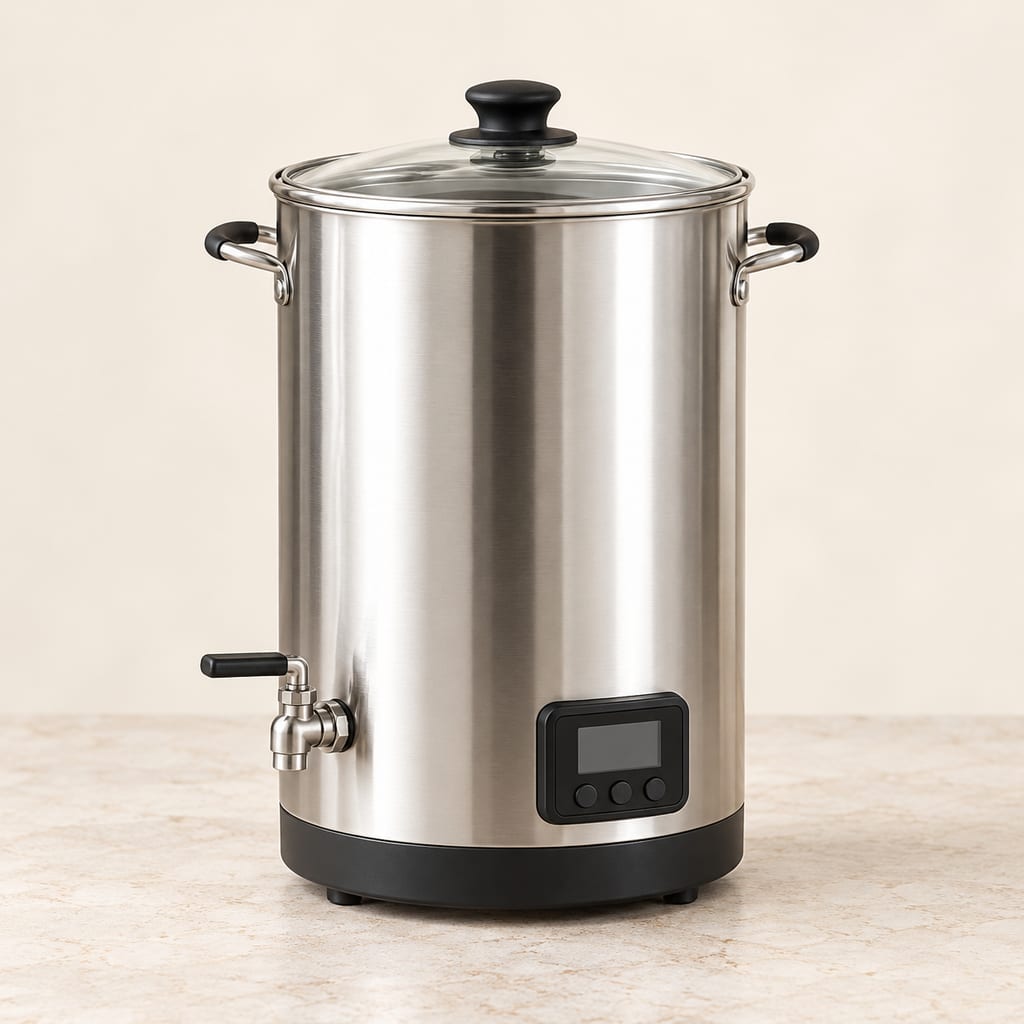
All-in-one brewer or electric mash kettle
An electric brewing vessel that combines controlled heating with a removable grain basket and, on the documented models, a recirculation pump for mashing and boiling wort.
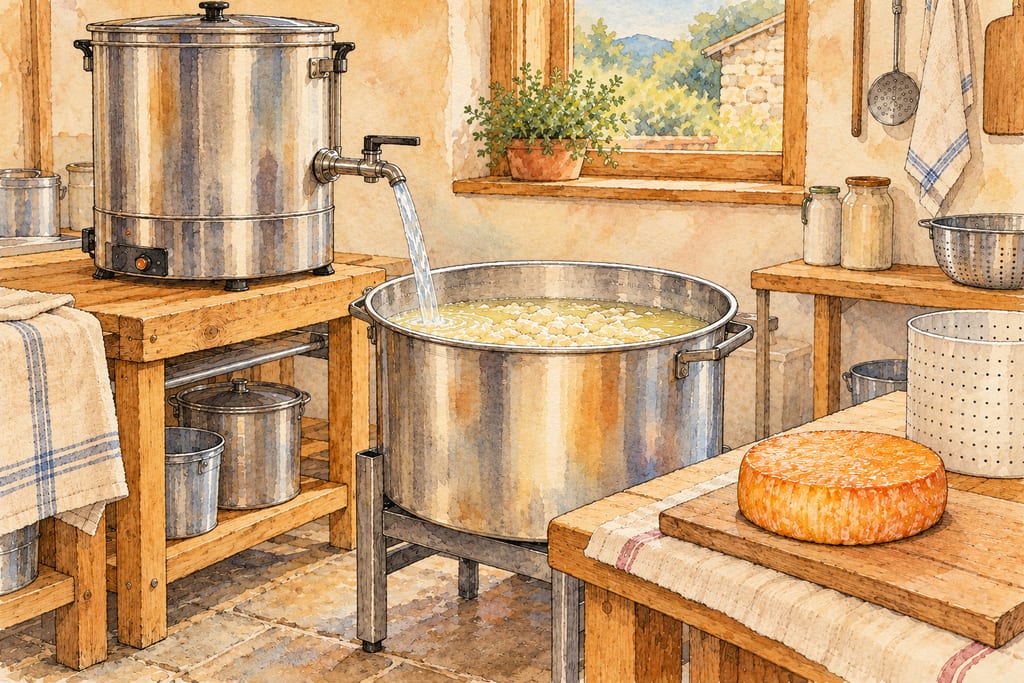
Brewer as a hot-water service station
The brewer holds clean water at a set temperature for washed-curd cheeses and other hot-water jobs, beside a separate cheese pot, instead of heating milk directly.
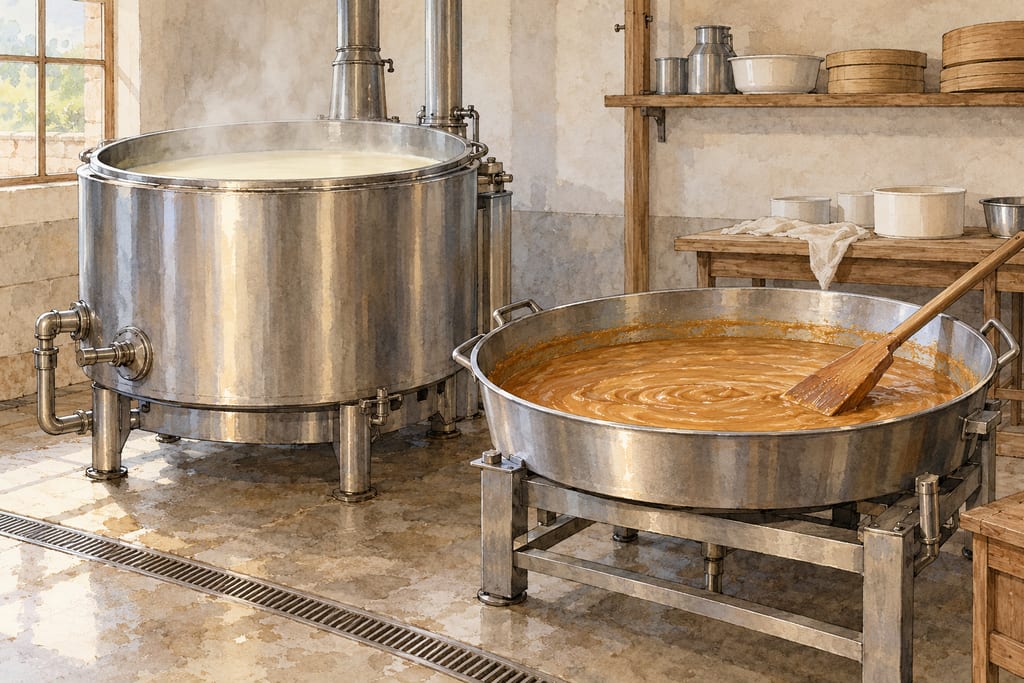
Brewer for bulk work and a finishing pan
The kettle heats and reduces a large volume of thin liquid such as whey; before it nears the brewer's minimum fill the batch moves to a wide pan for the thick, stirred finish.
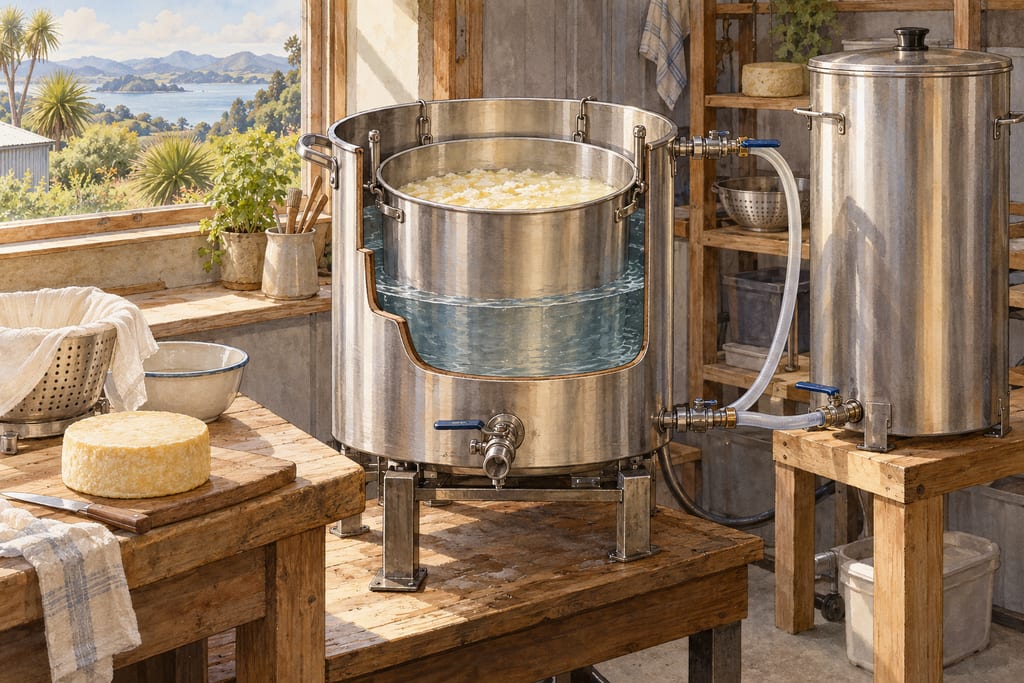
Custom brewery used as a nested cheese vat (Hamblyn)
New Zealand home cheesemaker Tony Hamblyn's custom brewery, in which a 50-litre cheese pot hangs in a 70-litre mash tun of circulated hot water; later one tank served purely as hot water.
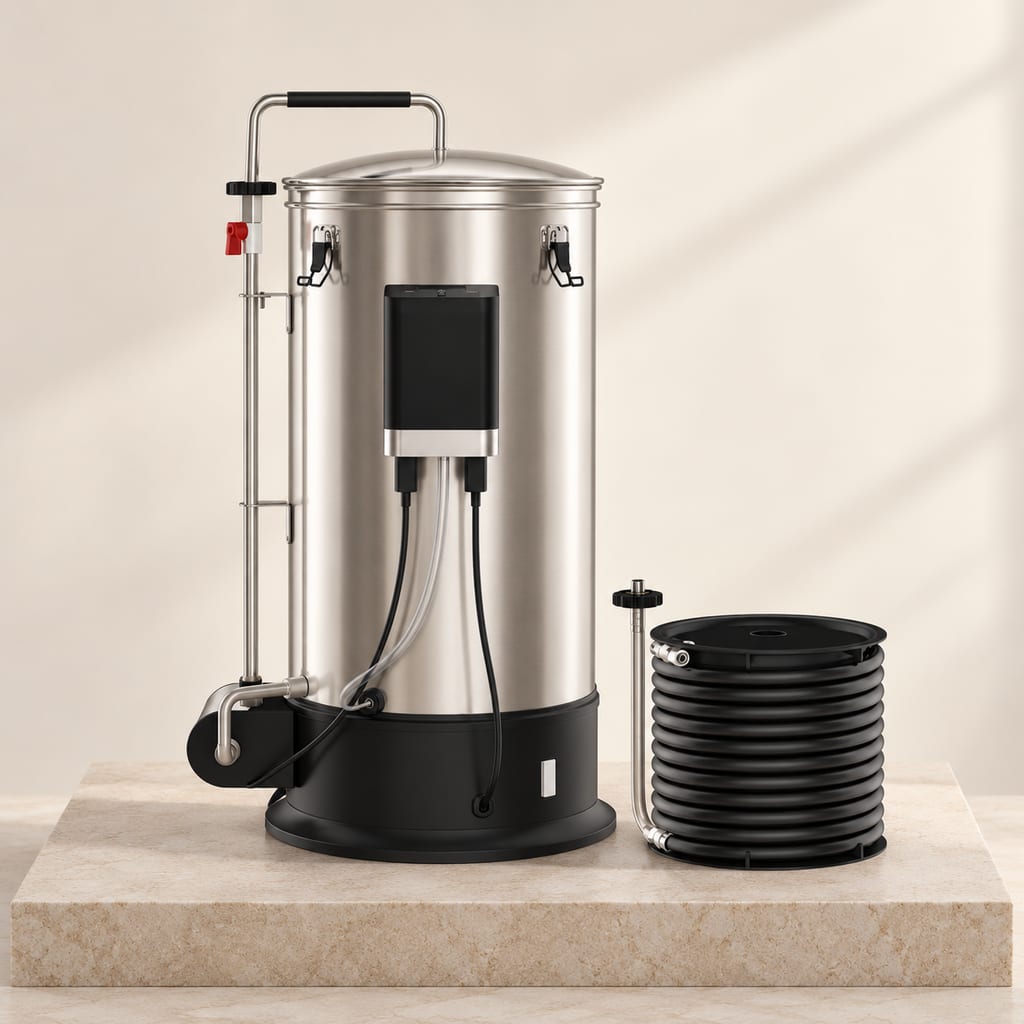
Grainfather G30 all-in-one brewer
A 30-litre stainless electric all-grain brewing system with a removable grain basket, controlled heat, pump-driven wort recirculation and counterflow chilling. Electrical ratings and controls vary by revision.
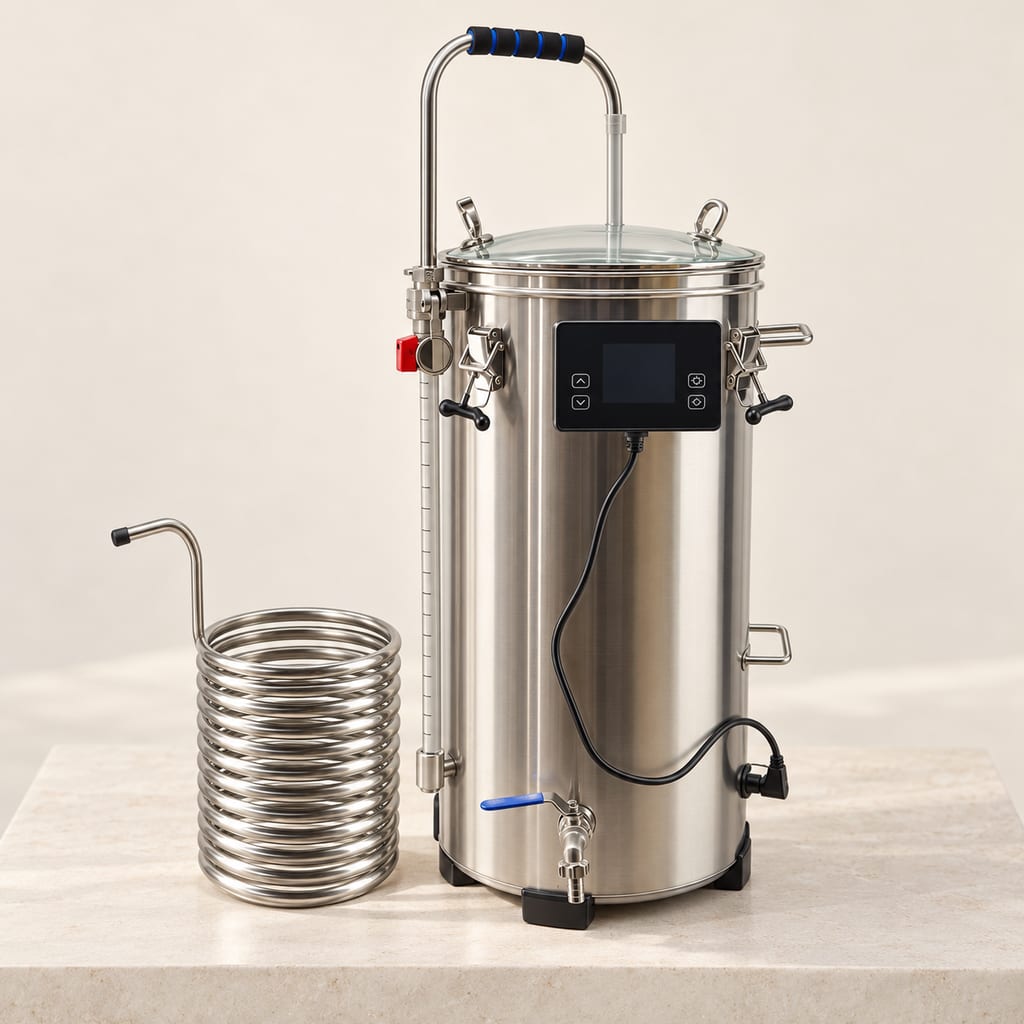
KegLand BrewZilla 35 L Gen 4.1
A 35-litre all-in-one electric brewing system with a malt pipe, pump, concave base and RAPT controller. KegLand lists 2,400 W and batches of about 25 litres; its manual specifies a 4-litre minimum fill.
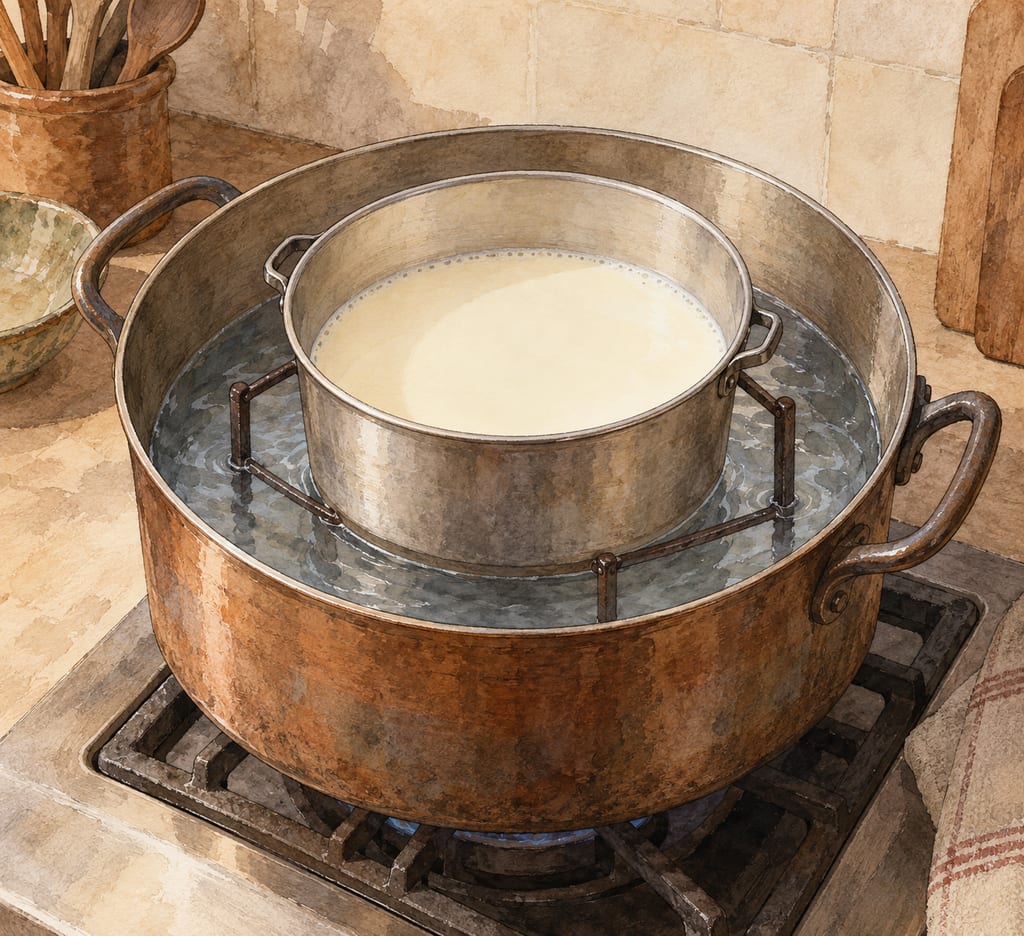
Supported pot inside a water bath
A food pot held at a fixed height inside a larger vessel of controlled hot water: the water distributes heat while the milk or whey inside stays still and away from the heater.
Community
No community contributions have been published for this entry yet.
Share what you made
Sign in to contribute. Published comments and photos are free to read.
Sources
New England Cheesemaking Supply Company (cheesemaking.com)
Tony Hamblyn Cheesemaker in New ZealandCited in: Tony Hamblyn's brewery double boiler; What water around the pot changes; Six ways to put a brewer to work; The rest of the brewer's workshop; A first trial and what to record
New England Cheesemaking Supply Company (cheesemaking.com)
Tony Hamblyn in New Zealand UpdateCited in: Tony Hamblyn's brewery double boiler; Six ways to put a brewer to work; Wash water: Gouda, baby Swiss and tomme; Cheddar, feta and canestrato: the work after the vat
Grainfather
Instructions - G30 (Grainfather G30 instruction manual PDF, 'Grainfather Connect Instructions')Cited in: Milk on a hot base, and the three stirring regimes; What the Grainfather and BrewZilla manuals establish; The rest of the brewer's workshop; Cleaning a brewery that has met milk
Grainfather Help Centre
What is a simple way of reducing power to the element on the G30 to lower the temperature?Cited in: Milk on a hot base, and the three stirring regimes; What the Grainfather and BrewZilla manuals establish
KegLand
35L BrewZilla Gen 4.1 | The Worlds Highest Selling Home Micro-BreweryCited in: What the Grainfather and BrewZilla manuals establish
New England Cheesemaking Supply Company (cheesemaking.com)
Cheddar Cheese Making RecipeCited in: Milk on a hot base, and the three stirring regimes; Six ways to put a brewer to work; Cheddar, feta and canestrato: the work after the vat
New England Cheesemaking Supply Company (cheesemaking.com)
Halloumi Cheese Making Recipe InstructionsCited in: Milk on a hot base, and the three stirring regimes; Halloumi: a cool set and a near-boiling finish; Whey ricotta and anari from the same batch
New England Cheesemaking Supply Company (cheesemaking.com)
Paneer Cheese Making RecipeCited in: Milk on a hot base, and the three stirring regimes; Six ways to put a brewer to work; The rest of the brewer's workshop
New England Cheesemaking Supply Company (cheesemaking.com)
Ricotta Cheese Making RecipeCited in: Whey ricotta and anari from the same batch
New England Cheesemaking Supply Company (cheesemaking.com)
Gouda Cheese Making RecipeCited in: Six ways to put a brewer to work; Wash water: Gouda, baby Swiss and tomme; The rest of the brewer's workshop
New England Cheesemaking Supply Company (cheesemaking.com)
Feta Cheese Making Recipe (Beginner)Cited in: Milk on a hot base, and the three stirring regimes; Cheddar, feta and canestrato: the work after the vat
New England Cheesemaking Supply Company (cheesemaking.com)
Tomme Style Cheese RecipeCited in: Wash water: Gouda, baby Swiss and tomme
New England Cheesemaking Supply Company (cheesemaking.com)
Swiss Cheese Recipe (Baby Swiss)Cited in: Wash water: Gouda, baby Swiss and tomme; Cheddar, feta and canestrato: the work after the vat
New England Cheesemaking Supply Company (cheesemaking.com)
Canestrato Italian Basket Cheese RecipeCited in: Whey ricotta and anari from the same batch; Cheddar, feta and canestrato: the work after the vat
TINE (tine.com, Asia site)
How is caramel cheese made?Cited in: Six ways to put a brewer to work; Brunost needs a second vessel
KegLand Distribution Pty Ltd (copy hosted by The Malt Miller)
BrewZilla 35L - Gen 4 Instruction Manual (Last Updated 30/08/2022), distributor copyCited in: What water around the pot changes; Milk on a hot base, and the three stirring regimes; What the Grainfather and BrewZilla manuals establish; Brunost needs a second vessel; Cleaning a brewery that has met milk
Penn State Extension (copy hosted by UC Agriculture and Natural Resources)
Home Cheesemaking (Penn State Extension, code ART-4803, (c) 2019)Cited in: Cleaning a brewery that has met milk; A first trial and what to record
Foods (MDPI) 2019, 8(7):232, doi:10.3390/foods8070232
Influence of Salting Method on the Chemical and Texture Characteristics of Ovine Halloumi CheeseCited in: Halloumi: a cool set and a near-boiling finish; Whey ricotta and anari from the same batch
Foods (MDPI) 2021, 10(5):1016, doi:10.3390/foods10051016
Effect of Farming System (Organic vs. Conventional) and Season on Composition and Fatty Acid Profile of Bovine, Caprine and Ovine Milk and Retail Halloumi Cheese Produced in CyprusCited in: Halloumi: a cool set and a near-boiling finish
Food Chemistry: X 2025, 32:103341, doi:10.1016/j.fochx.2025.103341
The effect of pH on the microstructure, rheological and functional properties of halloumi-type cheese: pH-structure-function relationshipsCited in: Halloumi: a cool set and a near-boiling finish
Food Science & Nutrition 2020, 8(7):3070-3080, doi:10.1002/fsn3.1463
Detection of dairy fouling by cyclic voltammetry and square wave voltammetryCited in: Milk on a hot base, and the three stirring regimes
Foods (MDPI) 2026, 15(3):428, doi:10.3390/foods15030428
Relationship Between Rennet Coagulation Properties of Milk, Cheese-Making Losses, and Cheese Yield in Manufacture of Parmigiano Reggiano PDO CheeseCited in: Milk on a hot base, and the three stirring regimes; Whey ricotta and anari from the same batch
Foods (MDPI) 2025, 14(8):1413, doi:10.3390/foods14081413
A Comparison of the Physicochemical Properties and Sensory Attributes of Ricotta Cheeses Purchased from Retail Outlets in PolandCited in: Whey ricotta and anari from the same batch
Foods (MDPI) 2025, 14(24):4258, doi:10.3390/foods14244258
Whey: A Valuable Technological Resource for the Production of New Functional Products with Added Health-Promoting PropertiesCited in: Whey ricotta and anari from the same batch
New England Cheesemaking Supply Company (cheesemaking.com)
Quark Cheese Making RecipeCited in: The rest of the brewer's workshop
Maangchi (maangchi.com)
Rice punch (Sikhye) recipe by MaangchiCited in: The rest of the brewer's workshop
Ministry of Agriculture, Forestry and Fisheries (MAFF), Japan
Beverages | Traditional Foods in JapanCited in: The rest of the brewer's workshop
Marukome Co., Ltd.
Koji Amazake Mustard Pork (recipe page)Cited in: The rest of the brewer's workshop
Maangchi (maangchi.com)
Homemade rice syrup (Ssal-jocheong) recipe by MaangchiCited in: The rest of the brewer's workshop
Ministry of Agriculture, Forestry and Fisheries (MAFF), Japan
Processed bean products | Traditional Foods in JapanCited in: Six ways to put a brewer to work; The rest of the brewer's workshop
Maangchi (maangchi.com)
Soy milk (Duyu) recipe by MaangchiCited in: The rest of the brewer's workshop
University of Minnesota Agricultural Extension Service
Homemade Maple SyrupCited in: The rest of the brewer's workshop
Maangchi (maangchi.com)
Dessert punch with persimmon, cinnamon, and ginger (Sujeonggwa) recipe by MaangchiCited in: The rest of the brewer's workshop
Gaps
- No published account gives milk temperature curves for a pot nested in a commercial all-in-one brewer, or a safe load for a rack or rim bridge inside one.
- How a brewer's controller, boil-dry cut-out and minimum fill behave when its liquid is a still bath around a second pot is unknown.
- For milk heated directly in a brewing kettle, the base temperature at reduced power, the point at which protein starts to stick and the curd yield compared with a water bath are unmeasured.
- How long a nested brewer pot takes to bring whey to the 88-91 C needed for halloumi is unknown.
- No home brunost method with quantities is established, and the endpoint is unclear to a cook who does not measure dry matter.
- No complete cultured mozzarella or burrata method, with its stretching acidity, is available for the brewer set-up.
- Culture names and doses for the Cheddar, feta and tomme recipes, the rennet dose for feta and the 4-gallon baby Swiss, and the milk volumes for tomme and canestrato are unknown.
- No home keeping time is established for sweet wort used as a cooking ingredient.
Updated 2026-10-27