
Drinks
Sbiten sellers of the Moscow street
A 1799 quota of three hot barrels a day, a recipe missing from Domostroi's oldest copies, an opera hero and a wartime tablet: how Russia's street honey drink lost to tea.
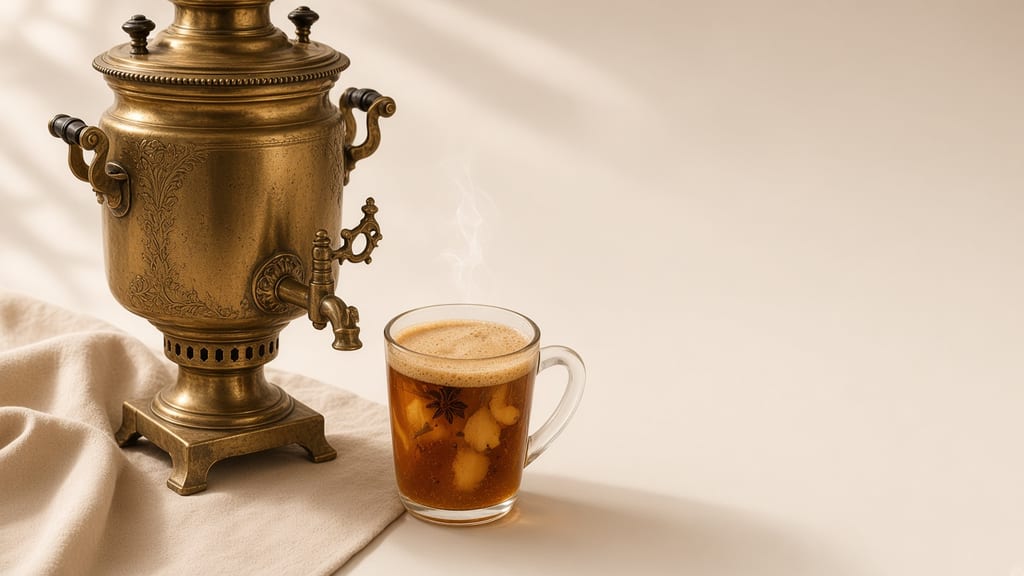
Portable iron sbitennik heater with wooden handle on warm ivory surface.
Three baklagi before noon
In St Petersburg in the 1790s, a man who sold sbiten in the street had a quota. He was hired for the whole winter on an agreed wage, and each day he had to sell three baklagi of the hot honey drink, at 150 kopecks a baklaga. Whatever he brought back unsold, the owner took off his hands at half price. Anything he sold over the quota earned him extra.
The baklaga was a wooden vessel. The seller wrapped it in felt and then canvas and carried it over his shoulder, and in hard frost it stayed hot from morning until about midday.
He carried more than the drink. Pretzel-shaped krendeli hung from a strip of bast, with buns or kalachi. His glasses rode in a hard leather case that Yakov Basin, who wrote all this down in 1799, compared to a soldier's cartridge pouch. On days when the church did not forbid it, he held a bottle of milk in his left hand and poured a little into a customer's glass on request.
A drink the city ran on
Sbiten is honey dissolved in water, boiled with pepper, ginger, bay leaf or whatever herbs the maker liked, and drunk hot. For roughly two centuries it was the hot drink of the Russian street. Cabbies, market clerks, soldiers on parade, seminary students and hospital patients drank it, and the state wrote it into naval stores and recruit rations. Then tea arrived in quantity, the sellers' urns were turned over to tea, and by the end of the nineteenth century the sbitenshchik had mostly gone.
The written record of the trade is better than the drink's reputation suggests. A sixteenth-century household manual gives a recipe. A 1799 book gives the sellers' quota and wages. A comic opera made one of them its hero. Ration orders give quantities to the half pound, and a Moscow doctor tried to bring the drink back during the First World War as pressed tablets. Read in order, these documents show how a cheap honey drink was made, who paid for it, and why tea won.
A recipe with vinegar in it
The oldest written recipe sits in Domostroi, the sixteenth-century manual on running a Muscovite household. The 1867 edition, printed from manuscripts in the Imperial Public Library in St Petersburg, gives it in a single sentence under the heading "On sbiten": a glass vessel of wine, a glass vessel of vinegar, a quarter of pepper, a pound of patoka, "three grivenki", and as much foreign wine as one happens to have, all boiled together with honey, "so that it does not boil over". When it is done it is left to settle and poured off into a vessel.
Patoka is a thick sugar syrup. The vinegar is the surprise, and the article just before it in the manual explains how to make vinegar from wort, honey and patoka kept warm on the stove for weeks. The sbiten that follows was a strong, sweet, sour, peppery cordial for the household store, nothing like a street drink.
Even this short text is unstable. A 2017 English version in Russian Life adds a bottle of beer that the 1867 Russian text does not have. And the 1867 editor added a footnote to the vinegar article: this article and those that follow it are absent from the Arkhivsky and Tsarsky copies, two of the oldest manuscripts. The first sbiten recipe in Russian is missing from the oldest copies of the book that contains it.
Sailors, soldiers and a legend
Basin opens his chapter by saying the sbiten trade existed by the leave of Peter the Great. He gives no document. A later story, printed as legend, has Peter caught in a storm in the Gulf of Finland in 1714, rowing ashore to light a signal fire and then asking whether the boat carried "sea sbiten and rusks". He drank a glass, told the oarsmen to drink two each, and slept by the fire under a sail.
The paper record starts a little later and is drier. On 6 July 1750 the Governing Senate, considering the brewing of beer, sbiten and kvass for naval servicemen, ordered ships on long campaigns to carry sbiten in place of beer, because sbiten did not spoil. For the Epiphany parade of 1758 the Empress Elizabeth ordered every soldier standing in the frost to be given two charki of vodka, two glasses of sbiten and a warm kalach.
By the nineteenth century sbiten had become a field ration with a written method. An 1852 instruction for officers leading parties of recruits says that men who did not drink their vodka ration were to get sbiten bought with the money saved. For 25 men: 30 pounds of water, half a pound of sage and an ounce of lemon balm, with lime blossom or bay leaf as substitutes, honey stirred in at the second boil up to a pound, a zolotnik of cinnamon or cloves, a quarter of an hour to steep, and a strainer. In besieged Sevastopol the sick and wounded drank a stronger version, one and a half pounds of honey to 25 pounds of water with 3 zolotniks of ginger or 2 of black pepper.
The kit
Basin's seller carried a wooden barrel. Later sellers carried the sbitennik, an urn strapped to the back with hot coals inside and layers of heavy cloth outside to hold the heat. Others poured the boiled drink into copper teapots or wooden baklagi, wrapped them in cloth and set out on foot. A half-round box of mugs or glasses hung at the sash.
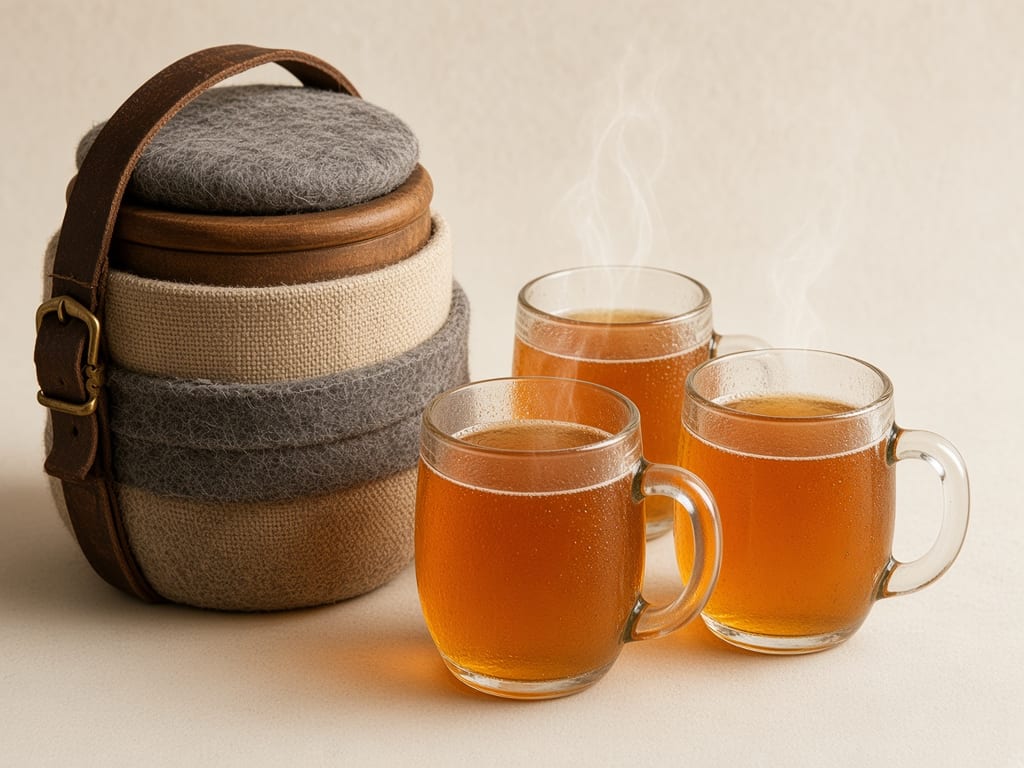
The mugs were pot-bellied, with a rim turned inward so the drinker did not burn his lips. Towels hung at the waist. Some sellers tied on a second small barrel of stewed dried pears or prunes for customers who wanted "sbiten with berries", and some kept a flask of vodka in a pocket for those who wanted it hotter.
Not every seller walked. The big markets had fixed kureni, huts where sbiten was boiled in huge samovars for the traders and their customers, and the smell of hot honey and spice carried across the square. Cabbies and shopkeepers who spent long hours in the cold used small sbiten shacks with a large window and a great urn on show.
Stepan the sbitenshchik
Yakov Knyazhnin wrote a comic opera about a sbiten seller in about 1783. The plot borrows from Beaumarchais's barber and Moliere's school for husbands. Stepan helps a young officer, Izved, win Pasha from her guardian, the merchant Voldyrev, who wants to marry her himself. The curtain rises at dawn on a St Petersburg street, and Stepan enters alone, selling: "Вот сбитень! вот горячий! Кто сбитня моего? Все кушают его: И воин, и подьячий, Лакей и скороход". Here's sbiten, hot sbiten, who'll have mine? Everyone drinks it, the soldier and the clerk, the footman and the runner.
Stepan explains his trade. He once worked for an apothecary, pounding almonds, sugar and cinnamon, and the habit of compounding medicines led him to make sbiten. His sbiten, he says, is held in great respect in the whole town, "that is, by the poor and the stingy".
The joke landed. The first known performances were in St Petersburg on 2 October 1786 and in Moscow on 27 January 1787, and Moscow saw the opera 40 times between 1787 and 1806. In 1802 a young Mikhail Shchepkin played Stepan. A Soviet revival in 1921 was titled The Sbiten Seller, with Erast Garin in the cast.
The opera's modern editors add the note that matters for this story. By the end of the eighteenth century, they write, tea, coffee and chocolate had pushed sbiten aside, and the drink, being cheap, had become mainly a treat for common people. Stepan's line about the poor and the stingy was already true.
Faces in the plates
The sellers were drawn as often as they were written about. Sbiten hawkers were common enough in eighteenth- and nineteenth-century Russian towns to turn up in engravings, woodblock prints and watercolours. Basin's 1799 text was itself written to go with a set of street-trade images.
One of the best-known pictures of the trade is in A Picturesque Representation of the Manners, Customs, and Amusements of the Russians, published in 1803 in three volumes with a hundred coloured plates. Its artist, John Augustus Atkinson, arrived in Russia in 1784 at the age of 9 with his uncle James Walker, engraver to Catherine the Great's court, and stayed 17 years.
Across these pictures the kit hardly changes: a wrapped vessel, a towel, a row of glasses and a string of bread rings.
Schools ran on it
Monasteries kept the older habit. Abbot Damaskin of Valaam recalled that on great feast days, at three in the afternoon, the kitchen boiled sage with red buckwheat honey in a cauldron, and the brothers drank this sbiten in the refectory from wooden cups. Each monk got two cups, one to drink from and one to use as a saucer.
From November to April, many Russian schools, almshouses and orphanages began and often ended the day with sbiten. What came with it showed rank. At Moscow's First Gymnasium in the 1830s, pupils of common birth got a glass of raw milk or sbiten and a piece of black bread for breakfast, and the noble boys, housed separately, got tea with milk and a quarter of a small white loaf.
At the St Petersburg seminary, before the 1830s, there was no official breakfast, and a servant sold the students sbiten and rolls. A sbiten seller was even allowed to rent a room inside the seminary walls, and when the authorities tried to evict him, the seminarians rioted.
In the Vladimir church school of the 1840s, a future archbishop remembered, the sbiten seller came to the pupils' lodgings each morning with a hot samovar in his hand, kalachi at his side and glasses in his belt. Two glasses cost a semitka, 2 kopecks. Boys without money drank on credit and marked their debts in notches on sticks.
Not everyone was grateful. A cadet of the Noble Regiment recalled tea with milk and white bread twice a year, at Christmas and Easter, and "disgusting, rancid sbiten" on the other 363 days. The War Ministry's supply rules for hospitals specified sbiten boiled "from clean, good honey", which suggests what stewards were tempted to use instead.
Sbiten as a powder
One cookbook complicates the whole picture. Vasily Levshin's Russian Cookery of 1816 has a recipe headed "kitchen sbiten for keeping" that contains no honey and no water. It is a spice powder: a quarter pound each of pepper and ginger and 8 zolotniks each of cloves, nutmeg and cinnamon, each pounded separately, mixed, sifted through a sieve, bottled, stoppered and kept dry. About 102 g each of pepper and ginger, then 34 g each of the rest.
Levshin seasons fish soup with "sbiten of all spices", and he argues that home-made powders of herbs, field mushrooms and honey fungus can replace "sbiten from foreign spices" for anyone not determined to buy only the expensive thing. In his kitchen, sbiten was the pounded mix itself, and the name follows the verb sbit, to beat or pound.
Vladimir Dahl's dictionary, in its second edition, takes the drink side. It defines sbiten as a hot drink "of scorched honey with spices" and records the sellers' patter: "Сбитень горячий, пьют подьячи! Сбитень сбитенек пьет щеголек!" Hot sbiten, the clerks drink it; sbiten, little sbiten, the dandy drinks it. Dahl also lists the kuren, the hut where sbiten was boiled and sold.
"Scorched" is chemically fair. Heating honey browns its sugars through caramelisation and the Maillard reaction, the same reactions that brown a bread crust, and both produce hydroxymethylfurfural. Honey graders measure that compound to tell old or overheated honey from fresh. A sbiten maker boiled the honey on purpose.
A hundred roubles a chest
Tea began as a luxury. In 1785 the best green tea cost 100 roubles a chest of 2.73 kg. Two years earlier the fabulist Ivan Krylov had arrived in St Petersburg and taken a government post at 25 roubles a year. A dozen ordinary porcelain cups cost 4 roubles.
The switch from sbiten to tea happened institution by institution, and people remembered the dates. The Tsarskoye Selo Lyceum served sbiten in place of tea in 1812, which Anton Delvig called the "economical" year, and many of the boys disliked it. When a temporary director named Frolov brought back tea and rolls in 1814, Pushkin wrote him a mock ode. A Tver schoolteacher remembered Pushkin calling in a sbiten seller for his whole company and joking: "What do we need tea for? This is our national drink." On 27 October 1847 the Holy Synod allowed the St Petersburg Theological Academy to give its students tea with sugar and rolls at breakfast in place of sbiten and a roll.
Taverns got ahead of the change. The writer Yevgeny Grebenka, recalling the 1830s, asked for tea and was given sbiten by a red-bearded innkeeper who swore it was tea and that all the seminarians drank it under that name. Moscow had a saying for merchants who had moved up: they had started putting on airs and playing the gentleman, drinking tea in place of hot sbiten.
Then the price fell. In 1801–1810 Russia imported 75,000 poods of tea, about 1,230 tonnes. From 1 April 1862 tea came by sea as well as overland through Kyakhta, and in 1862–1871 imports reached 1,614,000 poods, about 26,400 tonnes. Tea houses opened and city guidebooks began to note which inns offered rooms with a samovar. Honey went the other way. Forests were being cut and forest beekeeping was shrinking, and good honey for sbiten grew harder to find.
Even the clergy argued for the samovar. In 1863 Archpriest Mikhail Levitov, helping reform the Ryazan seminary, asked for the money spent on morning tea, sbiten and broth to go to the students so they could drink tea in their rooms in the evening: "An hour spent by a humming samovar in comradely talk will give no small innocent comfort."
Tea never became cheap by European standards. In 1898 the cheapest black tea cost 1 rouble 42 kopecks a pound in Russia against 18–20 kopecks in London, and Russians drank 0.87 pounds a head a year to the English 5.8. A folk ditty asked whether the copper samovars had made people poor.
Okhotny Ryad
The sbiten sellers lasted longest where people stood still in the cold. Vladimir Gilyarovsky, describing Moscow's Okhotny Ryad market, puts them among the pie men and pancake sellers on the pavement, pouring hot sbiten at a kopeck a glass. It was, he writes, the favourite honey drink of the time, and it warmed the cabbies and the clerks freezing in unheated shops.
His cabbies stood in groups by their sledges, smoking, talking and drinking sbiten, or vodka, which the sbiten sellers also sold with the tacit leave of the policeman on the beat. In summer the kvass sellers took over the same pavement, and the favourite was pear kvass, ladled from a bucket next to pyramids of soaked boiled pears.
Gogol had already fixed the type in a provincial window in Dead Souls: a sbiten seller with a copper samovar and a face as red as the samovar, so that from a distance there seemed to be two samovars on the sill, if one of them had not had a beard as black as pitch. By then the urn and the face were interchangeable.
Fermented or not
Most sbiten was boiled and sold the same day, and nothing in it fermented. The Domostroi recipe gets its alcohol from wine added to the pot. Tavern sbiten was fortified with wine, brandy or vodka. Street sbiten was generally sold plain.
There is one account of a slower method: herbs and spices pounded in a mortar, honey or molasses added, and the paste left to ferment slightly before boiling water was stirred in to make a lightly alcoholic drink. The account gives no quantities, times or temperatures.
Russian cookbooks kept fermented honey drinks apart. Elena Molokhovets's 1901 household manual gives six meads as recipes 3552–3557, among them a sugar mead, raspberry and blackcurrant meads and a monastery mead for drinking, next to its kvasses and beers. It has no recipe called sbiten at all.
Tablets for a dry war
The last attempt to save sbiten came with prohibition. When the sale of vodka stopped at the start of the First World War, the writer A. I. Faresov praised "this forgotten folk drink" as a substitute for alcohol, crediting Professor Snegirev with reviving it.
V. F. Snegirev, a well-known Moscow doctor, said he had been prompted by a letter: with spirits no longer sold, people who traded outdoors were freezing, and tea did not warm them enough. His answer was dry sbiten in small pressed tablets, each dropped into a glass of hot water to make a glass of spiced sbiten, at one and a half kopecks a tablet. A soldier's packet of 15 lasted a week.
For the home, O. N. Shamanskaya offered condensed sbiten: 5 pounds of patoka or honey boiled with cloves, cinnamon, ginger roots, cardamom, mace and bay leaves until dark and thick, kept in a glass jar in a cool place, and stirred into boiling water a tablespoon at a time. Neither idea brought the street trade back. Honey kept getting dearer and tea cheaper.
What is left
The vessels went to museums. The Nevyansk museum keeps a sbitennik, a vessel with one chamber for the drink and one for the fire, the arrangement the samovar inherited.
The drink survives in small batches. In Suzdal, the remains of the medovukha plant built for the Soviet tourist trade after 1967 were bought in 1999 and restarted, and its owners told Kommersant in 2006 that they planned sbiten concentrates next. Near Torzhok in Tver region, an artel led by Dmitry Slobodskoy brews sbiten from honey, northern berries, herbs and spices, up to 500 litres a month, mostly to order.
Five hundred litres a month is a small business. In Basin's St Petersburg, one hired man with a felt-wrapped barrel on his shoulder had to sell three baklagi every day before he earned a kopeck more.
Related
Discussed in this article
Honey
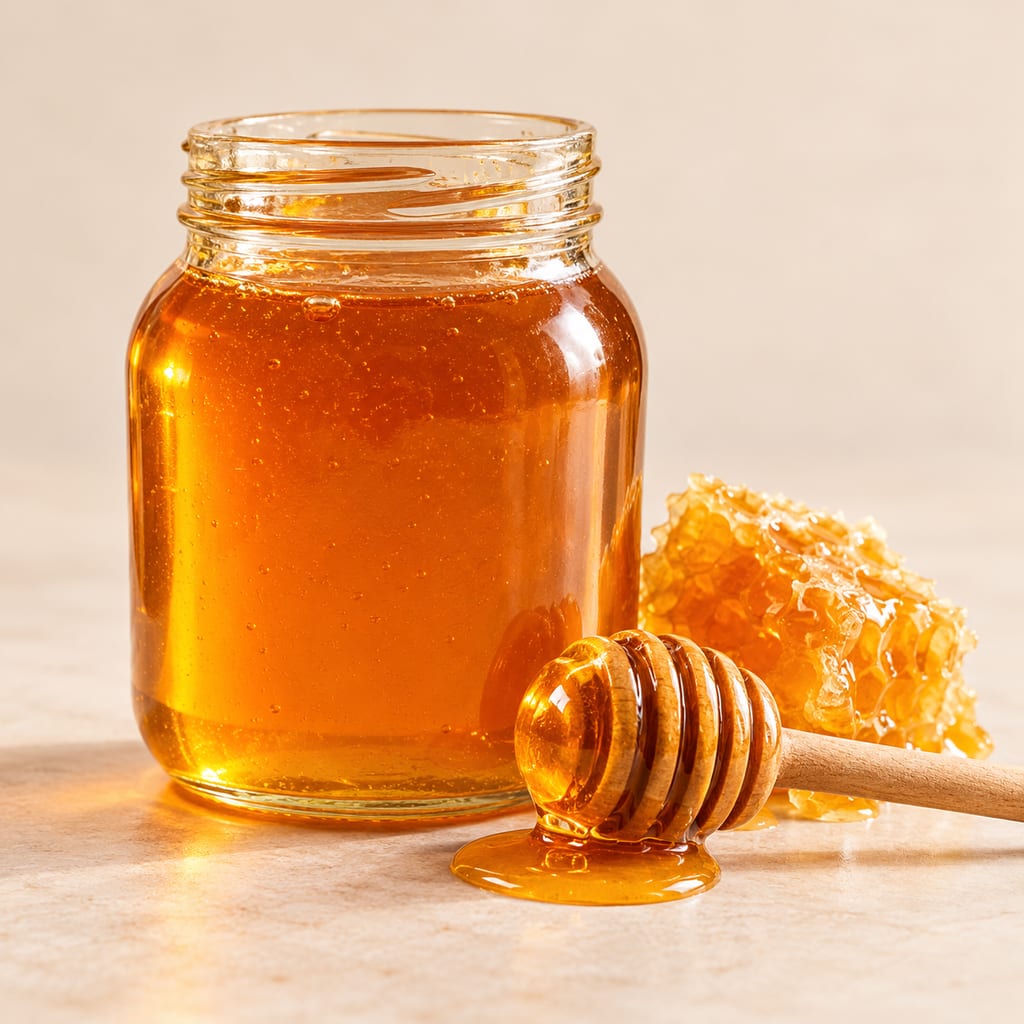
Honey is a bee-made food from floral nectar or honeydew; breads use it in dough or as a syrup served with cooked griddle breads.
Mead
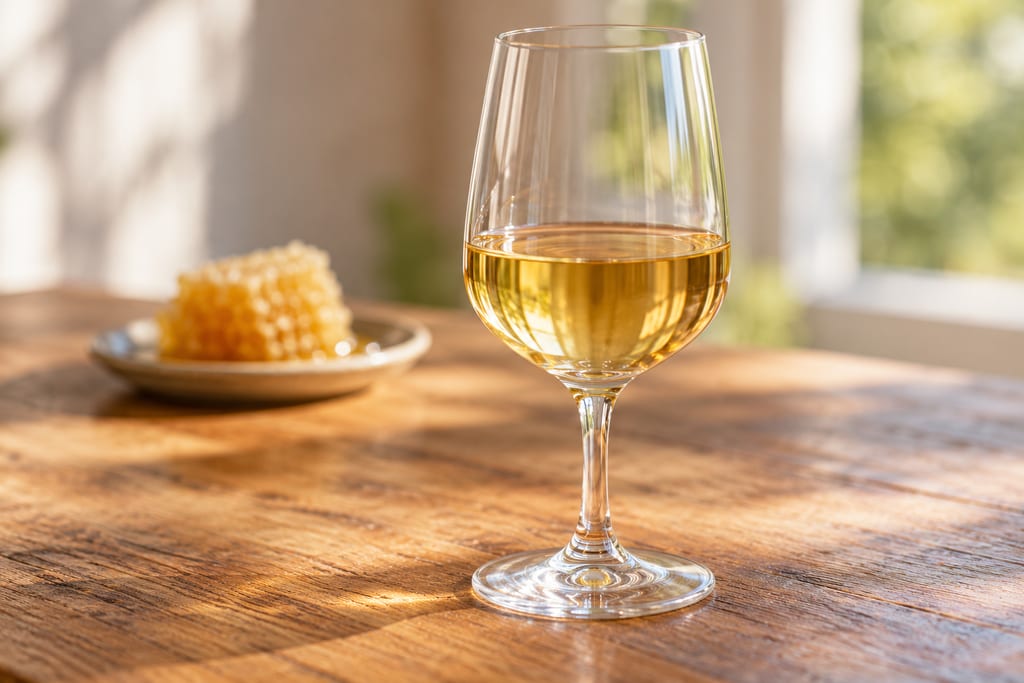
Mead is an alcoholic drink made by fermenting diluted honey with yeast, then racking and ageing it. The honey, not refined sugar, is what makes it mead.
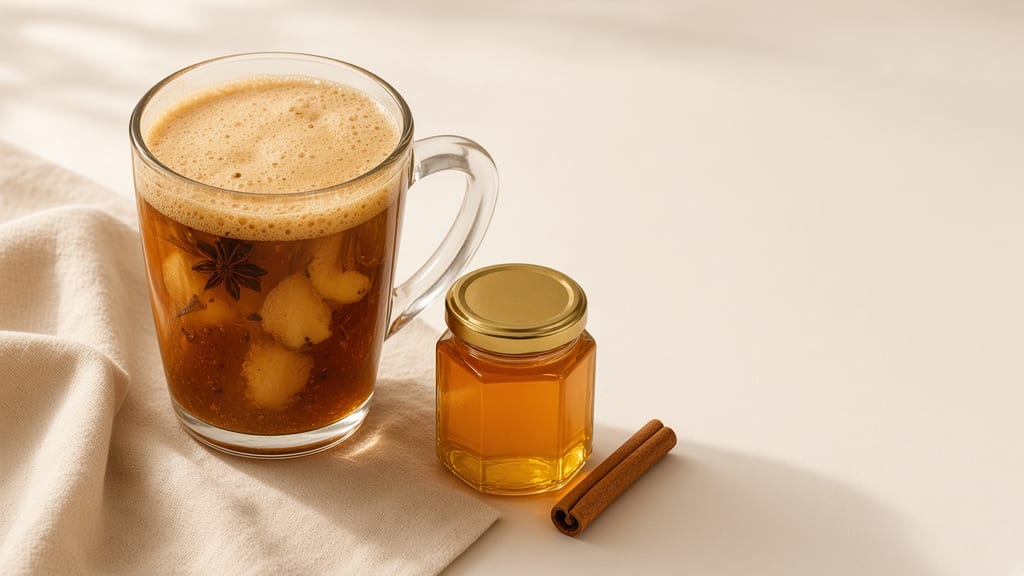
Sbiten
Hot Russian street drink of honey boiled with spices: a plain cup, the 1799 milk finish and a dark honey concentrate kept in a jar for a spoonful per glass.
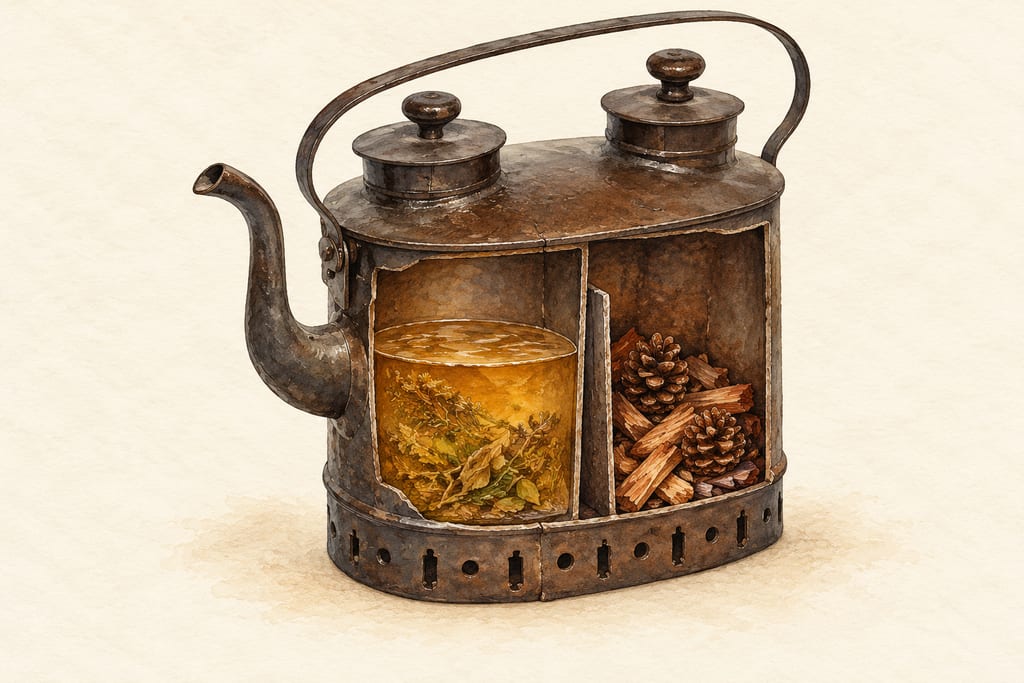
Sbitennik
A sbitennik is a portable vessel for heating and pouring sbiten. Museum records show a divided fire-and-liquid chamber and several nineteenth-century forms, from Nevyansk ironwork to copper and brass examples.
Community
No community contributions have been published for this entry yet.
Share what you made
Sign in to contribute. Published comments and photos are free to read.
Sources
Russian Life, Darra Goldstein, January 2003
A Honey of a Winter DrinkCited in: A drink the city ran on; The kit; Sbiten as a powder; Okhotny Ryad; Fermented or not
Russian Life, November 2017
Sweet SomethingsCited in: A recipe with vinegar in it; Stepan the sbitenshchik; Faces in the plates; A hundred roubles a chest
Nevyansk State Historical and Architectural Museum, Artefact (culture.ru)
СбитенникCited in: What is left
ed. D. Yakovlev, St Petersburg 1867 (Internet Archive)
Домострой по рукописям Императорской Публичной библиотекиCited in: A recipe with vinegar in it; Fermented or not
Ya. I. Basin, Moscow 1799 (transcription, CoolLib)
Национальныя изображенія промышленниковъ, снятыя съ натуры въ Санктпетербургѣ, ch. III ЗбитенщикCited in: Three baklagi before noon; A drink the city ran on; Sailors, soldiers and a legend; The kit; What is left
Manfred Schruba, XVIII век, сб. 31, 2024 (CyberLeninka)
Вокруг книги Я. И. Басина «Национальные изображения промышленников» (1799)Cited in: Three baklagi before noon; Faces in the plates
Wikisource
Сбитенщик (Княжнин), with notes from Комедии XVIII века (Hyperion 2003)Cited in: A drink the city ran on; Stepan the sbitenshchik
Vladimir Dahl, Wikisource
Толковый словарь Даля, 2-е изд.: Сбивать (сбитень)Cited in: The kit; Sbiten as a powder
Vasily Levshin, Wikisource
Русская поварня (1816): Запасание разных столовых и поваренных приправCited in: Sbiten as a powder
Kommersant, Svetlana Kuznetsova, 13 July 2015
«Стали важничать да барничать»: почему исчез самый любимый русский горячий напитокCited in: A drink the city ran on; Sailors, soldiers and a legend; The kit; Schools ran on it; A hundred roubles a chest; Tablets for a dry war
Elena Molokhovets (Internet Archive)
Подарокъ молодымъ хозяйкамъ, ч. 2 (1901)Cited in: Fermented or not
Torzhok Museum-Reserve, 2025
Сбитенная артель: как под Торжком варят десертный напитокCited in: What is left
Store norske leksikon, Knut Hofstad
russiske masseenheterCited in: Sailors, soldiers and a legend; Sbiten as a powder; A hundred roubles a chest; Tablets for a dry war
New Zealand Beekeeper, Kate Robertson, September 2019
HMF: the effects of aging and heat treatment of honeyCited in: Sbiten as a powder
Gaps
- The 1750 Senate order, the 1852 recruit instructions and Shamanskaya's concentrate are known only through their quotation in Kommersant in 2015; the original documents are not cited.
- The Domostroi text follows the 1867 Russian edition and Molokhovets follows the 1901 Russian edition. Published English translations of both are not cited.
- No source gives quantities for the slightly fermented sbiten paste.
Updated 2026-11-14