
Drinks
The Kyoto koji riot
In 1419 a shogun gave one Kyoto shrine's koji makers a monopoly and smashed the brewers' koji rooms. In 1444 the brewers and Mount Hiei won it back, and Kitano Shrine burned.
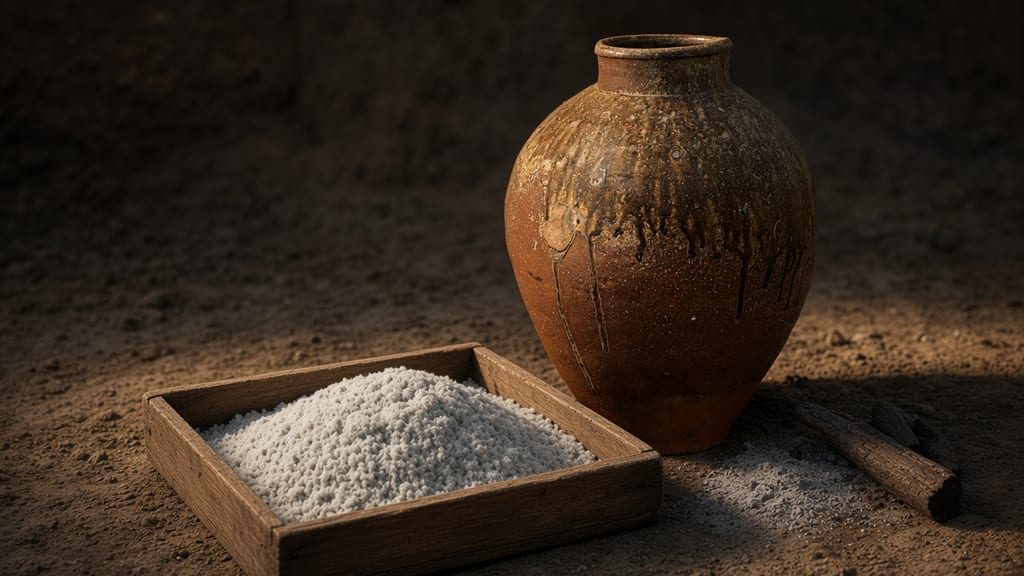
A modern reconstruction: a medieval-style stoneware storage jar beside a tray of rice koji.
The morning of the thirteenth
On the thirteenth day of the fourth month of Bun'an 1, 14 May 1444 in the Western calendar, the courtier Nakahara Yasutomi opened his diary and wrote that the weather was clear. Then he wrote about the fire. Around the hour of the dragon, the early morning, troops sent by the shogun's deputy Hatakeyama Mochikuni had gone into Kitano Shrine in the north-west of Kyoto. Inside were the men of Nishinokyō, the shrine's own koji makers, who had shut themselves in and vowed to stay for a thousand days.
Yasutomi's account is short and exact. The men inside broke into the western monks' lodgings, set fire to them and fought. The fire began at the north end of those lodgings. Everything within the east and south gates burned, the treasure pagoda with it, and the nearby Asahi-dera temple too. Two portable shrines and the shrine treasures were carried out to Shōbaiin, the household that ran the shrine. Only the sutra repository, with its scriptures, and the small shrine of the One-Night Pine were left standing.
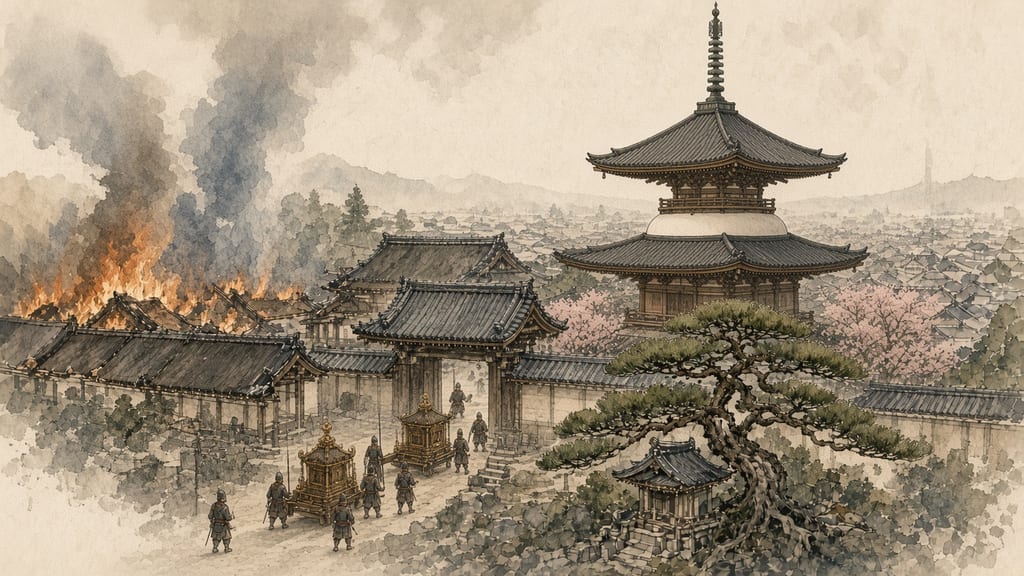
The fighting cost lives on both sides. Men of the city police under the Sasaki Kyōgoku house were wounded, and some were killed where they stood. In Nishinokyō, the shrine's district to the south, the residents set fire to their own houses, and Yasutomi heard that the whole quarter had burned to open waste ground. Because people had died inside the precinct, the shrine was declared defiled at the highest grade. The samurai-dokoro, the city's police office, whose men had been wounded, was given the second grade, and the shogun's deputy the third.
All of this was about koji, the mould-grown rice that starts every batch of sake. For a quarter of a century the men of Nishinokyō had held a legal monopoly on making and selling it in Kyoto. The capital's brewers wanted to grow their own, and they had Enryakuji, the great monastery on Mount Hiei, on their side. In 1444 the brewers won, and the shrine of the god of learning burned.
Grain, mould and a guild
Sake is made from rice in two biological steps. Steamed rice is grown over with Aspergillus oryzae, the koji mould, whose enzymes break starch into sugars; yeast then turns the sugars into alcohol. The koji is the expensive, skilled part. It needs a warm room, a watchful maker and a stock of good mould. Genetic work on the fungus, published in 2012, describes A. oryzae as a domesticated relative of a wild species, selected by people over a long period for this work.
By the Kamakura period, in the 13th and 14th centuries, Kyoto's brewers were a fast-growing trade, and koji came to them from separate specialists. Those koji makers lived around Kitano Shrine, held the status of jinin, lay servants of the shrine, and were organised as a za, a guild that paid its patron for the right to trade. The Kitano koji guild, the koji-za, supplied the west of the city and claimed it as its own market.
The Nishinokyō jinin had other duties too. They carried shrine offerings and took part in its rituals, and their rights came from the shrine's authority. No law of the state granted them. That arrangement worked as long as brewers bought their koji. It began to fail when the richer brewers, men with capital and storehouses of their own, started making koji in their own premises.
Their shrine stood at the north-western edge of the capital. Kitano was founded in 947, by the shrine's own account, to honour the spirit of the courtier Sugawara no Michizane, who had died in exile and was later worshipped as Tenjin, the god of learning. Like most large shrines of the time it was run together with Buddhist clergy. Its precinct held monks' lodgings, a pagoda and a sutra store as well as the main hall, and the Asahi-dera that burned in 1444 had served as its shrine temple from the start. The One-Night Pine, whose small shrine survived the fire, recalled the legend of a thousand pines that sprang up there in a single night.
Koji was not new in Kyoto. The court's own kitchen had made grain and soybean pastes with it since at least the 10th century. What was new was a city trade large enough to fight over.
Two patrons
Every guild in medieval Kyoto had a patron, and the brewers' patron was Enryakuji, the great Tendai monastery on Mount Hiei above the city. In the Shōwa years, 1312 to 1316, the city had 335 dosō, pawnbroker-moneylenders, of whom 280 were described as under the monastery's influence. Many brewers were moneylenders too, because a wealthy brewer had a storehouse and spare cash. Suzanne Gay's study of these lenders counts around 350 of them tied to Enryakuji in the early 15th century.
Kitano Shrine itself sat inside the same hierarchy. In the 15th century it was a branch of Enryakuji, and Sugitani Risa's 2020 study shows the jinin dealing directly with the Saitō, the monastery's western precinct. So the quarrel was not shrine against temple in a simple way. Both the koji makers and the brewers answered, in the end, to Mount Hiei, and the monastery took a cut from both.
In 1393 the shogun Ashikaga Yoshimitsu changed the rules. A decree on the moneylenders and brewers of the city made every one of them pay tax straight to the shogunate, guild or no guild. In return the shogunate took over powers the temples had held. Enryakuji objected and lost. The patrons' grip on the city trades loosened, and the trades began to look to the shogunate.
The decree of 1419
The koji makers saw their chance in that shift. They offered the shogunate money, and on the twelfth day of the ninth month of Ōei 26, in 1419, the shogun Ashikaga Yoshimochi issued an order granting the Nishinokyō jinin the sole right to make and sell koji anywhere in Kyoto. Yoshimochi favoured Zennō, the head of Shōbaiin, the household that managed Kitano Shrine, and the order went through Shōbaiin.
Enforcement was physical. Within weeks shogunal officers were going from brewery to brewery. The Kyoto City Archaeological Research Institute, summarising the documents for a 2014 public lecture, counts 52 brewers' koji rooms broken up in front of officials. Each brewer then signed a pledge, an ukebumi, promising never to make koji again. Dozens of these pledges survive in the Kitano archive, dated from the end of the ninth month onwards. Several say plainly that the signer's koji room had been destroyed. Some are signed with a full monogram; others with a rough mark.
Sugitani tabulates the pledges and puts the number of brewers brought under the order at 342. Earlier historians read the decree as part of Yoshimochi's wider restraint on drinking. He was a devout follower of Zen who disliked alcohol, and he had already restricted drinking in Zen temples. Whatever his motive, the order turned the koji makers of one shrine district into the only legal suppliers to a city of several hundred breweries.
Paper in the shrine
Most of what is known about the koji guild comes from its own papers. Kitano Tenmangū still holds them: 99 documents of the Nishinokyō jinin, mounted as 9 hand scrolls, 33 hanging scrolls and 2 loose letters, running from the 14th century into the Edo period. Japan's Agency for Cultural Affairs designated them an Important Cultural Property on 21 August 2014. Its citation calls them a rare surviving archive of a commercial guild, and a source that shows, in specific terms, how Kyoto's brewers did business and how a guild dealt with the shogunate.
The brewers' pledges of 1419 are part of that archive, which is why the order's enforcement can be followed almost door to door. Sugitani's table lists each pledge by date and signer: one Yūkō on the 29th day of the ninth month, Izumi on the same day, a woman called Myō, a Godayū, and on into the tenth month. They are short and formulaic. Each signer accepts the order and promises never to make koji again.
The scale of the trade behind them was large. Katō Hyakuichi, writing on sake and shrines for the Brewing Society of Japan in 1984, notes that the survey of the mid-1420s found 342 brewers in the city, and that some of them brewed 300 koku a year, about 54,000 litres. Kyoto was buying koji for all of them, and in 1419 one shrine district was told it could sell all of it.
Jars under the floor
What a Kyoto brewery looked like at this time can be seen under the modern city. In 2008 archaeologists excavating at Karasuma-Ayanokōji, in the commercial heart of the old lower town, found a townhouse of the early Muromachi period, the 14th century, with a frontage of six bays facing Ayanokōji street. Inside, a grid of large Tokoname stoneware jars had been sunk into the floor. The excavators reconstruct 66 of them, in about 15 rows running north to south.
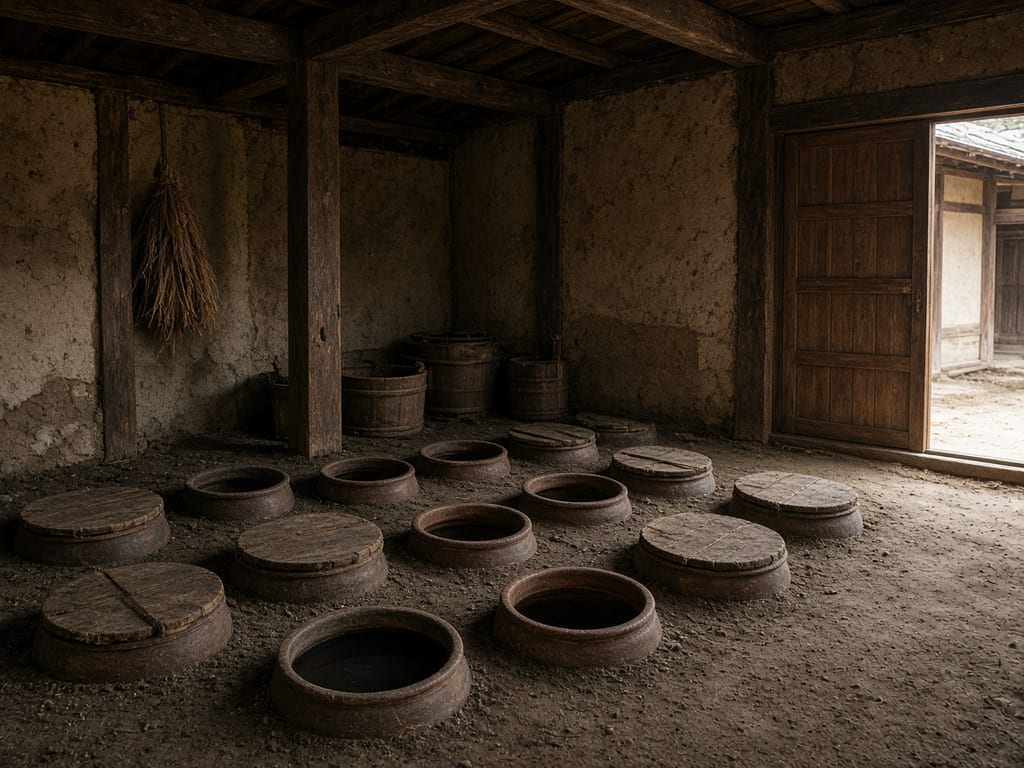
Next to the jars was an underground store about 5 metres by 2.5 metres and a metre deep, lined with boards held by stakes, with stones in the floor that once carried a slatted deck. The excavators read the building as a sake brewer's house, and a later shogunal list of brewers records a brewer on that very block after the Ōnin war.
The 2014 lecture goes a step further and suggests that underground rooms like this one might have been koji rooms, which needed steady warmth and damp. It is careful to add that no trace of koji mould has been confirmed in any of them, and that no koji room has yet been securely identified in Kyoto's ground. The jars are certain. The room where a brewer grew his own koji, and an officer broke it up in 1419, is still a guess.
Packhorse men and cheap rice
The 1419 decree did not end the quarrel; it moved it. Enryakuji asked Kitano to give up the monopoly. Kitano refused, because the koji money came to it too. Under shogunal pressure the monastery's three precincts met in assembly and, in a resolution dated to the intercalary first month of 1420, accepted the arrangement. In 1425 the shogunate tightened control again, hunting down brewers who made koji and drawing up a register of the trade. The register of 1426 lists 347 brewers, by the archaeology institute's count.
Then the packhorse men stirred. The bashaku of Sakamoto, the lakeside port below Mount Hiei, carried rice into the capital, and they worked under the monastery's protection. In 1426 they planned to break into the city and wreck Shōbaiin. Their complaint, as it was reported, was that the monopoly had cut the brewers' demand for rice, rice prices had collapsed, and with them the packhorse trade. Sugitani reads the plot as a protest against the koji monopoly itself.
In 1428 it came to open confrontation. From the 27th day of the seventh month, monks of the Saitō barricaded themselves in the precinct's Shaka Hall, and on the 27th of the eighth month their assembly demanded an end to the koji monopoly. The jinin answered by shutting themselves into Kitano. On the 18th of the ninth month the shogunate confirmed the monopoly again. The historian Shimizu Katsuyuki has argued that the great debt riot of that same year, the Shōchō uprising, began as an attempt by the packhorse men to break the koji monopoly at Kitano, and that the famous attacks on moneylenders were a side effect once troops blocked the road to the shrine.
Spring 1443 to spring 1444
By the 1440s the balance had shifted. In 1441 the shogun Ashikaga Yoshinori had been murdered at a banquet in the Kakitsu incident, and the shogunate that followed was weaker and run by its senior vassals. In the spring of 1443, Yasutomi's diary records, the city brewers and moneylenders sued once more against the koji monopoly, and they had Enryakuji's support.
On the seventh day of the fourth month of Bun'an 1, 8 May 1444, monks of Enryakuji shut themselves in the Saitō's Shaka Hall and then took their protest to the capital in the old way, a gōso, a forceful petition backed by the threat of the gods. The shogunate gave in and revoked the monopoly.
It was now the jinin's turn to feel betrayed. They gathered at Kitano and declared a sennichi-gomori, a thousand-day seclusion inside the shrine, a ritual siege of the kind monks used. The shogun's deputy Hatakeyama Mochikuni did not wait a thousand days. On the morning of the thirteenth, six days after the monks began their barricade, he sent in his troops.
What burned
Yasutomi's entry is the core witness, and Sugitani prints it in full. It is written in the classical Chinese of court diaries, and its phrases are blunt. The fire's source was the north end of the western monks' lodgings. Everything inside the east and south gates was lost. The Tahōtō pagoda and Asahi-dera went with it. Only the sutra repository and the One-Night Pine shrine survived. The western capital, he wrote, had burned entirely and become a wasteland.
The historian Sasaki Hajime has pinned the source more precisely, to the sutra store by the sacred well north of the western lodgings, behind the main hall to the west. On his reconstruction the burned area took in the main hall, the subsidiary shrines behind it, the offering hall and other buildings to the east, the Lotus hall and the pagoda, and spared only one corner of the precinct to the south-west.
The city archaeology institute's summary puts the result in two lines: the koji guild gave way to the brewers and declined, and the shogunate's authority fell while the great temples and shrines won back their influence. What the shogun's men had burned, in a sense, was their own monopoly. Twenty-five years earlier the same government had smashed brewers' koji rooms to protect the shrine's makers. Now it burned the shrine to protect the brewers.
Enemies of the god
Kitano's priests did not forgive the jinin. The fire had begun with their own hands, in the shrine's own buildings, and the shrine branded them shinteki, enemies of the god, and shut them out. Their pardon came only through Manshuin, the temple whose abbot held authority over Kitano, and even then the shrine's priests resisted.
The koji makers did try to win back their rights. In the eighth month of Tenbun 14, 1545, a century after the fire, the Saitō assembly issued a document ordering that koji in the western capital be made by the koji guild alone, as of old, because the trade had become a dead letter. Sugitani points out that the new claim spoke as if the monopoly had never been broken. By then the shogunate's word counted for little, and the grant did not last.
Formal readmission took longer still. The jinin's first petition to attend the shrine in their ceremonial dress is dated to 1598. Permission came in 1689, more than 240 years after the fire, and over the objections of the shrine's own priests.
Where the koji went
After 1444 the koji trade as a separate profession declined. Koji making became one step inside the brewery, and so it has stayed. Brewers, miso makers and soy sauce makers grow their own koji on their own premises to this day. Japanese Wikipedia names the riot as one cause of the rise of temple sake from Nara, Echizen, Ōmi and Kawachi, the famous monastery brews of the late Middle Ages.
The owner of one Kyoto firm has a theory about where some of the koji makers went. A brewer can grow koji but still needs good mould to start it. In Kyoto today the firm of Hishiroku sells tane-koji, the seed spores, to breweries across Japan. Its owner, Sukeno Akihiko, told nippon.com that the firm does not know its founding date or how many generations back it goes. Hishiroku's name appears in a copy of a 1769 manual of seed-koji making written by another maker. Sukeno suggests that after the riot some koji makers, unable to live from koji alone, turned to raising and selling good mould to the breweries, the trade of the moyashi-ya. That is his informed guess, not a documented line of descent.
The 2012 genome study of A. oryzae found the marks of that kind of long human selection in the fungus's genes. Generations of makers kept the cultures that worked and passed them on.
Roofs of taro stems
Every October the district south of Kitano still builds a shrine out of vegetables. The zuiki mikoshi, a portable shrine for the Zuiki festival, is roofed with zuiki, the stems of taro, in red and green, two tiers deep. Its corner tassels are made of dried aubergines and chilli peppers, its torii gate is faced with cut barley straw, and its carved panels are made of vegetables, fruit and seeds. The festival runs from the first to the fifth of October, and the shrine is carried through the streets on the fourth.
The festival grew out of the jinin's duty to bring food offerings to Kitano. Mieda Akiko of the University of Tokyo, who has spent years helping build the mikoshi with its makers, writes that the offerings turned into a mikoshi after the Ōnin war of the 1460s and 1470s. The Nishinokyō Zuiki Mikoshi Preservation Society, about 30 members, builds it now in late-night sessions each September. Members of the Shichiho-kai, a society of jinin descendants, still prepare offerings inside the shrine.
The paper trail is still growing. In 2022 Mieda learned that a group of documents from the Kanbe family, jinin of Nishinokyō, was for sale at a second-hand bookshop. It runs to about 600 items, from records of the family's status and rights to land plans and papers on the Meiji separation of shrines and temples. Her book on the jinin, published by Iwanami in 2022, is subtitled a thousand years of the people of Nishinokyō.
The koji guild that burned its own shrine in 1444 has no monopoly left and no koji rooms. Its descendants make a shrine of vegetables every autumn, in the district that Yasutomi wrote off as waste ground.
Related
Discussed in this article
Hishio
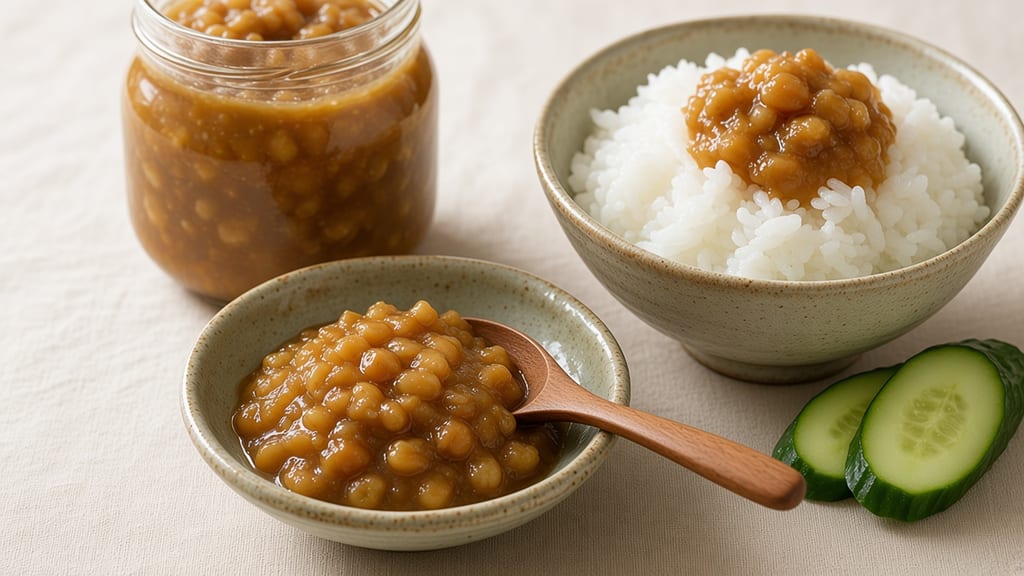
Hishio is soybean-and-barley koji soaked in soy sauce and water and stirred daily for about two weeks, a spoonable relish that descends from the grain pastes of Japan's Nara court.
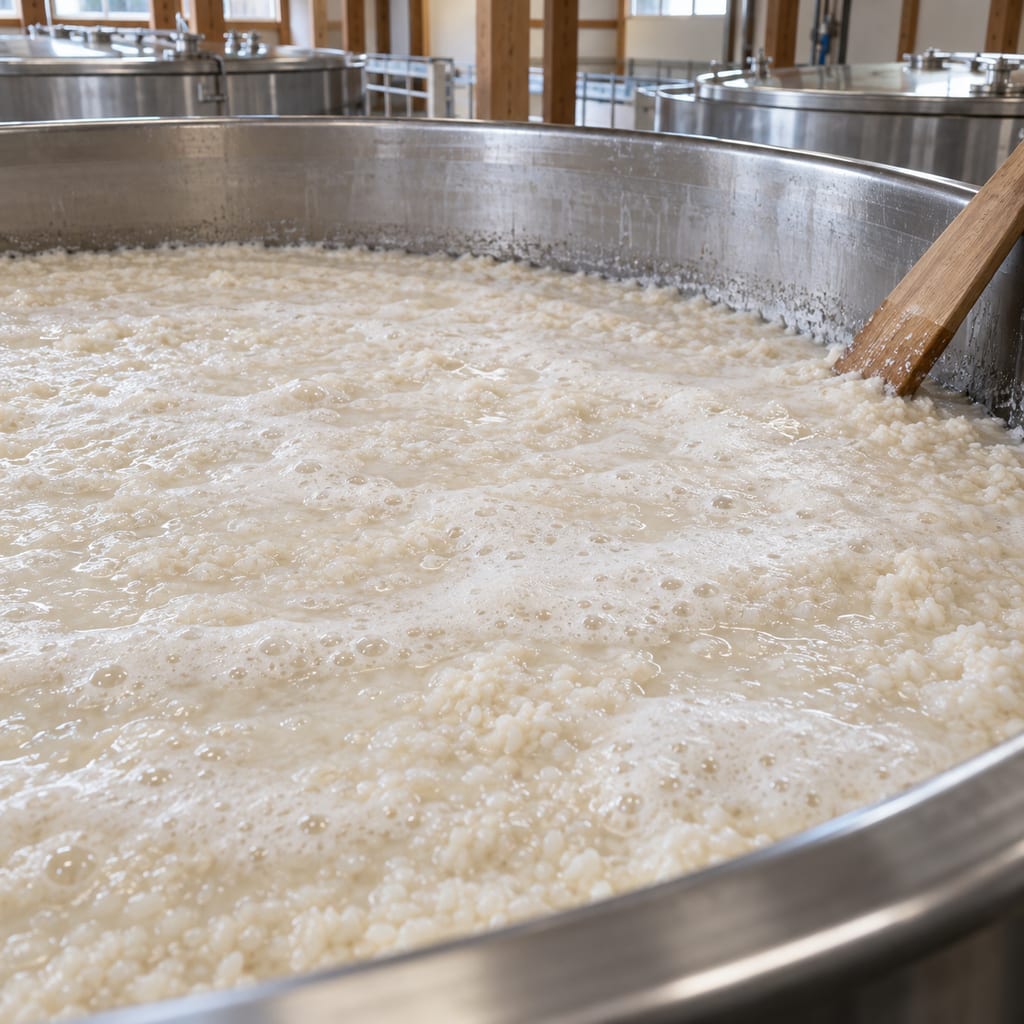
Nihonshu / seishu (Japanese rice sake)
Nihonshu (日本酒), or seishu, is Japanese rice sake: steamed rice, rice koji, water and a yeast starter ferment together in one mash, which is then pressed and finished.

Rice koji
Rice koji is steamed white rice through which koji mold has grown. It carries the enzymes that turn rice starch into sugar, and it is the starting point of sake, sweet miso, amazake and shio koji.
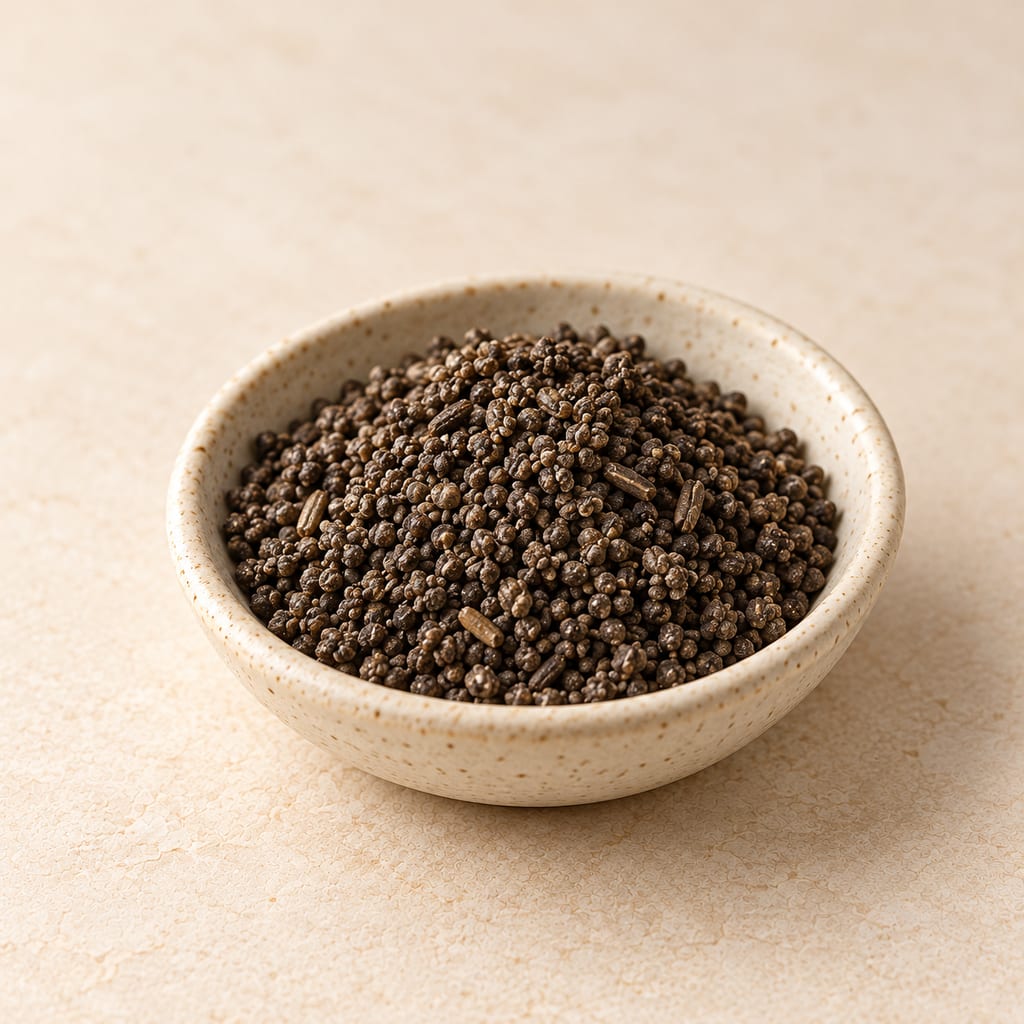
Seed koji
Tane-koji is the mold inoculum Sakimoto plants on steamed rice to make rice koji for Yonaguni awamori; its exact strain and supplier are unpublished.
Community
No community contributions have been published for this entry yet.
Share what you made
Sign in to contribute. Published comments and photos are free to read.
Sources
Sugitani Risa, Ritsumeikan Bungaku 668 (2020), DOI 10.34382/0002004442
戦国期酒麹専売訴訟にみる山門の京都支配:西京神人との関わりを中心としてCited in: The morning of the thirteenth; Two patrons; The decree of 1419; Paper in the shrine; Packhorse men and cheap rice; Spring 1443 to spring 1444; What burned; Enemies of the god
Japanese Wikipedia
文安の麹騒動Cited in: Grain, mould and a guild; Two patrons; The decree of 1419; Packhorse men and cheap rice; Spring 1443 to spring 1444; Enemies of the god; Where the koji went
Japanese Wikipedia
北野天満宮Cited in: Grain, mould and a guild; Spring 1443 to spring 1444; Enemies of the god
Katō Hyakuichi, Journal of the Brewing Society of Japan 79 (11), 1984, J-STAGE
酒神と神社(16)Cited in: Paper in the shrine
Kyoto City Archaeological Research Institute, 2014
土倉と酒屋の遺跡(第252回京都市考古資料館文化財講座)Cited in: Two patrons; The decree of 1419; Jars under the floor; Packhorse men and cheap rice; What burned; Where the koji went
Kyoto City Archaeological Research Institute, 2008
平安京左京五条三坊九町跡発掘調査現地説明会資料Cited in: Jars under the floor
UTokyo BiblioPlaza, University of Tokyo
Nihon Chusei no Minsyu-Sekai (The World of Commoners in Medieval Japan)Cited in: Roofs of taro stems
Kyoto Institute, Library and Archives (Kyoto Prefecture)
資料ガイド No.36 ずいき御輿Cited in: Roofs of taro stems
Journal of Japanese Studies 30 (1), 2004
Review of Suzanne Gay, The Moneylenders of Late Medieval KyotoCited in: Two patrons
Gibbons et al., Current Biology 22 (2012)
The evolutionary imprint of domestication on genome variation and function of the filamentous fungus Aspergillus oryzaeCited in: Grain, mould and a guild; Where the koji went
Iino Ryōichi, FOOD CULTURE No. 2, Kikkoman Institute for International Food Culture
醤油の歴史② 平安期における醤Cited in: Grain, mould and a guild
Gaps
- The Yasutomi-ki is quoted from Sugitani's printed extract, not from the Dai Nihon Kokiroku edition.
- The number of brewers under the 1419 order is 342 in Sugitani's table, while the archaeology institute counts 347 names in the 1426 register; the two figures count different documents.
- The 52 koji rooms destroyed in 1419 come from the archaeology institute's lecture summary; the underlying document was not checked.
- Shimizu Katsuyuki's reading of the Shōchō uprising and the link between the riot and the rise of temple sake are reported from Japanese Wikipedia, not from Shimizu's own work.
- Yoshimochi's dislike of drink as a motive is a view Sugitani attributes to earlier scholars; it was not checked in their work.
- Sasaki Hajime's reconstruction of the fire's source is known only through Sugitani's summary.
- The link between the riot and the seed-koji trade is the owner of Hishiroku's own suggestion.
- Mieda 2022 and Gay 2001 were not read in full.
Updated 2026-11-17