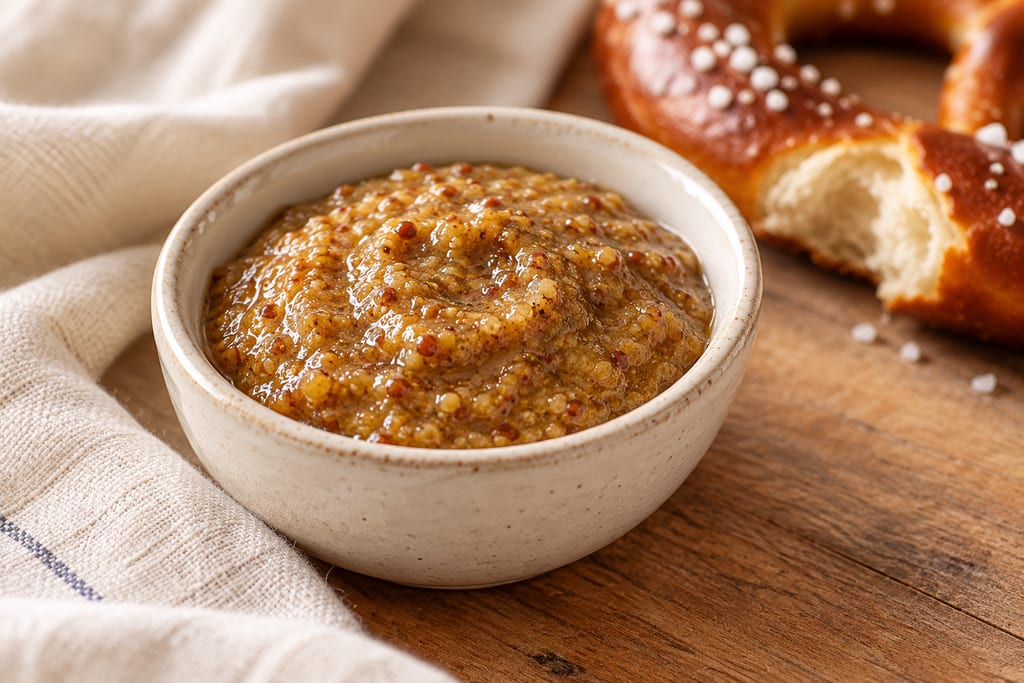
Bavarian sweet-inspired mustard
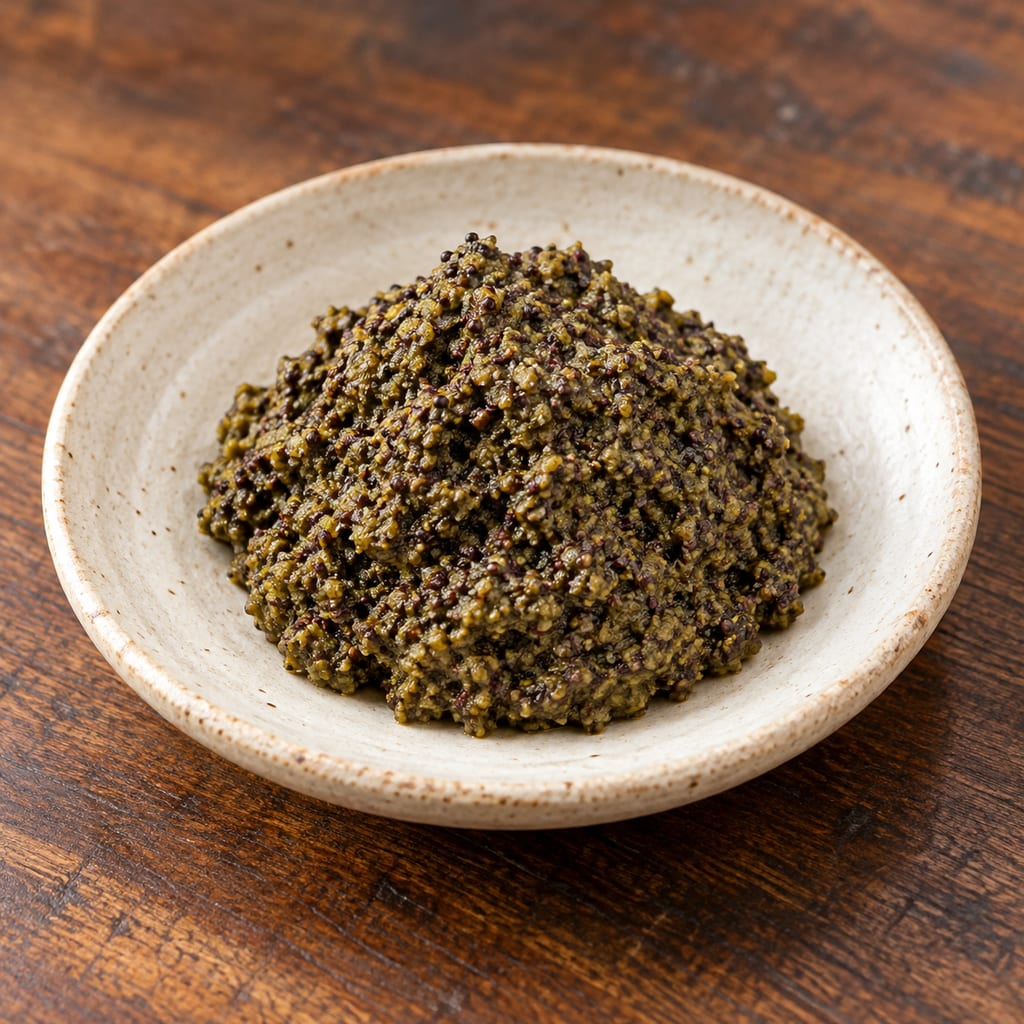
A coarse, sweet Bavarian-style mustard of yellow and brown seed in a cooked brown-sugar and vinegar base, made to eat with Weisswurst; an original refrigerated formula.
 FermenteaWhere food goes to change
Modern adaptation
English mustard mixed from powder · Freshly mixed English mustard
Ten grams of English mustard powder stirred with cool water into a thick cream: the plainest, sharpest mustard there is, mixed just before the meal.
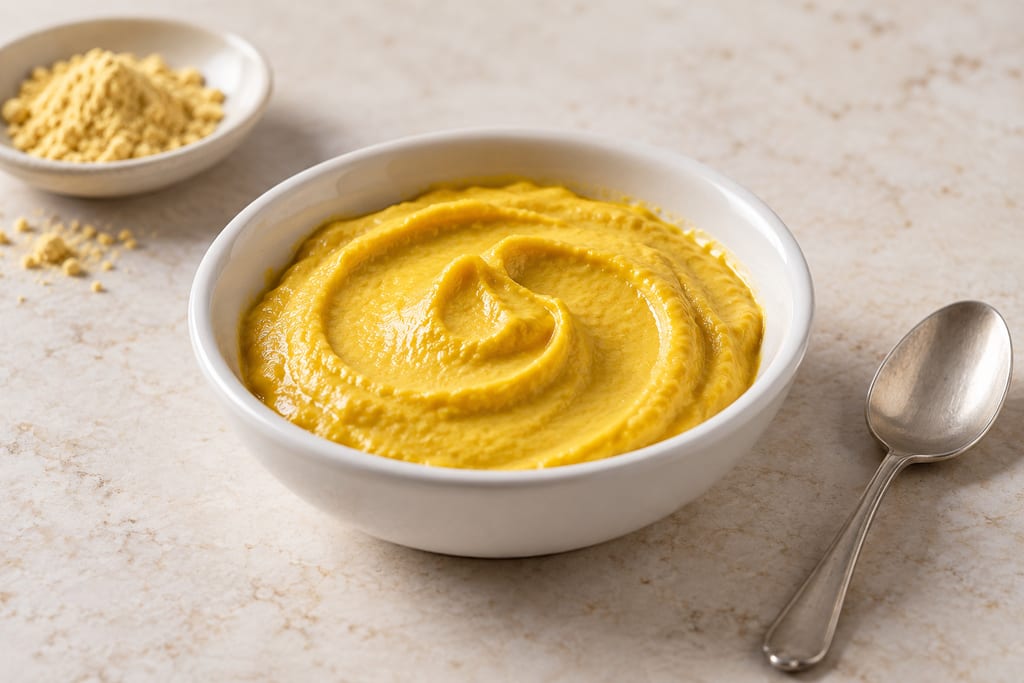
English mustard mixed from powder is the plainest mustard there is: finely ground seed, cool water and a few minutes' patience. Nothing in the tin is hot yet. Mustard seed carries sulphur-containing compounds called glucosinolates and, separately, an enzyme called myrosinase. While the seed is dry and whole the two stay apart; once its cells are broken and wetted, the enzyme converts the glucosinolates into isothiocyanates, the pungent compounds that give mustard its bite. Milling has already done the breaking, and the water you stir in does the rest. That is why a freshly mixed paste can feel fierce in the nose without tasting sour: its heat comes from chemistry started in the bowl, not from vinegar.
The formula keeps everything that might interfere out of the way. It uses water alone, cool rather than hot, and no acid. Heat is the clearest risk to fresh pungency: when myrosinase was extracted from black, brown and yellow mustard seed and tested in the laboratory, the three enzymes differed in how well they withstood heating, which helps explain why cooked and cold-mixed mustards made from similar seed behave so differently. Leaving vinegar out is this formula's own choice, on the reasoning that water should reach the powder first; anything sharper belongs to the prepared-style variation.
The rest after mixing is a flavour step, and its length belongs to the powder. Colman's foodservice instructions call for cold water and ten minutes, the figure this recipe uses; S&B gives water and four to five minutes for its own powder. Those are directions for particular products, and there is no single rule, fifteen minutes or any other, that fits every tin. A short wait before any acid goes in can change how hot the paste becomes, but nothing ferments in that time and nothing is made safer: the paste is simply reaching the pungency it was mixed for. Temperature works against it. Heating can inactivate the enzyme and alter the volatile fraction that carries the heat, so a fresh hot paste is mixed without heat and cooking is kept for milder, cooked styles.
Heat and sourness are separate sensations, and English mustard shows the difference better than any other. A freshly mixed paste can feel fierce in the nose without tasting particularly of vinegar, while a cooked American yellow mustard can be distinctly sour yet comparatively mild. Sugar, salt, seed variety, grinding, the timing of the acid and cooking each move one of those sensations, so a useful comparison names the one that changed instead of calling every mustard stronger or weaker.
Labels make the same point about sweetness. French's current US yellow mustard lists vinegar, water, mustard seed, salt and seasonings, with no added sweetener, while Colman's prepared English mustard contains sugar. Each label establishes what that one product contains. Neither says what every American or every Briton prefers, and an American condiment is not sweeter by nature: the yellow mustard is one of the plainest on the shelf.
Ten grams of powder to fifteen of water gives a thick cream that sits on the plate without running; up to five grams more water loosens it if it comes out too stiff. Make it close to the meal and put out a little at a time beside roast beef or ham, or spread it very thinly in a sandwich. The quantities are small on purpose. The paste is meant for the meal it was mixed for, and nobody has established how long a water-only mustard keeps.
Do not expect it to taste like the jar. Colman's own route to fresh mustard is its powder mixed with cold water and briefly rested, and that is a different thing from its ready-prepared English mustard, whose UK jar lists 21% mustard flour with sugar, salt, wheat flour, turmeric, citric acid and xanthan: sweetness, acid and texture modifiers that a powder-and-water paste does not have. The jar is a smooth hot mustard with some sweetness; the paste is fresh, direct heat. Nor does the paste share the jar's storage life. A commercial prepared mustard is kept as its own label directs after opening, and its heat treatment, preservatives and shelf-life assessment cannot be read from its taste. The dry tin has its own rules too: keep the unused powder dry, tightly closed and within its date, and remember that those instructions stop applying once water has been added.
Read the tin before you start. A packet sold as mustard powder may be pure mustard flour, a blend of seed types, or mustard with turmeric or other ingredients. The Colman's foodservice powder lists mustard flour; S&B's foodservice powder lists mustard flour and turmeric; and The Woks of Life notes that the Chinese dry mustard powder sold in Asian grocers is usually dry mustard with some turmeric. Colour is no guide to the seed, since turmeric supplies a bright yellow and some brown-mustard cultivars have pale seeds, so check the label before substituting one powder for another by weight. This recipe has not been kitchen-tested or tasted against Colman's or any other benchmark: treat it as a starting point, mixed fresh for one meal at a time.
This is a modern development formulation inspired by a named mustard style. Its particular formula has no documented historical origin.
Scaling: weigh every ingredient; scale by mass
The recipe contains mustard; people with mustard allergy need this ingredient identified.
Hazard sourceIdentify mustard clearly in ingredient and allergen information.
Control sourceThis is a water-mixed paste for one meal. The formula has not been tested for storage; mix it close to serving and discard the unused portion rather than borrowing a prepared jar's keeping time.
Contains mustard, an allergen; identify it clearly.
The supplied untested development formula has no documented place of origin; “English” describes its style label, not a sourced birthplace.
A coarse, sweet Bavarian-style mustard of yellow and brown seed in a cooked brown-sugar and vinegar base, made to eat with Weisswurst; an original refrigerated formula.
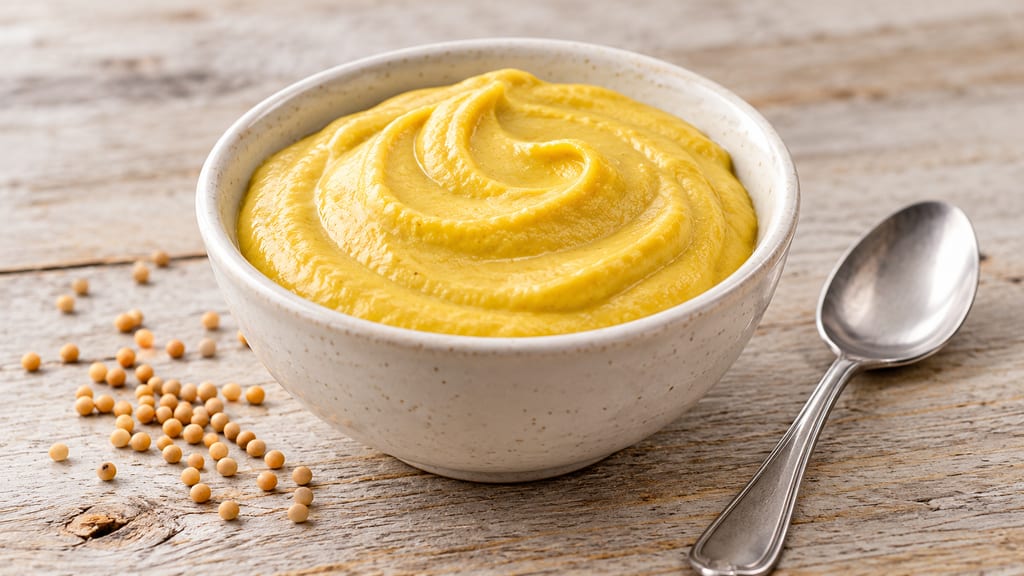
A mild, creamy Czech-style table mustard made from ground seed, vinegar, water, salt and a little sweetness. This home version follows a Czech Television formula and is not a copy of SPAK’s proprietary product.
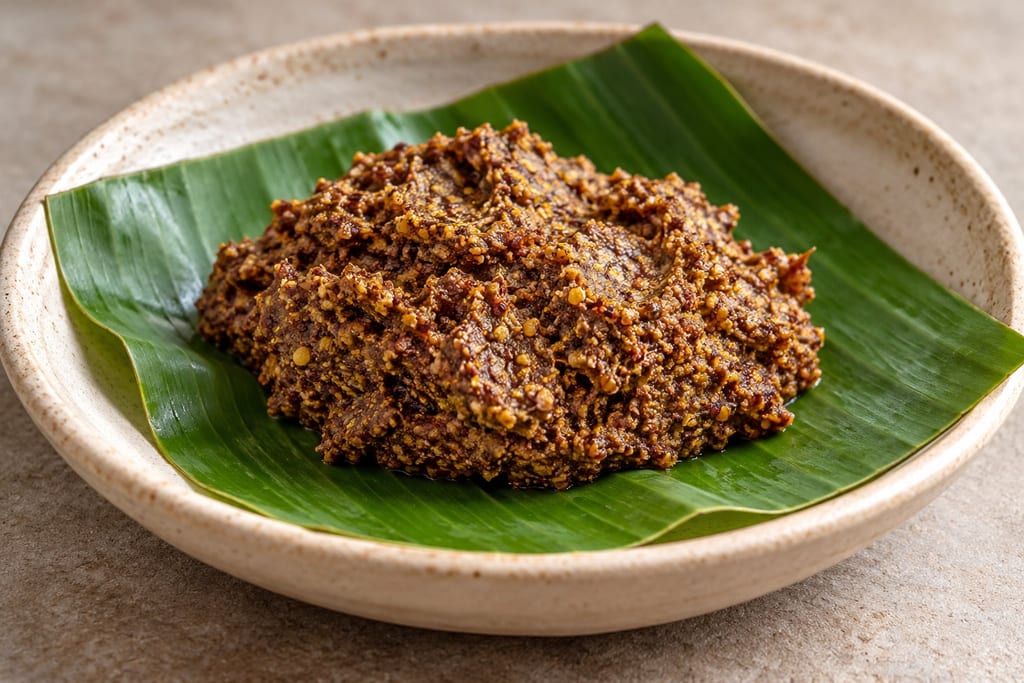
Kahudi is an Assamese mustard-seed condiment fermented with sour Thekera fruit into a strong mash; household methods and study results differ, and no validated home schedule exists.
A strong Assamese condiment of mustard seed mixed with khar, an alkaline banana-ash filtrate, wrapped in leaves and fermented in bamboo over a fire or in a kitchen pot.
No community contributions have been published for this entry yet.
Sign in to contribute. Published comments and photos are free to read.
Elsevier, Food ChemistryInspiration · Method
The effect of processing on the glucosinolate profile in mustard seedSupports the account in “Heat that is made in the bowl”.
Cited in: Heat that is made in the bowl
Elsevier, Food ChemistryInspiration · Method
Thermal and pressure stability of myrosinase enzymes from black mustard (Brassica nigra L. W.D.J. Koch. var. nigra), brown mustard and yellow mustard (full title continues beyond the record's display limit; the brown and yellow entries are Brassica juncea and Sinapis alba)Supports the account in “Heat that is made in the bowl”.
Cited in: Heat that is made in the bowl
The Woks of Life (recipe blog)Inspiration · Method
Chinese Hot MustardSupports the account in “The powder, the jar and the label”.
Cited in: The powder, the jar and the label
Colman's UKInspiration · Method
English MustardSupports the account in “Fierce in the nose, not sour”.
Cited in: Fierce in the nose, not sour
Food Standards Agency (GOV.UK)Safety
How to chill, freeze and defrost food safelySupports prompt chilling and refrigerator handling guidance.