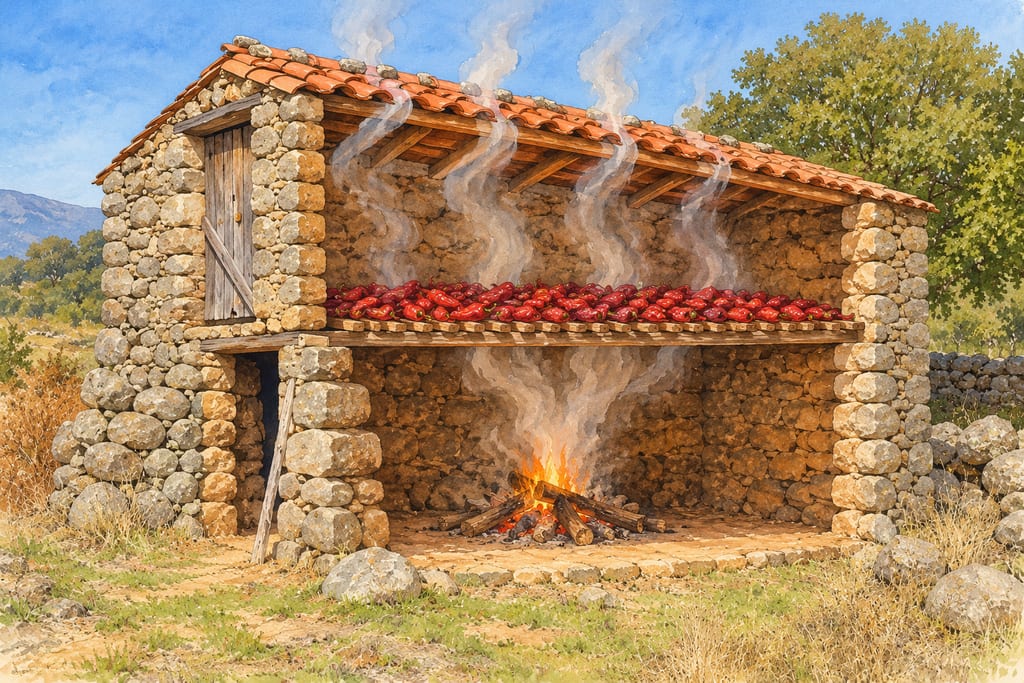
La Vera pepper-drying secadero
The traditional two-level pepper-drying building used for Pimentón de la Vera puts a wooden drying floor above an oak or holm-oak hearth, with heat and smoke rising through the peppers.
 FermenteaWhere food goes to change
Place · Cellars, caves and ripening rooms
Natural limestone caves in Asturias’s Picos de Europa are used to mature Cabrales cheese. Their airflow, humidity and water are part of the site; the documented cave conditions should not be generalized to other ripening rooms.
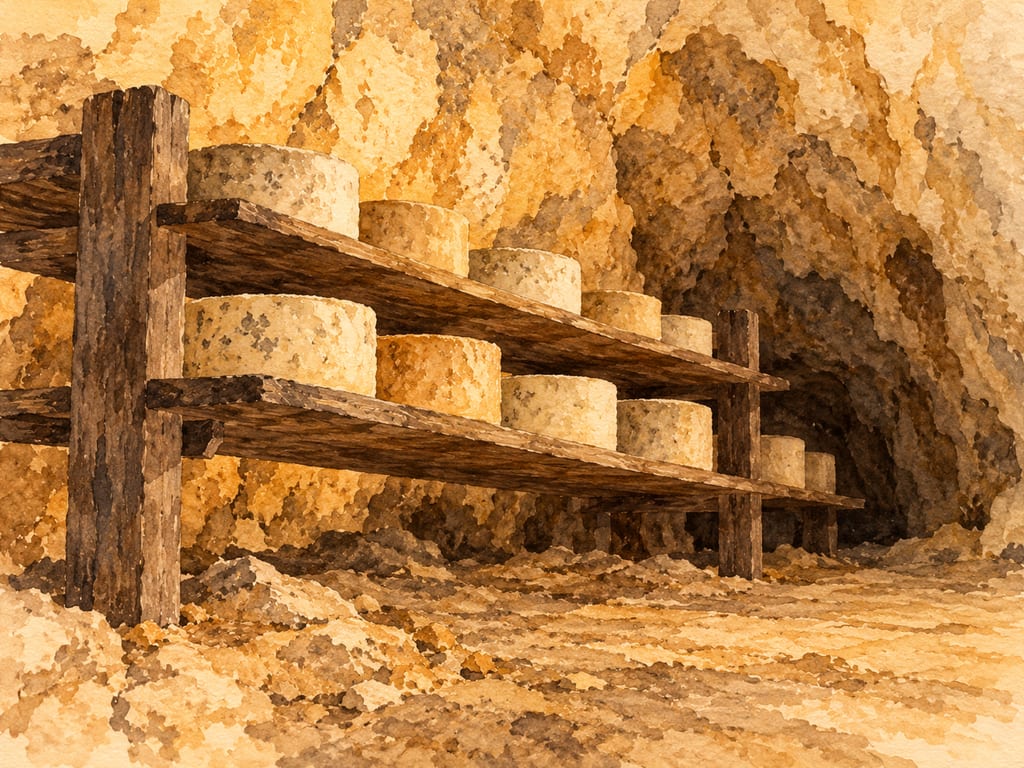
Cabrales mountain caves are natural limestone caverns used to ripen the blue cheese named for the Asturian production area. This is a built-environment record because the cave is a fixed place used for food production, not because the cavern itself was constructed. The Council specification describes caves of different sizes and characteristics in the karst limestone of the Picos de Europa; the candidate does not identify one specific cave or a universal plan.
The 2025 product specification says some maturation caves lie near a seasonal herder settlement or house, while many are farther away and reached by difficult mountain paths. It places them at 800–1,200 metres above sea level. These are attributes of the described cave network, not coordinates or measurements for every Cabrales cave.
The Council’s 2025 specification describes a suitable cave as deep, with an entrance facing north, at least two openings to the outside—one used for access and another for ventilation—and flowing water. The airflow is called a soplado. The same specification links those features with slight air movement, humidity above 90%, and temperatures of 6–10 °C. It describes a way caves are judged for Cabrales ripening rather than a construction specification that could be transferred to another site.
The Council’s current method page gives a separate general description of natural mountain caves at 8–12 °C and about 90% relative humidity, with ripening over two to four months. The 2025 product specification sets a minimum of two months and describes two to five months in caves. Those statements use different levels of detail; this page preserves that distinction rather than merging them into one exact universal setting.
The specification names wooden shelves called talameras as the surface where cheeses rest in the cave. It also describes periodic turning and cleaning of the rinds during maturation. The linked photograph, taken in the Cabrales Cave Exhibition at Arenas de Cabrales, shows cheese rounds on wooden shelves against rough cave rock. It is an inspected photograph of an interpretive site; it helps anchor the visible shelf-and-cave relationship but does not prove the layout of every production cave.
The cheese ripens in this environment as part of the Cabrales production method. The Council says the cave environment supports the development of Penicillium and the blue-green veins associated with the finished cheese. The linked Cabrales recipe page covers the cheese preparation itself; this build record focuses on the fixed ripening place.
The evidence supports a natural karst cave, a described airflow and water relationship, and wooden ripening shelves. It does not give a measured floor plan, excavation method, engineering assessment, or the design of one named cave. The generated illustration is editorial art based on the inspected Cave Exhibition photograph and the Council’s written cave description; it is not a documentary reconstruction or a construction guide.
The cave is distinct from a movable ripening cabinet, cellar rack or cheese vessel. The name applies to a place-bound setting within Asturias’s Picos de Europa production landscape. Temperature and humidity values are retained as the Council’s own descriptions and should not be used to design unrelated aging rooms.
Council specification describes Cabrales maturation caves in the Picos de Europa within Asturias; no specific cave is named for this candidate.
The traditional two-level pepper-drying building used for Pimentón de la Vera puts a wooden drying floor above an oak or holm-oak hearth, with heat and smoke rising through the peppers.
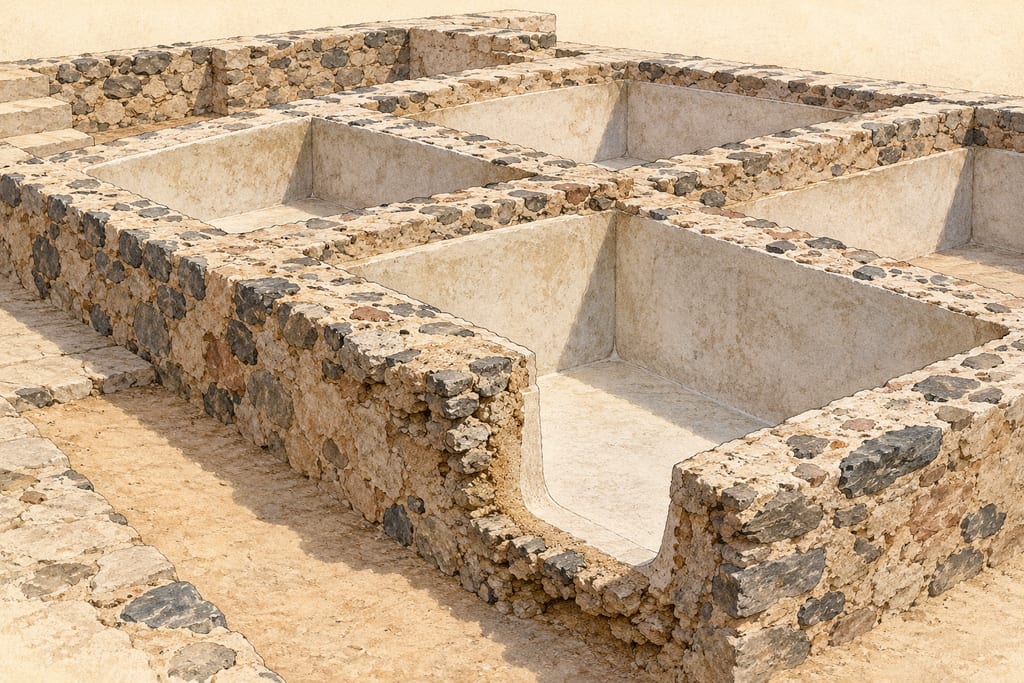
A cetaria is a fixed masonry basin in a Roman fish-processing installation. Examples at Baelo Claudia, Tróia and Monte Molião show varied forms, not one universal design.
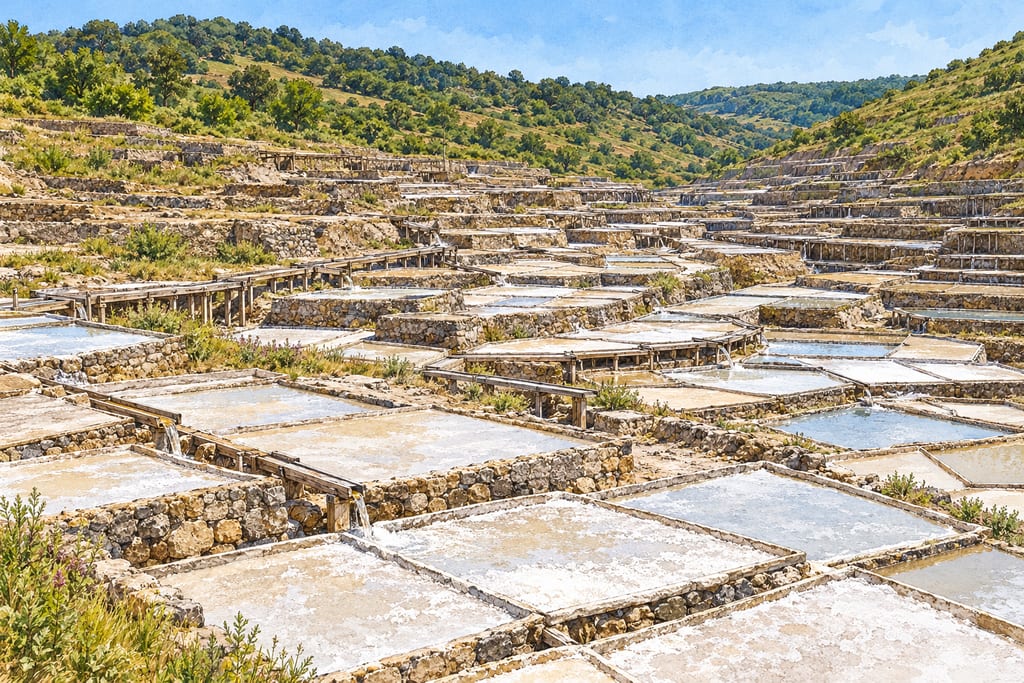
Valle Salado de Añana is an inland spring-brine saltworks in Álava, Spain, where wooden channels carry brine by gravity to stepped terraces of shallow evaporation pans.
An industrial fermentation patio places factory-made fiberglass-reinforced polyester olive tanks below floor level, with drainage and transfer infrastructure arranged around the buried vessels.
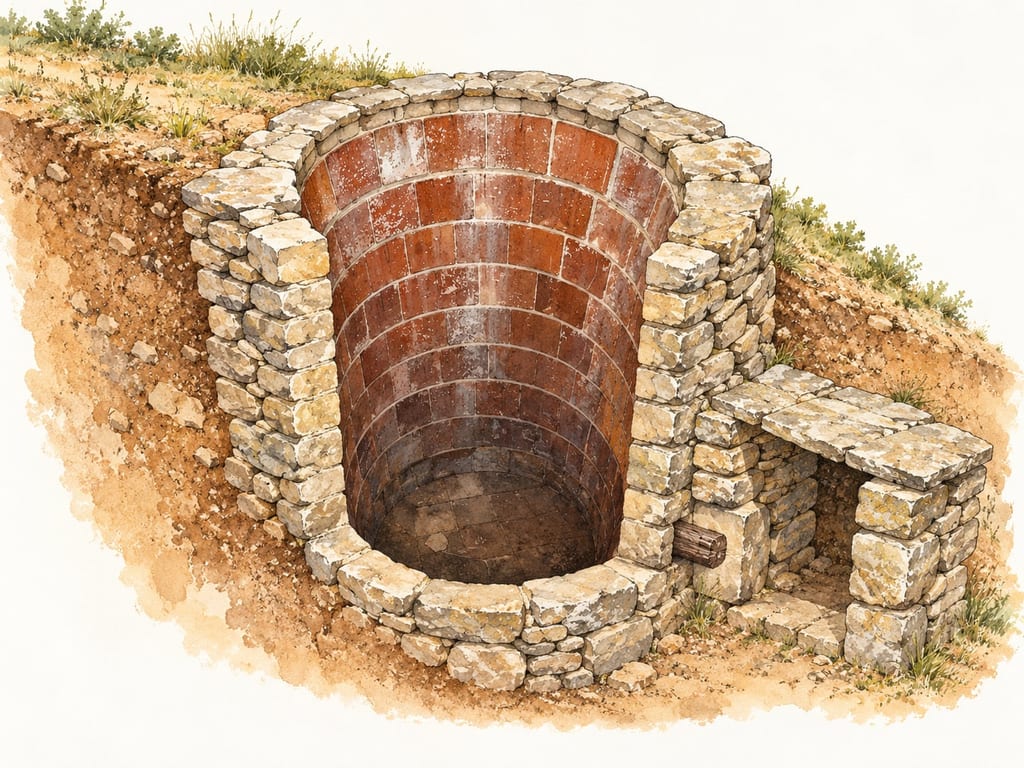
A tina de pedra seca is a fixed stone-built wine vat found among vineyards in Catalonia’s Bages region. These installations used dry-stone masonry and an inner lining of glazed ceramic cairons; variants and individual layouts differ.
No community contributions have been published for this entry yet.
Sign in to contribute. Published comments and photos are free to read.
Consejo Regulador D.O.P. CabralesSite · Geography · Materials · Climate · Ripening method
Pliego de condiciones de la DOP CabralesThe specification describes natural limestone karst caves in the Picos de Europa, many at 800–1,200 m and difficult to reach by mountain paths.
A suitable cave is deep, has a north-facing entrance, at least two openings to create airflow, and flowing water; the Council explains the resulting high humidity and 6–10 °C conditions as its detailed cave suitability description.
Cabrales cheese is ripened on wooden shelves called talameras and periodically turned and cleaned.
Cited in: A natural cave used as a ripening place; Air, water and cave conditions; Talameras and the ripening work; What is and is not documented
Consejo Regulador D.O.P. CabralesRipening method · Climate
Elaboración del queso de CabralesThe Council currently states that prepared cheese ripens two to four months in natural mountain caves at relative humidity around 90% and 8–12 °C; these are its current general figures, distinct from detailed cave suitability conditions in the specification.
Cited in: Air, water and cave conditions; Talameras and the ripening work; What is and is not documented
Official Journal of the European UnionHistory · Geography · Site · Ripening method
Publication of an approved standard amendment to the product specification of CabralesThe 2025 published specification describes cave formation in Picos de Europa limestone karst, suitable cave orientation and openings, flowing water, and wooden talameras where cheeses ripen for two to five months.
The document recounts 1911 accounts of herders’ caves in Cabrales; this supports historical practice but does not date every existing cave.
Cited in: A natural cave used as a ripening place; Air, water and cave conditions
Wikimedia CommonsImage reference · Cave and shelf form
Queso Cabrales.jpegThe photograph caption places this cave and wooden cheese shelving in the Cabrales Cave Exhibition at Arenas de Cabrales; it documents a specific interpretive cave interior and not a universal cave layout.
The photographer licenses the image CC BY-SA 4.0; credit and license are recorded on the linked image.
Cited in: Talameras and the ripening work; What is and is not documented