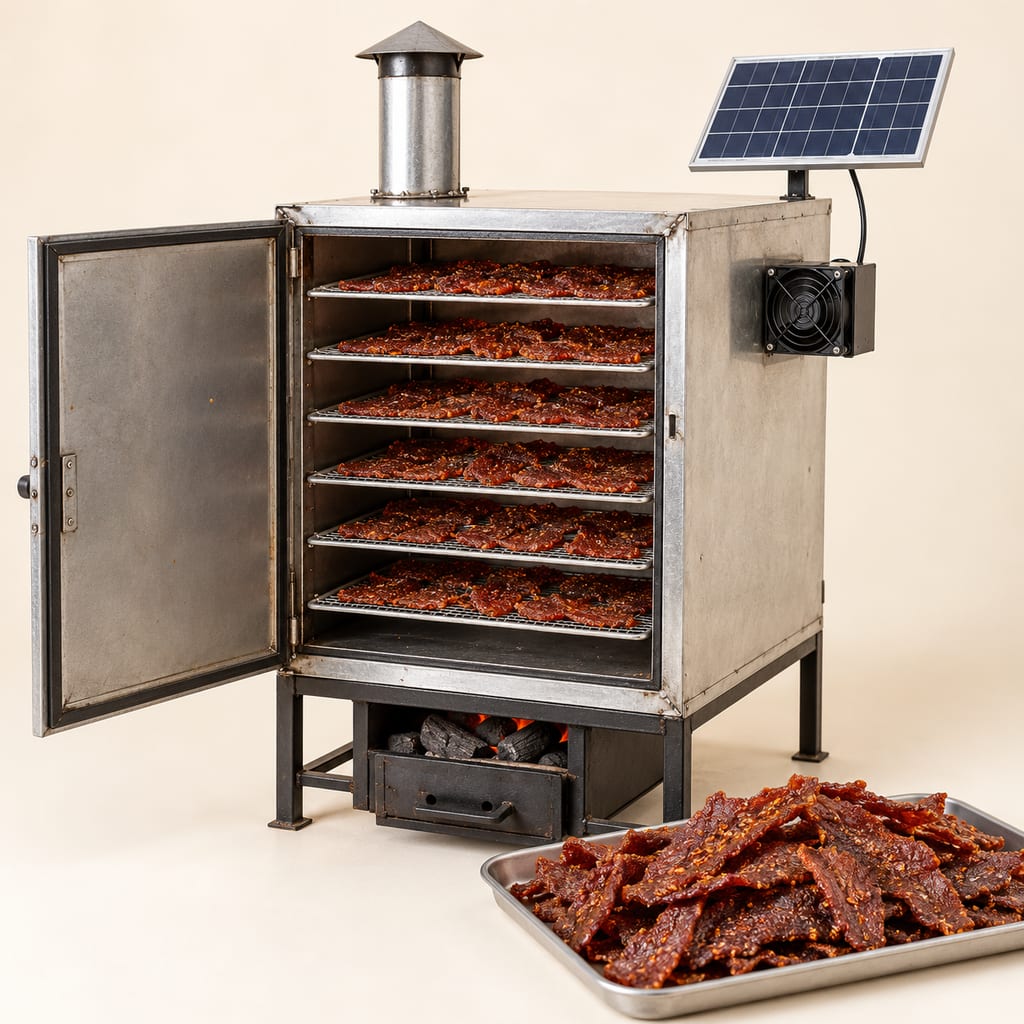
Charcoal-fired kilishi dryer (modified six-tray cabinet)
A six-tray charcoal-fired cabinet, modified at Ahmadu Bello University to dry kilishi with insulation, a DC fan on a photovoltaic panel and a relocated chimney.
 FermenteaWhere food goes to change
Equipment · Gourds, calabashes and carved bowls
Kworia
A Kworia is a large calabash used in northern Nigerian nono production: fresh milk ferments in calabashes before cream is skimmed and the sour milk is handled or sold.
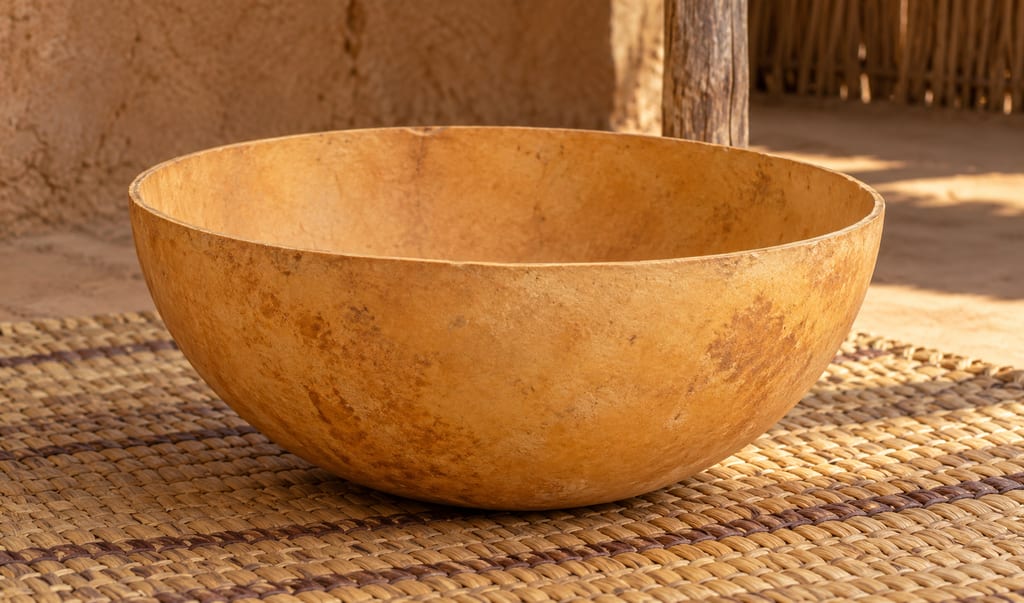
A 2007 account of Nigerian dairy production names large calabashes used for nono as kworia and associates the drink especially with Hausa and Fulani communities in northern Nigeria. The calabash holds milk through the souring stage; cream can be skimmed from the surface and kept as Fulani butter. Nono is also eaten by itself or combined with millet-based fura. The account gives the vessel a practical role in a pastoral dairy system without assigning the form a single birthplace or invention date.
A field study of three producers in a Fulani settlement near Zaria observed fresh milk fermenting in calabashes for 24 hours at ambient temperature. The calabashes were first used to collect milk, then held it during fermentation. After curdling, the producers scooped the surface fat into a gourd and shook it, returned the liquid to the milk calabash for whisking, and gathered the sale product in a larger calabash lined with polythene. These are distinct vessel jobs; the source does not establish one standard size or say that every producer uses the same arrangement.
The British Museum records a carved gourd bowl from northern Nigeria as a milk pail associated with Fulbe cattle herders; it was probably made by Hausa and is dated circa 1949. Its 15.6-centimetre height and roughly 36-centimetre width and depth describe that individual object, not the capacity or dimensions of a kworia used for fermentation. The museum bowl helps show the broad, open shape of a traditional gourd milk vessel, while the nono studies establish the calabash's fermentation use. A separate Commons photograph shows nono and fura being eaten from a calabash, a serving stage rather than a fermentation scene.
The vessel is a gourd calabash rather than a metal or plastic substitute. The Zaria study's observations also make clear that this material does not by itself guarantee hygienic milk: the researchers found E. coli, B. cereus, yeasts and moulds in samples before and after fermentation, and found yeasts and moulds on some calabash swabs. They recommend washing the calabashes with warm soapy water and rinsing with clean water before milk collection, alongside hand hygiene. This production study did not test whether gourd walls determine fermentation or its microbial community.
A circa-1949 British Museum milk pail from northern Nigeria is a dated comparison for gourd milk handling, not a dated prototype of the kworia fermentation vessel. The inspected sources name kworia in nono production but do not date that vessel form or name.
The Zaria study observed fermentation in calabashes but did not compare vessel materials, so it cannot show that gourd alone causes nono fermentation or determines its microbes.
Source →The source associates Kworia calabashes with nono production in northern Nigeria; this is not an exclusive-origin claim.
The study documents one Fulani settlement, not statewide prevalence.
The study is set in a Fulani settlement in Zaria; no more precise locality is claimed.
A six-tray charcoal-fired cabinet, modified at Ahmadu Bello University to dry kilishi with insulation, a DC fan on a photovoltaic panel and a relocated chimney.
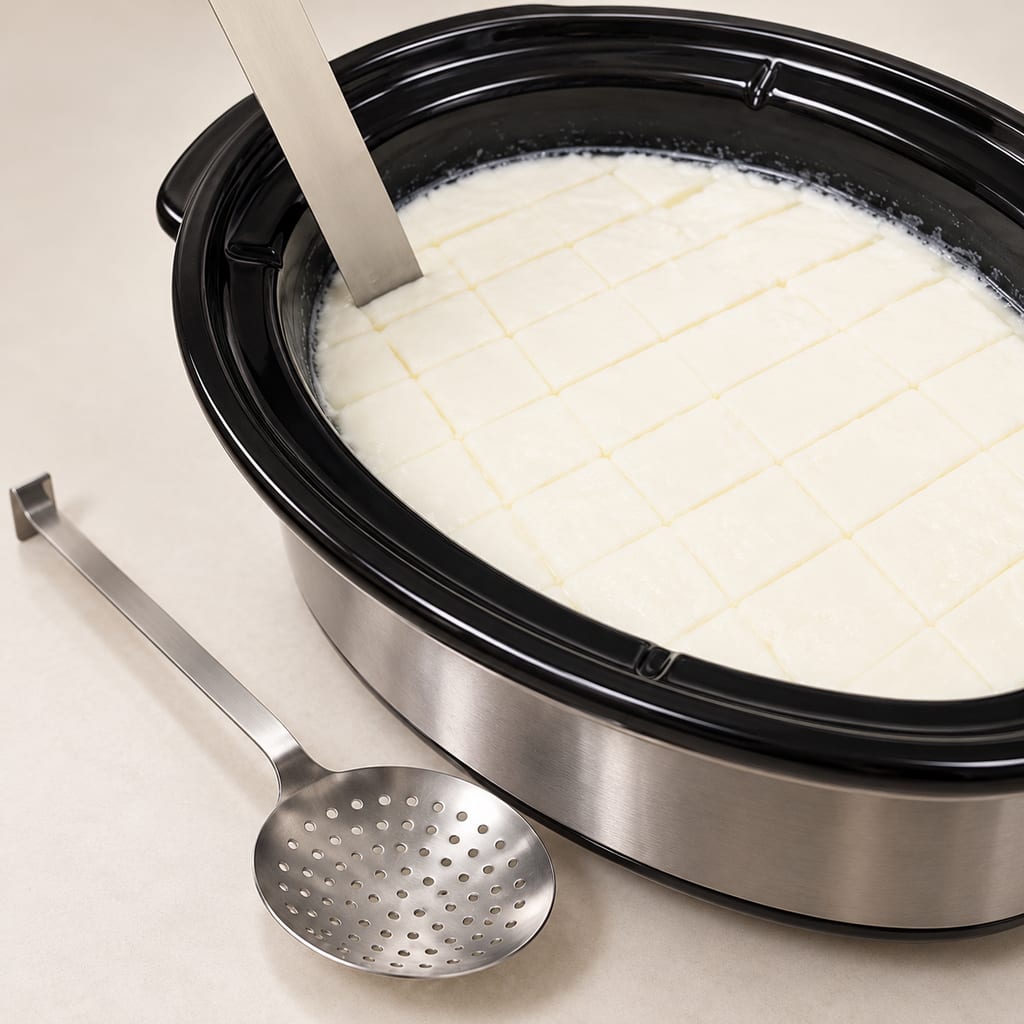
A curd knife cuts set milk into recipe-sized pieces; a perforated ladle lifts and moves curd while whey drains. The hand tools work at different moments in an open cheesemaking vessel.
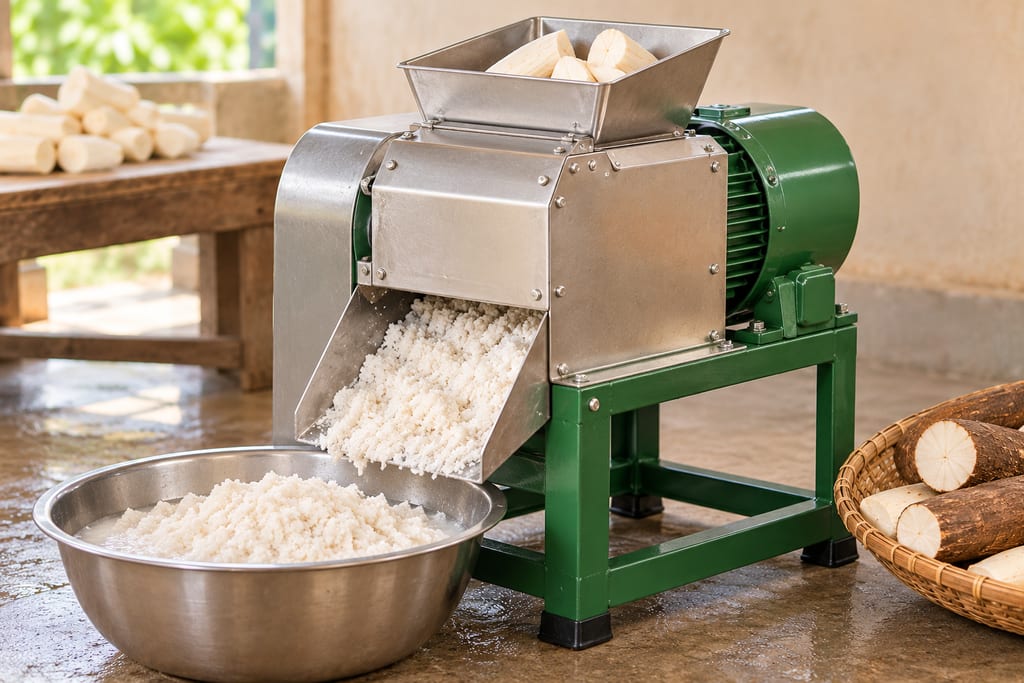
Graters, motorized rasping drums and processor grating discs reduce cassava or coconut to shreds or mash. They perform the grating stage only; later processing determines texture, extraction and cassava safety.
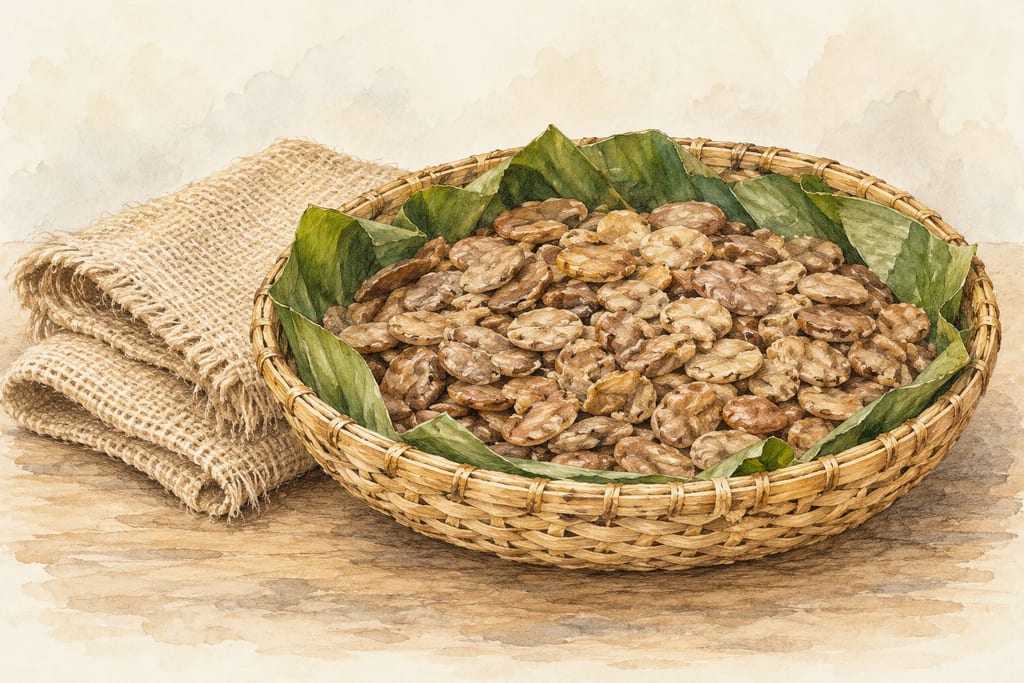
A shallow woven basket or tray can hold cooked, dehulled seeds while they ferment into alkaline condiments. Beninese and Nigerian sources document different basket, tray and cover arrangements rather than one regional standard.
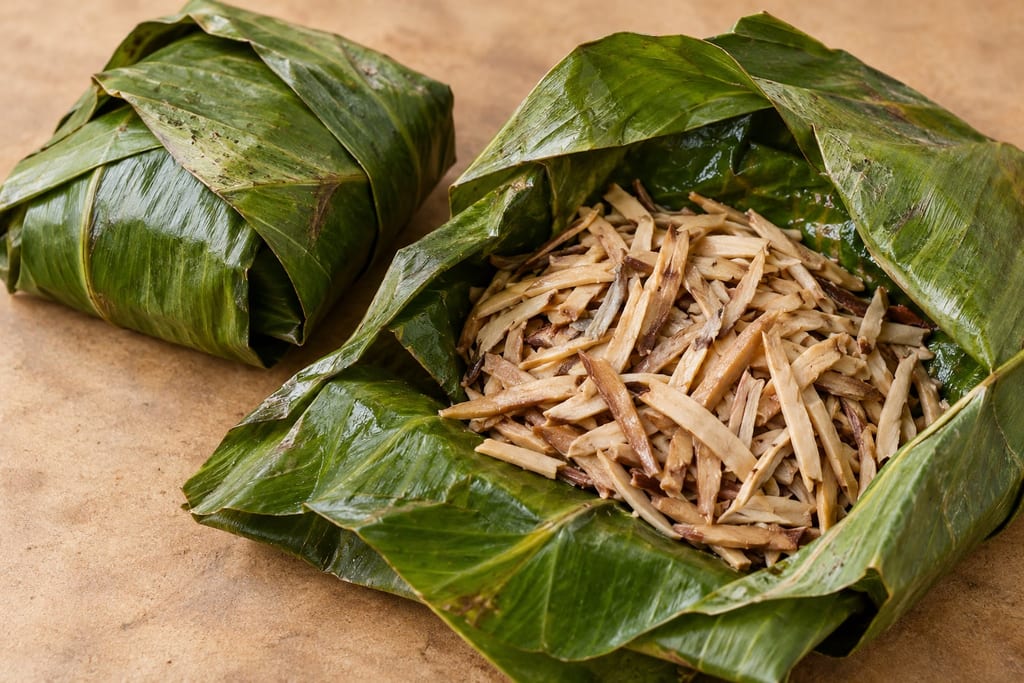
A flexible leaf parcel encloses sliced African oil-bean cotyledons during some Ugba preparations in southeastern Nigeria. Leaf species and layers vary by documented method.
No community contributions have been published for this entry yet.
Sign in to contribute. Published comments and photos are free to read.
C. N. Obi and M. J. Ikenebomeh; International Journal of Dairy Science, 2(1), 95–99Name · Use · Geography · History
Studies on the Microbiology and Nutritional Qualities of a Nigerian Fermented Milk Product (Nono)The authors describe nono as traditionally consumed particularly by Hausa and Fulani communities in northern Nigeria.
They name the large calabashes used for nono production as Kworia and describe cream skimming as producing Fulani butter.
They say nono is consumed on its own or used with cereal-based fura; the article does not date the kworia form.
Cited in: A calabash named for nono production
S. Bello, V. J. Umoh, M. Galadima and S. S. D. Mohammed; Journal of Bioscience and Biotechnology Discovery, 5(2), 20–31Method · Material · Care · Safety · Geography
Microbiological quality and HACCP of nono production in a Fulani settlement, Zaria Kaduna state, NigeriaThe authors observed three producers fermenting fresh unpasteurized milk in calabashes at ambient temperature for 24 hours; they then separated fat, added water, whisked and packed nono in calabashes.
Their account distinguishes the fermentation calabashes from a gourd used to shake the separated cream and a large calabash lined with polythene for market transport.
They report E. coli, B. cereus, yeasts and moulds in milk samples before and after fermentation and organisms on some calabash swabs; they recommend washing calabashes with warm soapy water and rinsing with clean water before milk collection.
The observations are from a Fulani settlement and Samaru market in Zaria, Kaduna State, Nigeria; they do not compare calabash materials with other vessels.
Cited in: Several calabashes can serve different stages; Material, handling and limits
The British MuseumForm · Material · Geography · History
Bowl, Af1950,43.2The museum records a carved gourd calabash bowl used as a milk pail, probably made by Hausa and associated with Fulbe cattle herders.
The object is dated circa 1949, collected in 1949–50 in northern Nigeria, and measures 15.6 cm high, 36.2 cm wide and 36.1 cm deep; these measurements describe this separate object, not a standard kworia fermentation vessel.
Cited in: A dated milk-pail comparison
Wikimedia Commons; photograph by IamgreacedImage · Serving
File:Fura and nono calabash.jpgThe photographer identifies a calabash containing nono and fura at the point of eating; the photograph documents serving, not fermentation. The file is licensed CC BY-SA 4.0.
Cited in: A dated milk-pail comparison