Identity and names
Bijao is a common name, not a unique botanical identification. This entry refers specifically to Calathea lutea (Aubl.) E.Mey. ex Schult., an accepted Marantaceae species native from southern Mexico through tropical America. Colombian sources also use bihao, but names can refer to other plants. A leaf called bijao should not be assigned to C. lutea without a reliable botanical or supply-chain identification.
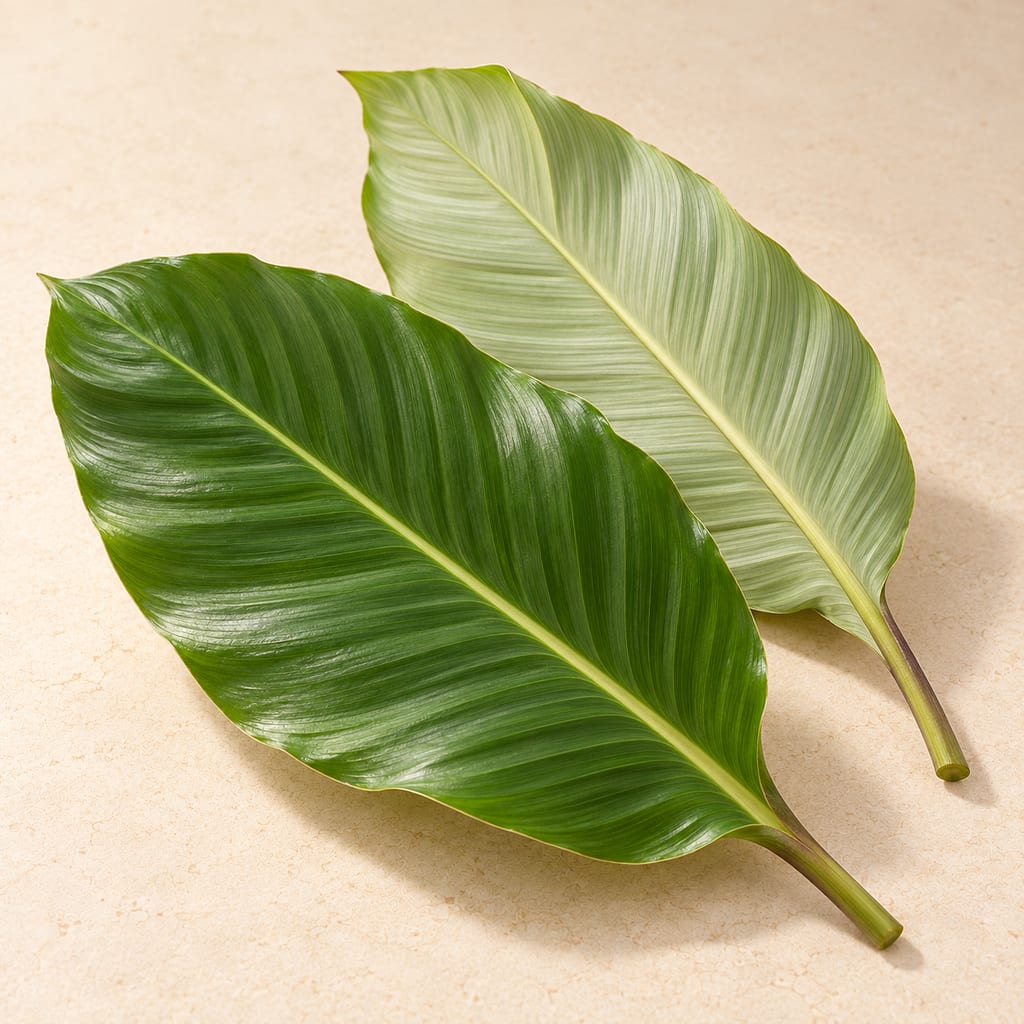
C. lutea has very large, broad, leathery leaves with a prominent midrib, green above and paler underneath. Their form suits wrapping and lining food, but appearance alone does not prove species identity.
Sources for this section
Food-contact uses
Colombian sources describe these leaves as wrappers, covers and linings rather than as a routinely eaten vegetable. Documented uses include guava bocadillo, tamales and other prepared foods, and wrapping or lining fish, meat, cheese, panela, chontaduro and coffee. A Ministry of Culture volume also records leaves covering a buried chicha-associated mixture; this is a covering role, not evidence that the leaf acts as a fermenting starter.
The protected Bocadillo Veleño specification identifies C. lutea as direct-contact packaging for guava paste and attributes aroma and a textural effect to the leaf. These uses do not show that every regional bijao wrapper uses the same plant or process.
Sources for this section
Documented preparation and place
The protected-product specification describes leaves gathered from wild or cultivated plants and a process including boiling until the central leaf changes colour, cooling and washing, draining, drying, trimming and storage. These are documented steps for Bocadillo Veleño, not a validated home safety protocol or universal method.
The specification names Vélez, Barbosa, Guavatá and Puente Nacional in Santander, and Moniquirá in Boyacá. These locations are tied to the protected product, not the full growing range.
Sources for this section
Historical record
The Ministry of Culture volume reports field and market research from the 1970s. The sources inspected do not date the first use of this exact species: older mentions of bijao may not distinguish C. lutea. The origin period given for Bocadillo Veleño should not be transferred to exact-species wrapper use.
Sources for this section
Evidence and safety limits
A 2024 laboratory paper screened C. lutea leaf extracts and fractions, including antimicrobial and Caenorhabditis elegans toxicity assays. Findings were limited to particular extracts and laboratory conditions; the authors call for food-matrix and in-situ work. This does not validate whole-leaf contact, consumption, preservation, pathogen control or consumer preparation.
Available sources do not establish validated home handling, food-contact migration limits, shelf life or an allergen profile. The empty allergen list is not an allergen-free claim. Treat bijao here as a documented wrapper material; do not infer that heating or drying guarantees safety.
Sources for this section
Places
Colombia
Documented use · Country evidenceFood-contact uses occur in Colombian sources; not claimed as a uniform countrywide practice.
Vélez, Barbosa, Guavatá, Puente Nacional and Moniquirá
Documented preparation · Region evidenceMunicipalities named for the protected Bocadillo Veleño product, not the full growing range.