
Almond mushroom
The almond mushroom, Agaricus subrufescens, was cultivated in eastern North America in the 1800s, lost its market, and returned as a cultivated mushroom from Brazil, where it is grown under several names.
 FermenteaWhere food goes to change
Mushrooms
Favolus tessellatus is a tropical wood-decaying polypore with a tessellated cap and honeycomb pores. Brazilian sources record it as food, but the evidence does not establish one traditional recipe or a universal harvest season.
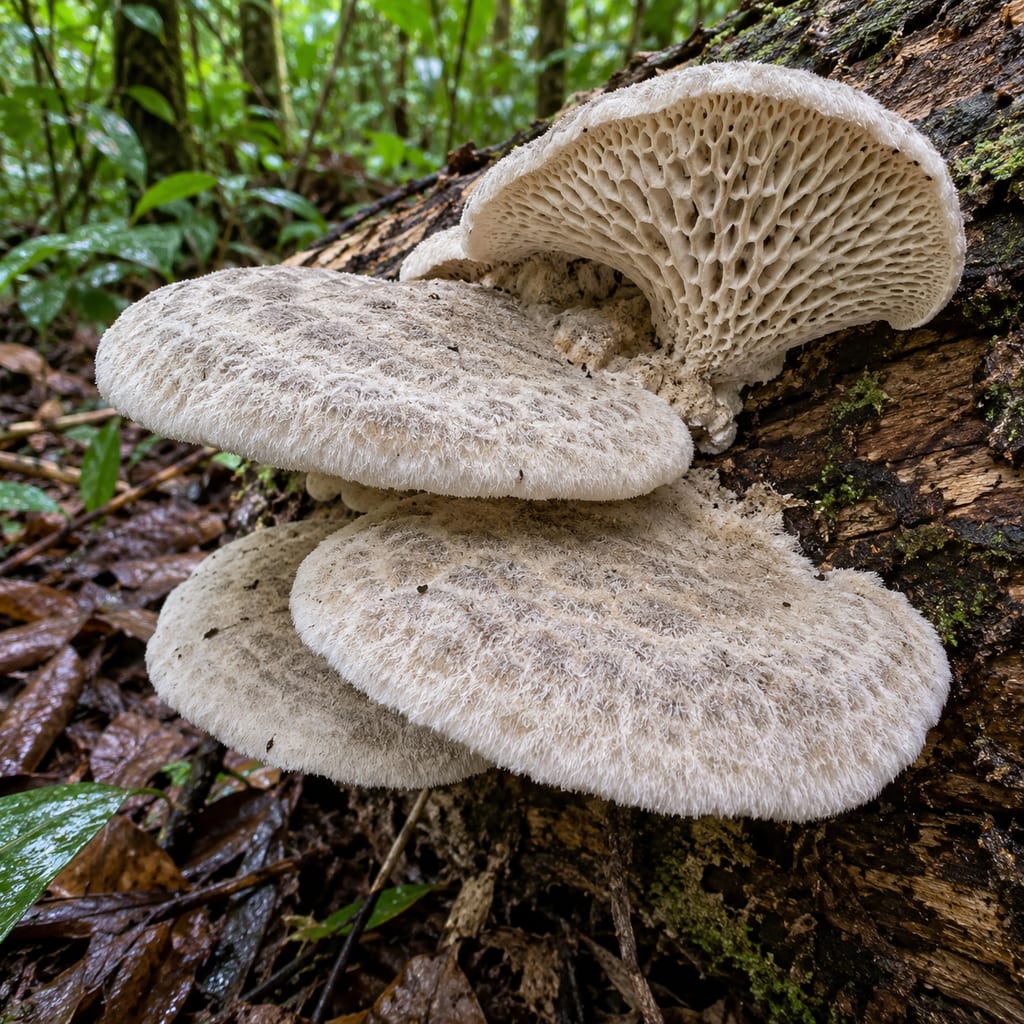
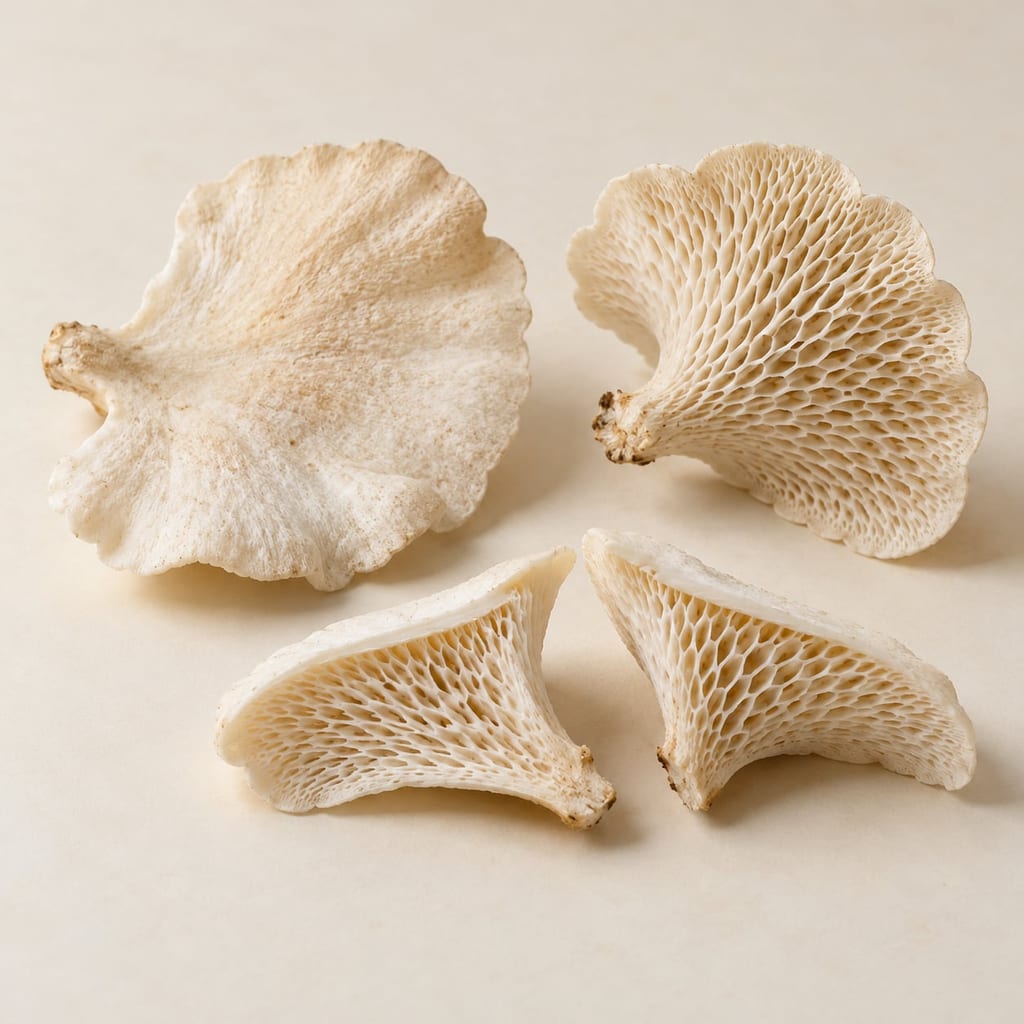
Favolus tessellatus is a wood-decaying polypore in the family Polyporaceae. Its fruit bodies grow in groups from dead wood. Each attaches to the substrate by a short, off-centre stem, then widens into a kidney-shaped or fan-shaped cap. The 2024 taxonomic treatment measured caps from about 2 to 13 centimetres across and 3 to 6 millimetres thick. They are robust for the genus, with a fleshy, flexible feel when fresh and a tougher, wrinkled surface after drying.
The top of the cap is its namesake feature: a mosaic of small raised or depressed areas, called a tessellate surface. It is covered in fine hairs, especially near the stem, and can be whitish, grey or tinged yellow and brown. The underside is not made of gills. It carries a white to pale-yellow pore surface with large, angular openings that often stretch radially away from the stem. Pores may be rhomboid or honeycomb-like, about 1 to 6 millimetres long and sometimes larger. Those features explain the catalogue’s common label, “honeycomb polypore,” but that common name is shared by several different fungi.
The pores are the spore-bearing surface, so turning a specimen over reveals features easy to miss in a photograph showing only the cap. The stem can be dense and woolly. Dried caps wrinkle markedly, while the edge may bend down. A single specimen can show much of the form, but colour and texture vary, and a photograph rarely captures the full set of characters used by taxonomists.
Its texture matters as much as its appearance. A mushroom can look delicate from above while still having substantial, leathery flesh. The taxonomic paper notes that pore partitions may split or become fringed as specimens age or dry. A pale colour or honeycomb underside alone does not settle a field identification.
Montagne described Favolus tessellatus in 1843 from a specimen collected in French Guiana. Later taxonomists treated it as part of a broad Favolus tenuiculus concept. That older grouping blurred separate Neotropical species and made regional records difficult to compare. The older Species Fungorum record still presents F. tenuiculus as the current name, while a 2024 revision reflects a newer conclusion.
The revision examined the F. tessellatus type specimen alongside recent collections and compared cap and pore morphology with DNA sequences from several genes. The authors recovered F. tessellatus as a distinct species and concluded that Favolus rugulosus, described from Brazil in 2021, was a later name for the same species. They also placed Hexagonia subcaperata from Jamaica and H. sulfurea from Mexico in its synonymy. Current names in biodiversity databases may lag behind the type-based revision; records made under old names should be checked before they are treated as separate food species.
The distinction is more than a spelling update. F. tessellatus is usually more robust than related F. reniformis and has larger, radially elongated pores, a greyish or whitish pubescent cap, and a densely woolly stem. It can also resemble F. brasiliensis, another Neotropical polypore. In the revision, the tessellated, hairy cap without the pronounced radial striations of F. brasiliensis, together with its larger pores, helps separate the concepts. These are taxonomic characters assessed across specimens; they are not a safe checklist for eating a wild mushroom.
A synonym is a name judged to refer to the same taxon; it does not mean every old specimen label has been verified anew. The 2024 authors reviewed particular types and collections, and explain that some historic types were contaminated or incomplete. For example, a name from Espírito Santo fit the current concept but was not validly published under botanical naming rules. This distinction between biological identity, the specimen a source actually examined and the formal status of a name matters for older labels.
Favolus tessellatus is an annual, white-rot fungus. Its mycelium decomposes wood, and its fruit bodies are recorded in groups on fallen branches and logs. The species is described as a generalist wood-decayer: collections come from fallen logs of several unidentified broad-leaved trees, from a cultivated pecan log, and from decaying Ficus roots. “Generalist” describes the breadth of recorded substrates, not a complete account of which trees it prefers. A conspicuous group of fruit bodies can make the fungus easy to notice, but visible fruiting is only a brief part of a wood-decaying fungus's life.
It occurs in preserved and disturbed humid forest, seasonal semideciduous forest, gardens and urban areas. The Global Fungal Red List assessment describes a broad range across tropical and subtropical America, extending to the southeastern United States. It lists records from Brazil, Argentina, Belize, Colombia, Costa Rica, Cuba, Ecuador, French Guiana, Guyana, Jamaica, Mexico, Panama, Peru, Puerto Rico and the southeastern United States. The taxonomic revision also supports the species through collections and type-based synonymy. The assessment cautions that older records from Africa and Asia may represent other Favolus species rather than F. tessellatus.
Brazil is the best-supported food-use geography in the sources consulted. A 2024 evidence review records the species from Espírito Santo, Paraná, Rio Grande do Sul and São Paulo in Atlantic Rainforest habitat and classifies its Brazilian record as BEM1. Other countries and regions establish the wider species range, but the sources do not make them additional locations of a food tradition.
The conservation assessment found no evidence of direct threats to this widespread species and assessed it as Least Concern, while describing its population trend as uncertain. That is not a claim that every habitat is secure: the assessment notes pressure on tropical forests from land conversion, fragmentation, invasive species, fire and climate-related drought. A species may remain widespread even as particular forest communities lose habitat.
The 2024 taxonomic revision reports collections in September, November through January, and March through June. Its specimens come from several Brazilian states and from Ecuador, Jamaica and Mexico. These dates summarize where collectors happened to find fruit bodies; they are not a complete phenology study. The species spans different climates and elevations, and the records do not establish one annual season that applies everywhere.
Community-science observations are consistent with the need for caution: the five inspected, research-grade iNaturalist records include dates in March, April, August, September and December across Brazil and other Neotropical countries. They provide recent, image-backed presence records, but five observations cannot define abundance, predict a local flush or justify a harvest schedule. Local rainfall, wood condition and habitat may affect when fruit bodies appear; sources reviewed do not quantify those effects for this species.
This calendar is best used to interpret collection history, not plan food gathering. A quiet month in one place does not show that the species is absent from its entire range, and a fruit body in a month recorded elsewhere does not promise one will appear locally. Collection dates also include historical specimens, with uneven effort among countries and states.
The Brazilian review places F. tessellatus among its BEM1 species and lists it as documented in Brazil. The authors combine evidence about occurrence, consumption and edible status. This is stronger than a record that merely says a mushroom grows in a country, but it remains a research classification rather than a product certification or substitute for identifying a specimen.
The 2024 taxonomic paper offers a rare species-specific account of eating quality. During one field survey, its authors ate the mushroom in pizza alongside other wild mushrooms and found it too leathery. They report that thinly sliced sautéing worked better and that pickled F. tessellatus was pleasant, with the pickling comment attributed to a researcher’s personal observation. These are useful culinary observations, but they do not amount to a measured recipe, a traditional household method or a validated preservation process.
The species’ food record should not be confused with all food use of the genus. Researchers report Favolus species as eaten in many countries and Indigenous food systems, but the named records can refer to F. brasiliensis or other species. The 2022 cultivation paper describes a wider genus-level food context and specifically discusses Yanomami agricultural knowledge around F. brasiliensis. That history must not be transferred to F. tessellatus. The evidence assembled here supports a Brazilian food-use record for this species but not a specific community, Indigenous name or single inherited dish.
The Red List assessment also says the species is not widely consumed or commercially traded. A mushroom can be categorized as edible and still have a narrow food footprint. There is no basis here for describing it as a staple, promising a commercial market, or assuming that its entire geographic range shares the same use.
The available food observations point to texture as a practical challenge. Whole or thick pieces may stay tough even when cooked in a mixed dish; the taxonomic authors’ thin-slicing suggestion responds to that texture, not a tested time-and-temperature instruction. They describe F. tessellatus as edible and cite earlier work on the synonym F. rugulosus. No source reviewed here sets a standard cleaning method, portion size, storage temperature, shelf life or safe pickling acidity for this ingredient.
Cultivation research exists under the name F. rugulosus. A 2022 study in Colombia evaluated mycelium and fruit-body growth, and the 2024 taxonomic revision later treated F. rugulosus as a synonym of F. tessellatus. The cultivation paper supports experimental potential under the revised name, but does not show an established commercial supply. The Red List assessment likewise describes cultivation potential while saying the species is not widely traded. Laboratory growth or a trial fruit body does not tell a grower what production system is reliable, profitable or food-safe at commercial scale.
For an ingredient page, that distinction prevents two common leaps: turning a research culture into an assumed market product and turning one author's tasting observation into a preservation recipe. The available work makes this polypore interesting to food and cultivation researchers; it does not establish the sourcing, storage and process details a buyer would need for a commercial product.
A photograph can show the fan-shaped cap and pore surface, but it cannot confirm a specimen’s identity. The genus contains similar wood-growing polypores, and older records may use different names. The revised concept uses a combination of cap texture, pore form, stem surface and microscopic characters, supported by type comparisons and molecular evidence. A market label or single visual feature is not enough to verify those characters reliably.
The food-use records do not provide a complete toxicological assessment or a species-specific safety protocol. BEM1 is a category in a literature-based evidence system; it should not be read as a guarantee that any lookalike is safe, that every specimen is suitable to eat, or that pickling makes an uncertain mushroom safe. Anyone considering wild fungi needs identification from a qualified local mycologist or another recognized expert before consumption. No safe harvest, storage or preservation instructions are established on this page.
The sources leave practical gaps. They do not set cleaning steps, preparation time, temperature, a method to remove toughness, shelf life after harvest or preservation controls. Those details should not be guessed from photographs or borrowed from another species. The record can say what researchers ate and what they found leathery; it cannot turn those observations into a tested method.
This record treats F. tessellatus as an ingredient with documented Brazilian food use while keeping its limits visible: the species concept has a recent revision, common names are not unique, and culinary methods are lightly documented. Better voucher-backed ethnomycology, local identification work and food-safety research would clarify which communities use it, under what names, and how they select and prepare it.
A 2024 evidence review records occurrence and consumption; these states are not all localities of a single tradition or preparation.
The holotype is from French Guiana; this is a taxonomic type locality, not evidence of food use.
Taxonomic collections and range sources document occurrence; these sources do not establish food use here.
Taxonomic collections document occurrence; the sources do not establish food use here.
A historical type of a name later synonymized with F. tessellatus supports occurrence, not food use.
A historical type of a name later synonymized with F. tessellatus supports occurrence, not food use.
The almond mushroom, Agaricus subrufescens, was cultivated in eastern North America in the 1800s, lost its market, and returned as a cultivated mushroom from Brazil, where it is grown under several names.
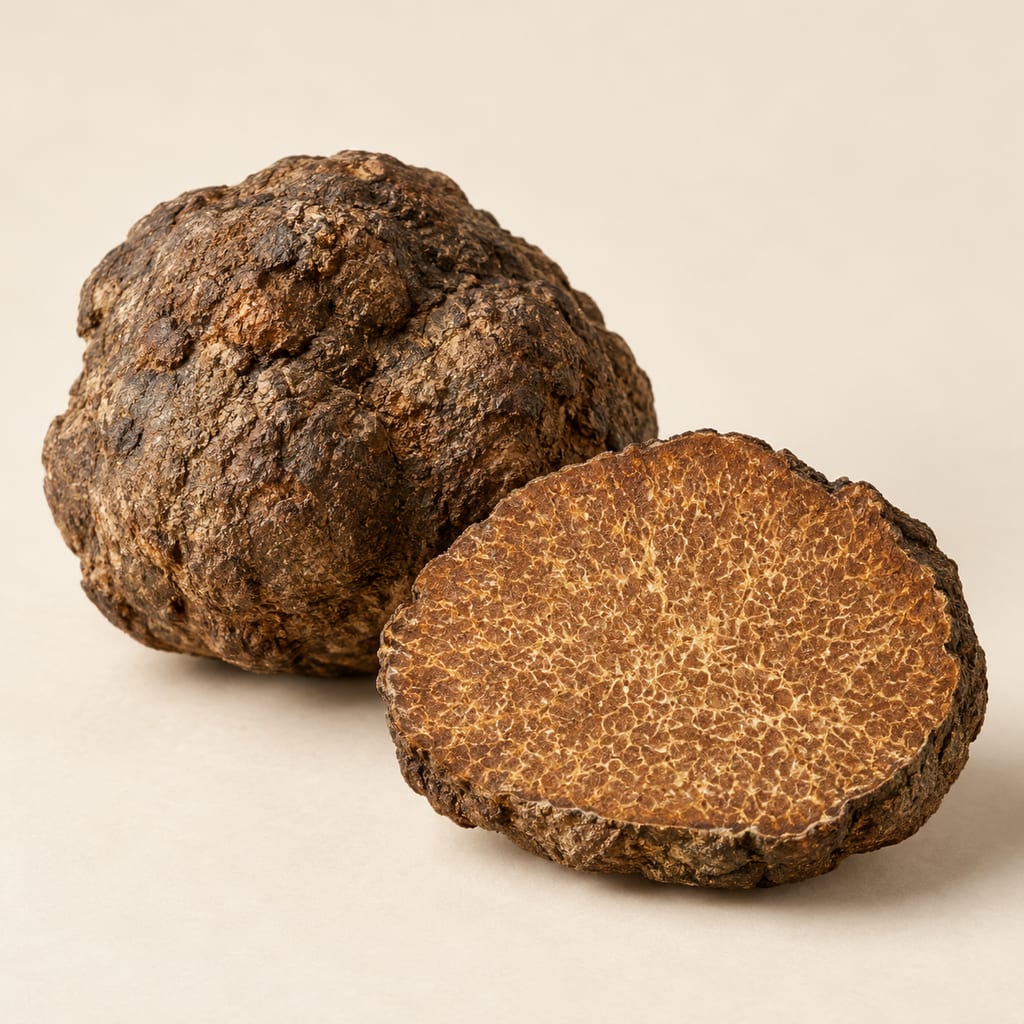
Polyporus indigenus, a polypore of the Brazilian Amazon. Its underground sclerotium, not the fruiting body, is the part people eat, and it is known locally as pão do índio.
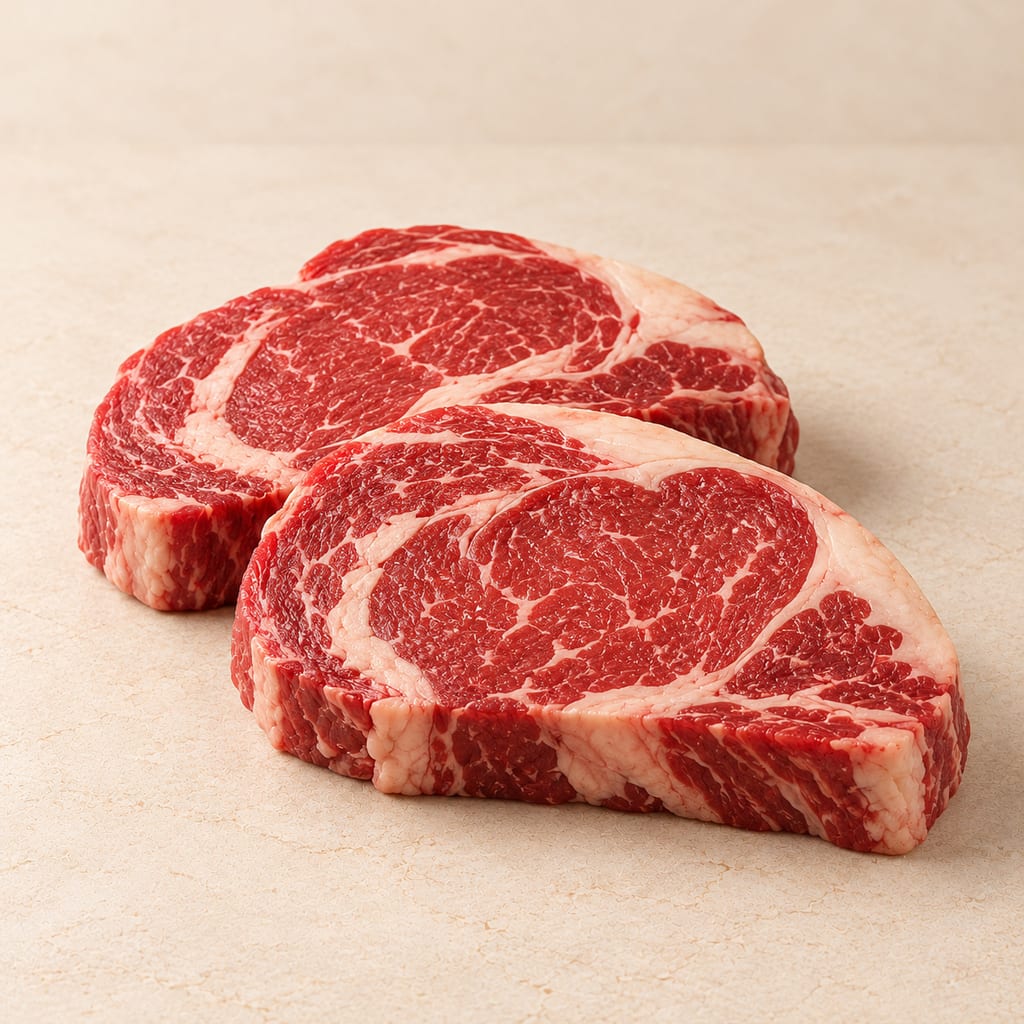
Beef is the meat of domestic cattle, Bos taurus and Bos indicus, sold as steaks, roasts, ground meat and cured products, and used in broths, salami and koji seasonings.
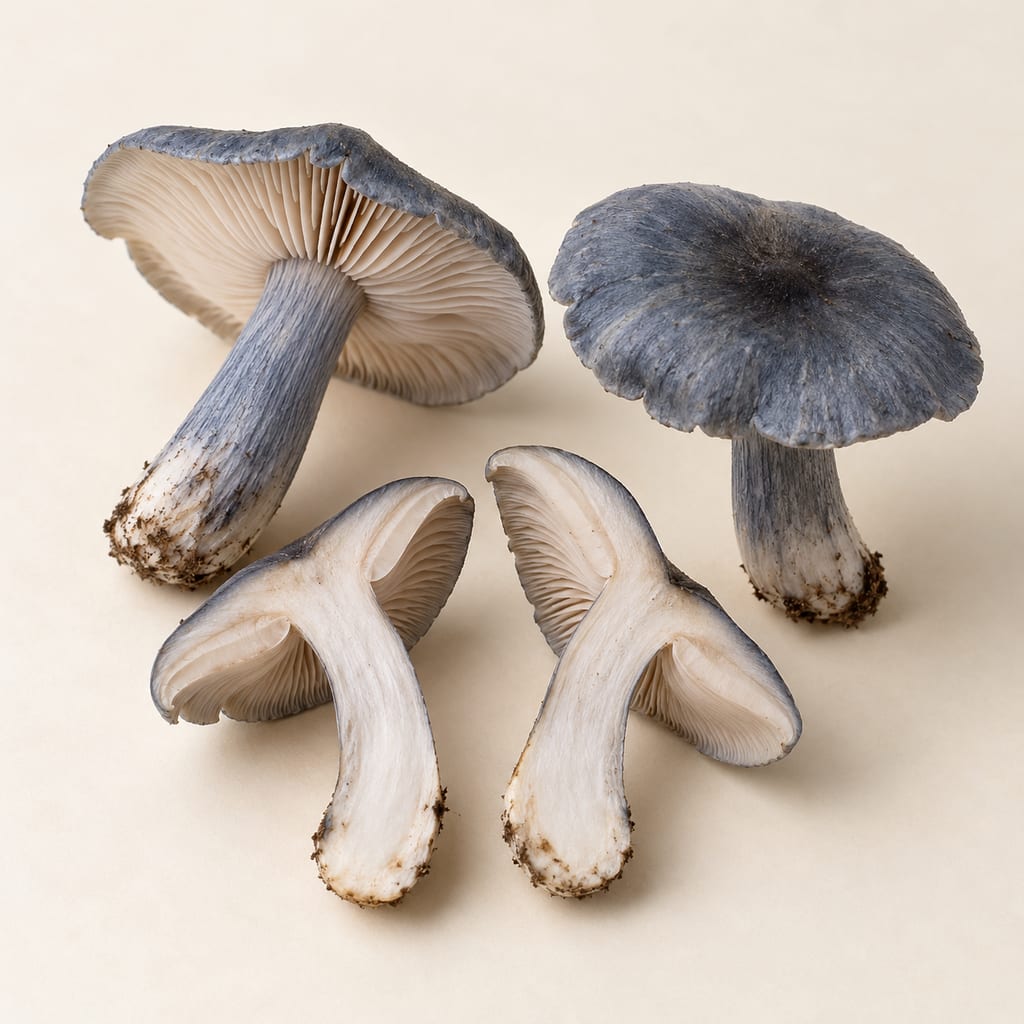
Bloxam's entoloma is a rare pink-gilled mushroom of old grasslands. Historical sources call it edible, but food-use evidence and older identifications remain uncertain; this does not recommend gathering or eating it.
Brazilian honeycomb polypore, Favolus brasiliensis, is a wood-growing fungus of tropical forests recorded as food in Brazil and Guyana. It has no standardized food-safety assessment.
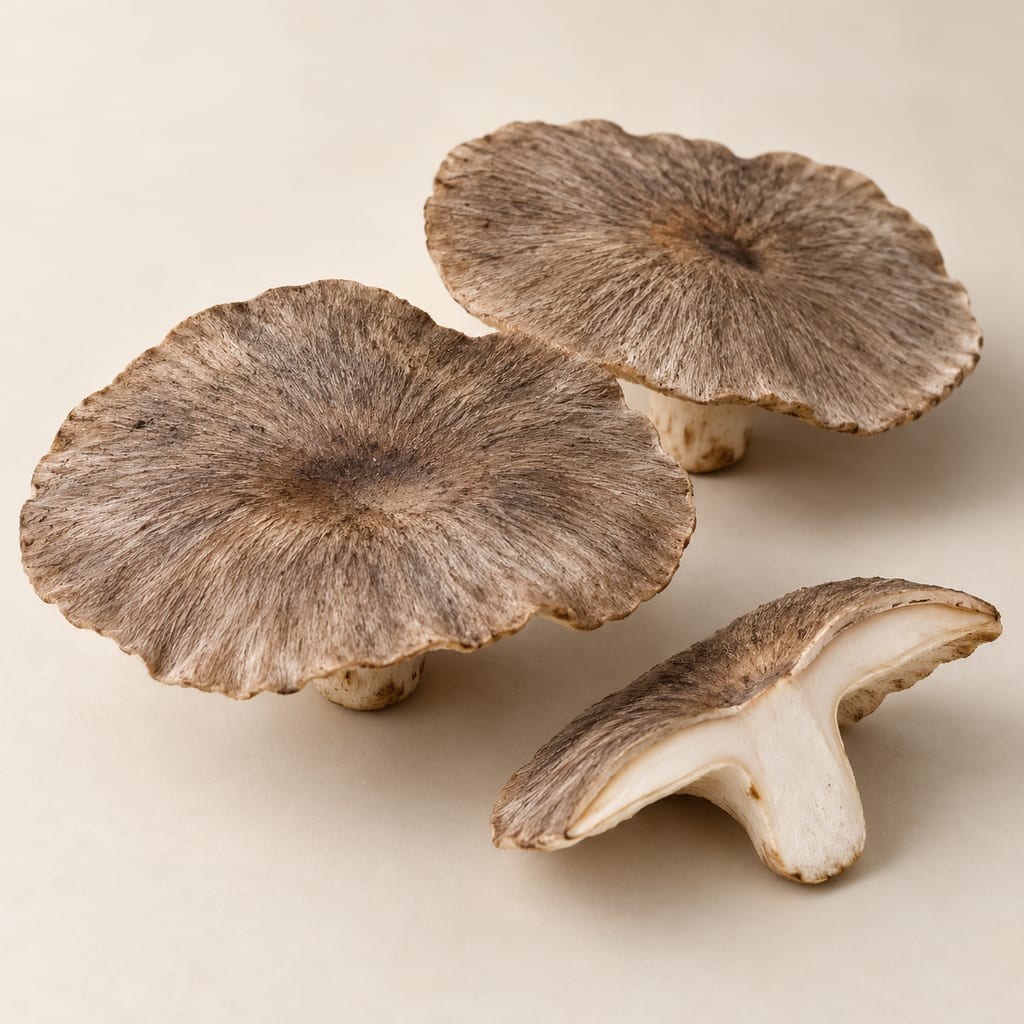
Bresadolia paradoxa is a large fungus of dead hardwood logs in Amazon and Atlantic Forest sites in Brazil and Colombia. Its only edibility source is a conservation assessment, so the claim is lightly documented.
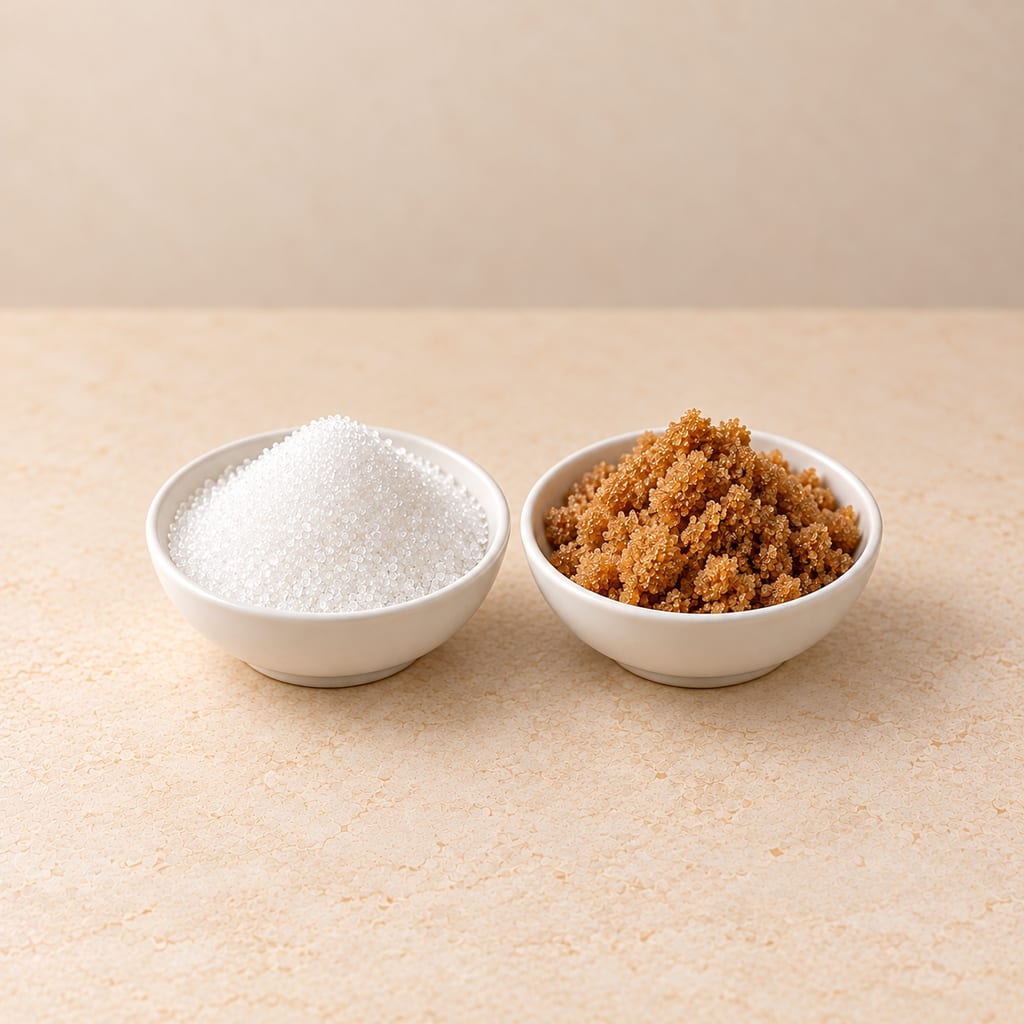
White sugar is refined sucrose, almost pure; brown sugar is sucrose with molasses, left in or added back. Molasses makes brown sugar moister, darker and more strongly flavoured.
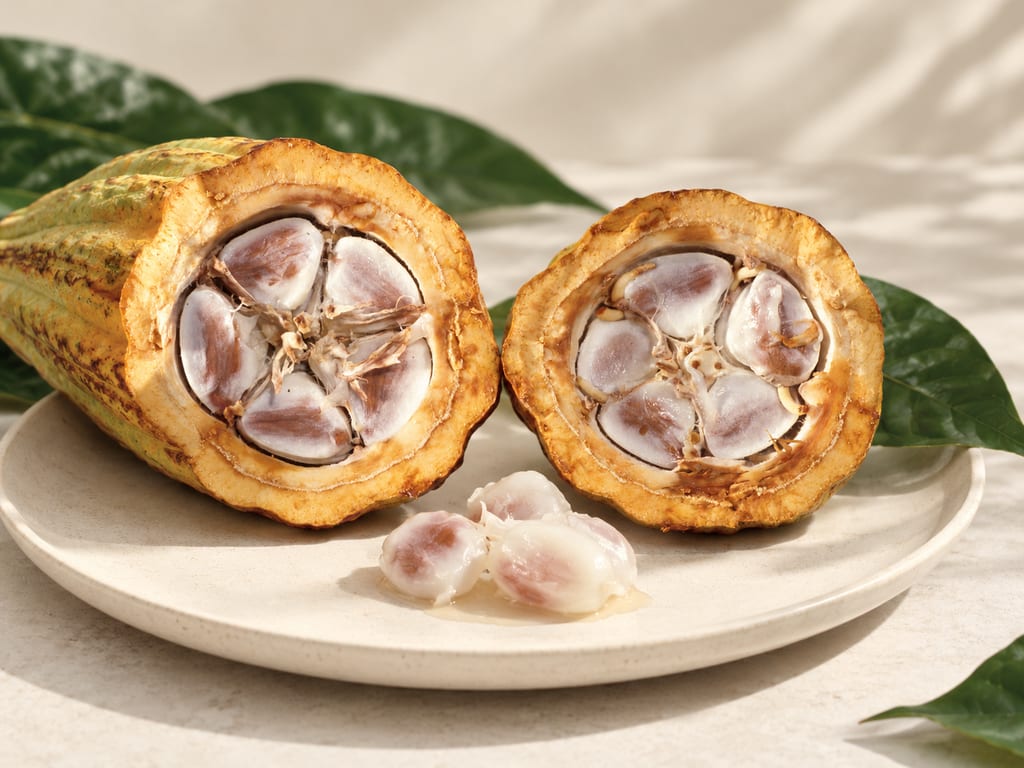
Cacao pulp is the moist, sweet-acid mucilage around cacao seeds. It fuels bean fermentation and can be extracted for fruit drinks, wine and vinegar.
No community contributions have been published for this entry yet.
Sign in to contribute. Published comments and photos are free to read.
Mycological Progress; full article hosted by ResearchGateTaxonomy · Identity · Morphology · Ecology · Phenology · Culinary use · History
Taxonomic reinvestigation of Favolus in the Neotropics utilizing morphological and multigene phylogenetic analysesType study and morphological/multigene analyses support F. tessellatus as distinct and synonymize F. rugulosus, Hexagonia subcaperata and H. sulfurea with it.
The treatment records morphology, wood-decay ecology, biogeographic range and specimen dates in September, November–January and March–June.
One field tasting found it leathery in mixed-mushroom pizza; authors report thin-sliced sauté and pickling observations, not a standardized preparation.
Cited in: A fan-shaped polypore with a checked cap; Why the name has changed; A decomposer of tropical hardwoods; Fruiting records, not a fixed harvest calendar; What the food evidence does and does not say; A leathery texture and experimental cultivation; Identification and safety limits
IMA Fungus / Springer NatureFood use · Distribution · Safety context
Over 400 food resources from Brazil: evidence-based records of wild edible mushroomsF. tessellatus is classified BEM1 and listed from Espírito Santo, Paraná, Rio Grande do Sul and São Paulo in Atlantic Rainforest habitat.
The review separates occurrence, consumption and edible-status classification and gives no species-specific recipe.
Cited in: A decomposer of tropical hardwoods; What the food evidence does and does not say; Identification and safety limits
Global Fungal Red List InitiativeDistribution · Ecology · Conservation · Trade
Favolus tessellatus — Global Fungal Red List Initiative assessmentBroad Neotropical-to-southeastern-USA range; humid and seasonal forests and urban areas; annual white-rot fruit bodies on dead angiosperm wood; population trend uncertain.
Edible status and cultivation potential are reported, but the species is not widely consumed or traded.
Cited in: A fan-shaped polypore with a checked cap; A decomposer of tropical hardwoods; Fruiting records, not a fixed harvest calendar; What the food evidence does and does not say; A leathery texture and experimental cultivation; Identification and safety limits
LilloaCultivation research
Favolus rugulosus in Colombia: mycelial and basidiomata production under different nutritional conditionsThe 2022 study evaluated mycelium and fruit-body cultivation under the name F. rugulosus; the 2024 revision later synonymized that name with F. tessellatus. This supports experimental potential, not an established commercial supply.
Cited in: What the food evidence does and does not say; A leathery texture and experimental cultivation
Species FungorumTaxonomy · Name history
Favolus tessellatus Mont. — Species Fungorum name recordThe older record lists F. tenuiculus as current name, showing that some databases retain historical synonymy superseded by the type-based 2024 revision.
Cited in: Why the name has changed