The old name and the current one
Boletus scaber Bull. is an older name for the species now treated as Leccinum scabrum (Bull.) Gray. Kew’s Species Fungorum synonymy and the Natural History Museum’s nameserver both connect the two names. Earlier records, including food writing and national checklists, may therefore use Boletus scaber even where current databases use Leccinum scabrum. Keeping the older name as an alias makes the record searchable without suggesting that it is a separate species.
This distinction matters because older field and food literature sometimes used wider species concepts for Leccinum. Closely related taxa can share a brown cap and dark stem scales, and a historic label does not necessarily document an identification under current standards. The older name belongs in the synonym list; food claims still need to be checked for source, region and taxonomic scope.
Sources for this section
A bolete of birch woodland
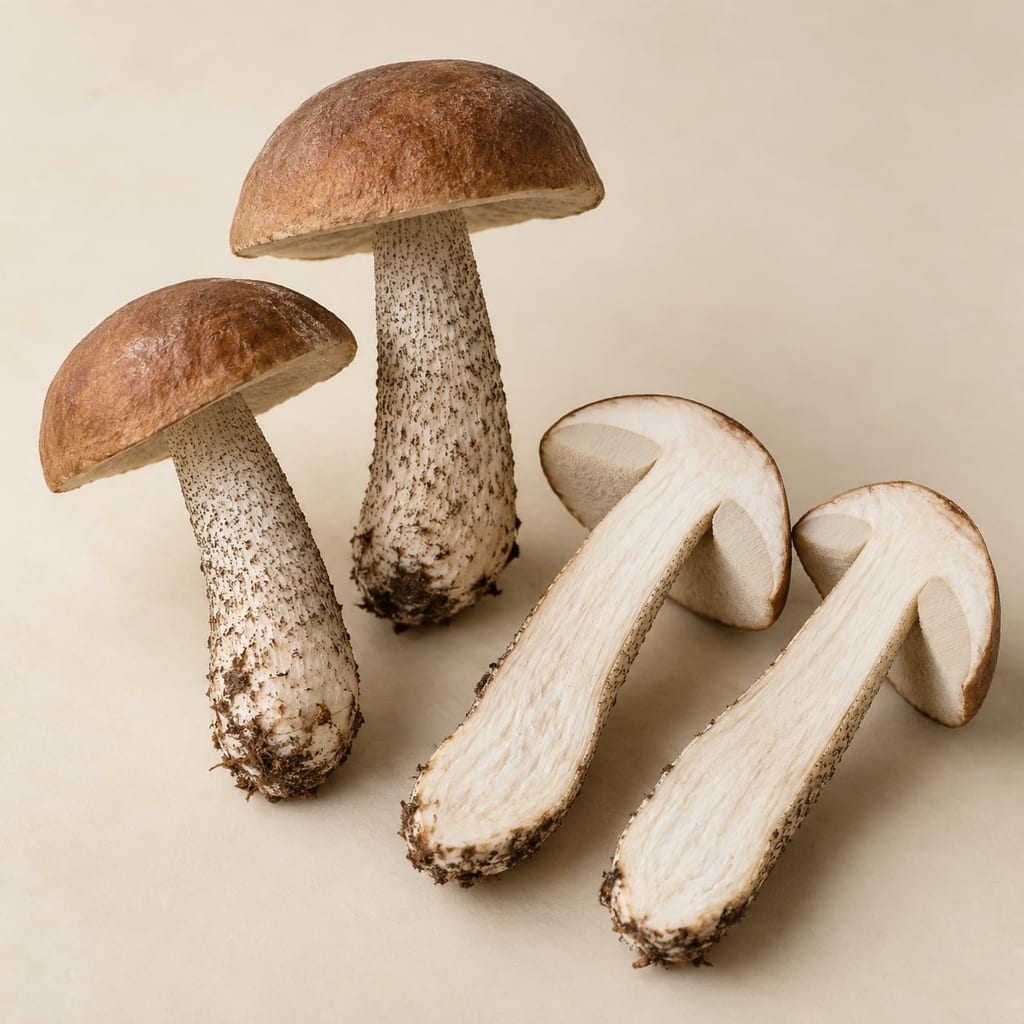
The brown birch bolete is a pore-bearing mushroom in Boletaceae. Descriptions typically give it a brown to grey-brown cap, a pale pore layer that darkens with age, and a pale stem dotted with rough dark scales called scabers. The flesh is pale and may show a mild pinkish change in some descriptions. Cap colour, size, and firmness vary with age and conditions, so a field guide’s character list describes a species concept; it does not authenticate an individual specimen.
The ecological association is with birch trees (Betula). The Georgian ethnobiology profile records the fungus on soil in open deciduous woodland, especially with birch, while British sources likewise describe it under birches. Like other ectomycorrhizal fungi, it grows in a partnership involving tree roots. That habitat link is useful context, but the presence of a birch is not a safe identification shortcut. Similar species and changing taxonomic boundaries make a photograph or one visible trait insufficient.
Sources for this section
Season depends on place
Sources place fruiting mainly in the warm months and autumn, but their calendars differ locally. The Georgian resource gives summer and autumn; a British and Irish guide gives July through November; the Bulgarian species account reports May through November. These are regional observations, not a single guaranteed season across the species’ range. Weather, habitat and year will affect when visible fruit bodies appear.
A peer-reviewed chemical study reports that its vouchers were collected during summer in the Białowieża Forest region on the Poland–Belarus border. This supports a summer collection record and shows that measurements came from particular specimens. It does not mean all populations fruit at the same time or have identical composition. The mushroom is gathered wild; sources reviewed here do not establish a dependable commercial cultivation method.
Sources for this section
Regional food records and uneven evidence
Food use is supported in several local sources, but not as one uniform tradition. The Bulgarian mycology site calls the bolete edible and of low culinary quality. A Georgia ethnobiology record gives local names and a qualified note describing edible use with reference to young, fresh material and drying or marinating. In Ukraine, a 2026 notice for Chornoliske forestry sets collection terms for Leccinum scabrum for personal consumption and licensed commercial use. The notice establishes a local managed harvest context, not nationwide prevalence.
Culinary value is not agreed everywhere. A Spanish mycological society describes the species as having no culinary value, while Bulgarian and Georgian sources list it as edible. Differences in taste, texture, local custom and source criteria can explain these assessments without turning either one into a universal verdict. Field accounts describe soft or watery flesh and favour younger, firmer mushrooms for texture; that is a culinary preference, not a safety test.
The FAO global overview discusses wild fungi in trade and notes that local Bulgarian traditions are poorly documented. It does not securely identify Leccinum scabrum or Boletus scaber as the exported species. The supplied index’s Bulgaria/Ukraine line is therefore kept qualified: the specific Bulgarian page and named Ukrainian notice support regional food contexts, while the FAO source does not independently prove the species attribution.
Sources for this section
Cooking caution and identification limits
The Nordic Council of Ministers’ food assessment states that Leccinum species, including L. scabrum, need thorough heat treatment because insufficiently cooked mushrooms can cause intoxication. A 2026 Swedish recommended-food list separately notes that some Leccinum mushrooms have caused gastrointestinal symptoms and advises careful cooking. These sources support a clear warning against raw or inadequately heated use. They do not provide a single schedule that can be transferred to every specimen and preparation, so this page does not invent one.
Food status cannot identify a mushroom in the field. A brown cap, pale pores, scabrous stem and nearby birch are descriptive features, not a complete determination. Related species may look similar, and historical names may cover material identified under broader concepts. Never treat a web photo, common name, or this page as confirmation that a specimen is edible.
The species is documented as a wild food ingredient, not as a starter culture or a traditional fermented ingredient. The sources reviewed do not show that fermentation neutralizes risk or establish a fermentation schedule, preservation life or storage conditions. Drying and marinating are mentioned in the Georgian reference, but it is not detailed enough to support a safe recipe.
Sources for this section
Drying, fresh quality and the harvest window
Sources mention both fresh consumption and drying. The Georgian ethnobiology entry reports a qualified edible-use note involving young material, fresh condition, drying and marinating. A Bulgarian species page also gives an edible rating but low culinary value. Research on the drying of L. scabrum describes dried mushrooms as a way to extend availability beyond the fruiting season and notes that dried material is also found in trade. These records support discussing drying as a documented preservation pathway, but not supplying a home-drying protocol: the sources do not establish a single validated endpoint, storage container, or shelf life for this page.
The experimental drying study is useful because it demonstrates that preservation changes more than water content. Researchers compared drying temperatures and measured effects on phenolic compounds, organic acids, ergosterol and antioxidant activity. The results show that temperature can change measured composition. They do not identify one universally best household process, and measured antioxidant properties do not prove a health effect in people. Drying preserves a seasonal wild harvest, but it cannot repair a mistaken identification or stand in for suitable cooking where heat treatment is required.
Sources for this section
What composition studies can and cannot tell a cook
One recent study reports protein, carbohydrate, dietary fibre, sugars, amino acids, fatty acids, vitamins and minerals measured from dried L. scabrum material. Its samples came from a defined summer collection in the Białowieża Forest region, were taxonomically examined and deposited as herbarium vouchers. That is more useful than an unattributed nutrition chart because the study identifies what was measured and where the material came from. It still describes a research sample, not a guaranteed composition for every fruit body, soil or season. Concentrations reported per dry mass should not be read as fresh-serving values without accounting for water content and preparation.
The same paper tests aqueous extracts using laboratory bacterial strains and extraction methods. Those experiments are not evidence that the mushroom is medicinal when eaten, that an ordinary serving has an antibacterial effect, or that adding it to food preserves that food. Extracts made with ultrasound or microwaves in a laboratory are not recipes. The safe editorial distinction is between a chemical or microbiological experiment and an established human food use.
Sources for this section
Collection places and the limits of regional labels
The supplied research index points to Bulgaria and Ukraine but marks the associated use uncertain. The FAO book’s country-level discussion of Bulgaria mentions exports of wild mushrooms and says local traditions are not well known; it does not name L. scabrum or its older synonym. That source is therefore background on a trade setting, not evidence that this species was the Bulgarian export. The Bulgarian mycology page is species-specific and provides a local food classification and season. The Ukraine notice names the species in an administrative context and confines its terms to Chornoliske forestry; it distinguishes household collection from commercial collection requiring a forestry permit. These records improve the geography but do not justify a broad claim about national custom or frequency of consumption.
The Georgia profile is a separate source tradition: it records local names from Kakheti and Imereti and summarizes older regional literature. Its habitat and use notes support a Georgian country-level record, but the listed local names are not enough to assign individual villages or map a precise practice. In Britain and Ireland, field-guide records describe a July–November fruiting season; in Białowieża, the voucher-backed research collection was made in summer. These places establish ecological and research observations, not automatically food markets or household customs.
A useful map of this mushroom should keep the relationships distinct. Local food documentation, official permissions for gathering, field occurrence, and a study collection are not interchangeable. The first may support a documented-use row, the second a geographically narrow harvest-use row, and the latter two occurrence or research rows. The sources do not support treating all of Europe, Bulgaria, Ukraine or the full range as one homogeneous culinary region.
Sources for this section
Environmental contaminants and processing claims
A study of processing in several edible boletes, including L. scabrum, measured potassium and radiocaesium after drying, blanching, pickling and maceration. The amounts leached differed by process, and investigators report that traditional home processing may not remove radiocaesium as effectively as assumed. This is a site-specific environmental-contaminant study, not a universal hazard finding for every harvest. Its practical lesson for an editorial account is narrower: preservation does not make collection location irrelevant, and no generic process should be described as removing all contaminants.
Wild fungi take up minerals from their surroundings, and the contaminant study also explains that soil and site matter. It does not support a blanket claim that this species is dangerous, nor does it establish a threshold for a specific region. It does support resisting the common but unsupported idea that drying, blanching or pickling automatically cleanses wild mushrooms. Food safety claims must stay tied to the tested species, site, analyte and procedure; one treatment’s measured reduction does not transfer to another contaminant or mushroom.
Sources for this section
A useful boundary for fermentation writing
The record is relevant to fermentation as an ingredient page, but the reviewed evidence concerns mushroom food use, drying, cooking and laboratory analysis. It does not describe a traditional fermented Leccinum product or a validated fermentation method. The Georgian source’s reference to marinating should not be silently recast as fermentation: a marinade and a fermented preparation are not the same process, and the source does not give a controlled method. There is no support here for a brine, acidification target, inoculum, time, temperature, storage period or safety claim.
That absence is valuable information for a fermentation reference. Readers can see where a mushroom is documented as a food and also see that no fermentation role has been established. Fermentation cannot be treated as a generic detoxification method. Where a species requires careful identification and thorough heat treatment, a fermentation account must not imply that acid or salt makes an uncertain specimen safe. Until a species-specific process is documented and evaluated, this ingredient should remain a wild food record without a fermented variant.
Sources for this section
Places
Bulgaria
Documented use · Country evidenceSpecies-specific Bulgarian mycology source describes the bolete as edible but low culinary quality and gives a May–November season; not proof of widespread consumption.
Georgia
Documented use · Country evidenceIlia State University ethnobiology resource records regional names and a qualified edible-use note; exact localities are not supplied.
Chornoliske forestry district
Documented use · Region evidenceLocal notice names Leccinum scabrum in collection rules for personal use and licensed commercial use; it does not establish a country-wide tradition.