Names and taxonomy
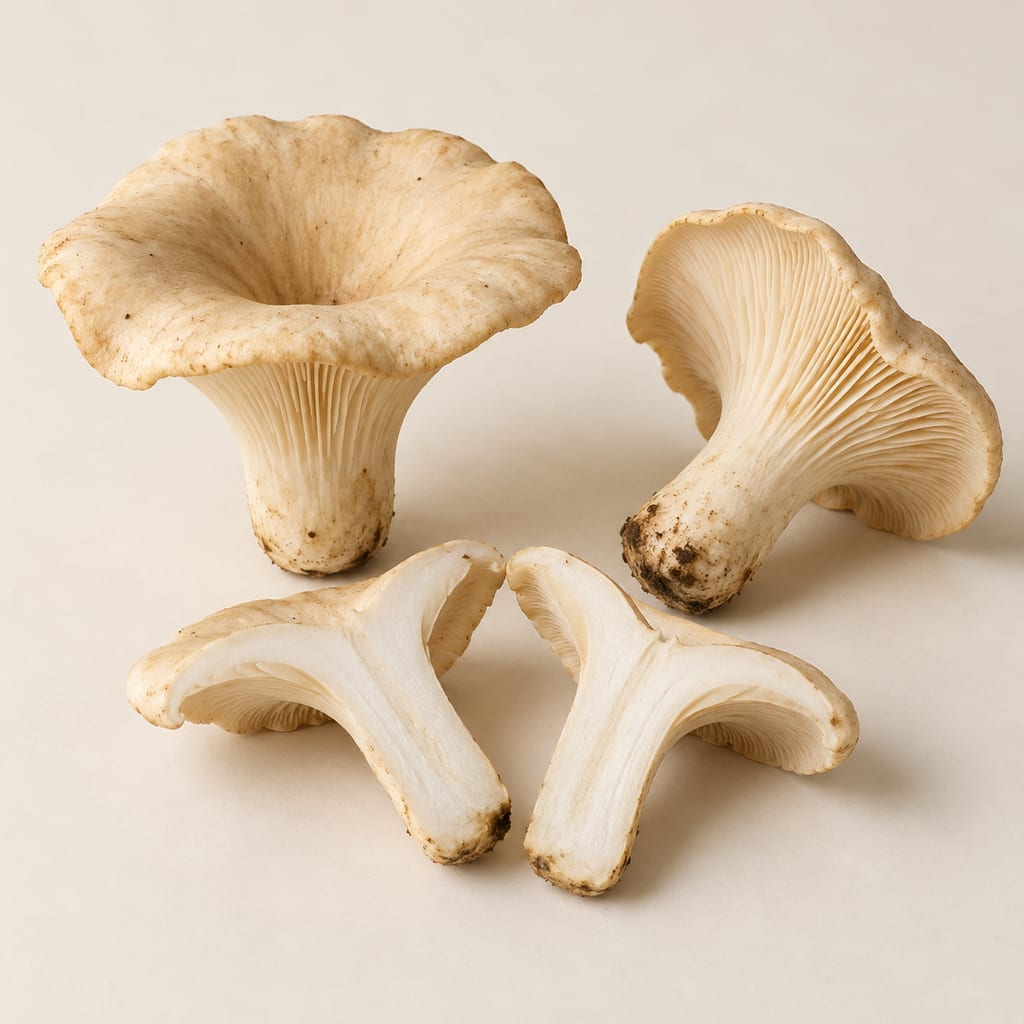
Current nomenclatural references use Infundibulicybe geotropa (Bull.) Harmaja. Clitocybe geotropa (Bull.) Quél. is a familiar older combination, and Agaricus geotropus Bull. is the basionym. Older field and food records may use either genus, so these names should be understood as historical treatments of one taxon. Trooping funnel is a common English name.
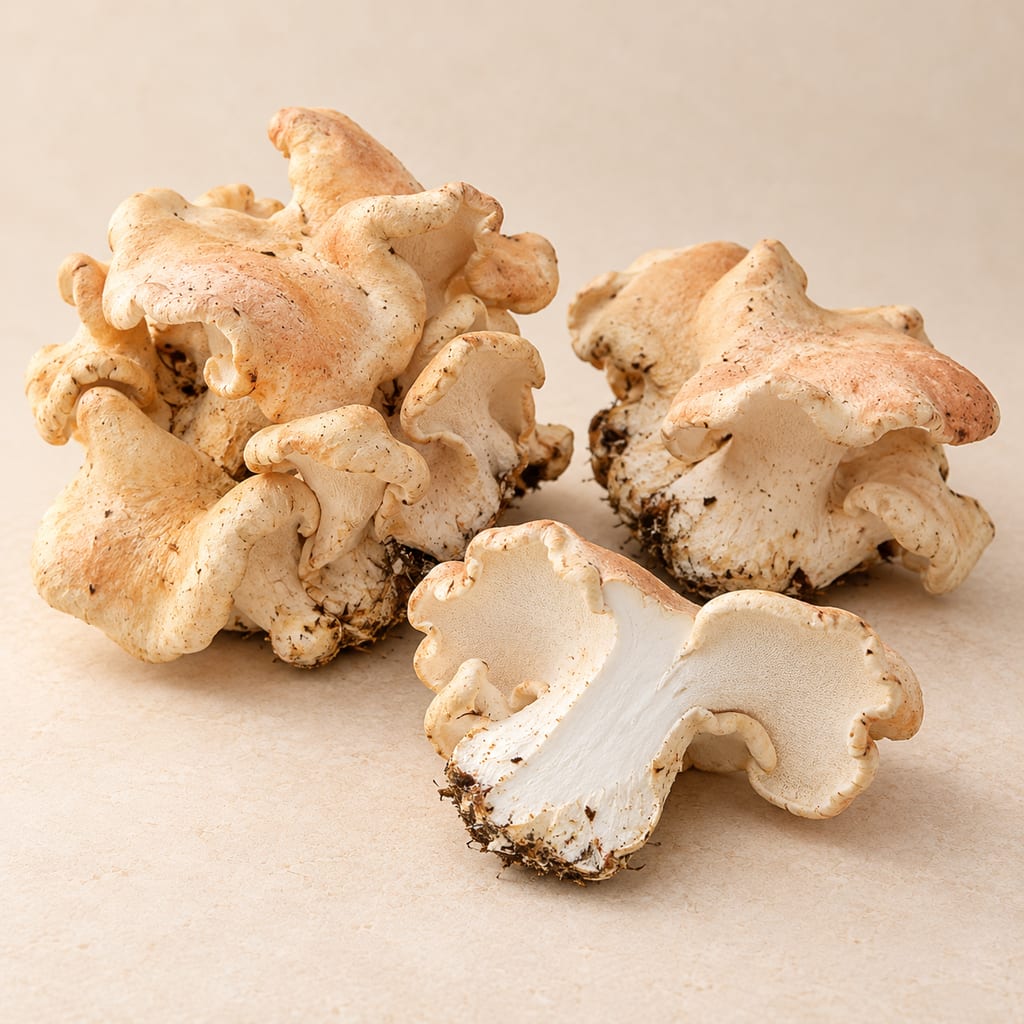
European mycological descriptions characterize a large, pale buff-to-cream mushroom with a depressed cap and decurrent gills. These descriptive traits are not an identification key. Pale funnel-shaped fungi overlap in appearance, and this page should not be used to identify or collect wild mushrooms.
Sources for this section
Food history and the limits of the claim
The supplied research archive reports a wild, cooked terrestrial mushroom used as food in Europe. Spain’s Real Decreto 30/2009 includes Clitocybe geotropa among wild mushrooms that may be marketed fresh. This is a commercial-list entry, not a general safety guarantee or identification endorsement. A Madrid regional page also places it among edible species that may be sold fresh.
FAO’s 2004 country tables preserve older records for Bulgaria, China and Spain. Bulgaria’s entry is bracketed as “[edible]”; FAO explains that brackets mark uncertain source use. The China line attributes “edible” to a general 1998 mushroom guide, and Spain’s “food” entry traces to a 1997 Castilla y León forest-use study. These historical listings establish what those sources reported, not current customary practice or independently verified consumption.
A 2026 Chinese catalogue gives Infundibulicybe geotropa the medicinal label 有毒, meaning poisonous or toxic. This conflicts with the older Chinese edible listing and makes that historical claim unsafe to generalize. A South Sardinia retrospective table lists two suspected I. geotropa cases, classifies it as edible, and records gastrointestinal symptoms. The table does not establish whether specimens were correctly identified or whether the mushroom caused the symptoms, but it documents reported illness associated with suspected ingestion.
Sources for this section
Season, ecology and geography
European references describe fruiting mainly from late summer through autumn, with some records extending into early winter. Spanish sources vary between late summer/autumn and autumn–winter, while British accounts commonly extend into December. Region and weather shift the season; the historical Bulgaria and China food records do not specify one.
The supplied catalogue describes a terrestrial litter decomposer with wild supply. Regional accounts report woodland clearings, forest margins and grassy places, sometimes on calcareous soils. These are ecological descriptions, not diagnostic criteria.
At the precision supported by the food-use sources, the historical country records are Bulgaria, China and Spain. The FAO tables do not name localities and do not establish a particular harvest site or contemporary regional custom.
Sources for this section
Lookalikes and limits
Official poison guidance identifies Clitocybe dealbata / C. rivulosa and C. phyllophila among muscarine-containing poisonous mushrooms. Spanish regional material also warns that Clitocybe nebularis can cause digestive intolerance and that Ampulloclitocybe clavipes, formerly Clitocybe clavipes, is associated with adverse reactions when consumed with alcohol. Similar common names and broad funnel shapes do not establish identity. This page preserves food-history evidence while making no recommendation to forage or eat wild specimens; suspected ingestion warrants advice from local poison services.
Sources for this section
Use in Fermentea
The cited sources describe cooked food use and fresh-market classification. They do not document a species-specific fermentation or preservation method, so no fermentation role or recipe is inferred.
Sources for this section
Places
Bulgaria
Historical attestation · Country evidenceFAO table prints [edible], with brackets indicating uncertainty in the original source's use claim; not a verified current custom.
China
Relationship not established · Country evidenceFAO lists edible via a general guide, but a 2026 Chinese macrofungi catalogue labels the species medicinal (有毒, toxic/poisonous); the food-use relationship is unresolved.
Spain
Documented use · Country evidenceFAO records a historical food-use report and Spanish regulation lists the historical name among wild mushrooms marketable fresh. Neither source establishes a precise locality or gives general foraging advice.